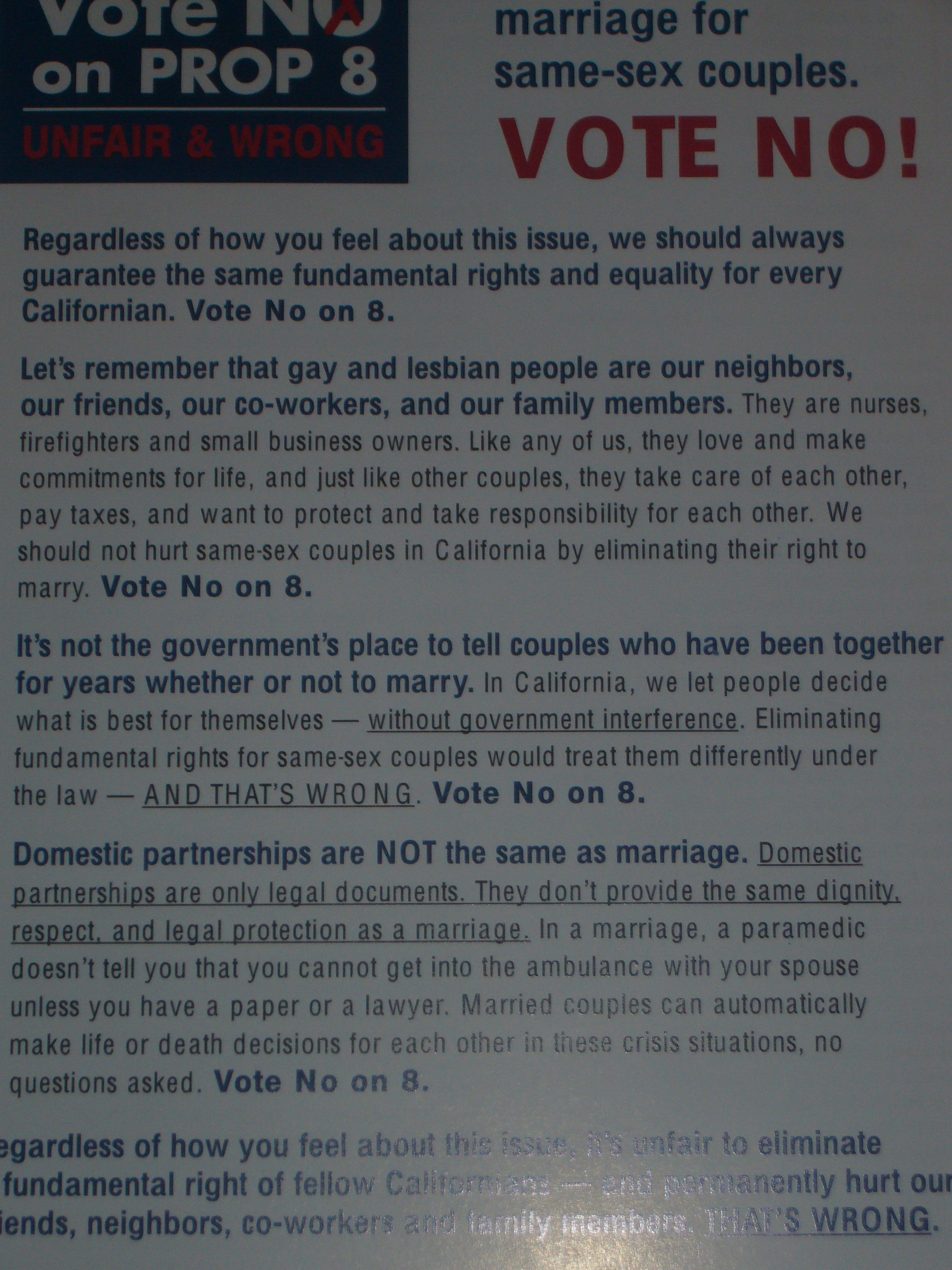
While leaving work today I was handed a “No on Prop 8” leaflet. For those of you not living in CA, prop 8 seeks to undo our state Supreme Court’s recent decision to remove gender requirements from the institution of marriage. In CA, same-sex couples in a domestic partnership already had identical rights and obligations as their married counterparts. Their “package” was simply being called by a different name (domestic partnership vs. marriage). In effect, the Supreme Court simply demanded that they be given a name change. And they have been, against the express will of the people. In response, the people of CA organized a ballot initiative to amend our state constitution to define marriage as being between one man and one woman only. The people handing out the leaflet I received today oppose this initiative.
As I expected, the leaflet was a propaganda piece full of half-truths and sophistry. Rather than reproducing this piece, I’ll just refer you to the picture above. To read the text just click the picture (it will magnify it). I would like to bring some of the most blatant rhetoric to your attention. There are five paragraphs, but I will only respond to the first four:
#1 They claim same-sex marriage is a fundamental right, but since when? It has not been recognized by any society in history until a decade ago. A right no one recognized until 10 years ago can hardly be considered fundamental. Just because a handful of people in black robes declare it to be a fundamental right by judicial fiat, does not make it one in reality.
As for equality, I agree. But the law already afforded equality to all Californians. Everyone had an equal right to marry a non-relative of the opposite sex. The law did not stipulate that homosexuals could not marry. Homosexuals are just as free to take advantage of the institution of marriage as are heterosexuals, but if they wish to avail themselves of this right, they need to marry someone of the opposite sex. The fact that they choose not to afford themselves of this right is not grounds for radically changing the historic understanding of marriage.
#2 Yes, same-sex couples are our neighbors, but what follows from that? People in Utah have polygamists as their neighbors, but does that mean society must redefine the number of participants in a marriage? No, so why should the fact that we have gay neighbors cause us to redefine the gender requirements of civil marriage?
They claim that same-sex couples are hurt by not giving their legally-recognized unions the name “marriage,” but how? Because they are not accorded the same social approval? First, we do not alter fundamental social institutions so that some people won’t feel bad. Second, marriage is a social institution intended to provide social support to relationships society deems important to the success of society. People in society are free to choose whom to give their support to and whom to deny it. And many do not wish to extend it to same-sex couples because they do not think their relationships are beneficial to the social fabric (indeed, they may be detrimental).
#3 No, “it’s not the government’s place to tell couples who have been together for years whether or not to marry,” but that is not the issue. This sentence was either framed poorly, or strategically, because the government isn’t telling anyone-heterosexual or homosexual-whether or not to marry. It only tells them the requirements they must meet if they wish to marry. But if they were to have worded it this way, it is clearly wrong. The government represents the people, and the people of this country have the right to define the requirements for marriage; i.e. which relationships they will and will not extend their social approval and support to. That’s not to say they can be arbitrary in their definition, but clearly that is not the case in this country. There are principled reasons we define marriage the way we do, and those reasons make no room for same-sex couples.
They claim we let people decide what’s best for themselves in CA. No, we don’t. I decided it’s best for me to be able to talk on my cell phone in my car, but the government decided it wasn’t. Taken at face-value, what they are advocating is anarchy. And I find it ironic that the pro-Prop 8 prop are speaking negatively of “government interference” when they have been working ferociously over the last 20 years to intimately involve government in this issue. If they truly eschewed government interference, they would not be asking for the state of CA to recognize and regulate their relationships.
#4 In one sense it’s true that domestic partnerships are not the same as marriage. But where do they differ? You might be surprised to know that in CA they are the same in all but the name. Domestic partnerships afford same-sex couples all the same rights and responsibilities as marriage. That’s why it is disingenuous on their part to bring up the issue of medical power-of-attorney. Domestic partnerships already give same-sex couples such rights. The only thing domestic partnerships do not afford same-sex couples is “the same dignity” and “respect.” But why ought they be given such when their relationships do not function in the same way in society, and when many people consider their sexual mores immoral? I see no reason to.
I hope my fellow Californians will join me in voting YES on prop 8.
 Thinking to Believe
November 3, 2008 at 8:35 am
Jason,
I’m not surprised that Californians would support gay marriage. I agree that civil unions don’t have the same protections as civil marriage – at least if the SCOTUS interprets the two to be different in anything other than name, which I question. And most people want gays to be able to have those legal protections.
What I’m surprised by, though, is the evangelical support for gay marriage, global warming, and the rest of the secular agenda. I just saw a show on PBS where young evangelicals said they are pro-life, but also agreed with environmentalism, gay rights, etc and many were supporting Obama because they agreed more with Obama. Although it was one biased PBS show, I’ve heard similar things from evangelicals, that the youth are being corrupted from within by “evangelicals” (often rebellious children of conservative pastors) who support the secular political agenda. I’ve heard some call environmentalism “creation care” or some such nonsense.
What makes somebody an evangelical today? Is it belief in a literal resurrection, virgin birth, etc? I suppose it’s possible to believe those things while embracing gay marriage, the moral sanctity of sodomy, global warming not Revelation, etc. But what happened to a belief in the literal truth of scripture as a requirement to be an evangelical?
They seem to be interpreting Scripture the same way that liberals on the SCOTUS interpret the Constitution. You find a stray statement out of context (eg, Adam and Eve are given the Earth to take care of), generalize it to an overarching statement (God wants mankind to “take care” of the earth, which means keeping the temperature, flora and fauna kept in artificial stasis), and then use the overarching statement to contradict clear Scriptural teachings.
Is this necessary to make Christianity “relevant”? Maybe the youth will not embrace Christianity unless it supports homosexuality, enviromental fundamentalism, and the like. Are these beliefs like Christian coffee shops or Christian rock, a way of conceding the trappings of secularism while conveying Christian fundamentals? It’s all strange to me.
Arthur
LikeLike
November 3, 2008 at 12:58 pm
Arthur,
As of 2000, 61% didn’t. That’s the year we passed prop 22 by 61%, which defined marriage as being only between a man and woman. The reason the state Supreme Court could overrule the will of the people earlier this year, however, is because this language was in the family law code, not the state constitution. Prop 8 seeks to add the same language to the constitution itself, thus overturning the state supreme court’s ruling that same-sex couples have the right to have their legally recognized relationships a “marriage,” exactly like their opposite-sex couples counterparts.
Actually, in CA, domestic partnerships did have the same protections as civil marriage. They differed in name only.
“Evangelical” is a flexible word that even Evangelicals themselves do not all agree on the definition of. But in general, it is both one’s doctrinal commitments (literal bodily resurrection of Jesus, inerrancy, virgin birth, second coming of Christ, salvation by faith alone, etc.) as well as the way they interact with culture (which is the only real distinction between fundamentalists and evangelicals). Being evangelical is not really defined by one’s views on moral or political issues, but I think historically speaking, it was almost a guarantee that if one was evangelical, they were opposed to abortion and same-sex marriage. Why? Because as you alluded to, the same hermeneutic that leads one to embrace those doctrines is the same hermeneutic that leads people to oppose abortion and same-sex marriage.
There could be several reasons why there is a disconnect among some evangelicals between their theological commitments and their moral/social/political commitments. It could be that they are nominal evangelicals, who hold to the doctrinal confessions, but not with conviction. Their worldview is shaped more by the culture than the Bible. Others have bought into the notion that theological commitments and moral convictions should be kept separate from politics. I’m sure there are more reasons than these, but I think they are probably the most prominent.
While a topic all of its own, I don’t think Christian rock or Christian coffee shops is a concession to secularism, although it is a concession to American culture. While I may find some of it annoying, I don’t think it is wrong, per se.
Jason
LikeLike
November 6, 2008 at 5:35 pm
Although I’m not opposed to legal recognition and protection of gay relationships, I’m deeply offended by the ACLU’s actions. How can they possible say that you cannot amend the constitution?
It’s terribly wrong for judges to twist the meaning of constitutions to fit their whims, and demand that the people overturn their dishonest rulings. But if the people actually go forward and do it, the courts must respect that. Anything else is anarchy. If the ACLU prevails, and the courts refuse to allow the people to control the state, the people should use ANY MEANS NECESSARY to remove those judges.
Just calling it like I see it.
LikeLike
November 6, 2008 at 6:19 pm
I agree. While I do not think the CA constitution demanded same-sex marriage before, any argument that it demands it now, after it has been amended to define marriage as only between a man and woman, is insane. Like you said, it is anarchy and those judges should be removed from office because they clearly do not respect the rule of the very law they swore to uphold.
In 2006 Georgia passed a constitutional amendment similar to CA’s. A GA judge ruled it was unconstitutional, just like the ACLU is seeking to get a CA judge to do. GA’s Supreme Court reversed the lower court’s decision. Something similar happened in Louisiana in 2004.
Jason
LikeLike
November 10, 2008 at 11:17 am
Before posing this, let me issue a disclaimer that I voted yes on proposition 8. This post is in response to the questions regarding how an amendment may be considered invalid.
Without getting into the merits of issue, let me pose an analogous situation to respond to. If the majority of voters in CA voted to amend the CA constitution to define a person as white, should that amendment be allowed to stand?
LikeLike
November 10, 2008 at 12:46 pm
Paco,
Would such an amendment be morally wrong and baseless? Yes. Would it be an example of the majority’s abuse of power (i.e. the use of power not intended for the common good). Yes. Should it be allowed to stand? Yes, if we respect the rule of law.
The people spoke. We cannot have judges tossing out amendments to the very constitution they have sworn to uphold (even if they disagree with some of it) on the basis that they think the people are wrong. Their job is to interpret the law, not to tell the people whether their opinions are right or wrong. They are not the moral arbiters of the state/nation.
As for your analogy, I understand the point you are trying to make, but I don’t think it’s truly analogous. Defining a person as “white” is unprincipled and defenseless. Refusing to open the institution of marriage to same-sex couples is a principled position. Skin color is an accidental property of human persons, not an essential property, and thus the law would be baseless in both reason and biology. But there are principled reasons for keeping marriage a man-woman institution.
In the case of SSM, the personhood of the couple is not in question. Neither is their ability to engage in homosex, to live together, or commit to one another for life. What is in question is whether society must give them the same sort of social approval we give opposite-sex couples, by officially recognizing, privileging, and promoting their relationships in the same way and to the same degree. Clearly, the answer is no. Same-sex relationships do not function the same way in society as do opposite-sex relationships, and thus society need not treat them the same way. We are obliged to treat equals equally, but oppososite-sex relationships are not socially situated equal to same-sex relationships. Want proof? If tomorrow, every same-sex couple broke up, and history never saw another same-sex relationship in the future, society would move on just fine. But if tomorrow, every opposite-sex relationship broke up, society would crumble. Opposite-sex relationships are the foundation for society, and function in a way that no other relationship can. Therefore, society is justified in treating that relationship different from all others. Judges ought to respect these principles, even if they disagree with them.
But this still doesn’t address your question. If a “white person law” amendment was passed, should it be allowed to stand? I would hope for its demise, but it must die through the proper channels. I would oppose the CA Supreme Court ruling it unconstitutional, because they would have no right or basis to do so. But I would hope that SCOTUS would overturn it, because it is an immoral and unconstitutional law. But what if SCOTUS upheld it? Well, then, it would be the law of the land and we would have to respect that. That doesn’t mean we could not work to undo it, but we must do so through the proper democratic proper channels.
Think of abortion. I think the immorality of abortion is far worse than the hypothetical “white person law,” (in that it sanctions killing millions of innocent and defenseless human beings) and yet the fact remains that the law allows it. I would argue that the principles of the Constitution, and the facts of embryology show that Roe is unconstitutional, but I respect the rule of law, even when it results in unjust laws.
And I can honestly say, that if a Constitutional amendment was passed that guaranteed the right to abortion, I would oppose a SCOTUS judge who ruled that amendment unconstitutional on the basis of pro-life logic. While he would be doing the right thing morally, he would be doing the wrong thing legally.
If leaders can disregard laws and constitutional amendments they do not like, then we cease being a nation governed by laws, and become a nation governed by the will of those in power. That is tyranny. I would rather be governed by bad laws decided by the people, than by the tyranny of a few who think they know better than the people (even if they do in some instances).
Jason
LikeLike
November 10, 2008 at 3:13 pm
thank you for this post. and this conversation is really helpful
LikeLike
November 10, 2008 at 3:59 pm
Jason,
While I understand your philosophical desire to remain consistent how laws are passed and maintained, I think your “black and white” view of the process is not realistic. In the areas of the law that touch on social norms, a court’s responsibility is more gray and nuanced that your method allows for.
What many people do not understand is that challenges to these kinds of laws are done in what is called a court of equity. Courts of equity are those that are deciding cases where the remedy sought is an injunction. Although courts have rules in how to deal with equitable claims, the court’s duty is to weigh the matter and to make a decision that provides justice for the parties in a fair way (this is a little simplistic, but it gets the basic idea across).
So in reviewing a case such as the “white person” law, or even the discrimination against same-sex couples, a court will be looking to determine justice for the parties by weighing the interests of the parties involved. This is how courts reach some of the decisions that many question as not holding true to the “rule of law.”
In dealing with the specific issue at hand, the reason I posed the analogy that the way I did, was to show you that even the CA Supreme Court would likely and responsibly strike down the “white person” law just based on the CA Constitution. The point of the analogy was to illustrate that the “white person” law was a direct contradiction to the CA equal protection clause (and also the equal protection clause in the 14th amendment to the U.S. Constitution). If the populace were able to change the constitution in such a way, it would allow for legislating just about anything by just creating an amendment to the state constitution and advertising it in such a way that a majority of voters would vote for it. I think there are plenty of situations where a court is in the right to strike down laws that are passed by a majority, but reprehensible and should not be allowed to become the law of the land (whether on the state level or the federal level).
Now to the SSM issue. Having stated that there are situations where laws voted on by a majority are rightfully rejected by a court, I don’t think this amendment fits in that category. Laws all across our country legislate morality in various ways. Morality is something that is determined in this country based on tradition and by the majority of the people in a given area (be it state or federal). Many of the people that voted for this law voted based, not on a desire to discriminate, but based on a personal code of morality. Not everyone that supported Prop 8 did so because of a religious conviction. Actually, if the only people that supported Prop 8 were those within a religion that did not support SSM, the proposition probably would have failed. Where there is no discriminatory intent, a law should not be struck down because of a court’s belief that the law will unfairly discriminate.
This was about a society determining a moral issue that the society felt was important enough that legislation was warranted. That is why this amendment to the CA constitution should be upheld, but not just because we have some concern over how laws are reviewed by courts. We need courts to have that kind of review, otherwise there are instances where intended discrimination will not be remedied timely, or maybe even at all.
Paco
LikeLike
November 11, 2008 at 5:53 pm
Paco,
As is often the case when you and I discuss these things, I am looking at things from a more idealistic perspective (the way things are supposed to work), while you are looking at them from a more realistic perspective (the way things do work). That may be a bit simplistic, but I think it explains part of the reason we differ. My argument is that in many ways, our government is not functioning the way our founders intended. Our practices may be accepted today, but they should not be as they are.
When it comes to the roles of each branch of government, they are spelled out in the Constitution. I don’t see any article saying the Court’s job is to act as the moral arbiters for the nation, especially when the law in question is an amendment to the Constitution itself passed by the people in a democratic way. When it comes to any hot-button issue like this, no matter which side the law comes down on, the other side will think the law is immoral, and/or that it violates some constitutional principle. All the losing side has to do to win back the day is find a judge who agrees with them, and is willing to legislate from the bench by applying some broadly vague constitutional principle to the issue at hand in a way that conforms to their moral viewpoint. But the real issue is whether or not the constitution should be used in such a loose manner so as to be applied to the issue at hand.
In my opinion, your proposal puts too much power in the hands of the government—especially those who are unelected. On your view, the people are only as powerful as the judges allow them to be. In such a case it is the judges, not the people, who hold supreme power. That is an oligarchy, not a democratic republic. The people wrote the constitution, and they can amend it to reflect their evolving will. The power is theirs.
I’m not saying we should pass laws or constitutional amendments based on bigotry or discrimination. I think such laws are immoral, and illegitimate uses of power. But the fact of the matter is that those laws are binding until changed by the people and/or their elected officials. There are several laws I think are immoral, and yet they were democratically enacted and thus I respect them. Of course, I have the liberty to work to change them.
As for the white law, I agree with you that it would violate the CA constitution, but I don’t see how the CA Supreme Court could rule it unconstitutional. I think that would need to be the job of SCOTUS (So I’m not saying no court has the ability to review the constitutionality of a constitutional amendment to determine its constitutionality. Indeed, they must. Alexander Hamilton even argued this way in Federalist #78, but he added that the danger is that the court would substitute their will for their judgment. How might they do so? By arguing from the spirit of the Constitution rather than the text itself, as he noted in Federalist #81. This is what courts are doing today.). And surely they would do so. And rightly so. But they would be doing so on the basis of a facial contradiction with other Constitutional amendments. When it comes to SSM, there is no facial contradiction. Prohibiting SSM can only be thought to contradict the CA and Federal Constitution if we read something into them that is not there on their face (the spirit of the Constitution that Hamilton spoke of). Equal protection, for example, cannot be legitimately stretched to demand SSM, since equal protection applies to individuals, not couples. Besides, marriage law does not discriminate based on sexual orientation. Everyone, regardless of their sexual orientation, is given the privilege of marrying someone of the opposite sex. The fact that homosexuals do not wish to afford themselves of this right is not an inequity of the law, but an inequity of desire. The state is under no compulsion to change the institution of marriage to allow for every variant desire out there. Marriage is defined as it is because that is the specific type of relationship society is interested in promoting. They are not in the relationship business—trying to promote romantic love and validate people’s relationships. They regulate heterosexual relationships because it is in the best interest of society to do so because of what heterosexual relationships typically produce: children. It is not in the (best) interest of society to regulate same-sex relationships. It is only in the interest of the same-sex couples who want society to recognize and give social approval to their relationships.
I agree with you that many people voted yes on Prop 8 for moral reasons. Ironically, I am hesitant to think of this as a moral issue. The moral issue is homosex: whether individuals of the same gender should engage in sexual acts with one another. SSM, on the other hand, is a social and legal issue. It concerns society’s regulation of same-sex relationships. There is nothing moral about the legal issues surrounding marital licensing. The only moral component to SSM that I can see, is that government, in sanctioning SSM, gives tacit moral approval to homosex (because marriage is a form of social approval, and because the law is a moral teacher). We do not legalize what we deem to be immoral, or bad for the common good, so if we legalize SSM we are saying same-sex relationships and the homosex they involve, are morally good.
What I find ironic is that many people don’t have a problem with granting same-sex couples domestic partnerships. They only have a problem when you want to change the name of that institution to “marriage.” That tells me people are more motivated out of emotion than moral concern. If morality was the motivating factor, they would equally oppose domestic partnerships. In fact, they would equally oppose homosex. And yet very few people who supported prop 8 would support a similar proposition outlawing homosex. At best, the populace has abandoned the real moral issue, and made a relatively non-moral issue into one. I’m not complaining that we decided to take a stand, but I sure wish we would have done so in earlier stages of the homosex-normalization project.
Jason
LikeLike