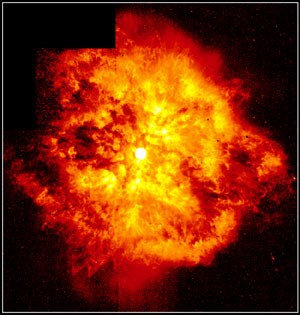
 For millennia philosophers maintained that the universe is eternal. The philosophical payoff of this view was that it avoided the God question. If the universe has always been, it did not need a creator. The emergence of the Big Bang theory in the early part of the 20th century, however, changed all of that. The Big Bang model successfully predicted that the universe–including all spatio-temporal-material reality–had an absolute origin at a point in the finite past, from which it expanded, and continues to expand today.
The theistic implications of this model were recognized instantly. If the universe began to exist, it seemed to require a supernatural cause (one outside the confines of the natural world). That’s why it was met with fierce opposition, and why it took several decades and many lines of empirical confirmation to become the reigning paradigm it is today. Even now, cosmogenists continue to put forth alternative models in hopes of averting the beginning of the universe, many of which are little more than exercises in metaphysical speculation, incapable of both verification and falsification.
While not friendly to an atheistic worldview, many atheists eventually made their peace with the empirical evidence, and accepted the theory. But the theistic implications of a temporally finite universe have not gone away. Anything that begins to exist requires a cause. If the universe began to exist, what caused it to exist? It could not be a natural law, because natural laws originated with the universe. It could not be self-caused, because this is incoherent. Something cannot bring itself into existence, for that would entail its existence prior to its existence.
The atheist has two options. He can either admit to the existence of an external cause of the universe, or affirm that the universe is uncaused. For most atheists the first option is out of the question. An external cause of the universe looks too much like God: immaterial, eternal, non-spatial, intelligent, and personal. That leaves them the second option. But this won’t do either. The causal principle is one of the most basic intuitions we have. Things don’t just pop into existence uncaused from nothing, so why think the universe did? If everything that begins to exist has a sufficient cause, on what grounds is the origin of the universe excepted? If one excepts it on the basis that it is impossible to have a cause prior to the first event, they are guilty of begging the question in favor of atheism, for they are assuming that physical reality is the only reality, and thus the only possible cause of the Big Bang must be a physical cause. But it is entirely plausible that the external cause of the Big Bang was an eternal, non-physical reality. The only way to demonstrate that the universe cannot have a cause, then, is to demonstrate that the existence of an eternal, non-physical reality like God is impossible. But the very beginning of the universe is an argument for such a being’s existence!
Some atheists, recognizing the problem the principle of causal sufficiency makes for the atheistic worldview, cling to an eternal universe despite the scientific and philosophic evidence to the contrary. They recognize that it is nonsense to think something can come from nothing, uncaused. Something can only come from something. From nothing, nothing comes. If there was ever a time when nothing existed (as the Big Bang model predicts), then of necessity there would be nothing still, because nothing has no potential to become something. And yet there is something, so there could not have been a time when nothing existed. As a matter of historical fact, there can’t ever be a time when there was nothing. Something must exist eternally. If something must exist eternally, and the universe is not that something, then something resembling the God of theism must exist. Rather than admit the obvious-that this is evidence for the existence of God-these atheists reject the scientific and philosophical evidence for a finite universe, and assert that the universe must exist eternally.
What’s important to see, here, is that this sort of atheist is not being intellectually honest with the evidence. He has an a priori philosophical and volitional commitment to atheism, and that commitment biases him to such an extent that he will not accept the destination to which the rational evidence leads. Only theism is consistent with the evidence, and consistent with reason. While I commend atheists who reject the notion that the universe could come into being from nothing totally uncaused as an irrational leap of faith, I admonish them to go one step further, and recognize that the principle that something only comes from something, combined with the scientific an philosophical evidence for the finitude of the universe, supports theism, not atheism. To be consistent and honest with the data, they should accept the finitude of the universe, and admit that its existence requires a personal and supernatural cause.
 Thinking to Believe
November 18, 2008 at 2:42 pm
Actually there’s a pretty big snag in your theory there. The Big Bang isn’t supposed to be the creation point of the universe. It’s supposed to be the point at which matter was created to fill the observable universe and any scientist will immediately tell you that the theory is a) incomplete and b) requires that the universe was already there to begin with as things don’t pop out of nothing.
There is also no evidence which would rule out that the universe is much larger and much older then we believe and there there’s matter beyond what we can detect. In fact there are observations to the contrary.
http://www.space.com/scienceastronomy/080923-dark-flows.html
What you’ve done here was to take a scientific theory in progress, give it an absolutist stance, ascribe it to atheists, discard new ideas and discoveries and then accuse atheists of being intellectually dishonest. Doesn’t sound like an intellectually honest argument to me…
LikeLike
November 18, 2008 at 3:14 pm
I’m sorry, gfish, but you are mistaken about the Standard Model. As physicist P.C.W. Davies wrote, “The coming-into-being of the universe as discussed in modern science…is not just a matter of imposing some sort of organization or structure upon a previous incoherent state, but literally the coming-into-being of all physical things from nothing.”
Again Davies writes, “If we extrapolate this prediction to its extreme we reach a point when all distances in the universe have shrunk to zero. An initial cosmological singularity, therefore, forms a past temporal extremity to the universe. We cannot continue physical reasoning, or even the concept of space-time through such an extremity. For this reason, most cosmologists think of the initial singularity as the beginning of the universe. On this view, the Big Bang represents the creation event—the creation not only of all the matter and energy in the universe, but also of space-time itself.”
Likewise, physicists John Barrow and Frank Tipler wrote, “At this singularity, space and time came into existence; literally nothing existed before the singularity, so, if the Universe originated at such a singularity, we would truly have a creation ex nihilo.”
Victor Stenger, a physicist who taught at the University of Hawaii wrote that “the universe exploded out of nothingness.”
Even Stephen Hawking wrote, “Almost everyone now believes that the universe and time itself had a beginning at the Big Bang.”
I hope this is sufficient to demonstrate to you that you have misunderstood the Standard Model.
LikeLike
November 18, 2008 at 4:42 pm
gfish,
It’s true the Standard Model has been refined. I am thinking in particular of the addition of an inflationary expansion between 10(-35) and 10(-33) seconds after the singularity. But it is not what I would necessarily call a theory in progress. It is well defined, and has a lot of empirical support confirming it. In the words of Britain’s Astronomer Royal, Martin Rees, “Fifty years ago we all thought of the Big Bang as very speculative. Now the Big Bang from one millisecond onward is as well established as anything about the early history of Earth.”
Where it still needs to progress is in understanding what happened prior to Plank time, when we reach the subatomic level and Einstein’s General Theory of Relativity (upon which the Standard Model is based) breaks down. Cosmogenists and physicists still haven’t figured out how to apply quantum mechanics to that immeasurably tiny period of time. But that hardly justifies portraying the Standard Model as one that is in progress, as if it is only speculative and not well-defined. Nothing could be further from the truth. It is the alternative models that are speculative, not well defined, and lack empirical confirmation.
As for the universe being older or larger, that is irrelevant to the question of whether it began to exist a finite time ago from nothing. It could be 1,000,000 times older and larger than we currently understand it to be, but that would not avoid the problem of cosmic origins.
I did not ascribe the origin of the Standard Model to atheists in my post. I merely said that many have come to make their peace with it (because they can’t escape the evidence for it), even if they initially found it philosophically distasteful (and they did, and still do). Indeed, one of the two individuals who birthed the theory was a Belgian priest and mathematician, not an atheist.
LikeLike
November 18, 2008 at 5:39 pm
You forgot ‘Brane Theory
LikeLike
November 18, 2008 at 7:32 pm
What physicists wrote or said in a random interview or a book doesn’t speak for the whole of science. To present this otherwise is kind of like dragging a random quote from James Dobson and say that it represents the whole of Evangelical Christianity. Choose the right quote and you make an entire religion unjustly look like hateful bigots. Quotes, no matter from whom, don’t prove anything. Only solid science does. A physicist’s opinion on the science is his opinion, not the science itself.
As for your proof for the Big Bang, I know very well what the model says but if it was so airtight, we wouldn’t have to build the LHC and try to figure out if we can detect a couple of hadrons. The Big Bang model for practical purposes is like a 1,000 piece puzzle with about 960 of the pieces assembled. It’s solid but we still need to do more refinement.
You’ve missed the larger point which is that we truly don’t know how the universe originated and that the Big Bang does in fact require a trigger. This is why you see the rush for developing brane theories, string theories, multiverses and other ideas about how the universe came to be. Like I said, the Big Bang is a starting point for us and what we can detect. Beyond that, we don’t know.
Finally your opinions on what atheists do and don’t find distasteful is about 60 years out of date. The usual atheist reply to how the Big Bang could create the universe is a reference to disruptions in space and time on a quantum level in which particle appear and disappear with no driving force.
LikeLike
November 18, 2008 at 8:49 pm
Name one single thing that has been observed to come into existence (besides the universe), and tell me what its cause was.
You say “everything which begins to exist has a cause,” as if this where a given. I posit that you have not ever observed ANYTHING begin to exist, and had you so obvserved such a thing, you’d have know idea whether it had a cause or not.
I do not grant your asserted premise that everything which begins to exist has a cause. You have not remotely demonstrated this.
LikeLike
November 18, 2008 at 8:51 pm
Rats, no way to edit comments.
s/know/no/ and s/where/were/
LikeLike
November 18, 2008 at 8:56 pm
Here I was ready to rebut your (mis)statements on the current state of play in cosmology, but gfish had gone and done it all for me already. Pity. The only thing I can add, so that this comment is not an entire waste of time, is that causality is a feature of (macroscopic) observations in this universe specifically, and may not apply to the larger picture. In fact, our Universe may have started as an uncaused quantum fluctuation upon a manifold of a dimensionality of a higher order. What’s more, the conception of “natural” has been extended to encompass string, brane, and multiverse theories of all sorts, and our spacetime is no longer considered to be unique. Indeed, it may have had a beginning but that does not say anything about other continua (or abstract graph-theoretical systems) preexisting (if that concept even makes sense in the absence of time).
LikeLike
November 18, 2008 at 9:05 pm
Specifically, you say: “Things don’t just pop into existence uncaused from nothing, so why think the universe did?”–which is incorrect, of course. The uncaused creation of virtual particles is a well-documented phenomenon, a central part of QFT and highly predictive of empirical observations.
LikeLike
November 19, 2008 at 12:05 pm
gfish
The Standard Model is the scientific consensus right now. The alternative models have yet to rise to the level of the empirical confirmation provided by the Standard Model.
Of course the model is incomplete, as I noted to you, but being incomplete and being wrong are two different things. Not knowing what to make of the physics at the quantum level before Plank time does not mean its prediction of an absolute origin of physical reality is false.
I quoted those who are doing the science, and know the field. They are not obscure individuals who represent the fringe of science, and it doesn’t matter where they said or wrote what they said or wrote. It’s either true, or it’s not. And I’m not quote mining. If these guys can’t be trusted to accurately represent what the Standard Model claims, who can? Ironically, I’m the only one here backing up my claims with quotes from scientists. Anyone can make assertions.
You are simply wrong on what the Standard Model claims. It is the absolute origin of physical reality, including matter, space, and time. On this model, there is no physical reality prior to the Big Bang that could cause it. If you wish to keep contesting this, find me at least two reputable sources that describe the Standard Model that differ. Are people proposing such prior physical causes? Yes, but in doing so they are departing from the Standard Model. Most of the models are exercises in metaphysical cosmology, not empirical science. Furthermore, they are proposing them for philosophical reasons, not to incorporate new data. They want to avoid an initial singularity because it begs for a supernatural cause.
Quantum disruptions in space and time cannot be the cause of the Big Bang because there was no space or time prior to the big bang in which they could occur. The Bang itself was the origin of space and time. You can disagree with that model if you want, but you don’t have the liberty to redefine what the model holds.
Jason
LikeLike
November 19, 2008 at 12:05 pm
Scaryreasoner
You seem to be interepriting “come into being” in a very narrow sense as “physical things coming into being from nothing.” That is not the meaning. It simply refers to any X that exists as X at time t2, but did not exist as X at time t1. I, for example, exist as a concrete entity today, but did not exist as a concrete entity in 1970, so I began to exist. And my existence required a cause. The fact that I was created from pre-existing matter does nothing to obviate the need for a cause. My point is that neither would the fact that something came into existence from nothing obviate the need for a cause.
Jason
LikeLike
November 19, 2008 at 12:05 pm
Jorg,
I am in the process of writing a piece rebutting the concept that causality is a wholly physical principle (which is what you seem to be advocating), so I won’t give away the show here by responding to your comments on that matter. Suffice it to say that this begs the question. There is nothing about the nature of causality that would relegate it to a wholly physical principle. Thoughts are not physical, and yet thoughts can cause other thoughts.
As for the alternative theories you mentioned, these are hypotheses floating around out there, but they do not have the sort of empirical confirmation that the Standard Model does (if any at all in some cases). Some of these mathematical models, such as string theory, haven’t even had all their equations formulated yet, yet alone worked out. So it’s a bit premature to be acting as if these are serious reasons to doubt the conclusions of the Standard Model that all physical reality began a finite time ago, before which nothing existed. It’s one thing to talk about what is possible using mathematics, and another thing to demonstrate that the idea is rationally and physically reasonable, possible, and actually represents reality. Mathematics do not always represent reality. To prove any of these theories one needs more than to show that the math works on paper.
As for your claims about virtual particles coming into existence uncaused, that is simply not true. As William Lane Craig notes: “Virtual particles do not come into existence uncaused from nothing; they are caused by the quantum vacuum, which is not nothing!” Not only are they not uncaused, but they don’t come into existence from nothing. It is simply the conversion of energy into matter and vice versa. As philosopher of science Robert Del Tet wrote, “There is no basis in ordinary quantum theory for the claim that the universe itself is uncaused, much less for the claim that it sprang into being uncaused from literally nothing.”
Besides, this would escape the question of causation and origins because one would still have to ask about the origin of the quantum vacuum. Postulating a quantum vacuum from which the universe originated uncaused only pushes the question of the ultimate cause of the universe back one step.
Jason
LikeLike
November 19, 2008 at 5:23 pm
You still haven’t considered ‘Brane Theory.
LikeLike
November 19, 2008 at 5:56 pm
What about it? It’s part of the Cyclical Ekpyrotic Scenario, one of two prominent cosmological theories based on the not-yet-fully-formed string theory.
There are problems with the theory. See this paper by Andre Linde et al for detailed details: http://arxiv.org/PS_cache/hep-th/pdf/0202/0202017v2.pdf
But what’s most important to note is that this theory cannot escape an absolute beginning (as it was originally intended to do), and thus the need for a cause still remains. The theorems that Borde, Guth, and Vilenkin developed in 2003 proved that even Brane theory, if true, cannot avoid a singularity. The father of the Ekpytroic theory himself, Paul Steinhardt, based on the Bord-Guth-Vilenkin theorems, came to recognize this. He admitted it here: http://www.phy.princeton.edu/~steinh/ under “Answers to Frequently Asked Questions: Has the cyclical model been cycling forever?”
Jason
LikeLike
November 19, 2008 at 9:58 pm
Jason,
You write a lot but say nothing. You’re still missing the big point because you clearly don’t have a good enough grasp of the Standard Model. If you did, you wouldn’t have to resort to copy/pasting quotes you seem to like. You remember the thing I told you about quotes? Quotes are not science. They’re an opinion. And opinion is not fact.
If you insist on ignoring the key points of the theory you want to discuss, I guess you’ve just shown that you only care about being right rather then being intellectually honest.
LikeLike
November 20, 2008 at 4:16 pm
gfish,
I am amazed by your persistence. You are long on assertion, but short on evidence. As I stated to you before, proof is needed for claims. I am claiming the Standard Model states one thing, and you another. The difference between you and I, however, is that I am backing it up by quoting scientists in the field who know the intricacies of the model. You aren’t quoting any scientists, yet alone those who say anything to the contrary.
And then you have the audacity to berate me for quoting those in the field? I agree with you that quotes are not science, neither is assertions without quotes from those who are doing the science. Obviously providing quotes from experts does not automatically prove the truth, but at least it is a starting point for dialogue and further debate, and at least it offers some authority and backing to the claims of non-physicists and non-cosmologists like me and you. For you to dismiss these scientists in the way you have indicates that it is you, not me, who is being intellectually honest, and cares more about your own ideas than the truth.
It’s not often that I write people off, but given your short track record on this subject, I don’t think it’s worth my time and effort to respond to you in the future, because you don’t take it seriously. I’d rather get into a year long debate with someone who can offer actual rebuttals to my arguments than a one day debate with someone who only offers assertions, contradicts points, and berates people for trying to back up their assertions with something other than more assertions.
BTW, I stumbled on a “paper” that responds to the claims made in the paper you linked to in your first comment. I’m sure you wouldn’t bother to read it, but for those who might, here it is: http://www.astro.ucla.edu/~wright/dark-flow-errors.html
Jason
LikeLike
November 20, 2008 at 4:22 pm
gfish,
Seems to me that you have given only opinion and no facts yourself. Besides this point, theories are only the opinions of what men can postulate based off of observable details of the physical universe.
Just an outsider’s view of this conversation…
LikeLike
November 24, 2008 at 12:03 pm
Good post Jason!
It really is a simple argument but quite damning for the atheistic position. “From nothing, nothing comes.” But there is something and we know that the something we see did not exist at some point in the past, so something that we don’t see preceded it and must have caused it.
I believe in the tasks of apologetics and polemics, but ofttimes it is like showcasing the work of Rembrandt to a school for the blind. They just can’t see it.
Or, they won’t see it because they won’t open their eyes.
So excuses for the blindness have to be invented. Such as, “we’re not sure we have all of Rembrandt’s paintings here. Or, are these all really Rembrandt? Is every brush stroke indeed that of Rembrandt? Until we can be 100% sure I won’t open my eyes to look.”
We’ve come a long way from Galileo’s religious objectors who would not look through his telescope. Now, who won’t look through the telescope?
LikeLike
November 24, 2008 at 2:41 pm
I like the analogy, Chad. You are quite right. While there are people who have been educated into thinking that what they are looking at are paintings by Picaso rather than Rembrandt, others choose not to see the Rembrandts. We can help the former group, but not the latter. An obstinate will is an obstinate will. I don’t mind interacting with skeptics to help them see how reasonable the theistic position is, but I tire of those who in the name of reason, are unreasonable.
Jason
LikeLike
June 28, 2012 at 11:22 am
test
LikeLike
January 11, 2013 at 1:21 pm
My opinion (and it is only an opinion) based on the physicists that I know and the writings of others such as Richard Feynman is that most physicists and cosmologists have no interest at all as to whether their research is helpful to the Creationist worldview or not.
Do you have any evidence for the motives of the scientists who didn’t at first accept the BB theory as claimed in your second paragraph?
Best regards,
Neil
LikeLike
May 9, 2013 at 1:51 pm
Neil,
The evidence is in the statements of the scientists themselves. Consider, for example, British physicist and cosmologist Arthur Eddington wrote, “Philosophically, the notion of a beginning of the present order of nature is repugnant to me…. I should like to find a genuine loophole.”
Fred Hoyle, who propounded the Steady State Theory, did so as a direct challenge to the Big Bang model because of its theistic implications. He wrote: “This most peculiar situation is taken by many astronomers to represent the origin of the universe. The universe is supposed to have begun at this particular time. From where? The usual answer, surely an unsatisfactory one, is: from nothing.” (Astronomy Today, 1975). And again,“To many people this thought process seems highly satisfactory, because a something outside physics can then be introduced at t=0. By a semantic manoeuvre, the word ‘something’ is then replaced by ‘god,’ except that the first letter becomes a capital, ‘God,’ in order to warn us that we must not carry the inquiry any further.” (Astronomy and Cosmology: A Modern Course, 684-5)
Stephen Hawking recognized the theistic implications of the Big Bang theory, and that specifically motivated him to find an alternative explanation for the beginning of the universe. So he developed his quantum gravity model. He wrote, “The idea that space and time may form a closed surface without boundary has profound implications for the role of God in the affairs of the universe. So long as the universe had a beginning we could suppose it had a creator, but if the universe is really completely self-contained, having no boundary or edge, it would have neither beginning nor end. What place, then, for a creator?”
Agnostic astronomer, Robert Jastrow, made the following assessment: “Theologians generally are delighted with the proof that the Universe had a beginning, but astronomers are curiously upset. Their reactions provide an interesting demonstration of the response of the scientific mind—supposedly a very objective mind—when evidence uncovered by science itself leads to a conflict with the articles of faith in our profession. It turns out that the scientist behaves the way the rest of us do when our beliefs are in conflict with the evidence. We become irritated, we pretend the conflict does not exist, or we paper it over with meaningless phrases.” (God and the Astronomers, 16).
And just read all of the modern atheists who attempt to explain how the universe could come into being without God. The reason they do so is because they recognize that the Big Bang seems to imply the need of a Big Banger. They are trying to find alternative explanations to show that the God explanation, although intuitive, is not necessary.
Jason
LikeLike
September 14, 2014 at 5:00 pm
Given the trend so far, I’d say it’s a clear-cut win for science (or naturalism as you like to call it–I’m fine with you equating the two because as far as I’m concerned, they are equal). We used to be unable to explain lightning, so we postulated Zeus, Thor, and other deities. Now we can, so no more Zeus. We used to be unable to explain fire, so we postulated an invisible substance called “phlogiston”. Now we can, so no more phlogiston. We used to be unable to explain biological movement, so we postulated “elan vital”, a life force. Now we can, so no more life force. Now we’re faced with yet another phenomenon whose explanation we haven’t discovered yet. But is this sufficient reason to claim that there is no explanation, as you’ve been claiming? Given the current trend, I think not!
LikeLike
September 15, 2014 at 3:50 am
David, I agree with your hypothesis…but still that is not science; perhaps a trend at best. It is the same with this multiverse idea–cosmology can not explain the universe and its apparent initial low entropy (for one) and so it postulates an infinite amount of universes…but where is the EVIDENCE (science demands physical and testable proof). All science is doing is making up its own god; believing in almighty Chance with its ability to just move the goal posts further down the ‘playing field’ when the conclusions about real intelligence are not to our ‘worldly’ liking. Of course it is logical that God can not be scientifically proven (frankly, that is the situation), but for us ‘open-minded’ scientists to close-mindedly reject out of bias is a violation of the very science we boast to use. There is one trend that has always got my attention and that is the general conclusion that whenever we find information it always points back eventually to a source of Intelligence…and that has made our situation (in life and of this universe) more a conspiracy than just a coincidence. What we are part of and experience is really odd for mutation, chance, fluke and error to be that responsible conclusion to…and it is driven by a strange insatiable curiosity. If we were just overgrown Darwinian monkeys…we would not have a LHC, four dune-buggies on the moon, nor care about atomic particle theory or quantum mechanics. All we would need to concern ourselves about would be: to eat and yet not be eaten; to survive our changing environment (adapt to it) and grab a mate to pass on the genes. We do much more in fact Darwinian wise we should not even be having the conversation for it does not address the drive of natural selection…but we DO it anyway; WHY??? !
LikeLike
April 21, 2016 at 8:18 pm
It shouldn’t be surprising that they won’t admit their belief is incoherent.
Look at Free Will. They will try to convince you till they’re blue in the face that we don’t have free will, which is almost embarrassing to just call self refuting– because in fact– its insane
They will ridicule people for coming to the conclusion that God is the best explanation for the world we observe right after they try to get us to change out minds about free will…..hahahaha. I mean, its pure lunacy. Quite frankly, I truly respect all of those people who actually try and thoughtfully explain to them where they’re wrong without laughing because its that embarrassing.
I think is why we are fascinated with them. They are such an easy target and we see them turn from their atheism in droves because their beliefs are so easily refuted.
But my point is their whole worldview is filled with pieces that dont fit the puzzle.
LikeLike
April 21, 2016 at 11:40 pm
Very well put, dirtbomb1. You sound like you are into Christian apologetics. Is that an accurate assessment?
LikeLike
April 23, 2016 at 2:27 am
DB1
“…….people …. coming to the conclusion that God is the best explanation for the world…..” has to be one of the most ill conceived phrases ever!
Nobody on this earth today has ever come to the conclusion that God is the best explanation for anything; the notion of the “gods” is one that has its root in ancient man-made religious dogma when man exploited the ignorance of the uneducated to satisfy his own ego and pleasures through magic that demonstrated the power of his god, called miracles and if magic didn’t work brute force did.
Before the discovery of fire-control that kept humans living in the cave and the mountain-top rockface for protection from the animals ready to devour them, it was not unusual to have relative harmony in the village camp facing a common foe. But after the advent of fire, man came out of the cave and ego ran amuck. It was dog eat dog as religion took hold of the imagination and religious dogma started being rammed down the throats of the gullible for indoctrination of the supernatural that has lasted down through the ages and influences everybody on earth until this very day. So please don’t imagine that you or anyone else had the freedom of free will to come to any conclusion about the explanation of the world.
Religion began eating the human spirit by stifling it to conform to the strong man’s ego when fire became the spirit signature of the ego man’s God. The indoctrination after ten thousand centuries has remained a force in the world ever since, for everybody ever born. So in saying that people came to the conclusion that God is the best explanation of the world is an exercise in fantasy that has erroneously lulled us into the sleep of a dulled mind. The best anybody can hope for, wish for, desire and pray for, is the strength of will to unburden ourselves from the shackles of ancient men who knew less then, than an elementary school child now; and if you think you have free will, well don’t think about “free will”, try reaching a conclusion about the world with knowledge and set your “will free” to do that; then, you’ll be giving your mind a reboot.
Don’t apologize for being a Christian, and I am not laughing at you, it’s too serious, to laugh about; we all have been led astray by the same influence, it is pervasive. Jesus tried to show us the tyranny of that tradition and I believe he would tell you the same thing, again, as I am telling you now and as he has told us before in his indictment against religious influence which you either did not read, skimmed over or did not understand the importance of; and that is well documented; first in John 7:1 (why he went into hiding) & John 7:7 ( the religious world), and then, Luke 11:52 (the key, hidden from the “people” you refer to). This is clearly outlined in the Gospel of Matthew who devoted one whole chapter about the very matter of the world, chptr 23….Jesus speaking……. to you and to me, et al. Read it again.
My farewell aim is that you may become re-energized by the Jesus perspective.
LikeLike