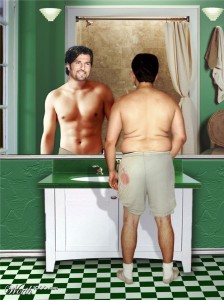
 Greg Ten Elshof just released an interesting book titled I Told Me So: Self-Deception and the Christian Life. Greg is a professor of philosophy at Biola University, and did his doctoral research in the area of self-knowledge and self-deception. During an interview with the Evangelical Philosophical Society, Greg offered a great definition and explanation of self-deception:
To be self-deceived is to intentionally manage one’s own beliefs for some purpose other than the pursuit of truth. It’s worth noting that, given this characterization, one can be self-deceived in believing what is true. One can even be self-deceived in believing something that is true and for which one has evidence. Self-deception occurs most often when there is an emotional attachment to believing in a particular direction. It often involves the management of attention away from evidence that would disrupt the desired belief. And it seems to be capable of achieving greater distances from truth and rationality in groups than in the individual. It was Nietzsche, I believe, who said that insanity is rare in the individual but the rule in groups.
How true this is! That is why I am a strong proponent of the virtues of intellectual honesty, openness, and integrity. We cannot get so emotionally attached to any doctrine that we are unwilling to consider the possibility that it may be mistaken, and unwilling to examine evidence against it.
And like Greg noted, self-deception is even greater at the group-level. I have found this to be true in my own life. There are certain teachings common to my religious organization that are not well-evidenced, but they are believed tenaciously by its members. People are afraid to question these teachings because the group accepts them as being true (and why question the group), and questioning/abandoning those teachings could impact their continued involvement with the group. I have seen people become emotionally disturbed when presented with evidence against these teachings. They often ignore the evidence contrary to their belief—going on as if they never heard it—so that their involvement with the group will not be negatively impacted.
I have even seen people go to great lengths to defend ideas and doctrines that no reasonable person would defend if they were not part of a group of people who believed and practiced such things. Humans have the tendency to want to justify the beliefs of the group they belong to. I have done so myself, and truth-be-told, I am probably doing this in certain areas even now. That’s the thing with self-deception: not only do we deceive ourselves in regards to specific issues, but we deceive ourselves into thinking that we are not deceiving ourselves when we do so. Lord, expose us to our own self-deception so we can see the truth more clearly!
 Thinking to Believe
August 12, 2009 at 12:25 pm
Yes and no. What part does revelation and experience play in this observation?
John 21
24. This is the disciple which testifieth of these things, and wrote these things: and we know that his testimony is true.
Are we open to evidence against the doctrine that his testimony is true? If so, then we don’t really KNOW it, do we?
Romans 8
28. And we know that all things work together for good to them that love God, to them who are the called according to his purpose.
1 John 3
19. And hereby we know that we are of the truth, and shall assure our hearts before him.
1 John 5
19. And we know that we are of God, and the whole world lieth in wickedness.
How is it we can know these things and be open to evidence against them? I think we can patiently hear arguments against these things and patiently answer questions about our faith, but I doubt we really know these things if we’re willing to abandon them when given “greater” evidence against them.
Consider the following:
Romans 8
16. The Spirit itself beareth witness with our spirit, that we are the children of God:
How does one marshal evidence against a personal experience with God? And how does one attack the doctrine of personal experience? One can cogently argue many people have out-of-body, UFO, time-travel, etc., experiences and that rational persons should question personal experience claims when it comes to affirming a doctrine everybody must believe.
For example, have you ever seen a demon or witnessed what you consider incontrovertible evidence of a demon spirit? Perhaps you have, but I think the overwhelming number of people haven’t had that experience — even those who go to church. A skeptic can argue people of all faiths have visions of one sort or another. That doesn’t mean these “visions” are actually demons or that the Bible is true. It simply means a very small minority of individuals have aberrant experiences. If you’ve never experienced a demon, are you open to evidence to the contrary? If so, then you don’t really KNOW the Bible is true, right?
What about our belief in the doctrine of Holy Spirit baptism? Are you open to evidence you didn’t really receive the Holy Spirit? Were you just emotionally worked up or did you actually receive the Holy Ghost? To question your experience with God is like questioning your experience with your parents. If you’ve had a genuine experience with God, you would be just as open to contrary arguments as you would that your experience with your parents was just illusory.
Not everybody is cut out to be a philosopher. Simply because a “simple” Christian has no patience for the claim s/he didn’t really receive the Holy Ghost is no impeachment of h/er belief in that doctrine.
John 10
14. I am the good shepherd, and know my sheep, and am known of mine.
27. My sheep hear my voice, and I know them, and they follow me:
One may be able to out-debate me about the Holy Ghost baptism; but I know what happened when God filled me with His presence, and no argument will dissuade me from the KNOWLEDGE that God filled me with His Spirit.
So…I believe there are many things about God and/or the Bible we do not know infallibly; and lacking infallibility, we should be open to evidence. However, for the aforesaid reason, I don’t think we can make that claim categorically.
LikeLike
August 12, 2009 at 5:17 pm
Scalia,
You raise some important issues. I actually addressed this in the comments section of my post “Could We Be Wrong About Christianity?” (https://theosophical.wordpress.com/2009/07/16/could-we-be-wrong-about-christianity/#comments). My point in that post was that as a matter of principle, we can be mistaken in our belief about any contingent truth. That doesn’t mean we should doubt that what we believe to be true about it is actually true (particularly when our belief is well-evidenced), but it does mean that we should always consider counter-evidence to our beliefs.
As for the portion of this post that you quoted me on, I am not talking about Christianity in general. I am talking about specific Christian doctrines. I think we should always be open to the possibility that we have wrongly interpreted the Word of God, no matter how clear we may think the doctrine is in Scripture. We should patiently hear out those who think we are mistaken, and consider the weight of their arguments. Indeed, if we did not practice this, we would never grow in our knowledge. There are several beliefs I have held to that I have since abandoned upon further reflection, or upon being presented evidence to the contrary.
As for revelation, I don’t give much weight to that. The revelation is Scripture. And what many have considered to be “revelations” from God are often nonsense. As for experience, I deal with that someone in the aforementioned blog post comments section. Depending on what kind of experience one is talking about, experience can be a defeater of other defeaters.
Jason
LikeLike
August 13, 2009 at 4:27 am
Interesting post…I suppose the first thing that comes to mind, is the contreversial topic of the Identity of Yeshua (Jesus). You can have someone that will challenge you, with scripture, that Jesus is NOT God, but was only a man. They will point you to the fact that only men have Fathers and only men have a God (Jn. 20:17). Therefore Jesus can’t be God. So if you haven’t properly reasoned out the distinction within the Messiah that He was both a genuine human being but still God in the flesh, then we could possibly run into confusion.
Just my two cents.
LikeLike
August 13, 2009 at 7:37 am
trthofgod,
True. But I can’t tell whether you are saying this in support of the post, or in opposition to it.
Jason
LikeLike
August 13, 2009 at 8:03 am
Jason, i’m saying this in agreeance with your article. The point i was making was to support your take on the fact that we need to think critically of our doctrine. And that the way we many times interpret scripture could be either incorrect or ,in the case of my example, incomplete.
LikeLike
August 13, 2009 at 11:57 am
In that post, you write:
What is your definition of a necessary truth? If our knowledge of a fact can be mistaken, then upon what can we be certain? How would you classify the statement Absolutes pertain to ontology, not epistemology (except for necessary truths)? Is that an absolute statement, or a contingent one?
And just what is this “testimony”? What is its basis? Is it rooted in experience and/or revelation or is it rooted in a book? If the former, then can we never be certain of anything written in any book, including the Bible? Is this what the Bible teaches?
Luke 1
3. It seemed good to me also, having had perfect understanding of all things from the very first, to write unto thee in order, most excellent Theophilus,
4. That thou mightest know the certainty of those things, wherein thou hast been instructed.
Moreover, the verses previously cited are also part of Christian doctrine. If we can be mistaken about all of that, then your position appears to be our only certainty is our “testimony” of the reality of Christ/God. Everything we “perceive” about Him via the Bible can be mistaken and may discarded if sufficient evidence is produced. Is that correct?
What is Christianity “in general” apart from what we know from the Bible?
So, insofar as the Bible is concerned, we don’t really “know” there is one God, that Jesus is the savior of the world, that faith in Christ is necessary for salvation, etc. We “contingently” believe that Jesus is our savior. If we can be mistaken about all these doctrines, then we can be certain of nothing biblically. If that is the case, Jason, again I ask: Is that what the Bible teaches? If so, then your position is self-defeating because your position logically reduces to: It is absolutely certain that the Bible teaches we cannot be absolutely certain of anything the Bible teaches. If it isn’t what the Bible teaches, then why are you teaching something contrary to the Bible? The Bible teaches certainty, you appear to teach otherwise.
II Peter 1
19. We have also a more sure word of prophecy; whereunto ye do well that ye take heed, as unto a light that shineth in a dark place, until the day dawn, and the day star arise in your hearts:
20. Knowing this first, that no prophecy of the scripture is of any private interpretation.
21. For the prophecy came not in old time by the will of man: but holy men of God spake as they were moved by the Holy Ghost.
The revelation is the Scripture? But you cannot be certain of anything in the Scriptures and your stated position is you will abandon everything the Bible teaches due to the fact every teaching contained in the Bible is a doctrinal statement. If you cannot be certain of any doctrinal teaching from the Bible, then the only basis of certainty is revelation/experience.
This reinforces my perception you are basing knowledge on experience (I know I did not commit murder). Again, the foundation of our knowledge is experience or revelation.
Yes, but you could be mistaken about that, right? You cannot be certain unbelief is unjustified.
The only logical “out” I see in your position is that the Spirit “witnesses” to you that the Bible is true. If that is the case, then everything you’ve “witnessed” from the Bible is absolutely certain, for the Spirit cannot lie to you. And if that is the case, then it appears your argument is groundless.
LikeLike
August 13, 2009 at 2:03 pm
Such as? If you prefer email, that’s fine.
LikeLike
August 13, 2009 at 6:26 pm
truthofgod,
Thanks for the clarification.
Jason
LikeLike
August 13, 2009 at 6:32 pm
Scalia,
Such as…I’m not saying. Nothing personal, but it’s been my experience that the safest way to swim through organizational waters is to keep one’s mouth closed. This is particularly the case in organizations whose articles of faith is longer than most grocery lists, and requires its own separate book to explain what it means. 🙂
Jason
LikeLike
August 14, 2009 at 10:05 am
Oh, “for fear of the Jews,” eh? 🙂
Just kidding! I totally understand. I just thought since you put it out there you might want to elaborate.
Best wishes,
Scalia
LikeLike
August 14, 2009 at 10:30 am
Scalia,
Agreement is rare, so the more items you require people to agree on in order to be part of your group, the smaller your group will be. If an organization’s articles of faith contains 30 articles, and that organization has a large membership, I would suspect that you either (1) have a bunch of people who aren’t thinking for themselves, or (2) a bunch of people who provide their affirmation with a “wink wink” so that they can remain in the group.
While this subject is deserving of its own post, I am convinced that creedal requirements in an organization should be kept to a bare minimum. The more creedal requirements you have, and/or the more specific you make them, the less likely it will be to forge agreement with others, and thus the less likely it will be to form a thriving organization. For if anyone disagrees with even one of your 30 items, they are excluded. If they once subscribed to all 30 when they joined, but then change their mind on a few along the way, they will be excluded.
Not only should the creedal requirements list (articles of faith) be kept short, but it should only contain core doctrinal issues. This may get me in trouble, but I think it is absurd that an articles of faith contain both an article on the oneness of God, and an article on mixed-gender swimming. While I agree with both, that the latter should be a defining belief of an organization, and a requirement for fellowship on the same level as belief in the oneness of God, to me at least, cannot be described as anything other than absurd and even demeaning—not of the men who subscribe to such an affirmation, but to the core Biblical doctrines that truly define Christianity.
Jason
LikeLike
August 14, 2009 at 12:11 pm
Scalia,
I can tell from reading your comments that you grossly misunderstand my point and my position. I’ll assume responsibility for this misunderstanding, as well as for clearing it up, but I suspect it will take several exchanges to accomplish this because we seem to be speaking in different languages here, and defining words in different ways.
A “necessary truth” is something that is true (exists) in every possible world. Most philosophers consider logical and mathematical truths to be such, and if God exists, God would also be included in that number. These are things that cannot not exist in any conceivable world. “Necessary” has to do with existence, not knowledge.
As for the statement, “Absolutes pertain to ontology, not epistemology (except for necessary truths)?”, you seem to be equating “necessary truths” with “absolutes,” and defining “absolutes” as epistemic certainty. An absolute is not the same as a necessary truth. An absolute is something that is objectively true. But there are many objective truths that are not necessary. For example, it is objectively true that I exist, and yet that is not a necessary truth. God could have created a world in which my existence would have never been. Furthermore, there are many absolutes for which I may be ignorant, or doubt. For example, the number of breaths I took yesterday is an absolute truth, and yet I am ignorant of that absolute truth. Similarly, Jesus’ resurrection from the dead is an absolute, and yet one can doubt that it happened.
As for the witness of the Spirit, if I understand Paul correctly, the witness is a direct, immediate knowledge communicated from God’s Spirit to our own. While we may have this experience after hearing some revelation from God, the witness itself is not mediated by that revelation. But I don’t see what this has to do with being able to be certain about what’s in the Bible. The witness of the Spirit does not testify to the truth of Scripture, but to the truth of one’s salvation. That aside, of course we can have “reasonable” certainty about things written in a book. I can be reasonably certain about the veracity of the phone numbers as they are recorded in the phone book. I can be reasonably certain about the Bible as well. But that doesn’t mean I cannot be mistaken about either. Indeed, how many Christians read 1 John 5:7 thinking they are reading what God inspired, when they are not? Psychological confidence does not mean one cannot be mistaken.
As for Luke 1, Luke researched the historical Jesus so that he could write an orderly account of all that Jesus began to do and teach, so that Theophilus could know that what he had been taught about Jesus was indeed true. What Luke wrote served to confirm what Theophilus already believed.
I think part of the problem, and what can explain many of the statements and charges you made, is that you seem to think that if we cannot be certain about something, then we cannot count it as knowledge. This is false. We know many things to be true, and yet very few of those we know to be true with certainty. Most we know to be true with varying degrees of certainty. We are finite beings. We do not have the luxury of omniscience, and thus certainty is something we can rarely achieve. But that doesn’t mean we don’t have knowledge. And it doesn’t mean we should doubt. Just because it is logically possible that we might be mistaken in regards to our beliefs about contingent truths/beings, does not mean we should think we are mistaken. This is why I reject your statements to the effect that we cannot know God exists, that Jesus is the savior, etc. Of course we can. But that doesn’t mean it is impossible for us to doubt those things, or logically possible for us to be mistaken. You could be mistaken in your interpretation of Scripture, or as I noted above, you could be mistaken for what you count as Scripture. You could be mistaken in your interpretation of your experience. But that doesn’t mean you need to doubt any of it. Again, knowledge is not the same as certainty. Knowledge does not require certainty.
Of course I base knowledge on experience. We all do. But I base my knowledge of spiritual things especially, on much more than that. If anything, I should be faulted for paying too little attention to experience when it comes to religious epistemology.
Jason
LikeLike
August 14, 2009 at 1:27 pm
I’ll reply in more detail later, but your reply completely missed the meat of my objections to your posts.
I ask you again for at least the third time: Does the Bible teach one cannot be CERTAIN of any of its teachings?
Luke didn’t say what you characterize of him. He said, that thou mightest know the CERTAINTY of those things, wherein thou hast been instructed. The book of Luke was written to give certainty to belief.
If you claim this is what the Bible teaches, then your position is self-defeating. If not, then why are you teaching what the Bible doesn’t teach? Please show us from the Bible where knowledge of doctrine is something less than certain.
LikeLike
August 14, 2009 at 2:48 pm
Scalia,
Yes, Luke uses the word “certainty,” but what does he mean by that? Does he mean “cannot be wrong,” or “cannot be doubted?” Surely not. Luke is speaking of psyhological confidence, not logical necessity or certitude.
And yes, we can have great psychological confidence of the truth of Christianity (call it “certainty” if you like, so long as you are not being philosophically technical with the definition as I am). Having psychological confidence does not mean one cannot be mistaken, however. I have had psychological confidence in a number of things I later repudiated when evidence came along demonstrating that I was mistaken, and my confidence was misplaced. I’m sure you have experienced the same (and if you haven’t, that would worry me).
I’m not saying I think Christianity may be false. I have no good reason to think it is, and every good reason to think it’s true. But logically speaking, if we can be wrong about something, we might be wrong about it. That’s why we should always be open to hear evidence contrary to our views. If what we believe is true, it will be able to defeat the defeaters being offered against it.
Jason
LikeLike
August 14, 2009 at 3:09 pm
Certitude isn’t based solely upon logical necessity. If you’re making a purely formal argument, then it is logically possible that God doesn’t exist, even though He is a necessary being. It is possible I don’t exist, even though I am incapable of rationally denying my existence.
But your posts affirm more than formal logic. Are you arguing there is NOTHING we cannot be wrong about?
As to Luke, of course he means he cannot be wrong. If his words are “God-breathed,” they cannot be wrong.
LikeLike
August 14, 2009 at 3:34 pm
Jason…Scalia….help me out…I am trying to decipher through all that is being said…here is my take of what I THINK is going on:
Jason – in a nutshell, in regards to THIS post, you are stating the following: there are some practices/teachings/doctrines that are enfroced by church organizations to be obeyed and followed, YET, the bible itself does not require allegiance to these concepts. *sidenote – this reminds me of this verse: Matthew 15:9 — 9 And in vain they worship Me, Teaching as doctrines the commandments of men. —Anyhow, many people have become emotionally attached to these concepts. As a result, many of these people are operating in self deception. As a remedy, Jason you suggest that “We cannot get so emotionally attached to any doctrine that we are unwilling to consider the possibility that it may be mistaken, and unwilling to examine evidence against it.”
Jason, as of now, I am assuming that these doctrines you are speaking of would be the doctrines/certain teachings that are (using your own words) “not well-evidenced.” Perhaps the confusion came in when you said “any doctrine” – BUT after stating that, you clearly mentioned certain teachings “not well-evidenced” – so if one read carefully, they would see what you were targeting. Am I correct? I want to plug that into your previous statement now. —“We cannot get so emotionally attached to any doctrine [that is ‘not well-evidenced’] that we are unwilling to consider the possibility that it may be mistaken, and unwilling to examine evidence against it.” —-
Jason, would that be an accurate summary of what you were intentionally saying? IF NOT, correct me brother.
Now, with that foundation laid, I turn my attention to you Scalia.
You took off running with an immediate rebuttal to Jason, centered around examples from Romans 8, 1 John 3, 1 John 5, John 10.
You asked Jason,
I think THIS is the point of misunderstanding. Scalia, I THINK you misunderstood what Jason was stating (and Jason, if I am wrong, I misunderstood! pun intended!) —- Jason was primarily focusing on those teaching/doctrines of the church which are NOT well evidenced. He made that clear in his original post. What you provided Scalia IS well evidenced in and of itself, rightfully so. But once again, Jason was targeting those teachings which are NOT well evidenced. Though Jason wisely chose not to give a specific example, I don’t mind attempting to provide one. And this is just MY example folks. Some teach that it is SIN to watch tv. I beleive that this concept is NOT well evidenced in the bible. However, there ARE those who tenaciously and emotionally believe that watching tv IS sin. AND they will use scripture to teach this concept as doctrine (Matthew 15:9!) Nevertheless, the priniciple Jason is sharing is that we should not be so emotionally attached to any doctrine/teachings that are not well evidenced, where we will not consider the possibility of them being mistaken, and refusing to examine evidence against it.
So if I am correct, there was a misunderstanding of what Jason meant (though to me he clearly specified it), and from taht point, this post snowballed, lol
BUT I absolutely realize that I may NOT have made anything more clear, and I could be off on what BOTH of you were saying, and intending to convey. If so, OOPS, I misunderstood! Yet, dont’ judge me, for there is a lot of that going around! 😉
LikeLike
August 14, 2009 at 3:38 pm
FYI – I just put up my post at August 14, 2009 at 3:34 pm —-however, I was working on it immediately after Scalia’s post at August 14, 2009 at 3:34 pm (it took me so long because I am at work, lol) — NOW I see that while I was posting, you two (Jason and Scalia) have already sent two more responses, clarifying all the more what yall are debating. I did not read those before putting up my post.
So hopefully my post is not “out of order” – it came before your last two posts (technically), but as you can see, it is posted last….
does that make sense? lol
Anyhow…carry on… 🙂
LikeLike
August 14, 2009 at 4:27 pm
Scalia,
It is contradictory to say “it is logically possible that God doesn’t exist, even though He is a necessary being.” To be a necessary being means it is logically impossible for the thing to not exist.
As for certitude, you are right, it is not based on logical necessity. People can have certitude about things that are contingent, and even things that are false! Certitude is a psychological disposition. It may tell us something about the knower (epistemology), but it tells us nothing about the object (ontology) the knower claims to know.
No, I am not arguing that there is nothing we cannot know for certain. I’ve explicitly stated some things we can know with certainty (laws of logic, mathematical truths). I would also include analytic truths.
Your statement about Luke is puzzling. You seem to be dealing with two issues: what Luke meant, and whether Luke was right. If Luke was inspired, then of course he is right. The question is Right about what? What did Luke mean by “certain?” Why think Luke was speaking with philosophical precision here? I don’t think he was speaking with any more precision than I do when I say, “I am certain I threw out the trash.” I don’t mean it is impossible for me to be mistaken. I mean that I have psychological confidence that I did so. But as it turns out, however, I actually forgot to take the trash out.
Jason
LikeLike
August 14, 2009 at 4:38 pm
Michael,
I largely agree with your assessment. I was not thinking of Christianity in general, or salvation through Christ when I wrote that. With that said, however, I would include those into the category too. I don’t see why any belief of ours should be beyond questioning. If it is true, it will stand up to scrutiny.
And of course, there are some doctrines that we think are well-evidenced, that turn out not to be. For example, I thought the doctrine of the pre-trib rapture was well-evidenced in Scripture. Later, however, upon evidence to the contrary, I changed my mind. Now I think it is one of the least evidenced views, and I am amazed that I, or anyone else, ever believed it (sorry to all my pre-trib friends out there!).
Or think of Muslims. There are Muslim apologists out there who defend the Muslim religion. I’m sure they think Islam is well-evidenced. What if they were of the opinion that well-evidenced views do not need to be questioned? What would happen when they were presented with evidence against Islam and for Christianity? They would reject it out-of-hand, and thus never come to the knowledge of the truth. Psychological certainty is something many of us have in a variety of issues, but merely having it does not mean that the object of our certainty is true. It only means we think it is true. It could turn out to be otherwise, and that’s why truth seekers should be open to the possibility, no matter how remote we may think it is.
Jason
LikeLike
August 14, 2009 at 5:12 pm
Let me back track for one quick second – annoyingly, my original reply is missing a part…when I directed my attention to Scalia, in regards to what he mentioned, I said: “Scalia, you asked,” —then the part that was intended to follow is missing! lol. I don’t know what happened – when you go back to read at that point, input this:
“How is it we can know these things and be open to evidence against them? I think we can patiently hear arguments against these things and patiently answer questions about our faith, but I doubt we really know these things if we’re willing to abandon them when given “greater” evidence against them.” (those were Scalia’s words)
With that out of the way —- Jason – I see more clearly what you are saying now…thank you for clarification, as I am going to ponder on it further…I agree with your thoughts – there is just one aspect that I need to meditate on –
“It could turn out to be otherwise, and that’s why truth seekers should be open to the possibility, no matter how remote we may think it is.”
I DO agree, yet there is one aspect that is blurry for me. HOWEVER, before I ask and make this a redundancy circus, I am going to review your previous posts, because you have addressed this before. No need for me to have you do extra work when you already put it out there man! *hi-five*
LikeLike
August 14, 2009 at 5:13 pm
That isn’t my proposition. The proposition is: It is possible God doesn’t exist. As a matter of logic, this is not strictly contradictory.
Of course one can be “certain” of something and be mistaken. I’m speaking of biblical certitude and biblical knowledge. If you’re certain of something but mistaken, then you never really knew it. Biblical certitude and knowledge merge in that biblical truths are infallible and knowable. And if one knows an infallible truth, one cannot be mistaken about it.
Luke wasn’t speaking about a fallible certitude when he (the Holy Ghost) wrote to Theophilus. He didn’t say, “I’m writing this to you so you’ll have contingent belief in the gospel”!
?? Sorry, but this doesn’t compute. If his words are God-breathed, are you saying God doesn’t speak with philosophical precision? I think our debate has taken a major turn. I was under the impression you believe the New Testament is word-for-word God’s words. If it’s merely an approximation, then of course one cannot be certain (really know) anything it teaches. It’s just what we’ve got until something better shows up.
Luke wasn’t saying “I’m right, but everything hereafter is subject to change upon greater evidence.” If he was inspired by the Holy Ghost, everything he wrote is infallibly true.
This is just hit and run right now. When I get a little more time, I’ll reply more comprehensively.
Signing off, for now!
Scalia
LikeLike
August 15, 2009 at 1:00 pm
I agree that organizations have teachings that cannot be defended by traditional Christian beliefs.
The Bible never teaches that the we should rely on the Bible alone. That is a fleshly doctrine of men. The Bible was assembled by the Catholic Church, and voted on by members of the Catholic Church (some books barely included or excluded), with the Protestant Bible later removing those books that Protestants found unhelpful to their beliefs. (For example, the true inspired KJV includes the Apocrypha.) Because the Bible’s authority relies on the authority of the Catholic Church, and you’re not a Catholic, I don’t see why you’d rely on the Bible as a sole source of inspiration.
2 Tim 3:16 refers to Scripture, but it clearly refers to the OT scriptures alone. That verse simply cannot be used to justify the world’s belief that the current Protestant Bible contains all and only the Word of God.
I agree with Jason that a greater humility about Christianity and the Bible would be advisable.
Arthur
LikeLike
August 15, 2009 at 10:12 pm
Arthur, I believe this is directed at me. Although I disagree with the points you raise, they are not the topic of this thread. I very much try to stay within the parameters of the topics Jason posts. Perhaps you can get him to post something about the Canon. Until then, I’ll keep my comments under this thread relevant to the topic.
Kind regards,
Scalia
LikeLike
August 15, 2009 at 10:22 pm
Michael said,
Thanks for your messages. I believe I addressed this in my initial comment:
So, if Jason is merely saying we don’t know everything and that we shouldn’t be dogmatic about under-evidenced issues, then I wholeheartedly agree. Although Jason is saying that, I believe he is saying much more. I believe his position logically entails biblical skepticism and that is what I am objecting to. Such a position is logically self-defeating and our back-and-forth revolves around that issue.
As to your comments about television, I very much disagree with you, but again, that is not the topic of this thread.
Best wishes,
Scalia
LikeLike
August 16, 2009 at 12:35 am
Jason said,
I’m all ears. 🙂
If an absolute is something that is objectively true, then said absolute is epistemic certainty.
Perhaps you and I are defining “knowledge” differently. If perception corresponds to the actual state of affairs, then one has knowledge. If perception does not correspond to the actual state of affairs, one has mere belief — it does not count as knowledge. I am arguing it is rationally undeniable we can KNOW the actual state of affairs.
My observation was in reply to your statement: Absolutes pertain to ontology, not epistemology (except for necessary truths). Jason, is that statement true in all possible worlds? If so, then it is a necessary truth. Two plus two equals four is a mathematical sentence and your statement is also a sentence. The former is an abstract statement about addition and the latter is a statement about the actual state of affairs. Hence, you have knowledge of this necessary truth and if it is a necessary truth, it cannot be wrong. If it isn’t true in all possible worlds, then what is your point?
Absolute statements are affirmations about a state of affairs. They can either be true or false. An absolute statement that is true is one which corresponds to reality; and if it corresponds to reality, then it cannot be wrong.
You define “necessary truth” as existence in all possible worlds, but this cannot be expressed or thought about without language or experience. And this means nothing unless it is KNOWN…and it cannot be known if it isn’t true. “Necessary” means essential and “truth” means conformity to fact or actuality. Thus, your description of the reality of mathematical necessity necessarily conforms to fact. If it doesn’t it is nonsensical. In other words, “necessary truth” isn’t restricted to mere existence; it involves statements about existence. The term “necessary truth” is a language descriptor of reality. So, when I refer to “absolute truths” or “absolute truth statements” I am referring to language that corresponds to reality. And if they correspond to reality, they cannot be wrong, even if they relate to contingent facts.
This is important because it directly engages your claim:
I have referred to a possible difference between you and I on how we define knowledge, but it appears you answer that when you write:
And…
Emphasis added.
Thus, according to how I’m reading your words, KNOWLEDGE cannot be mistaken. If you really KNOW the witness of the Spirit, no amount of contrary evidence will shake you from that knowledge because what you KNOW is what is true! Yet the Bible, as heretofore referenced, demonstrates conclusively that we have KNOWLEDGE, not mere belief in biblical doctrine:
John 7
17. If any man will do his will, he shall know of the doctrine, whether it be of God, or whether I speak of myself.
John 17
17. Sanctify them through thy truth: thy word is truth.
1 John 5
20. And we know that the Son of God is come, and hath given us an understanding, that we may know him that is true, and we are in him that is true, even in his Son Jesus Christ. This is the true God, and eternal life.
Luke 1
4. That thou mightest KNOW the certainty of those things, wherein thou hast been instructed.
The Bible does not teach that its words are contingent truths subject to revision. And if its words are infallible, then they cannot be mistaken. Your only logical recourse is to argue that though God’s word is infallible, we are incapable of really knowing what it teaches (for if we know what it teaches, then what we KNOW cannot be mistaken). But as I’ve pointed out, this is self-defeating because it reduces to I know enough about the Bible that the Bible cannot be known.
LikeLike
August 16, 2009 at 12:48 am
Jason, I forgot to address a few points you made:
Every sentence you’ve written here is either true or false. Taking these sentences at face value, you’re not certain of any of them. And if you’re not certain anything you’ve just said is true, why are you arguing with me? You cannot consistently tell me my argument “is false” if you’re not certain it is false.
I’ve never argued we are omniscient. I stated as much in my first comments under this thread. No matter how much you or I may believe something, and no matter how much evidence we marshal in favor of this or that position, if it turns out we were mistaken, then we never REALLY KNEW what we claimed to know. What you’re talking about are beliefs; and beliefs can be true or mistaken. You believe I’m mistaken, but you don’t KNOW that, do you?
When the Bible speaks about knowledge, it is speaking about fact, not mere belief.
LikeLike
August 16, 2009 at 1:19 am
I’ve never said it was impossible to doubt any biblical doctrine. Nor have I argued the logical impossibility of being mistaken. I am arguing it is possible to know biblical doctrine, and once it is known, it cannot be mistaken — even if we backslide and renounce it. Our denial of the biblical doctrine of salvation does not falsify that doctrine. It remains true regardless our state of mind or belief.
Luke 24
45. Then opened he their understanding, that they might understand the scriptures,
Jason, when Jesus opened the apostles’ understanding of the Scriptures, did He communicate contingent knowledge, subject to better arguments? When the apostles received this understanding, could their understanding of what Christ gave them have been mistaken? I’m not talking about mere logical possibility; I’m talking about what actually happened.
You are arguing more than mere logical possibility. You are arguing it is an ACTUAL state of affairs that we could be mistaken about EVERY Christian doctrine. I argue that flatly contradicts biblical teaching and is rationally self-defeating.
LikeLike
August 16, 2009 at 12:51 pm
Jason writes:
>>That is why I am a strong proponent of the virtues of intellectual honesty, openness, and integrity. We cannot get so emotionally attached to any doctrine that we are unwilling to consider the possibility that it may be mistaken, and unwilling to examine evidence against it… There are certain teachings common to my religious organization that are not well-evidenced, but they are believed tenaciously by its members… I have even seen people go to great lengths to defend ideas and doctrines that no reasonable person would defend if they were not part of a group of people who believed and practiced such things. Humans have the tendency to want to justify the beliefs of the group they belong to.<<
I do think that it's fair for me to raise "Sola Scriptura," as I did above, as an example of such self-deception. It is believed because the flesh desires to have simple, concrete answers, and not because it's Biblical. But carry on.
LikeLike
August 17, 2009 at 7:17 am
Scalia said,
…….”Thanks for your messages.”…….
Michael replies:
Your welcome.
Scalia says:
……….”I believe I addressed this in my initial comment:
I believe there are many things about God and/or the Bible we do not know infallibly; and lacking infallibility, we should be open to evidence. However, for the aforesaid reason, I don’t think we can make that claim categorically.
So, if Jason is merely saying we don’t know everything and that we shouldn’t be dogmatic about under-evidenced issues, then I wholeheartedly agree.”………….
Michael replies:
Likewise…and He did affirm that in his response to me after my post, THOUGH he did go on to include other apsects, or in other words, “saying much more”.
So with that said, in regards to the aspect you two are debating, yes, I see more clearly what you are targeting and what he is defending…I am intently observing. *wink* … Very interesting convo….
Scalia goes on to say:
….”As to your comments about television, I very much disagree with you, but again, that is not the topic of this thread”……
Michael replies:
*broad smile* – I am sure we don’t want to go there! Nevertheless, while I use television as an example, you would use another. That is expected and anticipated. The point of the matter is that there ARE those who teach as doctrines the commandments of men. How do we know this? Because Jesus made that crystal clear. Jesus objects to this, charging them as vain worshippers, who honor him with their mouths, but their hearts are far away from him. This still happens today. I use one example, you would use another – both of us attempting to make this principle relative to these times – yet regardless, the principle stands. And THAT is something which I am sure you VERY MUCH AGREE with me (or better yet, the WORD) concerning. 😀
LikeLike
August 17, 2009 at 7:51 am
Yes, Michael, I agree with the principle prohibiting the “commandments of men,” but I believe that passage (Matthew 15) defines it differently than you do. 🙂
LikeLike
August 17, 2009 at 8:16 am
Scalia, that is the basis of what I said 🙂
The principle prohibits the commandments of men being taught as doctrine…here, let me refresh your memory:
I said:
“The point of the matter is that there ARE those who teach as doctrines the commandments of men…..Jesus objects to this, charging them as vain worshippers, who honor him with their mouths, but their hearts are far away from him.”
See, that is the definition I gave – I basically quoted the passage, lol 🙂
Now Scalia, you would’t be referring to my television example would you? For we decided we would not discuss that 🙂 I can understand you not agreeing with the EXAMPLE, but the definition is so clear in scripture that I all I needed to do was quote it for the most part.
Additionally, I am wondering…you are not “trying” to find something to disagree with me on correct? Do you not want to be on one accord with a fellow brother in Christ? *smirk* So make it plain for me Scalia – we both agree on WHAT the scripture is saying, and we both agree on the meaning/definition. What is it that you would like to disagree about? The examples we both would put forth?
LikeLike
August 17, 2009 at 9:09 am
Yes, that is correct. I’m not trying to find disagreement. All I’m saying is I believe Christ defined that term differently than you are interpreting it. I’m not talking about any particular issue (e.g. TV); I’m talking about what that underlying principle means. 🙂
LikeLike
August 17, 2009 at 9:49 am
Scalia –
well THAT is good, that you are not trying to find disagreement. Amen 😉
Now, I am one who loves to learn and hear different perspectives. I request of you to share how you think Christ defines the passage – what the underlying principle means that is…
As I wait your reply, I must admit, I am a little bewildered. You and I both are referring to the same scripture and you and I both said minimal identical commentary about the scripture. The only other aspect I shared (which you did not) was an example. You disagree with my example. Cool beans 🙂 However, you then say you believe Christ defined “that term” differently than I am interpreting it. But how could you gather this? We had identical thoughts about the passage – HOWEVER, I am THINKING you are coming to this conclusion (of my supposed wrong interetation) based upon my EXAMPLE (which is an indication of my interpretation), an example which you just said you are not referring to….soooo, do you see the conflict? It appears to me that you ARE talking about a particular issue. Yet, I will not call you a liar – so that is why I would like you to tell me your interpretation – one without an example of course, since we aren’t talking about examples as you say 🙂 I am thinking your interpretation will be identical to mine – yet I wont know until you share. I am of the analytical group, always determined to see things at the root. Scalia, can you clear that up for me?
Lastly, I do realize we have gotten off subject somewhat, and I know that is not desired for anyone’s blog (sorry Jason!) – SO, as I wait for you to respond to all points/questions I have put forth so far, let me jump back to the specified topic on this particular forum:
I have a question (go figure! LOL)
Scalia, you say:
“I’ve never said it was impossible to doubt any biblical doctrine. Nor have I argued the logical impossibility of being mistaken”
You also say: “I am arguing it is possible to know biblical doctrine, and once it is known, it cannot be mistaken ”
My question – perhaps its about concepts I am not familiar with. Here let me do it this way:
1 – Scalia- from your statement above, can it then be said that you think it IS possible to doubt any biblical doctrine?
2 – Do you think it IS possible to be mistaken about biblical doctrine?
3 – Yet you say once biblical doctrine is known, it can’t be mistaken – so I must be missing something?
Can you clear that up as well for me?
Gracias!
LikeLike
August 17, 2009 at 11:04 am
1) Yes.
2) Yes.
3) Yes.
🙂
Logical possibility isn’t the same as existential possibility. Any statement begins as logically possible (e.g. unicorns exist, I am an elephant dreaming I am a human being, etc.) Logic is the study/evaluation of arguments, so whether or not a statement is true depends upon the premises adduced for a conclusion.
From a purely logical standpoint, it is possible I do not exist, but since it isn’t rationally possible to deny my existence, my possible nonexistence is merely a logical formality. Hence, my nonexistence is existentially undeniable even thought it is a logical possibility.
If I don’t know much about eschatology, it is possible I could be “pretribulation” by default. Hence, I can say I believe in a pretribulation rapture because some verses I’ve read seem to indicate that. But since I know very little about the subject, it is possible I’m mistaken about it.
Moreover, I can be convinced Jesus is not God and argue the Bible teaches He is the first created being through which God created the universe. Yet, if it is in fact true that Jesus is God, then I never really knew what I claimed to know; I was simply mistaken. In that sense, it is possible to firmly believe a doctrine and be mistaken. My argument with Jason isn’t relevant to that point. I am saying it is possible to KNOW biblical doctrine and once it is KNOWN, it is not rationally possible to be mistaken about it. The instant you know, really know, what a particular doctrine is, you cannot be mistaken about it, else you don’t really know it.
As to the commandments of men, I assure you I am not lying. 🙂
I must, however, respectfully decline to discuss it here, since it is not the topic of this thread.
Jason, you have my permission to give Michael my email address so that we may continue the off-topic subject in offsite.
LikeLike
August 17, 2009 at 1:32 pm
Scalia –
as for the off-topic and offsite discussion, that works for me!
Thank you for the response….
Scalia says:
“I am saying it is possible to KNOW biblical doctrine and once it is KNOWN, it is not rationally possible to be mistaken about it. The instant you know, really know, what a particular doctrine is, you cannot be mistaken about it, else you don’t really know”
Michael replies:
You know, it seems like the “bottom line” is that it all is contingent upon what you believe. I know, that is so broad, lol. Let me explain descriptively. I agree that it is possible to “know” biblical doctrine. Perhaps we should define “know” – I think Jason was hitting on this when defining what it is to have “knowledge” and so forth. I am assuming that when you capitalize “know” as you did Scalia, you were emphasizing a type of knowing that is of complete assurance/conviction – correct? IF that is correct, how about we call it FAITH 🙂
Once you have faith in the biblical doctrine, it is not RATIONALLY possible to be mistaken about it. Is that what you profess? If so, can you clarify that for me? As of now, I assume that you mean this: if I consider biblical doctrine to be absolute (irrefutable truth under all circumstances), and I have faith ( another absolute, in regards to complete assurance) in this doctrine, then for ME, I can’t be mistaken about it. IF I am mistaken about it within myself, I really don’t “know” it- or rather, I really don’t have faith in it…
Am I understanding this as you are conveying it Scalia?
You know, this reminds me of a previous discussion Jason and I had, as it relates to faith. This was on another post of his, of a different (yet similar) topic. He shared:
“Yes, we must have faith. But faith is not the kind of thing that that you either have it, or you don’t. Faith is degreed. Putting it in mathematical terms, one can have no faith (0%). But those who have faith may have 1%, 20%, or 99% of faith. Even Jesus spoke about faith being “little” and “great.” He spoke about those who had faith just the size of a mustard seed. So while it is true that one must have faith to please God, one must not have absolute certainty (100%) to have faith. Think of the man who wanted to be healed, and yet he confessed, “Lord I believe, help me in my unbelief.” He had faith, but it was mixed with doubt as well. He was not at the 100% faith level, and yet it pleased God, for Jesus healed him.”
I agree with Jason’s conclusion. So perhaps I should ask this (in addition to my previous questions in this response)…can you “know” something as you describe it Scalia, but still have unbelief? This man in the example t is a witness to that, correct? You can know but still be mistaken? Or maybe mistaken is not the word we should use? (or I should use rather). Nevertheless, Jesus was still pleased and he honored the request of the man.
It CAN be said of this man in the bible that he did “know” that all things are possible if you believe (Mark 9:24). It can ALSO be said of this man that he simultaneously had unbelief. So he did have an absolute measure of belief, but yet an absolute measure of unbelief as well. Of course we don’t know the mathematical percentages. Nevertheless, considering all of that – was this man’s unbelief indication that he HIMSELF thought he could be mistaken about what he DID believe? If the answer is yes, does that disprove your theory Scalia? If the answer is no, then how do we understand his “unbelief” and what does “unbelief mean”? If I have unbelief, doesn’t that mean that I could be mistaken about what I believe (which is why I have the unbelief in the first place)? And it CANT be said that this man didn’t really “know” because he said he did AND Jesus honored his degree of faith by healing the child…
hmmm…your thoughts? anyone?
LikeLike
August 18, 2009 at 12:09 pm
Hello, Michael! Very sorry for the delay. I have a VERY hectic schedule.
I believe I’ve already defined knowledge by saying it is a perception that corresponds to reality; and if perception corresponds to reality, then one cannot be mistaken.
I do not equate knowledge with faith. One can know God is real without having faith in Him. Satan knows God is real, but he definitely doesn’t have faith in Him.
Knowledge doesn’t have to be complete. Notice…
1 Corinthians 13
9. For we know in part, and we prophesy in part.
I know God is real and over the years, I’ve learned much about Him; but I don’t know everything about Him.
So…I can know God has healed me in the past and I can know God has healed others. I can also know God doesn’t heal everybody, nor does He heal every time He is asked. If I then become sick, I KNOW God can heal me, but I don’t KNOW He will heal me this time. That means I believe He can heal me and I hope He will, but that doesn’t necessarily mean I know He will.
Best wishes,
Scalia
LikeLike
August 18, 2009 at 12:12 pm
Oops! That last sentence should read: That means I know He can heal me and I hope He will, but that doesn’t necessarily mean I know He will.
LikeLike
August 19, 2009 at 5:20 pm
Arthur,
Since your comments are so off-topic, I don’t want to get side-tracked into a long discussion on the canon, but I do want to briefly respond to your points for the sake of anyone who may be reading. If you want to follow-up with me, you can email me at jasondulle@yahoo.com
The Reformers never claimed that we should rely on the Bible alone. They merely claimed that the Bible, being the Word of God, is the final authority on matters of faith and practice.
The Bible was not assembled by the Catholic Church. The Catholic Church, as such, did not exist when the question of canon was settled. And no one voted on it. You’ve been reading too much Dan Brown and not enough history. There was never a council that determined which books would be included, and which one’s wouldn’t. Decisions were made on a local level, and they were not arbitrary or new. For most books, the ecclesiastical leadership was simply pronouncing as authoritative those books that the people of God had long recognized as authoritative, but had no need to make a formal declaration about. It was only the rise of heretics who wanted to exclude books that had long been deemed authoritative, or include books as authoritative that had not been recognized as such before. So it is not true that the authority of the canon rests on the authority of the Catholic Church. The canon was recognized by believers for many years. Those in authority just made formal what most everyone already knew to be a list of inspired books.
Protestants did not remove any books from the canon, because the Apocrypha was not in the Canon. Those books were included in the Vulgate, but they were not deemed to be Scripture until after the Protestant Reformation (and the Catholics wanted to elevate them to a higher authority status because they supported some of their traditional teachings).
I agree with you about 2 Tim 3:16.
Jason
LikeLike
August 19, 2009 at 5:40 pm
Scalia,
It seems that you were defining “necessary being” in terms of factual necessity, rather than logical necessity. In my critique of your statement, I was defining it in terms of logical necessity.
Actually, some philosophers argue that God is not only a factually necessary being, but a logically necessary being as well, so that God’s existence is logically impossible. The ontological argument is one such argument attempting to demonstrate the logical necessity of God’s existence. If God’s existence is logically necessary, then it would be impossible for one to be mistaken in their belief that God exists, just like it is impossible for us to be mistaken about the laws of logic (which are also logically necessary beings). But that says nothing about one’s beliefs about the nature of this God. Those can be mistaken, and quite often are.
I think a lot of our disagreement is due to definitional differences, so let me try to be clearer. I agree with you that if what the Bible says about God is true, then if we believe it, we cannot be mistaken about it because it is objectively true. But its being objectively true (it is a mind-independent reality in this world) is not the same thing as its being necessarily true (it has to be true in any possible world). Most things that are objectively true are contingently true, meaning that while they are true, they didn’t have to be true (in another possible world, they could be false). And logically speaking, we could be mistaken about anything that didn’t have to be true (i.e. is not necessarily true). But the larger point is that whether an objective truth is contingent or necessary, it remains objective, and if we believe it, we have knowledge of it, and that knowledge cannot be mistaken. But even if our knowledge of that truth ultimately cannot be mistaken, that doesn’t mean we cannot doubt that we know it.
What does being “God-breathed” have anything to do with Luke’s intention, and how do you get the idea that I reject the verbal inspiration of Scripture from that quote?!? Words have multiple meanings and nuances. Just because we know God inspired Luke’s use of the word doesn’t tell us anything about the nuance of the word in Lk 1. Only the context can clue us into that. My point is that “certain” usually refers to an epistemic state (the psychological confidence with which we believe what it is that we believe), not ontology. When I say I am certain I threw out the trash, I am not saying it is not possible that I failed to do so (and thus my belief that I did so could be mistaken). I am merely saying that I have every reason to believe that I threw the trash out, and no reason to believe I didn’t. But if the trash is found under the sink rather than outside in the trash bin, only a fool would say “That’s impossible because I was certain I threw it out.”
Jason
LikeLike
August 19, 2009 at 5:52 pm
Scalia,
My position does not entail Biblical skepticism. Indeed, I am not promoting skepticism at all. If we have good reason to believe something, then we should believe it. Our beliefs should be proportionate to the evidence. If we have every good reason to believe that the doctrines of Christianity are true, then we should believe them with everything within us. And we can even claim that we are certain of them (referring to our own psychological confidence as to their truth). If the doctrines of Christianity are objectively true, then our belief in them is not mistaken.
Looking at Scripture for a moment, most of our beliefs about God are based on our interpretation of Scripture, which can be mistaken. That’s why we need to remain open to evidence contrary to our beliefs. I have had to change my mind on minor doctrines and not-so-minor doctrines in the past. But if one thinks a Christian has to be certain about every doctrine (in the sense of “impossible to be wrong”), they will not be open to hearing contrary evidence, and will not come to the knowledge of the truth. Indeed, people from other religions are certain that their religion is right, and yet they are wrong. I am open to hearing an argument for any position, even an argument against the laws of logic (which are necessary). That doesn’t mean I think the laws of logic are not true, or that I am not certain of them. I am (and have good grounds on which to be). But given how many things I have been certain about in the past, and yet mistaken on, it’s always best to keep an open mind. If what you believe is objectively true, and your reasons for believing it are good, then the contrary evidence will be shot down and your belief maintained. I am simply opposed to people thinking some doctrine (such as the Oneness of God or baptism in Jesus’ name) is so sacred that it cannot be questioned.
Jason
LikeLike
August 19, 2009 at 6:01 pm
Scalia,
You wrote, “If an absolute is something that is objectively true, then said absolute is epistemic certainty.” That is not true at all. It may be objectively true that there are 4,135,678 hairs on my head right now, but I am not at all certain that this is true. Objective truth refers to what exists in reality, while certainty refers to a knower’s assessment of reality.
You wrote, “Perhaps you and I are defining ‘knowledge’ differently. If perception corresponds to the actual state of affairs, then one has knowledge. If perception does not correspond to the actual state of affairs, one has mere belief — it does not count as knowledge.” I agree that if your beliefs about reality match up with reality, then one has knowledge. But knowledge and certainty are not at all the same thing. I can know something, and yet not be certain about it.
You quoted me as saying, “Absolutes pertain to ontology, not epistemology (except for necessary truths),” and then asked: “Jason, is that statement true in all possible worlds? If so, then it is a necessary truth.” Yes, it is true in all possible worlds. As a necessary truth, we can be certain about it. We both agree that knowledge of necessary truths logically cannot be mistaken. It’s contingent truths that we seem to disagree on. But even here, I am not claiming that we cannot claim to know those, or even have psychological certainty that they are true. I am only saying that logically speaking, it is always possible to be mistaken about contingent truths.
Jason
LikeLike
August 24, 2009 at 2:49 pm
Thanks for the clarifications. I think this post (#39) gets us a lot closer than I originally thought.
I think I’ve already answered that.
You questioned whether Luke was speaking with philosophical precision; but if he was under divine inspiration, “his” philosophical precision or lack thereof is irrelevant. Goes God speak with philosophical precision? I think so.
I think I also addressed this. Biblical certainty isn’t the same as “taking out the trash” certainty. When God inspired Luke to write the gospel, it wasn’t with the intent to give fallible certainty of Luke’s account; it was that we might KNOW the CERTAINTY of the things that have been taught.
LikeLike
August 24, 2009 at 3:11 pm
But this isn’t what our debate is about. My first comment acknowledges this.
But, from your previous quotes, you will not accept ANY contrary evidence to the witness of the Spirit, no matter how compelling. You justify this position because the Spirit’s witness conveys knowledge which cannot be mistaken.
Remember my first question? What part does revelation and experience play in this observation?
This communication of knowledge is not limited to the reality of God’s/Christ’s existence. As afore-referenced:
Luke 24
45. Then opened he their understanding, that they might understand the scriptures,
If Christ opens your understanding of the Scriptures, there is no possible way you can be mistaken about it. The implication of this as it relates to our debate is obvious: We should patiently hear every question and argument against what we know is true, but it is inconsistent with the biblical record to argue we could be mistaken about it. As I’ve repeatedly said, if all you’re talking about is mere logical formality, then we agree.
Here we go with definitions again. 🙂 That depends on how you define questioned. You are, of course, familiar with the term common among OPs: Getting the revelation. This stems from:
Matthew 11
… and no man knoweth the Son, but the Father; neither knoweth any man the Father, save the Son, and he to whomsoever the Son will reveal him.
You earlier stated that the revelation is scripture. I agree, but I will also add that it is not limited to scripture. As Luke 24:45 demonstrates, Christ opens our understanding of the scriptures. So, if Christ opens to Jason the scriptural understanding that He is God, then Jason cannot be mistaken that Jesus is God.
LikeLike
August 24, 2009 at 3:18 pm
Right you are. What I typed is not what I intended to type. 😦
I intended to type: If an absolute is something that is objectively true, then knowledge of said absolute is epistemic certainty.
Yes, as a matter of logic, that is correct.
Sorry it has taken so long to reply. My church responsibilities keep me very busy.
Kind regards,
Scalia
LikeLike