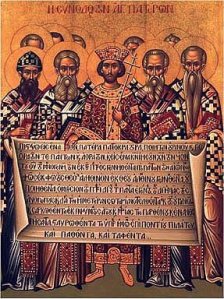
 Historically speaking, “creeds” and “Oneness Pentecostal” have not gone hand-in-hand. We have typically eschewed creeds, viewing them quite negatively. The reason for this is two-fold. First, creedal statements have often been invested with an authority equal to that of Scripture, and we do not believe anything is equal in authority to the revealed Word of God. Secondly, and more importantly, we have objected to the Trinitarianism that is either the backdrop of, or subject of the creeds.
Not only have we rejected the ancient creeds in particular, but we have rejected the notion of “creed” in general. This is most unfortunate. Not only are creeds useful as brief summations of the Christian faith, but they are Biblical as well. We find several apparent creeds and creedal affirmations in the Bible:
- 1Kings 18:39 And when all the people saw it, they fell on their faces; and they said, “The LORD, He is God; the LORD, He is God.”
- Mt 16:16 And Simon Peter answered and said, “Thou art the Christ, the Son of the living God.”
- Jn 6:69 “And we have believed and have come to know that You are the Holy One of God.”
- Acts 8:36-37 And as they went along the road they came to some water; and the eunuch said, “Look! Water! What prevents me from being baptized?” 37 And Philip said, “If you believe with all your heart, you may.” And he answered and said, “I believe that Jesus Christ is the Son of God.”
- 1 Cor 8:6 Yet for us there is but one God, the Father, from whom are all things, and we exist for Him; and one Lord, Jesus Christ, by whom are all things, and we exist through Him.
- 1 Cor 12:3 Therefore I want you to understand that no one speaking in the Spirit of God ever says “Jesus is accursed!” and no one can say “Jesus is Lord” except in the Holy Spirit.
- 1 Cor 15:3-4 For I delivered to you as of first importance what I also received, that Christ died for our sins according to the Scriptures, 4 and that He was buried, and that He was raised on the third day according to the Scriptures….
- Phil 2:6-11 Who, although He existed in the form of God, did not regard equality with God a thing to be grasped, 7 but emptied Himself, taking the form of a bond-servant, and being made in the likeness of men. 8 And being found in appearance as a man, He humbled Himself by becoming obedient to the point of death, even death on a cross. 9 Therefore also God highly exalted Him, and bestowed on Him the name which is above every name, 10 that at the name of Jesus every knee should bow, of those who are in heaven, and on earth, and under the earth, 11 and that every tongue should confess that Jesus Christ is Lord, to the glory of God the Father.
- 1 Tim 3:16 Who was revealed in the flesh, Was vindicated in the Spirit, Beheld by angels, Proclaimed among the nations, Believed on in the world, Taken up in glory.
- 1 Jn 4:2 By this you know the Spirit of God: every spirit that confesses that Jesus Christ has come in the flesh is from God….
For all our anti-creedalism, in practice we do subscribe to creeds. We simply call them by a different name: “articles of faith,” “doctrinal statements,” etc. While not invested with an authority equal to Scripture, they serve the same essential purpose as the creeds of old: to summarize what it is that we believe (creed comes from the Latin credo, meaning “I believe”), and to serve as a test for orthodoxy. If you don’t believe me, just ask all those who have been turned down for a ministerial license, or who have had their licenses revoked because they did not fully subscribe to some article(s) in the Articles of Faith of their denomination!
I find it unfortunate that we have rejected wholesale the ancient creeds. Some of the ancient creeds were great summaries of the Christian faith, minus their Trinitarianism of course (and some other fine points of theology). I think it is possible to redeem them of this feature—to eat the chicken and toss the bones, so to speak. And I have attempted to do just that. What follows is a creed I created based on the ancient creeds in style (similar language, meter), but thoroughly rooted in Oneness Pentecostal theology:
I believe in one God, eternal and almighty,
creator of heaven and earth,
who is one in essence, and one in person
and who for us became one of us, and yet remained God.
I believe in Jesus Christ, the image of the invisible God
who was conceived by the Holy Spirit,
born of the virgin Mary, and descended from David,
being both true God and true man.
Who was crucified under Pontius Pilate,
died for our sins, was buried, and rose again the third day,
who ascended to heaven, from whence He’ll return in glory
to judge the world, raise the dead,
and inaugurate a kingdom without end.
I believe in salvation through Christ alone,
by grace through faith, and evidenced by good works.
I believe in repentance from sin,
baptism in Jesus’ name, and regeneration of the Spirit.
Amen.
I am interested in your thoughts on the usefulness of creeds, as well as what you think of my own. Did I leave anything out? Unclear on something? Could I say something in a better way?


September 16, 2009 at 1:08 am
While I think there are times when Creeeds are useful, due to the way they are generally used in churches, I do not personally like them!
However, given that they are based upon scripture, they can be used well for teaching “laymen” the truths found in scripture. Of course, one has to be careful with the language, as when I was younger, I had a problem with the phrase “the holy catholic Church” for a long time in the Apostle’s Creed thinking it meant the Roman Catholic Church…
As a trinitarian, I can’t possibly agree with your Creed above though 🙂
LikeLike
September 16, 2009 at 6:31 am
Beautifully written. Maybe you should write a short doctrinal book or tract. We can always find better ways to explain our faith to new converts or even to enrich our own understanding. I also like 1Cor 15 because in the Death, Burial and Resurrection you have the whole plan of salvation.
As an A/P, I must heartily agree with your Creed above!
LikeLike
September 16, 2009 at 6:46 am
I don’t have a problem with creeds or bylaws, but the creed or bylaw has to be in line with the entire counsel of scripture. This is the common denominator. Many times creeds are taken out of context to fit a denomination’s preference, yet it may not reveal the entire truth. For example the SDA’s creeds revolve around observing the sabbath and dietary laws, for which they provide scipture. Yet it contradicts the New Testament teachings on not being judged by days and food (Romans 14, Colossians 2)or being bound to the observance of the Mosaic Law…However, I do agree 100% with your drafted creed regarding the Godhead, even though i’m not a O.P. It’s most certainly in line with scripture.
LikeLike
September 16, 2009 at 7:22 am
Absolutely excellent thoughts on the matter. I have contemplated on the issue of creeds often. They are simply a matter of fact. Everyone has creeds by some name. And even if they have no name, there is an essential framework of doctrine by which every church or denomination operates.
And as you pointed out, Scripture itself has multiple creedal-like statements which are summaries of foundational truths.
I too have worked on some personal creeds and played around with how I would frame up what I believe. And I love what you’ve put together. It’s really, really good.
LikeLike
September 16, 2009 at 7:26 am
I think that our anti-creedalism is a part of our extreme Protestantism and restorationist impulse, a longterm reaction to Rome, if you will.
However, I think it important to more critically review the issues of creeds by whatever name you call them. The reason is that it is forces you to think and articulate what you believe is basic, and what you believe in common with others. Also, it pushes issues of doctrine out into the light, and necessitates review of them. This is good b/c there is always some set of doctrines controlling the thought/actions of the church or denomination.
Also, it would interesting to discuss what parts of the creeds and councils that the OP movement is in agreement with and has kept. The issue of canon comes to mind as well as the Chalcedonian formulation of the two natures of Christ.
LikeLike
September 16, 2009 at 7:53 am
Another thought. I think there is a usefulness to short creeds and a usefulness to longer statements of faith. The first allows you to state briefly and succinctly the very core truths held in common. Examples of this are of course the Apostle’s Creed and the Nicene Creed. The latter helps expand into each area of doctrine and set forth a fuller statement of what is confessed. Examples of this are the UPCI Articles of Faith, the 39 Articles (Anglican), the Westminster Confession of Faith, the Baptist Faith & Message, and so on.
Obviously, a short creed can not cover everything. But that is ok, everything is not of first importance.
LikeLike
September 16, 2009 at 8:00 am
Great post, Jason! I used to hold the position you critique, including the “Biblical-terminology-only” position until I realized I was contradicting myself.
I also like your creedal statement. I would, however, clarify baptism by adding for the remission of sins and after regeneration of the Spirit add which constitutes the new birth.
LikeLike
September 16, 2009 at 9:48 am
Chad,
And here I thought I was the only Oneness Pentecostal writing creeds. Ha!
I like what you had to say about the value of creeds. Let me add one more: it forces us to create a taxonomy of doctrine. Since creeds are meant to be summaries of the Christian faith, only the things that matter most should be put in there, which forces us to prioritize which doctrines matter most.
It’s funny that you brought up examining the creeds to see what parts OPs agree with. That was going to be my next post! I go through some of the creeds to show which parts I think we can agree with, which parts we can’t, and which parts are questionable.
Jason
LikeLike
September 16, 2009 at 9:48 am
Scalia,
I was expecting you to object. What a pleasant surprise!
In my original draft I did have “for the forgiveness of sins,” but it really messed up the meter/flow, so I removed it. I reason that this is a creed rather than a doctrinal statement, so some of the theological nuances can be left out (such as the purpose of baptism).
Jason
LikeLike
September 16, 2009 at 11:30 am
After re-reading your creed, i couldn’t help but think of Peter’s discource in Acts 2:22-36.
LikeLike
September 16, 2009 at 5:59 pm
Great stuff…do you have a detailed statement of faith also?
LikeLike
September 16, 2009 at 6:14 pm
[…] I Believe… Jump to Comments A good friend, Jason Dulle, has just posted a wonderful article on a positive understanding of the concept of creeds. We all have them whether we deny it or […]
LikeLike
September 16, 2009 at 10:55 pm
D.C. Lake,
Welcome to the blog! Yes, I created a short doctrinal statement a number of years ago that can be found here: http://www.apostolic.net/biblicalstudies/state.htm. I had not read it in some time. Having just read it again, it could use some revising and expansion. As I like to say, writing consists of editing, editing, and more editing. Nothing is ever final, particularly when it’s published on the Web!
Jason
LikeLike
September 26, 2009 at 7:03 am
Greetings! Brother Dulle
Creeds, doctrinal affirmations, or statements are not justified by no organized body of people calling themselves christian for the simply reason that our faith, lifestyle, theology, and solemn declarations are effectively illustrated by the sacred scriptures alone. Therefore, whether oneness or non-oneness it is not justified by no one claiming to be a child of God or a follower of Jesus Christ to develop creeds, articles of faith, doctrinal statements, or religious bylaws to set forth their beliefs. To do so is to cultivate one’s own groups standard of righteousness which according to the scripture is as filty rags.
May the God of all grace continue to shew forth wisdom, grace, and peace upon you always. in the name of Jesus Christ. Amen.
Marquest Burton
LikeLike
September 26, 2009 at 7:10 am
Greetings! Brother Dulle
I disagree and do not endorse your creedal formulation as heretical. For it is my strong contention that God Almighty did not become a man but that he created a man and housed himself within to demonstrate his work to humanity (thus providing an example) and providing a sacrifice to rid the world of sin. Therefore, as I said before I do not endorse the usage of any creeds or the development of creeds by the christian community. (The true church of Jesus Christ has only one creed which is infalliable and inerrent–that is the sacred word of God. And we need not devise creeds, doctrinal affirmations, articles of faith, or bylaws to enunciate our beliefs.)
May the God of all grace have continual mercy, grace, and peace upon you all to lead you to the truth. in the name of Jesus Christ. Amen.
Marquest Burton
LikeLike
September 26, 2009 at 7:56 pm
Marquest,
Forget the issue of creeds. Your Christology is worse than Nestorian–it’s Adoptionism. If God did not become a man, then Jesus is not God. Your affirmation, then, is a denial of the deity of Christ. This is no small matter.
Jason
LikeLike
September 28, 2009 at 6:58 am
Greetings! Brother Dulle
My very affirmation that God did not become a man but robed himself in a man or a garment of flesh and blood is wholly scriptural. For Numbers 23:19 plainly declares that God Almighty is not a man neither does he become a man. Therefore, it is your concept of Christology that is in error which will endanger you to a place of torment and destruction in the fires of hell in the world to come.
LikeLike
September 28, 2009 at 7:06 am
Greetings! Brother Dulle
Let me reiterate once again the scriptures firmly declares that the one true God of all creation did not become a man neither is a man nor was a man before the creation of the world. But he (God) created for himself a fleshly tabernacle and wrapped himself in it and attached his name (Jesus) and his title which is Christ. Therefore, any belief that says that God became a man or was a man or is a man now is heresy and will condemn one straight to hell for eternity. Therefore, I advise you all to refrain from speaking falsehoods against the Most High God and turn your whole heart and mind unto the true way of the kingdom of heaven which is Holiness.
May the God of all grace continue to have mercy upn your soul. in the name of Jesus Christ. Amen.
Marquest Burton
LikeLike
September 28, 2009 at 10:45 am
See my article here for your misinterpretation of Numbers 23:19: http://www.onenesspentecostal.com/num23.htm
Your Christ is not a man, but God in a flesh costume. John said the Word became flesh. He didn’t mean that deity transmutated into humanity, but rather that God entered into a genuine human existence. If God did not become a man in a metaphysical way, then Jesus is not God, but a mere man who is God’s roommate, and thus worship of Christ is idolatrous.
Jason
LikeLike
September 29, 2009 at 7:31 am
Greetings! Brother Dulle
My Christ is according to the sacred scriptures which clearly affirms that God Almighty did not become a man nor is a man right now. Besides true followers of Christ Jesus do not worship the Son of God/Son of man but we worship God Almighty which indwelt the man and gave him his name and title to publish unto the world. As for reading your article I’ve already done so and found it unsound and contrary to scriptural principle. For God Almighty did not become a man for he is a spirit and is omnipresent and is unchanging. Therefore, he did not become a man rather he took on man or robed himself in flesh and blood to demonstrate his personhood unto the world.
May the God of all grace have continue mercy, grace, and wisdom upon your soul. in the name of Jesus Christ. Amen.
Marquest Burton
LikeLike
September 29, 2009 at 12:14 pm
Marquest wrote,
Marquest, none of these “statements” you’ve made are in the “scriptures alone.” By writing what you have, you are expressing a theological position that is not illustrated by the scriptures alone. Hence, by your own standard, what you’ve just said must be rejected.
Is that what you BELIEVE?? You’ve just issued non-scriptural statements of belief to the effect that no such statements are justified. Every time you write or speak about theology using words, sentences, or terminology not expressly found in the scriptures, you violate the very principle you claim to affirm. Given that, your argument is incoherent. How can you criticize us for using non-scriptural terminology when you’ve done that with every recent post?
I used to hold the position you defend, until I discovered it is rationally indefensible. One must adopt the following statement (or a variant thereof):
I believe the Bible teaches one cannot issue a non-scriptural statement of what the Bible teaches.
See the problem, Marquest? That statement itself is a non-scriptural statement of what the Bible teaches. And if all non-scriptural statements of belief are illegitimate, then that statement itself is illegitimate. Thus, no sense can be made of such a statement.
Moreover, the scriptures explicitly reject the position you’re affirming:
Nehemiah 8
8. So they read in the book in the law of God distinctly, and gave the sense, and caused them to understand the reading.
The Amplified Bible translates that verse, “So they read from the Book of the Law of God distinctly, faithfully amplifying and giving the sense so that [the people] understood the reading.”
Ministerial responsibility is not confined to mere scripture reading; it extends to summarizations, explanations and clarifications to intelligibly communicate just what the text is expressing.
All statements of faith are affirmations of what one believes the Bible teaches. You believe they are illegitimate, but that cannot be communicated unless you say or write something. The instant you deny a statement of belief, you express a belief of your own. And if that “statement” isn’t explicitly, word-for-word found in the Bible, then you’re making a non-scriptural belief claim to the effect no such claims are allowed. A clear contradiction.
LikeLike
September 30, 2009 at 11:51 am
Greetings! Scalla
Again I say unto you that creeds, doctrinal summarizations, or articles of faith are not justified to explain our faith. But every true disciple of Jesus Christ must explain their faith by the scriptures alone and nothing else. As for my affirmations that I have given on this forum they are true explanations of the scriptures alone not creeds, nor doctrinal summaries or articles of faith. Therefore, I advise you all to stop endorsing articles of faith, creeds, doctrinal summaries, bylaws, and statements of faith to explain one’s faith. But use the scriptures alone.
May the God of all grace have mercy upon your soul. in the name of Jesus Christ. Amen.
Marquest Burton
LikeLike
September 30, 2009 at 11:56 am
Greetings! Scalla
Let me clarify something:
Interpreting and explaining the scriptures are justified to give an individual an understanding that they can apply the scriptures unto their life. But formulated creeds, doctrinal summaries, statements of faith or articles of faith or bylaws are not justified to enunciate one’s beliefs because our beliefs are enunciated and set forth by the sacred scriptures alone.
May the God of all grace have mercy upon your soul. in the name of Jesus Christ. Amen.
Marquest Burton
LikeLike
September 30, 2009 at 12:36 pm
Marquest writes,
Not to be sarcastic, but I also like pizza. What we like or dislike is fine. If you prefer a particular approach for witnessing purposes, more power to you. But if you argue we, as Christians, are required by God’s word to use only Biblical terminology, then your position is self-refuting. No “interpreting” is justified if your position is to use ONLY biblical terminology.
In fact, you website has NUMEROUS doctrinal statements and summations of biblical teaching, such as:
Who is the trinity?: False doctrine
Is there free will?: Yes
God is…: Jesus Christ
There are millions of Christians who fervently believe the Trinity is a biblical doctrine (I used to be one of them). Here you “summarize” biblical teaching by calling that doctrine false. That’s a doctrinal statement if ever there was one.
There are many Christians who believe the doctrine of free will is an affront to God’s sovereignty. Again, you “summarize” biblical teaching by affirming free will. Another doctrinal statement.
The last one about God is…Jesus Christ is something I believe, but the Bible NOWHERE uses that terminology the way you use it. You are correctly “summarizing” what the biblical record of Christ is, but you are not using the “sacred scriptures alone” to affirm that. Rather, you are RESTATING what the scriptures teach as a doctrinal declaration.
If you call the tail of a dog a leg, how many legs does a dog have? Four. No matter what you call it, a tail is still a tail (attributed to Abraham Lincoln). You may choose to call your non-biblical doctrinal statements something else, but they’re still non-biblical statements.
LikeLike
September 30, 2009 at 12:42 pm
Marquest, again I ask you to engage the argument. That requires you to understand why I object to your position. When you understand that, you must then demonstrate why your position isn’t self-refuting.
You are, of course, under no obligation to do so. But unless you do, you’re spinning your wheels because no rational person will adopt a self-contradictory belief.
LikeLike
October 1, 2009 at 9:53 am
Greetings! Scalla
Let me clarify something my views have changed concerning freewill to state that man’s will is not free considering that he has a fallen nature. More specifically I endorse some of John Calvin’s beliefs concerning free will, election, atonement, and other things. Yet I strive by the grace of God to teach his perspective from a oneness adherent view point.
Concerning your views that my statements are illogical I totally disagree that my views are not compatible with the scriptures of truth. For when one interprets the scriptures of truth under the inspiration of God then the true interpretations are equivalent to inspired scripture. Or more plainly when a man is moved by the Holy Spirit to explain the scriptures then the man’s explainations are inspired and thus are scriptural explainations.
However on the other hand creeds, doctrinal summarizations, articles of faith, or bylaws are not inspired by the Holy Spirit for either entirely or in part they constradict the sacred scriptures which means that God’s people will not endorse them as a means to enunciate our beliefs.
May the God of all grace have mercy upon your soul. in the name of Jesus Christ. Amen.
Marquest Burton
LikeLike
October 1, 2009 at 10:31 am
Marquest wrote,
LikeLike
October 1, 2009 at 10:33 am
Very sorry, but my previous post wasn’t formatted properly. Here it is again in proper format:
Marquest wrote,
Unbelievable! All this discussion and you end up agreeing with Jason’s original point! Neither Jason nor I have argued we should endorse unscriptural statements. We have consistently argued we can accept only what conforms to the scriptures. Our language is too plain for you to have misunderstood it. I can only conclude you’re not even trying to understand what we’re saying. I highly recommend you understand a post before you reply to it.
You “clarify” your views by stating that you were wrong about free will. So, when you spoke about man’s free will, you were speaking falsely, correct? Does that make you a false prophet? Should everybody who reads your webpage dismiss EVERYTHING you wrote because you were wrong about free will? Let’s see, you were inspired when you wrote of the truth of Jesus’ name baptism and the error of the Trinity, but you weren’t inspired when you wrote about free will. Therefore, by your own standard, every doctrinal statement on your website should be dismissed as uninspired or a “creed of man.”
The fact somebody is correctly interpreting the word of God does not make that person directly inspired by the Holy Ghost.
Phillipians 1
15. Some indeed preach Christ even of envy and strife; and some also of good will:
16. The one preach Christ of contention, not sincerely, supposing to add affliction to my bonds:
17. But the other of love, knowing that I am set for the defence of the gospel.
18. What then? notwithstanding, every way, whether in pretence, or in truth, Christ is preached; and I therein do rejoice, yea, and will rejoice.
Truth is truth regardless who says it. We rejoice if it is true, we reject it if it is false. Hence, when somebody makes statements that are true and false, I’ll only accept what is true — and that’s all we’re saying!
LikeLike
October 1, 2009 at 11:01 am
Greetings! Scalla
I apologize for misunderstanding what you have said as well as Jason. But I am hesistant with affirming any non scriptural creed, article of faith, doctrinal summarizations or bylaws if it does not conform unto sacred scripture even if it contain elements of truth. Yes I do agree that even false religions contain elements of truth yet I am very hesitant to cite their beliefs to enunciate my beliefs as to not endorse their religion. Therefore, I strive to confine my speech to the words of scripture exclusively.
Concerning explainations and interpretations I disagree that they are not inspired along with inspired scripture. For if the Holy Ghost moves men to interpret and explain scripture then the explainations are equally inspired along with the scriptures.
May the God of all grace have mercy upon your soul. in the name of Jesus Christ. Amen.
Marquest Burton
P.S. Concerning my website the statements that I spoke that contradicted the scriptures shows that I spoke unadvisedly with my lips until my understanding was enlightened to the truth of my error that I may make correction. Consider Simon Peter whom was having a respect of persons when he separated from those whom were Gentile believers when certain Jewish believers came to see him until Paul of Tarsus rebuked him for his error. Therefore, I did not say that a man whom is inspired of God will not deviate from the word of God because that man even though he is of God still has the sin nature within his flesh which neccesites the he remain guided by the Spirit of grace that he may speak forth sound or inspired words.
LikeLike
October 1, 2009 at 11:15 am
Thanks for the lively discussion, Marquest. We all have a lot of learning to do.
In Christ,
Scalia
LikeLike
March 27, 2013 at 4:44 am
Have you ever considered about including a little
bit more than just your articles? I mean, what you say is fundamental
and all. Nevertheless imagine if you added some great pictures
or video clips to give your posts more, “pop”!
Your content is excellent but with images and clips, this website could undeniably be
one of the best in its field. Amazing blog!
LikeLike
February 6, 2017 at 5:25 am
That was very well put and certainly you are right;we have creeds with different names.
LikeLike
September 12, 2017 at 7:53 am
What about the Holy Spirit? Nothing is written about the Holy Spirit! What is the Holy Spirit for you?
LikeLike
September 13, 2017 at 3:36 pm
The Holy Spirit is God.
LikeLike