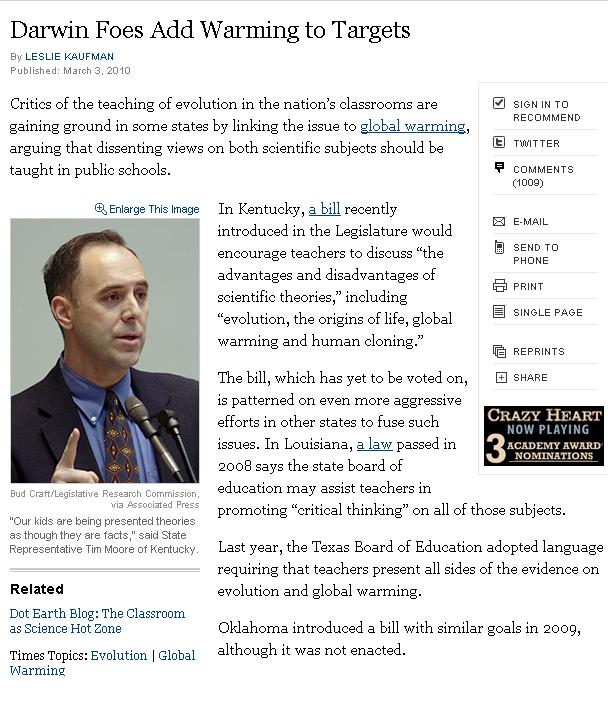
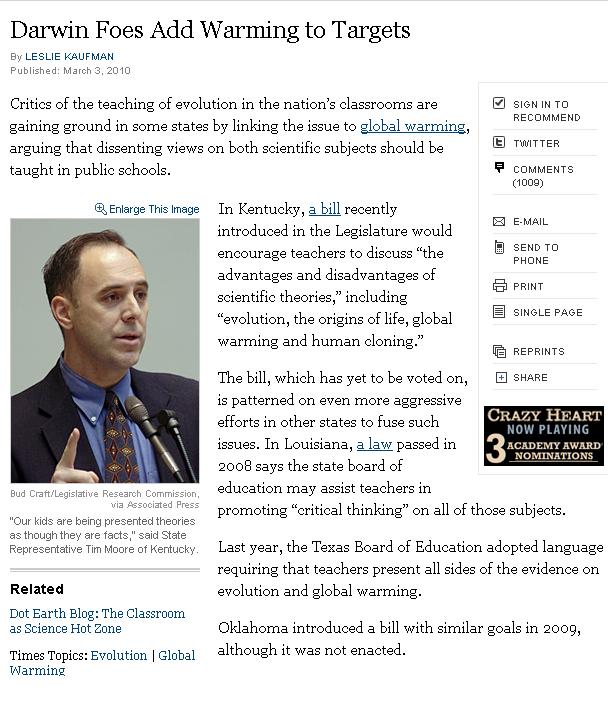
 The New York Times ran an article on their front page about academic freedom bills that are popping up in some states. Some of these bills require that teachers teach both the evidence for and against certain scientific issues (such as evolution and global warming), or at least allow them to do so. Who could oppose such bills? You would be surprised! But I digress.
The one part of the article that irked me the most was their mischaracterization of intelligent design as “the proposition that life is so complex that it must be the design of an intelligent being.” What’s so disturbing about it is that they have been told by the Discovery Institute (the main ID think-tank) in the past that this definition is inaccurate, and yet they refuse to characterize ID accurately time and time again.
I decided to comment on the article to set the record straight and vent my frustrations with the NYT. Seeing that my comment, if it is approved, will be #1010-ish, I doubt it will get read by too many people, including those at the NYT (but I feel much better now). Here is what I wrote:
Can the NYT ever get the definition of ID right?! This is not what ID advocates argue, and it is not how they define their own theory. ID is defined as “the study of patterns in nature that are best explained as the product of intelligence.” As for how intelligence is detected, complexity is just one factor—that by itself is not determinative. Something must be both complex and “specified” before a design inference can possibly be made.
So unlike your portrayal of ID, it is not an argument based on ignorance (“Well, dat dere’s so darn complicated that I dunno how it happened. God musta dun it!”), but an argument based on what we know about certain features of our universe, and what we know about the causal adequacy of naturalistic versus intelligent causes to produce the features in question.
NYT, have a little integrity and let the people who hold to the theory define it, rather than you imposing a definition that turns ID into a straw man that can easily be knocked down.
 Thinking to Believe
March 6, 2010 at 10:53 am
Jason,
I don’t think the solution is for the NYT to become honest. The solution is for people to stop reading or citing the NYT. Let the extremists read it, an echo of liberal propaganda that’s heard only in a leftist echo chamber. The rest of America can watch Fox News, read the local paper (including AP stories) with a skeptical eye, and ignore the propaganda posing as reporting.
Arthur
LikeLike