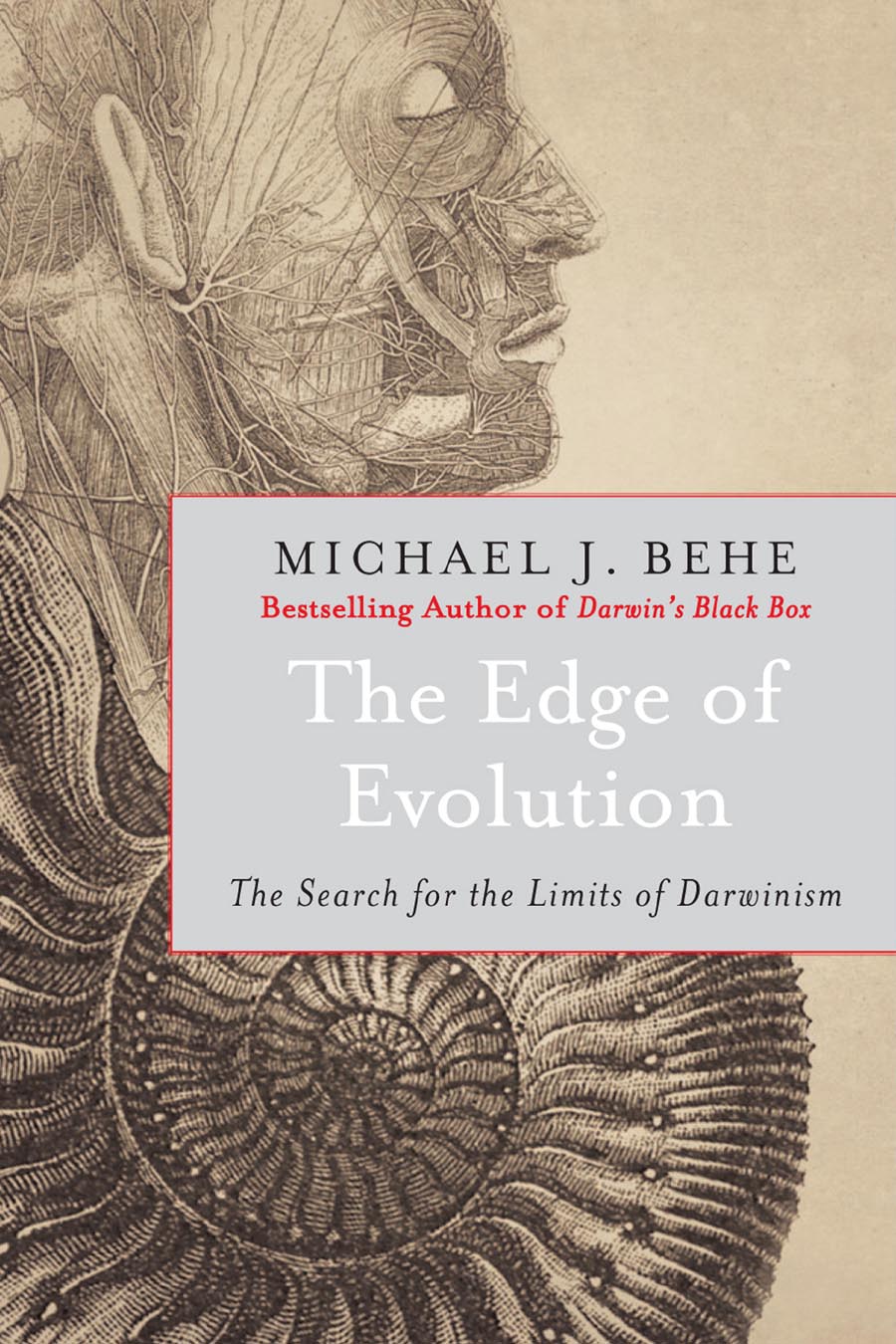
 Several months ago I blogged my way through Stephen Meyer’s Signature in the Cell, summarizing his devastating critique of naturalistic origin-of-life theories and powerful argument for the intelligent design of the first life (parts 1, 2, 3, 4, 5, 6, 7a, 7b). But what about the proliferation of life? Can a fully naturalistic theory like neo-Darwinian evolution account for the proliferation and variety of life once it began? To answer this question I am going to summarize Michael Behe’s key argument against a Darwinian account of evolution in The Edge of Evolution (paperback only $6 through Amazon right now, regular $15).
What Needs to be Explained
To properly evaluate Darwin’s theory of the evolution of life, we must clarify what is meant by “evolution.” Evolution can refer merely to small biological changes within a species over time. Called “microevolution,” or the special theory of evolution, this definition of evolution is relatively uncontroversial and has been confirmed empirically (e.g. drug resistance in bacteria, changes in the size of finch beaks, etc.). Evolution can also refer to large-scale biological changes[1] that, over time, transform one species into another into another ad infinitum. This kind of evolution is called macroevolution, or the general theory of evolution. Darwin’s theory entails this latter definition, and thus proof for his theory requires evidence that there are no natural limits to the amount of variation an organism can experience.
Have Darwinists met their burden of proof? No. To date, no evidence for macroevolution has been provided. Darwinists routinely offer the evidence for microevolution as if that is evidence for macroevolution, but this is a methodologically illegitimate extrapolation from the evidence. Evidence for microevolution is just that: evidence for microevolution. It is not in itself evidence for macroevolution. To be sure, the reality of microevolution makes macroevolution a plausible concept because it proves that organisms are capable of experiencing biological change of some sort, but more than plausibility is required if we are to take Darwinism seriously. Minimally Darwinists need to offer empirical proof that there are no natural limits to genetic change, as well as a detailed biological pathway for the transition from one organism to another, as well as evidence that this pathway could reasonably be traversed given the amount of time available. Without such a demonstration, there is no reason to think macroevolution is anything more than an unsubstantiated hypothesis.
And what does the evidence reveal? It strongly suggests there is a natural limit to the amount of variation organisms can undergo before they reach an evolutionary ceiling. As Gilbert, Opitz, and Raff wrote:
The Modern Synthesis is a remarkable achievement. However, starting in the 1970s, many biologists began questioning its adequacy in explaining evolution. Genetics might be adequate for explaining microevolution, but microevolutionary changes in gene frequency were not seen as able to turn a reptile into a mammal or to convert a fish into an amphibian. Microevolution looks at adaptations that concern only the survival of the fittest, not the arrival of the fittest. As Goodwin (1995) points out, “the origin of species—Darwin’s problem—remains unsolved.”[2]
Organisms are like balloons: They are capable of experiencing a range of change, but only within prescribed limits. It would be foolish to assume that because we can inflate a balloon to the size of a basketball, given enough time it could be inflated to the size of a planet. Likewise, it is foolish to think that just because an organism is capable of undergoing small biological changes, given enough time it will become an entirely different organism altogether. Balloons and DNA are designed with a measure of elasticity, but both have a breaking point beyond which no further change is possible. While beak sizes may change within a population of finches during seasons of drought, there is no empirical evidence demonstrating that finches can evolve into squirrels over time. The genetic evidence is overwhelming in favor of the conclusion that there is a natural limit to genetic variability. And if there is a natural limit to genetic variability, Darwinism is proven false.
Stay tuned. Tomorrow we will explore the adequacy of random mutations to explain the origin of new biological information – information that is necessary to drive evolution forward.
[1]These changes are usually understood to be the product of purely unguided, natural processes, not intelligent agency.
[2]Scott Gilbert, John Opitz, and Rudolf Raff, “Resynthesizing Evolutionary and Developmental Biology,” Developmental Biology, Vol. 173, 1996, p. 361.
 Thinking to Believe
April 9, 2010 at 9:32 pm
The New York Times review of this book is here:
LikeLike
April 10, 2010 at 9:07 am
Sounds like some great input for IMGOOD.ME 🙂
LikeLike
April 10, 2010 at 11:21 am
When talking about finches and how the beak size will change because of environmental changes and then suggesting that since there is no evidence of a finch evolving into a squirrel that this is supposed to refute MACRO evolution seems a bit disingenuous. The reason given by the people that want to use stem cels from a fetus as opposed to adult stem cells is because they can “engineer” those stem cells in determining what they will enentually become as opposed to the adult stem cells having already determined what they will become. Why couldn’t a cell that will eventually turn into a finch before it has been determined that it will be a finch be altered by environmental conditions and mutate into something else that eventually mutates into a squirrel?
LikeLike
April 14, 2010 at 1:23 am
Arthur,
If you would like to summarize the main points of the review, I will respond.
Jason
LikeLike
April 14, 2010 at 1:29 am
Bill,
I am not suggesting that since there is no evidence of a finch evolving into a squirrel that this refutes the idea of macroevolution, but simply that this is not in itself evidence for macroevolution. And yet this is the kind of evidence routinely offered by Darwinists to support their contention that one organism can evolve into a wholly different organism over time.
As for your stem cell analogy, that won’t work. The difference between the different cells is found in the range of genetic switches. Adult stem cells have had certain genetic switches turned off, thus directing them to develop into a specific kind of cell. Embryonic stem cells are cells that have yet to have some of their switches turned off. They don’t have the ability to become a different organism, no matter what you do to them. To become a different organism would require a different genetic code.
Jason
LikeLike
April 16, 2010 at 11:24 am
[…] under Apologetics, Evolution, Intelligent Design, Science Leave a Comment (Read parts 1 and 2 in the […]
LikeLike
April 19, 2010 at 11:25 am
[…] previous posts, see parts 1, 2, 3a) [1]On average, a new mutation will occur every time a copy of the virus is made. Compare […]
LikeLike
October 9, 2020 at 1:23 pm
[…] (For part 1 in the series, click here) […]
LikeLike