 The Bible begins with one of the most famous proclamations of all time: “In the beginning God created the heavens and the earth” (Genesis 1:1). Theologians have historically understood “in the beginning” to refer to the very beginning of time itself. It was the boundary between timeless eternity and temporality.
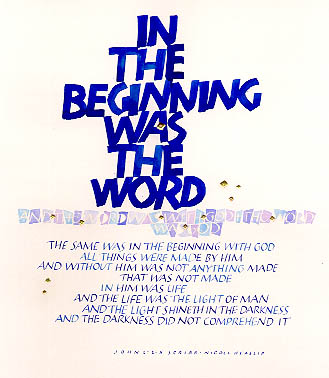
Fast forward to the first century A.D. John opens his gospel about Jesus Christ with these words: “In the beginning was the Word, and the Word was with God, and the Word was God. 2 He was in the beginning with God. 3 All things were made through him, and without him was not any thing made that was made.” The resemblance to Genesis is unmistakable. Both Moses and John begin their work with “in the beginning,” and both speak of the creative word of God.
The question arises as to whether John is using “in the beginning” in the same way as Moses. For Moses it referred to the beginning of time and creation, but that’s how John is using it, then to say the Word was “in the beginning” seems to imply that the Word was not eternal, but a created entity who began to exist concomitantly with the created realm. Clearly this cannot be the correct interpretation because John 1:1 identifies the Word as being God (whom we know is eternal, and thus existed “prior to” the universe), and John 1:3 identifies the Word as the uncreated creator. Why, then, would John say the Word was “in the beginning?” Why not say Jesus was “before the beginning” or “before the ages?” What is your take on the matter?


October 16, 2010 at 6:58 am
In verse 3 John notes that Jesus is indeed the creator of the universe, so isn’t the point of verse 1 simply to note that He was around at the time creation (the “beginning”), and therefore it’s not a statement about whether He is eternal or not but, rather, He is simply emphasising Jesus being there to create. Isn’t it similar to the apocryphal Wisdom of Solomon 9:9, which reads: “With you (God) is Wisdom, who knows your works and was present when you made the world.”?
LikeLike
October 16, 2010 at 3:43 pm
My perspective has been that John intentionally used the phrase “in the beginning” to cause us recognize that Jesus is the Creator of Genesis 1:1. John uses similar terminology in his letter 1 John as well. In both cases, John is discussing Creation.
So, I believe John is cluing us in to the fact that the Creator of Genesis 1:1 is the Jesus of his gospel and epistle. This also points to the Oneness of God.
I have taught on this before, so I am going to have find my notes and see if I can do a better job of expressing myself on the subject.
LikeLike
October 16, 2010 at 3:51 pm
Although “beginning” appears to be a demarcation of time, time as we know it didn’t exist in Genesis 1:1. Not until the creation of the Sun/earth relationship does time exist (calendar cycles, days, hours, etc.).
It might be beneficial to look at other translations of Genesis 1:1 as well. If I am remembering it correctly, the Jewish Pubilcation Society’s translation of the Tanach reads like this: “In the beginning of the creation of God, God made the heavens and the earth.”
This might only indicate “time” insomuch as it relates to the physical universe. This would answer the question of the “uncreated creator”, as you called it, in John. When God began to create, He made the heavens and the earth as His first objects, hence a beginning (a demarcation of time) which only exists within the material realm. This would mean the Word (God Himself) pre-existed creation, and therefore, time, leaving Genesis 1:1 and John 1:1-3 in complete agreement.
Comparing this to Colossians 1:16 we read how “by Him all things were created…”. “By” in this verse is the Greek preposition “dia” meaning through, as in the channel of the act. Jesus is the channel of the act whereby God created all things, which, in John, is the Word, which uses the same preposition in verse 3.
So when God decided to create, He chose to do so through the Word (God Himself as divine utterance or thought, i.e. logos), which eventually became flesh in the person of Jesus Christ (John 1:14). This indicates that the Word existed at the beginning as the vehicle whereby God created (channel of the act).
Also, the verb “was” is in the imperfect in Greek, indicating no definite beginning or ending, as compared to creation, which (whilst unknown to us) has a definite beginning and will have a definite ending. This shows that at the point of creation, the Word was already existing.
Therefore John 1:1 could read like this:
In the beginning, the Word was existing, and the Word was with God and the Word was existing as God Himself.
This literal reading strongly implies that the Word pre-existed creation, which answers why John supposedly didn’t write anything about the Word/Jesus existing before or prior to beginning/ages, because, in actuality, He did.
LikeLike
October 17, 2010 at 7:34 pm
“In the beginning God created” and “In the beginning was the Word”. Of course God spoke and creation happened. In John “logos”, as I understand it, means plan or computation. In my estimation, John was saying that in the very beginning God had a plan. We know that the lamb was slain before the foundation of the world so it is obvious God had a plan. It is John’s aim to say that the plan was not just an abstract thing but it became flesh and dwelt among us. John wasn’t trying to say the Son existed – that is why he used the word “logos”. The plan and computation of God did exist and using His plan he executed it precisely. John communicated the truth to the monotheistic Jews that Jesus was the creator, the planner, and the Savior.
LikeLike
October 18, 2010 at 5:12 pm
Aaron,
Time did begin to exist in Gen 1:1, even if the celestial tools used to measure it did not exist until day 4 (and some would argue that they were present from the beginning, but only were revealed on day 4). Time is metaphysically distinct from any measurement of it.
And yes, the context of John 1 makes it clear that the Word pre-existed creation. I think James has it right when he says the point of referencing the beginning was merely to point out that the Word was present in creation; not necessarily to indicate the Word’s beginning. You seemed to be saying this as well.
Jason
LikeLike
October 18, 2010 at 5:14 pm
cs,
I know saying the logos is the plan of God is a popular Oneness explanation, but plans do not create anything, and plans are not incarnated. Personally, I see no reason to interpret logos according to the Greek’s philosophical usage of it since John was a Jew who was clearly alluding to the OT’s use of the Word in connection with creation. The Word is none other than God Himself, expressed in creative action.
Jason
LikeLike
October 18, 2010 at 5:54 pm
OK, I still haven’t bothered to look up my notes on this subject. But I do know that the Aramaic translations of the Old Testament, the Targums, used the Aramaic word memra (think I am spelling that right) which means word, in place of God. This came from their reverence for the name of God. In fact when they translated Genesis 1:16-17 & Genesis 2:2, they used memra in place of God.
I don’t think it’s much of a stretch to think that John was conversant with the Targums (The Aramaic translations, etc.) and used Logos in much the same way as the Targums used memra. I see no reason to think that he would have used logos in the manner of Greek philosophy. The Hebrew mindset was such that you cannot separate God from His Word.
The bottom line in my opinion, is that John was simply pointing out that Jesus (obviously not the incarnation aspect of Jesus) is the Creator of Genesis 1. (both in the Gospel and in 1 John)
By the way, John is not the only one to use this phrase “in the beginning” when referencing Creation. The author of Hebrews quotes Psalm 102:25-27 (Septuagint version) in Hebrews 1:10-12. The context of the writer quoting this Scripture (read 1:8-12), is identifying Jesus Christ as the LORD and the Creator of Genesis 1. Right in that short passage of Scripture, Jesus is identified as Yahweh (LORD) and the Creator.
So, the bottom line message of John in his Gospel and letter, along with the author of Hebrews, is that Jesus Christ is one and the same One God of Creation.
LikeLike
October 19, 2010 at 7:12 am
Jason
Does logos not mean computation/plan/something said including thought/reason/divine expression? It is not my attempt to use philosophy in any way to interpret this. By the way, words do not create things either. Words are only an expressed thought or plan and that expression was ultimately Christ and him crucified. It seems we are saying the same thing but you are trying to be less “oneness” about it… 🙂
LikeLike
October 19, 2010 at 10:51 am
cs,
Logos has a wide range of meaning, but the primary meaning is “word.” The Greeks gave it a philosophical meaning of the controlling princiiple of the universe, but I see no reason to believe John is using it that way.
I don’t think John is referring to literal words anymore than I think Moses was referring to literal words. As I wrote in my last comment, the “Word is none other than God Himself, expressed in creative action.” It is a way of referring to God expressing His will in creative activity.
No, I am not trying to be less Oneness about it. If anything, I am trying to be more Oneness about it. To say the Word is God expressed in creative activity is about as Oneness as you get. Making the Word out to be an impersonal plan of God seems less Oneness to me, and it fails to fit the point of the passage. Whatever the Word is, it is referring to personal agency, and a plan is not a personal agent.
Jason
LikeLike
October 19, 2010 at 10:53 am
Darren,
Agree 100%. In fact, I just heard Dan Segraves teaching on this very topic and making these same points. John is identifying Jesus as the active Creator in Genesis 1.
Jason
LikeLike
October 19, 2010 at 11:37 am
Jason
I agree with what you’ve written. Yet I think you are failing to see my point. God had a plan did he not? That plan was God expressing himself in and to creation.
And the smiley at the end of my last statement was meant to convey I was joking with you. We both agree that it is upholding the biblical truth of One God.
LikeLike
October 19, 2010 at 1:17 pm
cs,
Forgive me for being so serious. 😉
Yes, God had a plan, I just don’t think that John was referring to the divine plan in his use of logos because that definition ceases to make sense of how the logos is described (as a personal agent).
Jason
LikeLike
October 20, 2010 at 8:14 pm
Jason,
After reading your comment about Segraves, I made the effort to look up my notes. I got the info. from his book “Reading Between The Lines”, so He get’s credit for my comment. 🙂
LikeLike
October 21, 2010 at 8:19 am
Jason
No problem… I wasn’t clear with my attempt at humor.
I’m grappling with this take a tiny bit. When you say personal agent and that personal agent was “with God” that tends to muddy the water just a bit for me. Reading it in the kjv may not be very clear.
LikeLike
October 21, 2010 at 12:55 pm
Let me clarify. I believe John simply means “word” by using “logos,” but he has in mind the understanding of “word” we see in Genesis 1: the expression of God’s will in creative activity. This can be said to be “with” God just like I can speak of my word or will being with me, and yet I do not mean to give it distinct personhood from me. I can make a distinction between me and my word/will, but it is simply an expression of me. That’s what I think John’s point is: God’s express will in creative activity was with God, but not something separate from God. It is God Himself in action, which is why the logos can be identified with God.
Jason
LikeLike
October 21, 2010 at 1:09 pm
Thanks for clarifying.
LikeLike
October 21, 2010 at 7:23 pm
cs,
The “with” from “with God” from John 1:1 is pros from the Greek and means toward or pertaining to.
We think of with as accompaniment, which would indicate two separate things. But pertaining to, as in the Logos pertained to God helps enlighten the meaning.
LikeLike
October 21, 2010 at 7:50 pm
Thanks Aaron. I’m definitely not a greek scholar or even an english scholar, for that matter! 🙂
LikeLike
October 22, 2010 at 11:25 am
No scholar, either. Just a rabid fan of Biblical Greek prepositions.
LikeLike
October 25, 2010 at 8:30 am
Glad someone is… I’m learning more about the Greek side of things.
LikeLike
October 26, 2010 at 2:31 pm
I know I’m just jumping in on this but I’ve delved into this subject somewhat already because of a few conversations I’ve had with trinitarians on this subject. The “Word” in John 1:1-3 can definitely be viewed as a literal Greek logos which, according to a simple Strong’s interpretation, means a spoken word, including the thought. God spoke all things into existence. In the same way my arm is with me and my arm is me and my arm is not me is the same way that the “Word was with God, and the Word was God.” Let me attempt to explain…
God had an ultimate plan that inspired Him to create all things–Christ. It in this sense that the “WORD was made flesh.” The plan became a reality in a physical sense when God took on the form of man for the purpose of redeeming mankind.
Hargrove
LikeLike
October 26, 2010 at 2:32 pm
*It {is} in this sense..
LikeLike
October 26, 2010 at 3:01 pm
Hargrove,
But John’s point in his prologue is to identify Jesus as the agent of creation. Plans do not create. Furthermore, plans are not incarnated. People create and people are incarnated. The Word is clearly a person. John is using logos to refer specifically to the expression of God’s creative will.
Jason
LikeLike
October 27, 2010 at 7:13 am
Jason,
I am not disagreeing with you. But, would not the EXPRESSION of God’s creative will be His WORD?
While I agree that the Word is a person–God–I feel that it is also not God in roughly this sense: my word is me in the sense that it is the expression of my heart if I am honest, which God is because He cannot lie, and yet not me in the sense that it is just the audible part of what I am saying. As an analogy, it is like somebody–we’ll say Pat–making a statement that is unique to his or her personality. In commenting on that statement, somebody else says “That’s Pat.”
Obviously, God’s Word alone did not create the universe. It was the will behind that vocal expression. What I am saying is included in that will is the role of Jesus as our Redeemer. Thus, the plan for the incarnation was fulfilled when God was made flesh.
John, while definitely identifying Jesus as the Creator, is most likely doing so poetically. Most of the prophetic books of the Old Testament are written poetically. It is not too much of a stretch to believe New Testament writers did the same.
Do all roads lead to Rome? No. There has to be a certain range of facts and interpretations that accurately fit this scenario. Do all polka-dots have to be round? Yes. Do they have to be the same color? No. Should they be within a range of colors to match their background? Yes. Whether you agree or not, I feel we are saying the same thing. I just feel like you are saying it in a more condensed manner. If you still feel my reasoning is flawed, please elaborate.
Respectfully,
Hargrove
LikeLike
October 27, 2010 at 7:16 am
*Except for “polka-dots,” all instances of “-” are intended to be a break in the flow of the sentence.
LikeLike
October 27, 2010 at 2:30 pm
Yes, God’s expressive will is his “word” which is why John uses logos to describe it, but “word” is just a metaphor. God didn’t say anything in creation because He doesn’t have a mouth or vocal chords. Moses used the word “word” to convey the idea of God’s creative will in expression, just as John did.
I think I understand what you are trying to say: God’s word is a way of referring to God, but to a distinct aspect of God. Just like when I say, “My word is as good as gold,” my word is being distinguished from my person, even though in reality it is me–at least my expression of myself.
Jason
LikeLike
October 27, 2010 at 2:36 pm
Jason,
I do believe we are on the same page. 🙂
By the way, I’ve been reading many of your articles on onenesspentecostals.com. Although I haven’t managed to go through all of them, I would like to say they are all very thought-provoking and informative. Thanks for publishing them.
Hargrove
LikeLike
January 26, 2012 at 1:19 am
Bro Jason, is this teaching by Daniel Segraves online?
LikeLike
January 28, 2012 at 5:42 am
Jevan,
I believe the audio for his lesson is at http://www.evidentialfaith.com/audio/OnenessofGodbySegraves.mp3, located at http://evidentialfaith.webs.com/apps/links/.
Jason
LikeLike
October 13, 2020 at 5:04 pm
John 1:1 “In the beginning WAS the Word.” The word “was” shows grammatically that the Logos was prior to the “beginning” to which it relates to. This is what I read from some Greek scholars who made an emphasis on this single word, showing once again the eternality of the Logos. What can you say about this?
LikeLike
October 15, 2020 at 12:35 pm
Joel, the word “was” is past tense because “in the beginning” is in the past. I don’t know of any Greek grammatical argument that suggests this usage means the logos existed prior to the beginning. Of course, the grammar does not preclude that either. My point is simply that John is locating the logos at the beginning, not prior to that point. The reason he does so is not because he thinks the logos is a creation, or that the logos came into being at creation, but because he is harkening back to Genesis where the logos appears at creation. His theological point is that Jesus is the creator God that spoke everything into existence back in Genesis.
LikeLike