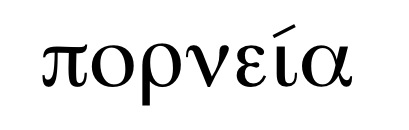
 David Janzen wrote an article in 2001 that was published in the Journal for the Study of the New Testament on the meaning of porneia in Matthew 5:32 and 19:9.[1] In Matthew’s account of Jesus’ teaching on marriage and divorce, Jesus only allows for divorce in cases of porneia. But what does this refer to? It’s usually translated as “adultery,” but the Greek word for adultery is moicheia. Porneia has a wider semantic rate, referring to a range of sexual sins. It can be used of adultery, incest, pre-marital sex, etc.
Janzen argues that Jesus’ use of porneia is best understood from the cultural context. In Jesus’ day, some argued that divorce could be obtained for any reason, while others argued that one must have just cause. All agreed, however, that the husband only had to return the wife’s dowry to her if he had just cause for divorcing her. Jesus sided with those who taught that the only justification for divorce was a just cause. He identified that cause as porneia. What does porneia refer to? Is he referring to a wide range of sexual sins? Janzen argues that the cultural context makes it likely that porneia refers specifically to something akin to adultery. Why didn’t Matthew use moicheia, then? The most likely explanation is that Jesus was not limiting the exception to sex with another person during the marriage (adultery), but was also including sex with another person during the betrothal period (which, in Jesus’ day, was as legally binding as marriage).
Check out the article: Porneia in Mt 5_32 and 19_9–Janzen
_____________________
[1]David Janzen, “The Meaning of Porneia in Matthew 5:32 and 19:9: An Approach From the Study of Ancient Near Eastern Culture,” in Journal for the Study of the New Testament, 2001; 23; 66; available from http://jnt.sagepub.com/cgi/content/abstract/23/80/66.
 Thinking to Believe
February 24, 2015 at 6:24 pm
Yahshua as The Prophet of Whom Moses spoke (Deuteronomy 18:15-19) consistently works to bring us back within the protective perimeter provided by God’s Torah/Instructions. Truly as He said, “I am the Good Shepherd’.
In the instance of Matthew 5:32 He manifests that aspect of His Ministry by exhorting us to adhere to foundational Scripture.
*Matthew 5:31, 32. “‘It hath been said’ is again a reference to the Old Testament commandment of Mosaic regulation (cf. Deut. 24:1). The normal custom of the ancient Near East was for a man to verbally divorce his wife. In contrast, the ancient law of Israel insisted on a writing of divorcement or certificate of divorce. This written statement gave legal protection to both the wife and the husband. Jesus explains elsewhere (cf. Matt. 19:8) that Moses’ concession was not intended to be taken as license. The only exception given by Christ is for the cause of fornication (Gr. porneia), meaning sexual unfaithfulness. These statements make it clear that adultery or fornication is a legitimate ground for divorce. However, the legitimacy of the divorce does not necessarily establish the legitimacy of remarriage. Scripture never commands that one must divorce an unfaithful wife or husband. On the contrary, there are many examples of extending forgiveness to the adulterous offender (cf. Gen. 38:26; Hos. 3:1; John 8:1-11). The responsibility of divorce is clearly laid upon the one seeking the divorce. ‘Whosoever shall put away his wife’ without biblical basis ’causeth her to commit adultery.’ Thus, the divorcer brings about an unjust suspicion upon the divorcee.”
A key element to understanding Yahshua’s admonition in Matthew 5:32 rests with the realization that He reverts to Torah: Deuteronomy 24:1-4; i.e., When a man hath taken a wife, and married her, and it come to pass that she find no favor in his eyes, because he hath found some uncleanness in her: then let him write her a bill of divorcement, and give it in her hand, and send her out of his house. And when she is departed out of his house, she may go and be another man’s wife. And if the latter husband hate her, and write her a bill of divorcement, and giveth it her in her hand, and sendeth her out of his house; or if the latter husband die, which took her to be his wife; Her former husband, which sent her away, may not take her again to be his wife, after that she is defiled; for that is abomination before the LORD: and thou shalt not cause the land to sin, which the LORD thy God giveth thee for an inheritance.
* Deuteronomy 24:1-4. “The law of divorce is defined and described. ‘When’ is best translated ‘if’ and begins the conditional sentence. ‘Then let him’ should be translated ‘and he writes her,’ It continues the conditional element of the sentence and is not a command. ‘Uncleanness’ seems to be a technical term (lit., ‘nakedness’) but the meaning is no longer clear. In 23:14 the same word is used to designate something ‘unclean.’ However, other usage may mean ‘inadequate.’ Whatever the problem, it was not adultery, since this was punishable by death (22:22). That the couple in view is married, not merely betrothed, is clear from the context, as is the possibility of divorce and remarriage. If the wife was sent out (‘divorced’) by her husband she was free to marry another man, but was not permitted to divorce her second husband in order to return to her first one. To take her back would be an ‘abomination before the LORD.’ Such unchastity would then cause the land to sin (Lev. 18:25, 28; 19:29). The purpose of this law was to prevent hasty divorce, discourage adultery, and preserve marriage. The people of Jesus’ day took this permission to divorce as a promotion of divorce but Jesus reminded them that such was not God’s original plan [as written in God’s Torah] (Matt. 19:4-6), and that divorce was allowed by Moses only because of the ‘hardness of your hearts’ (Matt. 19:8).”
*Matthew 19:3-6. “The Pharisees come tempting Him with a difficult question. They want to test His wisdom with one of the most controversial questions of their day, and Jesus proves far superior to their expectations. ‘Is it lawful:’ They sought to challenge His interpretation of Mosaic Law in Deuteronomy 24:1-5, where a ‘bill of divorcement’ was required. The more strict school of Shammai held that divorce was lawful only upon a wife’s shameful conduct; whereas, the more liberal school of Hillel gave the widest possible allowances for divorce. [Yahshua again cites Torah] ‘Have ye not read:’ Jesus refers them to God’s original purpose in creation, that they should be ‘one flesh.’ Genesis 2:24 indicates that being one flesh is one new entity, and is not to be limited to sexual union. The Bible clearly indicates that sexual union does not itself constitute marriage, which is fundamentally a covenantal agreement between two partners for life (cf. Prov. 2:17; Mal. 2:14, ‘wife of thy covenant’).”
At this point Yahshua clarifies the ill conceived misconception of Pharisaical leaders; nullifying their takanot while instructing them in the one substantiated ground for divorce:
*Matthew 19:7-9. “The question ‘Why did Moses then command?’ reveals the misuse of Deuteronomy 24 by the Jews of Jesus’ day. Moses did not command divorce. He permitted it. God had instituted marriage in the Garden of Eden. He is not the Author of divorce; man is its originator. However, to protect the Hebrew women from being taken advantage of by a verbal divorce, Moses commanded that it be done with a ‘writing of divorcement’, an official written contract, permitting remarriage. Some Jews tended to take this as an excuse or license to get divorced whenever they pleased. Therefore, Jesus gave one exception to the no-divorce intention of God [Matthew 19:6 ‘Wherefore they are no more twain, but one flesh. What therefore God hath joined together, let not man put asunder.’], for fornication (Gr. porneia), ‘sexual sins,’ not to be limited to premarital sex only, but it includes all types of sexual sin, such as adultery, homosexuality, and bestiality. Among the Jews, only the male could divorce, so Mark 10:12 [‘And if a woman shall put away her husband, and be married to another, she committeth adultery.’] reverses the statement for His Gentile audience.”
Pertaining why Matthew’s Gospel account selects ‘porneia’ as opposed to “moicheia” for Yahshua’s operative word to identify His singular exception involving divorce it requires a study of the connotative & denotative meaning of “fornication”; its usage in Old Testament & New Testament context with particular attention to its significance concerning the act of idolatry/unfaithfulness & the condition of uncleanness/impurity. For that I refer you here: http://www.gotquestions.org/fornication-adultery.html
*The King James Study Bible references and notes copyright 1988 & Published by Thomas Nelson, Inc. {30 31 32 – 10 09 08 07}
LikeLike
November 25, 2019 at 11:31 am
What about sexual immorality that is carried out over a computer, as with use of live videos? Would this be included in the word porneia?
LikeLike
November 27, 2019 at 11:47 am
It is sexual sin, but that doesn’t necessarily mean it is cause for divorce. Jesus said looking at a women with lust is a sexual sin, but clearly that is not grounds for divorce.
LikeLike
February 8, 2021 at 3:15 am
God divorced Israel for idolatry. I believe any form of on-going and unrepentant idolatry is truly grounds for divorce. Fornication may be the correct translation as in the KJV and we are trying to cram it into our modern understanding of our English word fornication. Porneia also means idolatry.
LikeLike
December 30, 2024 at 11:19 pm
An excerpt from your article says: “Why didn’t Matthew use moicheia, then? The most likely explanation is that Jesus did was not limiting the exception to sex with another person during the marriage (adultery), but was also including sex with another person during the betrothal period (which, in Jesus’ day, was as legally binding as marriage).”
The problem with the explanation in the above excerpt is that adultery on the part of the woman, in ancient Jewish culture (including in the first century), referred to infedility either during the betrothal or after the wedding. Unlike modern day engagement, ancient Jewish betrothal was part and parcel of the marriage although the bride remained in her father’s house after the betrothal; it was the first step of a two-part marriage. Thus, any sexual infidelity on the part of the woman during the betrothal period was regarded as adultery.
The betrothal was a binding marriage that could only be dissolved through a legal divorce.
LikeLike
December 31, 2024 at 1:55 pm
Carl, I agree with you that it was considered adultery for a woman to have sex with another man during her betrothal or marriage period. I don’t take Janzen’s interpretation to be the correct one. I was simply summarizing his argument. I interpret porneia to refer to sexual immorality more broadly.
LikeLike
January 1, 2025 at 12:40 pm
Jason, though you are correct that porneia had a general application in the Greek world when the New Testament was written, it also had the traditional restricted meaning in specific contexts. Note that porneia was listed alongside moicheia in Mt. 15:19, Mk. 7:21 & Gal. 5:19. If it was always taken to refer to sexual sins in general, then why juxtapose it with moicheia? Moreover, its use in 1 Cor. 7:1-2 shows its restricted meaning (unmarried sexual relations with a woman). Thus, the general application doesn’t always apply.
So, when interpreting Mt. 19, we cannot assume that the general application is what Jesus was referring to. Since He was making a legal argument to the Pharisees, and since the Pharisees recognized betrothal divorce, He most certainly could have been referring to a specific kind of fornication. As evidence for this, notice the parallel account in Mk. 10. Reading both accounts together, we find that the Lord made the divorce and remarriage statement twice (once to the Pharisees and once to the apostles). Both contexts indicate that the apostles were present during the Lord’s dialog with the Pharisees, but it appears that they didn’t clearly understand what the Lord meant. So…
The apostles asked Him again about the matter, and His response made it crystal clear that there are no exceptions when it comes to divorce and remarriage.
LikeLike
January 8, 2025 at 1:47 pm
Scalia, what would the restrictive definition of porneia be, and how would you determine that? You would have to look at the contexts in which porneia alone is used, and see what kind of sexual behavior it describes (when it is specific about the behavior). If it always describes the same sexual behavior, then you could say that porneia has a more restrictive meaning when used alone. But that’s not what we find. A specific sexual sin will be labeled as porneia in one context, but in another context, a different sexual sin will also be labeled as porneia. For example, pre-marital sex is described as porneia in 1 Cor 7:2 (fornication), but a married woman having sex with her stepson (both adultery and incest) is described as porneia in 1 Cor 5:1. Sleeping with prostitutes is also described as porneia in 1 Cor 6:13-18, which would be an act of fornication for the single males but an act of adultery [adultery as defined by Jesus, which could be committed by either a man or a woman] for married men. Why? Because each of these sins is a sexual sin, and porneia is a catch-all term for sexual immorality. So I’m not persuaded that porneia has a restrictive meaning at all.
So what about contexts in which other specific words for immoral sex acts are used alongside porneia? Does that mean porneia must have a restrictive meaning in those contexts? Perhaps, but I don’t see why one would think this is required. First, in these sin lists, synonyms are used and synonyms often have overlapping semantic domains. Preachers commonly do this today. They’ll be calling out sins and will talk about the abundance of “sexual immorality, fornication, and adultery” in our culture. Even though they are using a term that covers every sexual sin in the English language, they still want to call out specific sexual sins. No one would argue that since the preacher included “sexual sin” in a list of other specific sexual sins, that “sexual sin” must refer to a specific sex act in this context.
Second, even when porneia appears alongside of moicheia, there seems to be a reason for this. As I wrote in my paper on divorce: “[J]ust because the two words are used in the same context does not mean that porneia must mean something other than adultery. It could still be the case that porneia includes the concept of adultery, even if there is another word that specifically and only refers to adultery. Why would Jesus choose a word that merely includes the concept of adultery rather than a word that specifically and only refers to adultery if Jesus meant to say that adultery alone justifies divorce and remarriage? The answer to that question may be found in the way moicheia and porneia were used in Greek literature. Mocheia was typically used when referring to a man’s adultery whereas porneia was used when referring to a woman’s adultery. In Matthew, Jesus is specifically referring to the woman’s sexual sin, so we would naturally expect Him to use porneia.”
You seem to hold to the view espoused by Gordan Wenham and John Piper that porneia refers to sexual sin during the betrothal period. If so, I provide six arguments against this view in Appendix II of my divorce paper.
As for the Pharisees, of course they recognized betrothal divorce, but they recognized much more than that. Both those who subscribed to the Hillelite and Shammaite view would have understood Jesus’ teaching to be more restrictive than their own, even if Jesus was referring to adultery proper.
Jason
LikeLike
January 8, 2025 at 3:34 pm
Jason, you write:
Yes, context is the key.
So, you affirm that 1 Cor. 7:2 is speaking of pre-marital sex, which is my point. And your second example doesn’t follow. The man’s father may have died; thus, making the offense a non-marital sexual sin. That’s the kind of hasty conclusion that can throw exegesis off. We can’t conclude that against the use of the word in clearer contexts. And I fail to see the relevance of your third example. Yes, it would be adultery if the “John” were a married man, but if porneia was used by Paul to refer to unmarried sexual relations (as he clearly did in the next chapter), then Paul wasn’t directly referring to married men. That’s what I consider another example of an overreach.
Sorry, but I had to wince at that one. You’re seriously comparing modern preaching to the divinely inspired text? If the audience understands a particular word to include all sexual sins, then that word suffices. And since you’ve acknowledged a restricted meaning in some contexts, hermeneutical consistency demands that in the absence of textual evidence otherwise, we consider the terms to have distinct meanings, especially when they’re listed together. Clearly, as shown multiple times in the New Testament, the prima facie evidence is that porneia isn’t moicheia.
But I haven’t argued that adultery alone justifies remarriage. I am merely showing that some of your arguments do not follow, and that the parallel account in Mark clearly shows that Christ made two marriage statements: one to the Pharisees and the succeeding one to the apostles who wanted clarification on the matter.
Partly. I believe that betrothal unfaithfulness is included in the remarriage allowance, but that’s not all that Christ was referring to. Under the Old Covenant, there were illegitimate marriages (e.g., to proscribed nations and incestuous ones). If a man was in an illegitimate marriage, he could certainly “divorce” his wife and obtain a wife sanctioned by the Scriptures.
Finally, I read your paper. Sorry, but I find it wholly unpersuasive with respect to divorce and remarriage in the church.
LikeLike
February 12, 2025 at 12:58 pm
Scalia,
Regarding 1 Cor 5, it would not matter whether the man’s father had died or not. It’s the fact that the son is having sexual relations with the same woman as his father (whether past or present). But it’s clear that Paul doesn’t have ordinary fornication in mind by his use of porneia here. The sexual sin he has in mind is much worse than ordinary fornication, which is why he describes it as “of a kind that is not tolerated even among pagans.” This is a sexual sin beyond ordinary fornication, and yet Paul still calls it porneia.
As for my third example in 1 Cor 6:13-18, this is entirely relevant. Do you really think that Paul only had single men in mind, as if only single men sleep with prostitutes? It’s statistically more likely that more married men engaged in the practice than single men. Married men who had sex with prostitutes would be guilty of adultery, while single men would be guilty of fornication, and yet Paul uses porneia to describe both. You would have to provide some good argumentation for thinking that Paul only had single men in view here to avoid this point, and you can’t say that his use of porneia proves that he is only talking about single men without begging the question.
You wrote, “You’re seriously comparing modern preaching to the divinely inspired text?” Scalia, this feels like a cheap shot. I don’t know how you could walk away with such an interpretation. My point was simply (and in my opinion, clearly) that there is no reason to think that a list of sins can’t include both words referring to broader categories of sin as well as words referring to very specific sins. The presence of more specific words does not mean that a word with broad meaning suddenly takes on a very restricted meaning. This is true in English, and I have no reason to think it’s any less true in Greek.
You wrote, “And since you’ve acknowledged a restricted meaning in some contexts, hermeneutical consistency demands that in the absence of textual evidence otherwise, we consider the terms to have distinct meanings, especially when they’re listed together.” No, I haven’t acknowledged this. I’ve disptuted it. I’ve shown how in contexts where porneia is used alone, it describes different kinds of sexual sins. Since context informs meaning, I have no reason to think that porneia is ever used in a technical sense to refer to a single sin. And even if I agreed that, in principle, when porneia occurs in a list of sins that it takes on a narrow definition, how could we ever know what that narrow definition is is the contexts in which it is used alone refers to a number of different sins?
Why would Jesus choose a word that merely includes the concept of adultery rather than a word that specifically and only refers to adultery if Jesus meant to say that adultery alone justifies divorce and remarriage? The answer to that question may be found in the way moicheia and porneia were used in Greek literature.
You said, “But I haven’t argued that adultery alone justifies remarriage.” I wasn’t claiming you are, although I see how what I said could be read that way. It was a poorly worded way of setting up my argument that porneia and moicheia were both used to refer to adultery, with one term applied to women and another to men. Granted, I have not done the textual study of Greek literature myself to verify this. It comes to me via another scholar’s research. I wouldn’t stake my life on it.
Glad you read your paper. Agreement is rare, so I can live with your disagreement. 🙂
LikeLike
February 14, 2025 at 11:24 pm
Jason, you write:
Of course it would matter if his father had died because you called it adultery. And of course incest is worse than consensual unmarried heterosexual sex. Fornication is simply sexual relations between unmarried persons. You were attempting to construe 1 Cor. 5 as an instance of adultery, and that exceeds textual warrant. Moreover, the fact that one sexual offense may be greater than another offense is irrelevant if the dispute is over whether the parties were married. Clearly, a man wouldn’t be married to the child he abuses via incest any more than a man who has sex with an adult woman. Regardless the gravity of offense, fornication is a sexual offense between unmarried persons.
I tend to avoid speculation when I can. That is an extremely poor method of interpreting a text, and relying on non-existent statistics to boot! Just a few verses later (1 Cor. 7:1-2), Paul clearly uses the same word to describe unmarried sex, and he addressed adultery earlier. Moreover, he also juxtaposed fornication with adultery, so textually speaking, he clearly distinguished the two.
Because that was the sole example you used to support your claim that Paul was picking out moicheia from under the umbrella of porneia for emphasis. I would never argue that way because it bears no relevance to exegesis.
Sure it’s logically possible to pick out a specific from a general for emphasis, but when the definition of a term is precisely what is at issue, this becomes question-begging. It doesn’t establish a definition. At best, it can explain why moicheia was emphasized if it was indeed included under porneia. But since it is equally possible that it isn’t included under porneia’s umbrella, especially since there are clear instances where unmarried sex is described, this again amounts to speculation.
But nobody argues that porneia refers “to a single sin.” Where did you get that from what I wrote? Fornication covers all kinds of sexual sins, from harlotry to incest to homosexual relations to heterosexual relations between unmarried persons. The disagreement is over whether married persons are included. And on that score, you offer little evidence.
As stated above, Jesus used a term (porneia) that had a specific meaning in the context of His dialog. Even conceding the all-inclusive nature of porneia, the context does not permit that here. First, it is odd, to say the least that the gospels (Mark & Luke)commonly understood to address the Greco-Roman world (which was rife with immorality), would be silent on any exception to divorce. Moreover, Paul specifically addressed the matter in Romans and 1 Corinthians, but also never mentioned an exception to divorce. Second, betrothals were legal marriages to the point where both parties were called husband and wife. The only way to break a betrothal was via divorce over unfaithfulness. Third, Ezra describes severing priestly marriages, even those which produced children, when he discovered that they were married to women from proscribed nations. Fourth, since incest was prohibited by the Law, it follows that incestuous marriages or any kind of marriage that is based on a sinful relationship would be considered invalid. Fifth, the Apostles clearly wanted clarification from the Lord when they followed-up His dialog with the Pharisees with the same question on the matter in a house they were staying in. The Lord’s answer floored them to the point where they declared that it was preferable not to be married. Why would they react that way when it was commonly understood that a significant faction of the Jews taught that adultery was a justified reason for divorce and remarriage? Jesus’ clarification contains no exception.
Consequently, a man could indeed divorce his wife and marry another if his marriage was invalid or if he was legally betrothed and his wife was unfaithful. We don’t live under the Law, but even in our day there are invalid marriages (brothers who have married sisters under the radar, homosexual marriages, and parties who discover that their heterosexual marriage is invalid because one party improperly “dissolved” the first marriage). The Pharisees and educated Jews understood that point. In the New Testament, Christ recalled the original marriage standard between Adam and Eve—from the beginning it was not so! There was no divorce and remarriage allowance. That was introduced for the first time under Moses, and Jesus directly said that was the result of the hardness of men’s hearts. What God hath joined together, let not man put asunder.
LikeLike
March 12, 2025 at 1:01 am
if Matthew was referring to adultery for the word porneia then why even use moichatai? Just continue using porneia. Same thing in 1 Corinthians 6:9. Both words are used again side by side. So why even use the word moichatai when porneia is the same thing? It’s because they’re not the same thing. Porneia is obviously fornication while moichatai is adultery.
LikeLiked by 1 person