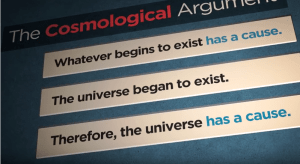
 Here is a very concise version of the Kalam Cosmological Argument:
Things that begin to exist require an external cause. The universe began to exist, so it requires an external cause. As the cause of all physical reality, the first cause cannot itself be part of physical reality, but must be immaterial, non-spatial, eternal, powerful, and personal, which is a basic description of the theistic God.
Here is another way of presenting the gist of the argument without the technical-sounding language:
Nature is a series of physical causes and effects. It’s like falling dominos: One domino falls and causes another domino to fall (the effect), which in turn causes another domino to fall, and so on. We can trace this cause and effect chain all the way back to the first domino: the Big Bang. That event is not a cause, but an effect. Since all effects must have causes, the Big Bang needs a cause as well. It can’t be a prior domino (something physical) because the Big Bang is the origin of physical reality. That means the cause must be something non-physical. It must be eternal, spaceless, powerful, and personal as well, which perfectly describes the God of theism.
Finally, here is an extended version that explains the argument and logical inferences regarding the identity of the cause in more detail:
There are good scientific and philosophical reasons to conclude that physical reality had a beginning. And since things that begin to exist must be caused to exist by something else, physical reality had to be caused by something else.
We can learn a bit about what caused the universe by looking at the effect – making inferences about the nature of the cause based on the nature of the effect. What sort of cause would be required to bring the universe into existence?
Time is part of physical reality, so whatever brought physical reality into existence also brought time into existence. If the cause brought time into existence, it cannot itself be temporal. It must be eternal by definition.
Space and matter are also part of physical reality, so whatever brought physical reality into existence also brought space and matter into existence. If the cause brought space and matter into existence, it itself cannot be spatial or material. It must be spaceless and immaterial.
The cause must be powerful and intelligent as well to explain the origin of massive amounts of energy and the complex organization of physical reality.
Finally, the cause must be a personal agent. There are only two types of possible causes: natural events, personal agents. Either a conscious mind (personal agent) causes a thing, or a mindless, natural process (natural events) causes a thing. The origin of physical reality marks the first temporal event and the beginning of nature. Since you can’t have an event prior to the first event, and there was no “nature” prior to the origin of physical reality, the cause of physical reality could not have been a natural event. It must have been a personal agent.
A personal, intelligent, powerful, eternal, spaceless, and immaterial cause is a perfect description of God, and thus we conclude that God is the eternal something that exists.


December 20, 2024 at 4:06 pm
Jason,
This is a solid introductory apologetic for theism. However, the main drawback is that it doesn’t get you immediately to monotheism. One could posit that a joint effort of multiple personal, intelligent, powerful, eternal, non-spatial, and immaterial agents were the first cause.
Indeed, angels, who are personal, intelligent, powerful, eternal, non-spatial, and immaterial beings may also fit under this definition and qualify as first cause. Either the Kalam would need further modification to remove this metaphysical possibility, or the argument should be eschewed altogether.
LikeLike
December 31, 2024 at 2:01 pm
Andrew, I address this in my series on arguments for God’s existence, and somewhere on this blog, I addressed this with Scalia as well, so I’ll just respond briefly here. First, I don’t hold to the idea that an argument has to be a homerun to be a good argument.
Second, I’m assuming you’ll point to Thomas’ Five Ways as being able to get us to monotheism. Let’s assume they do. Why can’t they be equally faulted for not getting one to Christian theism? After all, Christianity isn’t the only monotheistic religion. The fact of the matter is that no one argument will take you all the way from atheism to Christianity. There is no homerun argument, so faulting any argument because it doesn’t get you to some desired X is fruitless in my opinion.
Third, I have provided a few reasons for thinking the cause of the universe is a single agent rather than multiple. Those arguments are simply conjoined with the Kalam.
LikeLike
January 1, 2025 at 12:24 pm
Jason, you write:
I think you’re missing the point. As you note, there isn’t an argument anywhere that will lead to Christianity. The knowledge of the gospel comes via the special (as opposed to natural) revelation of the Scriptures. Without God’s purposeful revelation, we wouldn’t know about Christ. The point of philosophical arguments is that man can at the very least know that God exists via the record God has left of Himself in the cosmos.
When evaluating theistic arguments, we naturally grade their effectiveness in persuading others of God’s reality. In this regard, the KCA falls short because, as Craig himself admits, the best it can do is show that matter has an immaterial cause (or causes). The KCA then has to rely on an effects-to-cause argument (which is the essence of the Five Ways), but even then it doesn’t prove monotheism. So, it one must implement effects-to-cause anyway, then simply begin with it and add the refinements that Aquinas did. And in that regard, the Five Ways show that it is impossible, even in principle, that there could be more than one God, and that this one God must have all the attributes traditionally associated with Him.
Bottom line: If we’re forced to argue effects-to-cause, let’s use the better argument.
LikeLike
February 9, 2025 at 10:02 am
I argue against the first premise
Since the start of the universe have we ever witnessed anything begin to exist? Like a thing coming out of nothing ? A sandwich beginning to exist? No there has never been new matter added into the universe ever its impossible or at least we never witnessed it everything in the universe is particles assembled to make new thing or disassembled to make other things. How can we conclude that the first premise is true if the only thing to ever begin to exist is the universe which also we cant be sure that the big bang is its beginning maybe it always existed but the big bang is the earliest we can trace the universe back to.
LikeLike
February 10, 2025 at 6:10 pm
Ahmed, you misunderstand the first premise. I address this in my paper. Premise 1 should not be understood in the narrow sense of something coming into being from absolutely nothing (creation ex nihilo), or in the narrow sense of transforming matter from one form to another. It refers to any and all kinds of efficient causation. It refers to any x that exists as x at time t2, but did not exist as x at time t1. “Begins to exist” is a temporal concept that is wholly indifferent to the material source of the entity in question. Something which begins to exist includes any entity that is temporally finite, regardless of that entity’s material source (or to couch this in Aristotelian language, the “material cause”) or lack thereof. So long as the entity in question is not eternal, then it “begin to exist.”
You recognize that efficient causes are necessary to transform existing matter into different forms, so why would you think that an efficient cause is not needed when there is no material form? As I wrote in my paper: “Does the fact that we have only experienced existing matter being transformed into other forms of matter mean our understanding of cause and effect may not apply to things coming into being ex nihilo? No. It’s like claiming that a cause is required to transform a pile of metal into a car, but no cause is required to bring a car into existence from nothing. This is obviously false. If we cannot obviate the need for a causal entity to bring about a new form of matter by re-arranging existing matter, then how much more can we not obviate the need for a causal entity to bring a new material entity into existence from no existing materials! If the principle of causation applies to the less difficult, then this is good reason to think it applies to the more difficult (creation out of nothing) as well. … If things that come into existence within the universe must have both a material and efficient cause (meaning they are created from something and by something), why think the universe itself requires neither? Obviously there can’t be a material cause to the universe since matter came into being concomitant with the universe. It’s hard enough to conceive of how matter could come into being without a material cause (source), but it is beyond ludicrous to think matter could come into being without an efficient cause. WLC [William Lane Craig] says this is worse than believing in magic, because at least when a magician pulls a rabbit from his hat, he starts with a hat. Those who think it’s possible for the universe to pop into existence uncaused from nothing lack both the hat (the material cause) and the magician (efficient cause)! Whence, then, comes the universe?”
As for whether or not the Big Bang is the origin of material reality, I address this in my paper as well. While there is good reason to think the Big Bang is the origin of all physical reality, even if we discover that it’s not, a number of philosophical arguments as well as the Borde-Guth-Vilenkin theorem demonstrate that there must be some beginning to physical reality.
LikeLiked by 1 person
February 14, 2025 at 4:05 am
“If the principle of causation applies to the less difficult, then this is good reason to think it applies to the more difficult (creation out of nothing) as well. … If things that come into existence within the universe must have both a material and efficient cause (meaning they are created from something and by something), why think the universe itself requires neither? Obviously there can’t be a material cause to the universe since matter came into being concomitant with the universe. It’s hard enough to conceive of how matter could come into being without a material cause (source), but it is beyond ludicrous to think matter could come into being without an efficient cause.”
When scientists refer to “a universe from nothing,” they’re not talking about the “absolute nothingness” theists are referring to. That would be impossible according to the first law of thermodynamics, which states that energy/matter cannot be created nor destroyed, only transformed from one to the other. The evidence indicates that our universe formed from an extremely hot, dense energy state, much of which then transformed naturally and automatically into matter as the universe expanded and cooled.
So it’s not ludicrous to think matter could come into being without a purely natural cause. If energy is simply a brute fact of existence…that’s all we need to account for our universe and everything in it. Unlike the theistic creator claim of a god creating that energy out of “absolute nothingness,” there’s no violation of the first law of thermodynamics.
There’s also no need to multiply unnecessary entities (adding on unnecessary assumptions), which would be a violation of Occam’s Razor.
There’s also no need to posit some intelligent creator, which would contradict ALL the evidence we have indicating that minds are an emergent property of brains, which exist only within the context of material spacetime (even the very act of thinking requires a change in a mind over time).
And there’s no need to resort to fallacies like special pleading to say a creator god must be a brute fact of existence, while dismissing the more parsimonious option of energy being the “first cause.”
Finally, there’s no need to postulate that there ever was “absolute nothingness,” something we’ve never had any evidence for, and something that may not even be a state that is possible to “exist.”
Thus, the existence of the universe provides no rational justification for claiming a creator god is necessary to explain the universe.
LikeLiked by 1 person
February 15, 2025 at 12:07 pm
Jason, let’s also discuss the claim that, ‘the universe must have a cause,’ because it began with the Big Bang. While this argument may seem intuitively plausible, a little scrutiny suggests major hurdles to its salience. If everything needs a cause, why assume the universe is bound by the same rulebook?
The idea that ‘anything that comes into being must have some cause’ functions on an empirical scale where time and the laws of physics predate existence, like the building of a car or tree planting. If the Big Bang is the beginning of time itself, though, then the words and ideas ‘before’ or ‘causation’ get philosophically tricky. Causality requires temporal donorship; in the absence of a temporal scope, the concept of a ’cause’ at universe source breaks down. How can we talk about a ’cause’ when time itself hadn’t started yet? This is like asking if someone would be south of the North Pole, an ontologically vacuous question.
Capping off the strangeness of this probabilistic acting-in-the-weird is quantum mechanics itself, where subatomic particles simply erupt from vacuum-fluctuations for no reason at all. If particles can pop into existence uncaused, why not the universe? If some of these phenomena are observed at microscopic scales, can macroscopic frameworks of causation be extended to the universe’s origin? Does quantum weirdness get a free pass, but the universe doesn’t?
Most physicists are at least somewhat familiar with the Borde-Guth-Vilenkin theorem, which often appears to be used in support of some cosmic beginning but whose implications are often overstated. The theorem demonstrates the failure of classical physics when extrapolated to the past boundary, but does not constitute a clear ‘beginning’ of spacetime. Does physics breaking down mean there was ‘nothing,’ or just that our tools are inadequate? Competing cosmological models—like quantum bounce theories or eternal inflation—offer the idea that the Big Bang marks a phase transition and not an ultimate beginning. As for the idea that the universe must have had some sort of external cause, this becomes less and less defensible if you hold the view that the universe existed at every time—just not in a way we can wrap our heads around.
Simply special pleading is one of the biggest failures of the argument for the ‘uncaused cause.’ If the universe needs a cause, but a particular god or divine force doesn’t, that’s an arbitrary exception to the causal principle it claims to defend. Why does the universe need a cause, but its proposed creator doesn’t? Isn’t that stacking the deck? What this implies is that the claim that there are infinitely many causes, or the claim that the universe is a brute fact of sorts requiring no causes, must be considered as philosophically dubious. Although non-intuitive, this later outlook aligns with recent theoretical physics pursuits of self-sustaining cosmological scenarios.
Last, metaphors that liken the universe to human-made objects (think of cars, etc.) are bound to fail in a causal theory of everything since the causal relations between objects in the universe are in any case not transferrable in the ontology beyond the universe. Can the rules of a game explain how the game was invented? The universe is not inside of the pre-fabricated that is a frame, it is the frame. This distinction makes normal causal reasoning inadequate to explain its origin.
That is all well and good, but ultimately this is where extrapolating from things we can see and measure to the dimensionless realm goes awry. Cosmic origins is one of the last genuinely deep open questions of physics and metaphysics, one that should inspire modesty in the face of scant evidence and the provisional nature of many of the paradigms. Shouldn’t a mystery this profound make us hesitant to force-fit answers?
LikeLike
February 15, 2025 at 12:12 pm
Please don’t conclude from my response that I don’t believe in god . it’s just that I think the kalam cosmological argument is not that good in proving the existence of god I believe the Argument from Contingency does the best job at it
LikeLike
February 18, 2025 at 2:09 pm
Hello, Ahmed! Nice to meet you. You write:
Causality necessitates logical priority; it does not entail a relation to time. Thus, when theists speak of causes “prior” to the universe, time descriptors point to a logical scale, not a temporal one.
This appears to be question-begging. The fact that a cause is unobserved does not entail the conclusion that a phenomenon is uncaused. Science is incapable, even in principle, of determining what does not exist on the basis of what it fails to observe. Moreover, physics gives us a description of the mathematical and abstract structure of matter. So, just because something doesn’t appear in the description doesn’t mean it isn’t there. And, finally, the causal principle simply asserts that an effect arises from an actual state of affairs, which accounts for particle formation, even if it is currently unknown precisely how that is done.
I’m not quite certain what you mean by existing “at every time,” but given what you said just before that, you are perhaps asserting that an external cause is implausible if the universe were eternal. But if you’re familiar with the Kalam Cosmological Argument (KCA), then you’re failing to address one of the argument’s most essential components: the impossibility of an actual infinite (or to traverse an actual infinite). Now, I hasten to add that I think the KCA fails to demonstrate God’s existence, because even granting all its premises doesn’t prove that the universe’s cause is God. Nonetheless, I find it surprising that you appear to think that the possible eternality of the universe counts against the KCA. It seems that an effective counter obligates a critic to address a proponent’s arguments about infinity.
This leads me to wonder how familiar you are with the KCA. This isn’t special pleading in the slightest. If time is concomitant with the universe, and if the universe is caused, then by definition its cause is atemporal, which means it exists “outside” of time and is not influenced by temporal constraints. In other words, it has no beginning or ending; it is eternal. The conclusion is thus far from arbitrary.
This again overlooks KCA arguments against infinite causality. Moreover, “brute fact” falls under the same umbrella as the derided “God-did-it” arguments. In the absence of rational demonstration, resorting to “God did it,” is correctly seen as an irrational maneuver. But some of those critics see no inconsistency whatsoever when they appeal to brute facts. The so-called lovers of science and reason suspend rational inquiry by pronouncing something beyond the need for further explanation. For me, it is far preferable for a skeptic to say that he simply doesn’t know what the ground is (or if there is any ground) for a particular fact than to bring the curtain down on further explanation.
But this appears to presuppose the unargued position that the effect must be entirely dissimilar to its cause. We (theists) argue that the causal principle is a metaphysical one. Anything coming to be is logically dependent on an actual state of affairs. If nothing grounds the coming-to-be of being, then being can arise from absolutely nothing, which is logically incoherent (absolute nothing would have to have the potential to produce something, in which case it isn’t absolutely nothing).
LikeLiked by 1 person