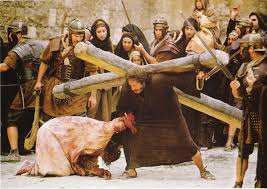
 Here’s how a parenthetical statement can provide interesting insights about the provenance of a Biblical book. Mk 15:21 says, “And they compelled a passerby, Simon of Cyrene, who was coming in from the country, the father of Alexander and Rufus, to carry his cross.”
Identifying Simon as the father of Alexander and Rufus only makes sense if Mark’s audience personally knew Alexander and Rufus. Mark added “the father of Alexander and Rufus” to help his audience identify the particular Simon who helped Jesus carry His cross.
The statement implies four things: (1) Mark’s readers personally knew Alexander and Rufus, but not their father Simon, which further implies that (2) Alexander and Rufus were followers of Jesus in the local Christian community; (3) Mark wrote his gospel for a specific rather than general audience – an audience that had a personal knowledge of Alexander and Rufus; (4) Mark wrote his gospel early enough for Simon’s sons to still be alive at the time of his writing.
Unfortunately, we don’t know how old Simon was when he carried Jesus’ cross, and we don’t know if Alexander and Rufus were born before or after that event. We don’t know if Mark’s readers were not acquainted with Simon because Simon had already died, or if it was because Simon lived elsewhere. As such, this parenthetical statement cannot tell us much about when the book was written, other than that it must have been written sometime in the first century, within a generation or two of the events in question.
It’s even possible that Mark received the testimony about Simon of Cyrene carrying Jesus’ cross from his sons, Alexander and Rufus. Perhaps Mark wrote the brothers into his book as a way of referencing his sources.
 Thinking to Believe
September 18, 2025 at 4:02 pm
Romans 16:13 (KJV)Salute Rufus chosen in the Lord, and his mother and mine.
LikeLike
September 26, 2025 at 3:42 pm
Jason’s reflection on Mark 15:21 is thoughtful and well-composed, and it rightly draws attention to the curious inclusion of Alexander and Rufus in the narrative. His suggestion that this parenthetical detail may indicate audience familiarity with the sons of Simon of Cyrene is a reasonable and widely accepted possibility. He doesn’t present this as a certainty, and to his credit, he acknowledges the speculative nature of the inference. His tone throughout is exploratory, not dogmatic, and he is careful to note the limitations of what can be known from the text.
Still, there are a few areas where the post could benefit from greater precision. For instance, while it’s plausible that Mark’s audience knew Alexander and Rufus personally, it’s also possible that these names were simply well-known in early Christian circles, or that Mark included them to connect his narrative to oral tradition. Jason’s interpretation leans toward personal acquaintance, which is one valid reading, but it might be helpful to acknowledge that communal recognition or source attribution could also explain the inclusion.
The attempt to draw conclusions about the dating of Mark’s Gospel based on the presumed familiarity with Simon’s sons is cautious, but perhaps too ambitious. Jason does not claim to pinpoint a date, and he rightly notes that we don’t know the ages of Simon or his sons, nor whether they were born before or after the crucifixion. However, the suggestion that the Gospel must have been written “early enough for Simon’s sons to still be alive” doesn’t significantly narrow the timeframe. People lived into their 60s or 70s, and if the sons were young during Jesus’ crucifixion, they could easily have been alive decades later. So, while the reference supports a first-century composition, it doesn’t offer much precision beyond that.
Toward the end, Jason speculates that Mark may have received the story of Simon from Alexander and Rufus themselves. This is an interesting idea and certainly worth considering, but it remains speculative. There’s no textual or historical evidence to support it, and while it’s framed as a possibility, it might benefit from a clearer acknowledgment of its hypothetical nature.
LikeLike