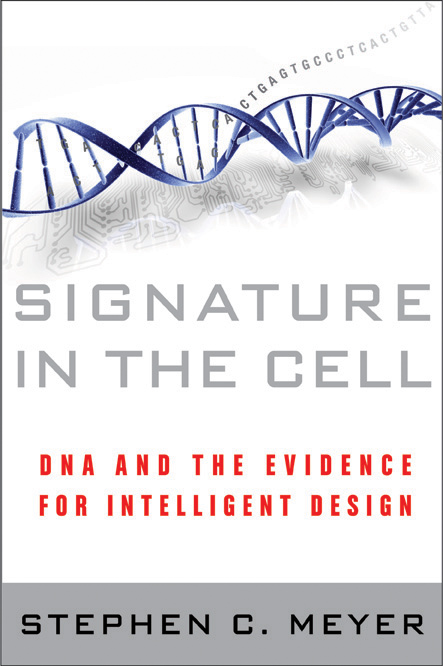
 It’s been a month, but I haven’t forgotten! For new readers, this is part 6 in my series of posts summarizing Stephen Meyer’s argument for design from his new book, Signature in the Cell. Past posts can be found here: Parts 1, 2, 3, 4, and 5.
In the last two installments we demonstrated that the OOL cannot be explained by either chance or necessity. Now we’ll turn our attention to the possibility that the OOL can be explained by a combination of both chance and necessity. While many models could be examined—and were examined by Meyer—I will only examine the RNA-first, a.k.a. the RNA World hypothesis, since this is the prevailing OOL model today.
The cell presents OOL researchers with a chicken-and-the-egg paradox of which came first: the DNA that makes proteins, or the proteins necessary for replicating DNA? The paradox was insoluble, so another solution was required. If neither DNA nor proteins could arise first, what did?
Carl Woese, Francis Crick, and Leslie Orgel proposed an RNA-first model in the late 1960s, followed by Walter Gilbert (Harvard biophysicists) who developed it in the 1980s and gave it its common name.[1] This model proposes that the first cell consisted of a much simpler self-replicating, self-catalyzing RNA (RNA is similar to DNA, but it is a single strand rather than a double helix, and the nucleotide, thymine, is replaced by uracil).[2] This model was largely fueled by the discovery of Thomas Cech and Sidney Altman in the early 1980s that sometimes RNA can catalyze chemical reactions like an enzyme does, and thus RNA could serve the dual purpose of information storage (like DNA) and enzymatic functions (like proteins). “The paradox of the chicken and the egg was thus resolved by the hypothesis that the chicken was the egg.”[3]

 Thinking to Believe