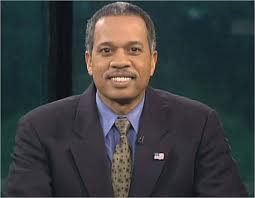
 National Public Radio has terminated the contract of longtime news analyst Juan Williams because he said the following on Bill O’Reilly’s show: “Look, Bill, I’m not a bigot. You know the kind of books I’ve written about the civil rights movement in this country. But when I get on the plane, I got to tell you, if I see people who are in Muslim garb and I think, you know, they are identifying themselves first and foremost as Muslims, I get worried. I get nervous.”
I can’t believe he would get fired over this comment. He was simply expressing what virtually every American thinks and feels in such a circumstance. We know not every Muslim or Arab is an extremist or terrorist, but we can’t forget that it was Muslims, not Buddhists or Hindus, that attacked us on 9/11 and want to carry out more attacks.
It’s a sad day in American when you can’t express what should be obvious to all without losing your job. I can guarantee you that if he had said something similar about Christians his contract would not have been in danger. Political correctness has caused us to lose our minds.
 If you ask the typical atheist why s/he does not believe in God, you are likely to be provided with a list of intellectual objections to theism: the presence of evil is incompatible with a loving and powerful God, science demonstrates the irrelevancy of God, etc. Others will cite a lack of evidence for God’s existence. In either case, atheism is presented as, and perceived to be a purely intellectual conclusion.
James Spiegel begs to differ with this assessment and perception of atheism. In his book, The Making of an Atheist: How Immorality Leads to Unbelief, Spiegel argues that the root cause of atheism is immorality, not intellectual skepticism; disobedience, not evidence. While atheists offer intellectual arguments in support of their position, Spiegel claims that such arguments are not the cause of their unbelief, but mere symptoms of their moral rebellion—the real cause of atheism. As Soren Kierkegaard wrote, “People try to persuade us that the objections against Christianity spring from doubt. The objections against Christianity spring from insubordination, the dislike of obedience, rebellion against all authority. As a result people have hitherto been beating the air in the struggle against objections, because they have fought intellectually with doubt instead of fighting morally with rebellion.”[1]
Spiegel does not expect for atheists to agree with his assessment, but he is not attempting to persuade atheists; he is simply attempting develop a Christian account of atheism. The Biblical data is his starting point, but he offers other supporting data as well. In support of Spiegel’s contention that unbelief is caused by disobedience and moral rebellion, consider the following Scriptures:
(more…)
 National Public Radio has terminated the contract of longtime news analyst Juan Williams because he said the following on Bill O’Reilly’s show: “Look, Bill, I’m not a bigot. You know the kind of books I’ve written about the civil rights movement in this country. But when I get on the plane, I got to tell you, if I see people who are in Muslim garb and I think, you know, they are identifying themselves first and foremost as Muslims, I get worried. I get nervous.”

 Thinking to Believe