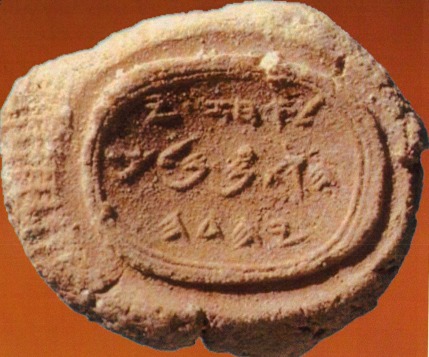
 In the mid-1990s a very important bulla showed up on the antiquities market. A bulla is a flattened lump of hardened clay bearing the impression of a seal. They were used to seal papyrus documents. The papyrus would be folded and tied with a string. A soft lump of clay would then be placed on the string and impressed with a signet ring or pendant bearing the seal of the sender. The clay would harden, thus securing the contents of the document.
August 2011
Monthly Archive
August 12, 2011
August 11, 2011
Biblical Archaeology 14: Tiglath-Pileser III Inscriptions
Posted by Jason Dulle under Archaeology[6] Comments
 2 Kings 16:7 So Ahaz sent messengers to Tiglath-pileser king of Assyria, saying, “I am your servant and your son. Come up and rescue me from the hand of the king of Syria and from the hand of the king of Israel [Pekah], who are attacking me.” (ESV) See also Isaiah 7.
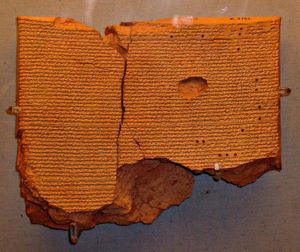 Tiglath-Pileser III was a prominent Assyrian king (745–727 BC). Austen Henry Layard discovered his palace in 1873-4. Also discovered were multiple inscriptions that were summary statements of TPIII’s accomplishments.
Summary statement number seven dates to 729 BC and reads: “In all the countries which… [I received] the tribute of… Jehoahaz (this is Ahaz with a theophoric prefix attached) of Judah…(consisting of) gold, silver, tin, iron, antimony, linen garments with multicolored trimmings….”
Given the historical context provides in Scripture, it is likely that Ahaz paid this tribute to TPIII to secure his alliance against the kings of Israel and Syria who were fighting against him. Once again, this confirms the Biblical record.
August 10, 2011
 Sometime around 1979 an ivory pomegranate no bigger than a human thumb and dated to the 8th century BC showed up on the antiquities market. Around the top it contains an inscription which reads, “[Belonging] to the House of [Yahwe]h, consecrated to the priests.” Some scholars think this pomegranate adorned the head of a priestly scepter from Solomon’s temple.
While the authenticity of the pomegranate itself is not in dispute, the inscription is. Professor Yitzhak Roman of the Hebrew University examined the inscription with an electron microscope and is convinced it is authentic, not a modern forgery.[1]
The debate will linger on, but if the inscription is proven to be authentic, it is a truly significant find.
August 9, 2011
Biblical Archaeology 12: Deir ‘Alla Inscription (Balaam Inscription)
Posted by Jason Dulle under Archaeology1 Comment
 Numbers 22-24 tells the story of the prophet Balaam, son of Beor. The children of Israel had finally entered the Promised Land and were conquering the inhabitants of the land one after another. The Moabites, fearing they would be next, hired Balaam to curse the children of Israel. While he tried his best, God prevented him from doing so. Instead, he blessed them.
There was no extra-biblical record of a prophet by this name, but in 1967 Dutch archaeologists excavating in Deir ‘Alla, Jordan, uncovered one. They found 119 fragments of plaster with ink writing carbon-dated to ~800 BC (the time of Ahab). The language is a mix between Aramaic and Canaanite. The presence of archaic words indicates it is based on an older text.
When put together, the fragments tell the story of a prophet, Balaam son of Beor, had a vision in which the people would be chastised by a fiery judgment:
August 5, 2011
 2 Kings 12:4-5 Jehoash said to the priests, “All the money of the holy things that is brought into the house of the Lord, the money for which each man is assessed—the money from the assessment of persons—and the money that a man’s heart prompts him to bring into the house of the Lord, 5 let the priests take, each from his donor, and let them repair the house wherever any need of repairs is discovered.”
A sandstone tablet containing 16 inscribed lines commemorating the renovation of Solomon’s temple by Jehoash (9th century BC) surfaced in 2001. The tablet measures 12” x 24” x 3”. The Hebrew text in which it is written reads:
August 4, 2011
Biblical Archaeology 10: House of Yahweh Ostracon
Posted by Jason Dulle under ArchaeologyLeave a Comment
 An ostracon dated to the early 6th century BC was discovered in Arad (an ancient city of Judah). It reads, “To my lord Eliashib: May YHWH inquire after your well-being. And now, give to Shemaryahu a measure (of flour), and to the Kerosite you will give a measure (of flour). And concerning the matter about which you commanded me, it is well. He is staying in the house of YHWH.”
The author of this ostracon is unknown—as is the precise circumstances surrounding the writing—but the recipient is Eliashib. Nothing is known about this individual. The ostracon makes it clear, however, that the author is responding to a prior correspondence from Eliashib. The author speaks of a mutual acquaintance as staying in the house of YHWH, which is likely a reference to Solomon’s temple in Jerusalem.
Significance:
- This is the 2nd oldest mention of Solomon’s temple discovered (the “3 shekel” ostracon is the oldest).
- This was written within a few years/decades before Solomon’s Temple was destroyed by the Babylonians in 586 BC.
The ostracon is currently housed in The Israel Museum.
August 4, 2011
Biblical Archaeology 9: Seal of Shema, Servant of Jeroboam
Posted by Jason Dulle under Archaeology[4] Comments
 2 Kings 14:16,23 And Jehoash slept with his fathers and was buried in Samaria with the kings of Israel, and Jeroboam his son reigned in his place. 23 In the fifteenth year of Amaziah the son of Joash, king of Judah, Jeroboam the son of Joash, king of Israel, began to reign in Samaria, and he reigned forty-one years. (ESV)
During an expedition in Meggido in 1903-4, archeologists discovered an ancient seal that reads, “Shema, servant of Jeroboam.” Given the location and dating of the find, this seal probably belonged to an official in the court of King Jeroboam II of Israel (782-745 BC). If so, this seal was used by a minister in Jeroboam’s court to conduct official business!
Significance:
- This confirms the existence of King Jeroboam II.
August 2, 2011
 Last Wednesday my son, Silas Augustus Liam Dulle was born into this world weighing 8 lbs 4.5 oz, and stretching out to 21″ long. Give him a few years, and he’ll be blogging on this site alongside his daddy!
August 2, 2011
Biblical Archaeology 8: The Black Obelisk of Shalmaneser
Posted by Jason Dulle under Archaeology1 Comment
 1 Kings 19:15-16 The Lord said to him, “Go back the way you came and then head for the Desert of Damascus. Go and anoint Hazael king over Syria. 19:16 You must anoint Jehu son of Nimshi king over Israel, and Elisha son of Shaphat from Abel Meholah to take your place as prophet.
2 Kings 10:36 Jehu reigned over Israel for twenty-eight years in Samaria.
In 1846 archaeologists discovered a black basalt, four-sided obelisk measuring 6’5” in Kalhu, Iraq (modern Nimrud). This was the site of the ancient Assyrian capital. The obelisk was erected as a public monument in 825 BC, glorifying Shalmaneser III’s (858-824 BC) military exploits over a period of 31 years. It contains a mixture of reliefs and inscriptions recording the conquests of Assyrian King Shalmaneser III. There are a total of 20 reliefs: five per side. Five different kings are pictured paying tribute to Shalmaneser: (1) Sua of Gilzanu; (2) ruler of Musri; (3) Marduk-apil-usur of Suhi; (4) Qalparunda of Patin. The fifth king is none other than King Jehu of Israel, who payed tribute to Shalmaneser in ~841 BC, approximately 10 years before Jehu’s reign ended. The inscription connected to the relief of Jehu reads, “The tribute of Jehu, son of Omri: I received from him silver, gold, a golden bowl, a golden vase with pointed bottom, golden tumblers, golden buckets, tin, a staff for a king [and] spears.” 

 Thinking to Believe