2011
Yearly Archive
August 16, 2011
Posted by Jason Dulle under
Archaeology
Leave a Comment
This slideshow requires JavaScript.
2 Kings 18:13-17a In the fourteenth year of King Hezekiah’s reign, King Sennacherib of Assyria marched up against all the fortified cities of Judah and captured them. 18:14 King Hezekiah of Judah sent this message to the king of Assyria, who was at Lachish, “I have violated our treaty. If you leave, I will do whatever you demand.” So the king of Assyria demanded that King Hezekiah of Judah pay three hundred talents of silver and thirty talents of gold. 15 Hezekiah gave him all the silver in the Lord’s temple and in the treasuries of the royal palace. 16 At that time King Hezekiah of Judah stripped the metal overlays from the doors of the Lord’s temple and from the posts which he had plated and gave them to the king of Assyria. 17 The king of Assyria sent his commanding general, the chief eunuch [Tartan], and the chief adviser from Lachish to King Hezekiah in Jerusalem, along with a large army.
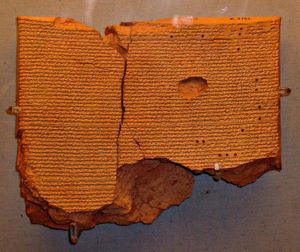
Sargon II was followed by his son Sennacherib who ruled from 705-681 BC. Early in his reign he began to attack and defeat the fortified cities of Judah. One of those cities was Lachish, which he defeated in 701 BC[1], and was still present in the city when Hezekiah engaged in correspondence with him in a desperate plea to spare the overthrow of Jerusalem.
(more…)
August 15, 2011
Posted by Jason Dulle under
Archaeology
[6] Comments
 Isaiah 20:1-2 In the year that the commander in chief [Tartan], who was sent by Sargon the king of Assyria, came to Ashdod and fought against it and captured it—2 at that time the Lord spoke by Isaiah the son of Amoz, saying, “Go, and loose the sackcloth from your waist and take off your sandals from your feet,” and he did so, walking naked and barefoot.
Ashdod was a Philistine city. They rebelled in 713 BC, and were defeated by 711 BC by the commanding officer [Tartan] of Sargon II’s army. The only problem was this story was that there was no extra-biblical evidence of Sargon’s existence. Scholars once believed that either Isaiah was mistaken, or that Sargon was an alternate name for another Assyrian king. The mystery was resolved in 1842 when Sargon II’s palace was discovered. Sargon II was a genuine historical figure. He reigned from 722-705 BC. The reason scholars did not find any trace of him in the Assyrian records at Ninevah is because his palace was not located in Ninevah, but in Dur Sharrukin (modern Khorsabad,Iraq). Sargon had moved the capital there.
(more…)
August 12, 2011
Posted by Jason Dulle under
Quote of the Day
[9] Comments
“We theists must admit that we, like everyone else, are certainty seekers and that we, like everyone else, are willing to accept less than compelling evidence for our favored conclusions and to ignore evidence unfavorable to our beliefs.” — Kelly James Clark, Five Views on Apologetics, pp. 88-9.
“Tact is the knack of making a point without making an enemy.”—Isaac Newton
August 12, 2011
Posted by Jason Dulle under
Archaeology
[4] Comments
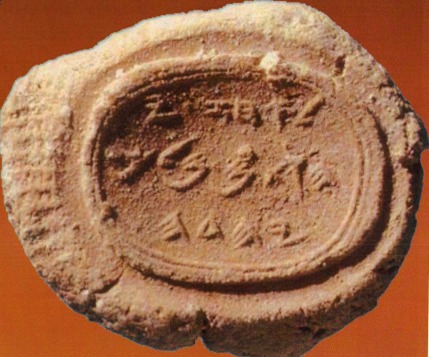 In the mid-1990s a very important bulla showed up on the antiquities market. A bulla is a flattened lump of hardened clay bearing the impression of a seal. They were used to seal papyrus documents. The papyrus would be folded and tied with a string. A soft lump of clay would then be placed on the string and impressed with a signet ring or pendant bearing the seal of the sender. The clay would harden, thus securing the contents of the document.
(more…)
August 11, 2011
Posted by Jason Dulle under
Archaeology
[6] Comments
 2 Kings 16:7 So Ahaz sent messengers to Tiglath-pileser king of Assyria, saying, “I am your servant and your son. Come up and rescue me from the hand of the king of Syria and from the hand of the king of Israel [Pekah], who are attacking me.” (ESV) See also Isaiah 7.
 Tiglath-Pileser III was a prominent Assyrian king (745–727 BC). Austen Henry Layard discovered his palace in 1873-4. Also discovered were multiple inscriptions that were summary statements of TPIII’s accomplishments.
Summary statement number seven dates to 729 BC and reads: “In all the countries which… [I received] the tribute of… Jehoahaz (this is Ahaz with a theophoric prefix attached) of Judah…(consisting of) gold, silver, tin, iron, antimony, linen garments with multicolored trimmings….”
Given the historical context provides in Scripture, it is likely that Ahaz paid this tribute to TPIII to secure his alliance against the kings of Israel and Syria who were fighting against him. Once again, this confirms the Biblical record.
(more…)
August 10, 2011
Posted by Jason Dulle under
Archaeology
1 Comment
 Sometime around 1979 an ivory pomegranate no bigger than a human thumb and dated to the 8th century BC showed up on the antiquities market. Around the top it contains an inscription which reads, “[Belonging] to the House of [Yahwe]h, consecrated to the priests.” Some scholars think this pomegranate adorned the head of a priestly scepter from Solomon’s temple.
While the authenticity of the pomegranate itself is not in dispute, the inscription is. Professor Yitzhak Roman of the Hebrew University examined the inscription with an electron microscope and is convinced it is authentic, not a modern forgery.[1]
The debate will linger on, but if the inscription is proven to be authentic, it is a truly significant find.
(more…)
August 9, 2011
Posted by Jason Dulle under
Archaeology
1 Comment
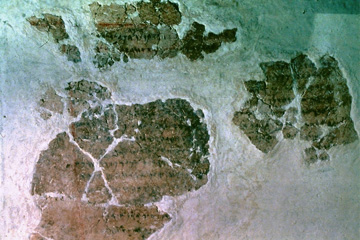 Numbers 22-24 tells the story of the prophet Balaam, son of Beor. The children of Israel had finally entered the Promised Land and were conquering the inhabitants of the land one after another. The Moabites, fearing they would be next, hired Balaam to curse the children of Israel. While he tried his best, God prevented him from doing so. Instead, he blessed them.
There was no extra-biblical record of a prophet by this name, but in 1967 Dutch archaeologists excavating in Deir ‘Alla, Jordan, uncovered one. They found 119 fragments of plaster with ink writing carbon-dated to ~800 BC (the time of Ahab). The language is a mix between Aramaic and Canaanite. The presence of archaic words indicates it is based on an older text.
When put together, the fragments tell the story of a prophet, Balaam son of Beor, had a vision in which the people would be chastised by a fiery judgment:
(more…)
August 5, 2011
Posted by Jason Dulle under
Archaeology
Leave a Comment
 2 Kings 12:4-5 Jehoash said to the priests, “All the money of the holy things that is brought into the house of the Lord, the money for which each man is assessed—the money from the assessment of persons—and the money that a man’s heart prompts him to bring into the house of the Lord, 5 let the priests take, each from his donor, and let them repair the house wherever any need of repairs is discovered.”
A sandstone tablet containing 16 inscribed lines commemorating the renovation of Solomon’s temple by Jehoash (9th century BC) surfaced in 2001. The tablet measures 12” x 24” x 3”. The Hebrew text in which it is written reads:
(more…)
August 4, 2011
Posted by Jason Dulle under
Archaeology
Leave a Comment
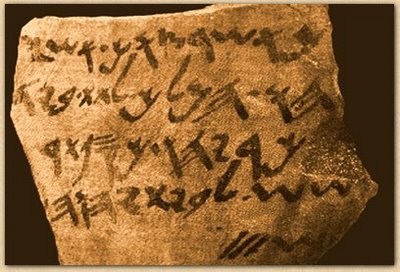
 An ostracon dated to the early 6th century BC was discovered in Arad (an ancient city of Judah). It reads, “To my lord Eliashib: May YHWH inquire after your well-being. And now, give to Shemaryahu a measure (of flour), and to the Kerosite you will give a measure (of flour). And concerning the matter about which you commanded me, it is well. He is staying in the house of YHWH.”
The author of this ostracon is unknown—as is the precise circumstances surrounding the writing—but the recipient is Eliashib. Nothing is known about this individual. The ostracon makes it clear, however, that the author is responding to a prior correspondence from Eliashib. The author speaks of a mutual acquaintance as staying in the house of YHWH, which is likely a reference to Solomon’s temple in Jerusalem.
Significance:
- This is the 2nd oldest mention of Solomon’s temple discovered (the “3 shekel” ostracon is the oldest).
- This was written within a few years/decades before Solomon’s Temple was destroyed by the Babylonians in 586 BC.
The ostracon is currently housed in The Israel Museum.
August 4, 2011
Posted by Jason Dulle under
Archaeology
[4] Comments
 2 Kings 14:16,23 And Jehoash slept with his fathers and was buried in Samaria with the kings of Israel, and Jeroboam his son reigned in his place. 23 In the fifteenth year of Amaziah the son of Joash, king of Judah, Jeroboam the son of Joash, king of Israel, began to reign in Samaria, and he reigned forty-one years. (ESV)
During an expedition in Meggido in 1903-4, archeologists discovered an ancient seal that reads, “Shema, servant of Jeroboam.” Given the location and dating of the find, this seal probably belonged to an official in the court of King Jeroboam II of Israel (782-745 BC). If so, this seal was used by a minister in Jeroboam’s court to conduct official business!
Significance:
- This confirms the existence of King Jeroboam II.
August 2, 2011
Posted by Jason Dulle under
Odds & Ends
[9] Comments
 Last Wednesday my son, Silas Augustus Liam Dulle was born into this world weighing 8 lbs 4.5 oz, and stretching out to 21″ long. Give him a few years, and he’ll be blogging on this site alongside his daddy!
August 2, 2011
Posted by Jason Dulle under
Archaeology
1 Comment
 1 Kings 19:15-16 The Lord said to him, “Go back the way you came and then head for the Desert of Damascus. Go and anoint Hazael king over Syria. 19:16 You must anoint Jehu son of Nimshi king over Israel, and Elisha son of Shaphat from Abel Meholah to take your place as prophet.
2 Kings 10:36 Jehu reigned over Israel for twenty-eight years in Samaria.
In 1846 archaeologists discovered a black basalt, four-sided obelisk measuring 6’5” in Kalhu, Iraq (modern Nimrud). This was the site of the ancient Assyrian capital. The obelisk was erected as a public monument in 825 BC, glorifying Shalmaneser III’s (858-824 BC) military exploits over a period of 31 years. It contains a mixture of reliefs and inscriptions recording the conquests of Assyrian King Shalmaneser III. There are a total of 20 reliefs: five per side. Five different kings are pictured paying tribute to Shalmaneser: (1) Sua of Gilzanu; (2) ruler of Musri; (3) Marduk-apil-usur of Suhi; (4) Qalparunda of Patin. The fifth king is none other than King Jehu of Israel, who payed tribute to Shalmaneser in ~841 BC, approximately 10 years before Jehu’s reign ended. The inscription connected to the relief of Jehu reads, “The tribute of Jehu, son of Omri: I received from him silver, gold, a golden bowl, a golden vase with pointed bottom, golden tumblers, golden buckets, tin, a staff for a king [and] spears.” 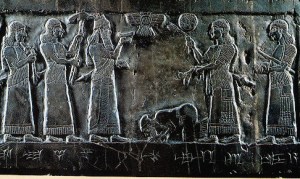
(more…)
July 28, 2011
Posted by Jason Dulle under
Archaeology
[2] Comments
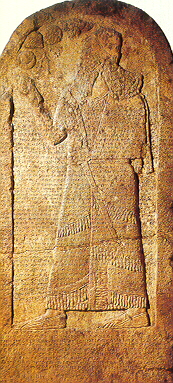 In 1861 archeologists discovered a 7.2’ stele recording the first six years of the reign of Assyrian King Shalmaneser III (859-824 BC).[1] The stele is dated to dated 853 BC, and describes Shalmaneser’s campaigns in western Mesopotamia and Syria. At the end of the stele, however, it gives an account of the Battle of Qarqar.
Twelve kings allied themselves together against Shalmaneser at the Syrian city of Qarqar, one of whom was King Ahab of Israel. The relevant portion of the stele says, “I approached the city of Qarqar. I razed, destroyed and burned the city of Qarqar , his royal city. 1,200 chariots, 1,200 cavalry, and 20,000 troops of Hadad-ezer of Damascus; 700 chariots, 700 cavalry, 10,000 troops of Irhuleni, the Hamathite; 2,000 chariots, and 10,000 troops of Ahab, the Israelite; 500 troops of Byblos; 1,000 troops of Egypt; 10 chariots and 10,000 troops of the land of Irqanatu; 200 troops of Matinu-ba’al of the city of Arvad; 200 troops of the land of Usanatu; 30 chariots and X,000 troops of Adon-ba’al of the land of Shianu, 1,000 camels of Gindibu of Arabia; X hundred troops of Ba’asa, the man of Bit ruhubi, the Ammonite–these twelve kings he took as his allies.”
(more…)
July 26, 2011
Posted by Jason Dulle under
Archaeology
Leave a Comment
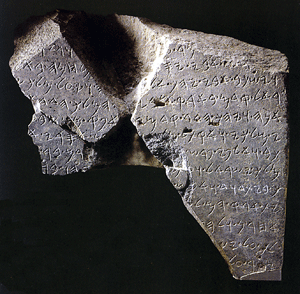 David is celebrated as the greatest, and most famous king of Israel. It was quite interesting, therefore, that archaeologists had never turned up any reference to David outside of Biblical records. The absence of evidence led many to conclude that David was not a historical figure. That changed in July 1993 when archaeologists discovered three stone fragments while excavating the city gate at Dan.[1] The stones contained an Aramaic inscription dating to the mid 9th century BC that mentions “the house of David.” The 13 extant lines of text read:
(more…)
July 25, 2011
Posted by Jason Dulle under
Archaeology
1 Comment
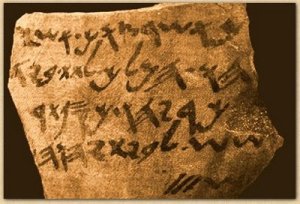 A pottery shard measuring 4” x 3.5” with Hebrew writing on it showed up on the antiquities market. It reads, “As Ashyahu the king[1] commanded you to give into the hand of [Ze]chariah silver of Tarshish for the House of Yahweh: three shekels.”
It appears to be a receipt for a donation of three shekels of silver to the “House of Yahweh,” a reference to a temple. It is dated between 835 and 796 BC, and thus likely refers to Solomon’s temple. If so, this receipt was written approximately 130-160 years after the Temple was built.
Significance:
- This is the oldest mention of Solomon’s temple ever discovered.
[1]The identity of this king is not clear, but it could be Jehoash or Josiah since it is similar in form and both kings had a temple official named Zechariah.
July 21, 2011
Posted by Jason Dulle under
Apologetics,
Evolution
1 Comment
Discovery News & Views has a good post on the problem sex presents for Darwinism. No, not the act of sexual intercourse, but the origin of sexual organisms (male and female). Asexual organisms have the ability to produce offspring at twice the rate as sexual organisms, and they never fail to reproduce on the grounds that they can’t find a mate. Given these clear biological advantages of asexual reproduction, how did sexuality ever evolve? How did it come to dominate in the struggle for survival? Sexuality should have been outcompeted very early on. Even more intriguing is the question of how asexual organisms could gradually evolve into sexual organisms without dying out in the process. A partially formed reproductive system does not result in progeny. Even if we find a way to hurdle the problem of a gradual transition, what is the likelihood that random mutations would create two different, and completely complimentary reproduction systems? And what is the likelihood that this would happen at the same time? Apparently chance is just really lucky.
A couple of new Darwinian explanations have been offered to solve this long-standing Darwinian conundrum. The post explores these explanations and shows how they fall short of explaining what needs to be explained. Check it out.
July 18, 2011
 In 2010 Jerry Fodor, a philosophy professor at Rutgers University, and Massimo Piattelli-Palmarini, a biophysicist, molecular biologist, and cognitive scientist at the University of Arizona, published What Darwin Got Wrong. Fodor and Piattelli-Palmarini (FPP) are, by their own admission, died-in the-wool atheists and committed to a fully naturalistic account of evolutionary development. And yet, they admit that they do not know how evolution proceeds. One thing they are sure of is that Darwin’s account of natural selection cannot be it. Natural selection fails as an explanation on both scientific and philosophical grounds.
(more…)
July 15, 2011
 The Center for the Study of New Testament Manuscripts recently released a video series on NT textual criticism oniTunesUniversity. I’ve delayed blogging about it until after I could watch all the videos. I assumed they would be superb given the presenter: Daniel Wallace. My assumption was correct. Not only is the content tremendous, but the video quality is great as well. If you would like a good, well-rounded introduction to NT textual criticism, do yourself a favor and watch these videos. You won’t be disappointed.
July 15, 2011
Posted by Jason Dulle under
Archaeology
[3] Comments
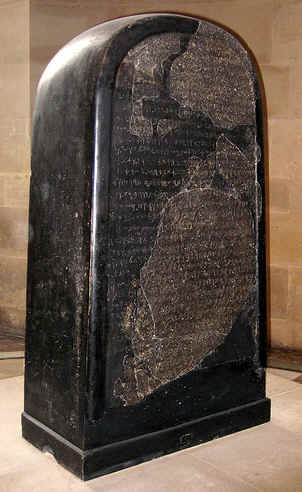 2 Kings 3:4-6,24 Now Mesha king of Moab was a sheep breeder, and he had to deliver to the king of Israel 100,000 lambs and the wool of 100,000 rams. 5 But when Ahab died, the king of Moab rebelled against the king of Israel. 6 So King Jehoram marched out of Samaria at that time and mustered all Israel. [The account goes on to talk about an alliance with Jehoshaphat of Judah and the king of Edom. When they run out of food and water, they consult Elisha who prophesies that the Lord will provide water for them, and defeat Moab.] 24 But when they came to the camp of Israel, the Israelites rose and struck the Moabites, till they fled before them. And they went forward, striking the Moabites as they went. … 26 When the king of Moab saw that the battle was going against him, he took with him 700 swordsmen to break through, opposite the king ofEdom, but they could not. 27 Then he took his oldest son who was to reign in his place and offered him for a burnt offering on the wall. And there came great wrath against Israel. And they withdrew from him and returned to their own land.
In 1868, at Dhiban in Jordan, archaeologists uncovered a black basalt stone measuring 3’8” x 2’3” with an inscription recording the acts of Mesha, King of Moab around 850 BC. It contains 34 lines of text written in Moabite: (more…)
July 14, 2011
Posted by Jason Dulle under
Archaeology
Leave a Comment
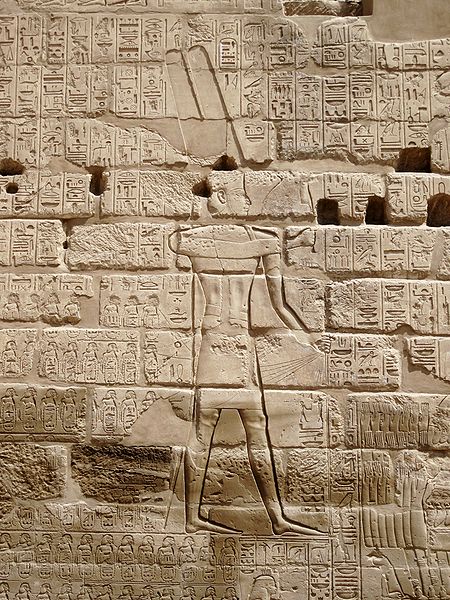
Pharaoh Shishaq's invasions recorded on the Karnak Temple
2 Chron 12:2-4,9 “Because they were unfaithful to the Lord, in King Rehoboam’s fifth year, King Shishak of Egypt attacked Jerusalem. 3 He had 1,200 chariots, 60,000 horsemen, and an innumerable number of soldiers who accompanied him fromEgypt, including Libyans, Sukkites, and Cushites. 4 He captured the fortified cities of Judahand marched against Jerusalem. 9 King Shishak of Egypt attacked Jerusalem and took away the treasures of the Lord’s temple and of the royal palace; he took everything, including the gold shields that Solomon had made.” (NET) See also 1 Kings 14:25-26.
When archaeologists discovered the Karnak Temple of the god Amun in Egypt, on its walls there was a record of Pharaoh Shishak’s (Shoshenq I, 943-922 BC) raid of 140 different places, including cities in Judah and Israel (925 BC). The Judahite section of the wall is mostly ruined, so we can’t see many of the names. The engraving is dated to 924-922 BC.
Significance:
- Confirms the Biblical account of the invasion of Judah (the Bible does not mention Shiskak’s raids in Israel).
- Confirms some of the place names mentioned in the Biblical accounts.
« Previous Page — Next Page »






 Thinking to Believe