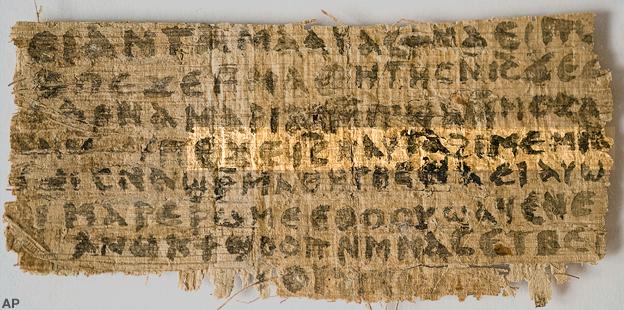
“Jesus said to them, ‘My wife'” highlighted.
I had previously written about the so-called Jesus’ Wife fragment that was brought to the public’s attention in 2012 by Karen King of Harvard Divinity School (here, here, and here). It was greeted by a lot of controversy regarding its authenticity, with the evidence leaning heavy in the direction of forgery. We had been waiting for tests to be performed on the papyrus and ink for well over a year to see if they also pointed in the direction of forgery. Those results finally came out in April 2014. It turns out that the materials are old (~8th century A.D.), but not nearly as old as King initially suggested and the paleographic evidence indicated (4-5th century A.D.).
Despite the ~300 year difference between estimated age and actual age of the papyrus, this seemed to be a vindication for King against those who argued that it is a modern forgery. But is it? Couldn’t it be a modern forgery using ancient materials? After all, no forger buys his paper at the local Wal-Mart! We would expect a forger to use an old papyrus for his forgery, so an analysis of the materials alone is not sufficient to tell us whether this is a forgery (it can confirm forgery, but not preclude it). The analysis of the contents (vocabulary, grammar, writing style, etc.) is equally important, if not more important than the material composition itself for evaluating authenticity.

 Thinking to Believe