 Slavery is evil and God is good, so surely the Bible condemns slavery, right? Surprisingly, it doesn’t. The OT regulated how slavery could be practiced in Israel, while the NT regulates the behavior and attitude of both slaves and masters alike.
Does this mean God is pro-slavery? No, not necessarily. After all, God regulated divorce in the OT despite the fact that He considered divorce to be morally evil (Mt 19:7-8). So it does not follow that because God regulates X, God approves of X.
Just as creation reveals God’s true perspective on divorce, creation reveals God’s true perspective on slavery. When God created human beings, He created us in His image (Gen 1:26). That means we have intrinsic value. All of us. And when God created human beings, He did not create classes of human beings. He did not create some free and create others as slaves.
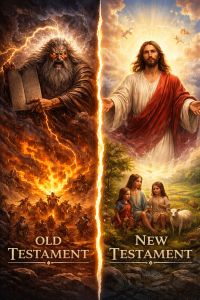 A lot of people – both Christians and non-Christians alike – see a vast difference between the way God is portrayed in the Old Testament vs. the New Testament. Some have claimed that it’s two different gods, while others think of it more like a conversion experience of the same God: The judgmental, wrathful God of the OT became the merciful, loving God of the NT. Such views of the Biblical God are based on a cherry-picking of the Biblical data. In my latest podcast episode, I demonstrate that we find a God of both love and justice in both testaments.
 Christians and Jews believe the God of the Bible is morally good. Many non-believers, however, think otherwise. They claim the God of Christianity is morally evil, and thus no God at all. So is the Biblical God the epitome of moral perfection, or a moral monster?
 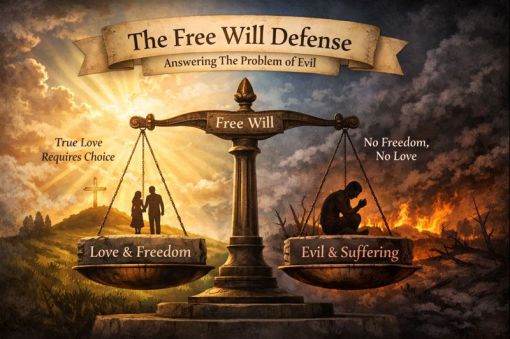 My series on the problem of evil will be wrapping up soon. The last two episodes (186-187) have focused on a potential flaw in the Free Will Defense (FWD), which is arguably one of the best answers to the problem of evil.
 I posed a moral dilemma to a few Christian thinkers, but none were able to provide a fully satisfactory answer. While I think most ended up at the right conclusion, no one could really articulate the moral principles used to come to that conclusion. So I thought I would pose the dilemma to AI and see what it had to say. Could it provide any additional insights into Christian moral reasoning? I chose to use ChatGPT and Gemini. I will reproduce the chats below for your reading pleasure, but I would like to make several observations first.

 My podcast series on the resurrection is still going strong. I’ve recently started my last sub-series within the larger series, focused this time on the Shroud of Turin. If you have never heard of it before, it’s the purported burial cloth of Jesus Christ, bearing the image of a crucified man. Many Protestants have dismissed it as a fake Catholic relic, and most non-Christians have dismissed it as a medieval forgery due to carbon dating tests in the 1980s. However, interest in the Shroud has not gone away, and for good reason. There is much more to the story. In this sub-series, I’m examining the mountains of evidence for its authenticity, and I’ll address questions related to dating, and more.
 We have a hard time understanding how the Germans allowed the Holocaust to take place. How could people so easily and so readily disregard the humanity of an entire group of people? How could they so callously kill millions of people? How could so many people who disagreed with the actions of the state stand by and do nothing? It’s not that hard to see how, really.
 I posted back in
  I’ve
I’ve  I’ve begun a new podcast series on the historical evidence for the resurrection of Jesus. The series will not only cover the historical evidence for Jesus’ resurrection, but also explore alternative (naturalistic) explanations, the evidence for Jesus’ existence, the theological and practical significance of the resurrection, questions and objections, our own future resurrection, an examination of the Shroud of Turin, and a harmonization of the gospel accounts of Jesus’ death and resurrection.
 The final argument for God’s existence in my podcast series, Does God Exist?, is a version of the existential argument. I argue that our deepest existential longings can only be explained by and satisfied by a theistic God: the desire for meaning and purpose in life, objective morality, immortality, free will, and love. People must either (1) believe there is a God who can satisfy our deepest longings or (2) believe there is no God and that our deepest longings are misguided and can never be satisfied.
 The design argument for God’s existence that I presented in my “Does God Exist?” podcast series could be succinctly summarized as “the universe looks designed because it was designed.”
 “The one who states his case first seems right, until the other comes and examines him” (ESV).
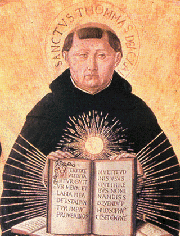 I just wrapped up my podcast discussion of Aquinas’ Five Ways by examining his Fourth and Fifth Ways. The Fourth Way argues that the grades of perfection we observe in the world can only be explained by the existence of a maximally perfect being. The Fifth Way argues for the existence of an intelligent being who guides everything towards their natural ends.
 There are so many ways to summarize the moral argument for God’s existence that I have a hard time boiling it down to just one or two. The most concise summary of the deductive moral argument for God’s existence could be stated as follows: “If objective morality exists (and it does), then God exists.”
 My episode on Aquinas’ Third Way is now live. This is his argument from contingency. Aquinas argues that the existence of contingent beings can only be explained by the existence of a necessary being whose essence is identical to His existence.
 I published my episode on Aquinas’ Second Way for God’s existence on Friday. Aquinas argues that a causal series can only be explained by a first, uncaused cause who is the source of all causation (which we call “God”).
 As I continue to examine additional arguments for God’s existence, I have finally come to Thomas Aquinas’ Five Ways. The first episode on the First Way went live today.
 Thinking to Believe