Apologetics


A few weeks ago the famed atheist and philosopher of science, Michael Ruse, wrote a response in the Guardian to the question, What can Darwin teach us about morality?  Ruse’s multifaceted answer is accurate, intriguing, and at times, incoherent – but always and thoroughly enlightening about where atheistic and evolutionary thought leads. 

Ruse admits that without God “there are no grounds whatsoever for being good.”  Morality, he says, is just a matter of emotion and personal taste on the same level as “liking ice cream and sex and hating toothache and marking student papers.”  But he’s quick to point out that just because there are no grounds for being good, it doesn’t mean we should be bad.  While this is true insofar as it goes, it fails to answer the more important question: Why – in the absence of a moral law giver, and thus in the absence of any objective moral law – should anyone behave in ways traditionally thought to be “good” if and when it is in their own self-interest to do otherwise?  In the name of what should they deny their own impulses?  In the name of the Grand Sez Who?

(more…)

Here’s another attempt to explain the Biblical plagues without reference to the supernatural: global warming and a volcano eruption.  It’s always funny to me how—in an attempt to avoid the supernatural—people appeal to explanations that are so implausible that it takes more faith to believe them than it does to believe the Biblical account that God was responsible.  

For example, how is it that Moses’ could have known in advance that a plague of frogs would be produced by global warming?  What’s even more unbelievable is the fact that each of the natural phenomena just-so-happened to stop when Moses said it would stop.  And how is it that each of the ten plagues happened one after another, and never simultaneously?  Who do they think they are trying to kid? 

The National Geographic Channel will air a program on this April 4 (Easter day).

Atheists are fond of comparing belief in God to belief in Santa Clause, claiming that belief in one is as justified as the other.  But the two beliefs are not analogous at all.  There are plenty of positive rational reasons to believe God exists (the origin of the universe, the fine-tuning of the universe for intelligent life, the origin of life, consciousness, the existence of objective moral values, etc.), but the same cannot be said of Santa.  Indeed, when it comes to Santa’s existence, not only are there no good reasons that favor his existence, but there is plenty of evidence against his existence.  If Santa exists we would expect to find his home in the North Pole, or have empirical evidence of flying reindeers or elves, and yet despite all the expeditions of the North Pole, we find none.  Furthermore, we have widespread evidence from both credit card receipts and personal testimony that the gifts appearing under millions of Christmas trees were purchased by regular human beings from retail stores, not made by elves in Santa’s workshop.  Finally, our knowledge of physics proves it impossible for one man to travel the globe in the amount of time allotted to Santa, carrying the number of gifts he would have to carry to supply gifts to all those .

Comparing belief in God to belief in Santa Clause may be rhetorically effective, but it is logically fallacious.  As Paul Copan wrote, “To place belief in Santa Claus or mermaids and belief in God on the same level is mistaken. The issue is not that we have no good evidence for these mythical entities; rather, we have strong evidence that they do not exist. Absence of evidence is not at all the same as evidence of absence, which some atheists fail to see.”[1]

I think it is also worth pointing out that while virtually everyone abandons their belief in Santa Clause even prior to reaching adulthood, the same cannot be said of belief in the existence of God(s).  The vast majority of people continue to believe in God(s).  Why is that?  Apparently they recognize that the grounds for believing in the one are not at all comparable to the grounds for believing in the other.  Belief in God’s existence is rationally justified, while belief in Santa is not.


[1]Paul Copan, “The Presumption of Atheism”; available from http://www.gospelcom.net/rzim/publications/essay_arttext.php?id=3; Internet; accessed 13 February 2005.

I just love Greg Koukl!  In his most recent issue of Solid Ground he provides a wonderful response to a challenge atheist Michael Shermer likes to lodge against theistic moral objectivists: “If there was no God, would you still be good?”   

Shermer expects an affirmative answer from his theist detractors.  If theists would be good even without God, he reasons, then God is not necessary for morality as the theist claims.  While this is a clever rhetorical device, it misses the point entirely.  The theist’s argument is not that one must believe in God to behave in ways people generally consider “good.”  Our argument is that if God does not exist, there is no such thing as “goodness” at all.  As an individual or as a culture we might prefer to help a grandmother cross the street as opposed to running her over with our car, but neither behavior is morally superior to the other.  All human acts are just molecules in motion, and the last I checked, neither molecules nor motion come in “good” and “bad” varieties.  Morality is not a quality of matter, but of mind.  

(more…)

I just finished reading an article in The Guardian by Oliver Burkeman regarding the changing face of evolutionary theory.  He discusses a book by Jerry Fodor and Massimo Piattelli-Palmarini (What Darwin Got Wrong) that challenges the coherency of natural selection.  Fodor notes that Darwin assumed natural selection “selects for” specific traits in an organism.  He finds two problems with this.  First, natural selection is a mindless, blind process, so it cannot “select for” anything. 

Second, there is no way to determine that a specific trait was “selected for,” rather than merely “selected.”  Traits are correlated together in an organism, and thus one cannot single out a specific trait to say “X was selected for by natural selection.”  Not every trait is adaptive, and thus not every trait will be “selected for.”  Some will merely be selected by default.  For example, why think the Cheetah’s spots were “selected for” by natural selection?  It very well could be that the Cheetah was selected by natural selection because of its speed, and its spots were merely “selected” in the process – coming along for the ride if you will.  Organisms qua organisms are selected, not specific traits. 

(more…)

In the human genome, only 1.5% of our 3.2 billion base pairs of DNA codes for proteins.  For a long time evolutionists though the other 98.5% was “junk” DNA: DNA that was preserved in the genome, but had no function; the byproduct of billions of years of aimless mutations.  Over the past seven years, however, scientists keep discovering more and more function for this “junk.”  For example, it has been discovered that ~90% of our genome codes for RNA products.  Junk DNA also:

  1. Regulates DNA replication
  2. Regulates transcription
  3. Marks sites for programmed rearrangement of genetic material
  4. Influences the proper folding and maintenance of chromosomes
  5. Controls the interactions of chromosomes with the nuclear membrane
  6. Controls RNA processing, editing, and splicing
  7. Modulates translation
  8. Regulates embryological development
  9. Repairs DNA
  10. Aids in fighting disease[1]

And now, biologist Richard Sternberg has brought my attention to a very interesting find related to a specific kind of “junk” DNA called Short Interspersed Nuclear Elements (SINEs).  SINEs are mobile DNA that can insert themselves in various locations within the genome, and are thought to be functionless according to evolutionary biologists.

The rat and mouse are said to have diverged from one another 22 million years ago.  Since that time, each is thought to have experienced hundreds of thousands—if not millions—of SINE insertion events.  Given so many insertion events, we would expect for the location of SINEs to be very different in the mouse genome than in the rate genome (in the same way we would expect a moon that split in two 22 million years ago to evidence a very different asteroid bombardment pattern on its surface).  And yet, when we compare the location of SINEs in the mouse and rate genomes this is what we find:

They are virtually identical!  This is not what we would expect from a degenerative process like mutations and random insertions over millions of years.  We would expect radical divergence, not a nearly-identical pattern.  While the SINE sequences are not the same in the rat and mouse genomes, the placement of the SINEs is nearly identical (and they are concentrated in gene-coding regions of the genome).

How do we account for this pattern?  Can it be the result of a degenerative process?  Surely not.  Patterns are indicative of design, and hence purpose.  Contrary to the expectations of evolutionary biologists, SINEs do have purpose and function, even if we are only beginning to understand them.


[1]Stephen C. Meyer, Signature in the Cell: DNA and the Evidence for Intelligent Design (New York: Harper One, 2009), 404-7.

I recently heard a preacher repeat the oft-cited aphorism, “A man who has an argument is always at the mercy of a man who has an experience.”  This is quite true as an anthropological observation, but I don’t think this is necessarily a good thing.

The aphorism was quoted by the preacher in the context of those who doubt the reality of Spirit baptism and glossalalia.  I am inclined to agree with him in one very real and practical sense.  No matter what argument someone might present to me against glossalalia, the fact of the matter is that I have experienced it for myself and, thus, I know it is real.  But the blade can cut both ways.  What about the Mormon who claims to have received a “burning in his bosom” confirming the truth of the Book of Mormon?  Should the Mormon trust his experience over sound reason to the contrary?  I imagine the preacher would say that in this case, reason should trump experience.  But why should the aphorism apply to us, and not to the Mormon?  To the Mormon, his experience was equally as real as our own.  If we can reject arguments that contradict our experience, why can’t the Mormon?

(more…)

Some people argue that if someone is pro-life with respect to the unborn, by the same logic they should also be opposed to capital punishment.  If a pro-life supporter opposes abortion but not capital punishment, these detractors claim they are being hypocritical, or worse yet, that such inconsistency serves to undermine the pro-life ethic.  This is often called the seamless garment argument.  It is advanced by both abortion-choice and pro-life advocates alike (pro-life advocates who are opposed to both abortion and capital punishment).

A couple of things could be said in response.  First, even if the pro-life ethic demanded that one be opposed to both abortion and capital punishment, the pro-life ethic would not be undermined merely because someone inconsistently applies that ethic.  An individual’s logical inconsistencies do not dictate truth.  Even if the pro-lifer is logically inconsistent, it could still be the case that the pro-life ethic is true, and thus abortion is wrong.  The abortion-choice advocate would be committing a logical blunder himself if he thinks that the pro-lifer’s logical inconsistency in applying the pro-life ethic is itself evidence that the pro-life ethic is false.  His conclusion is non-sequitur.

(more…)

In days gone by many atheists thought the existence of evil in the world disproved theism.  Largely due to the work of philosopher Alvin Plantinga, however, most professional philosophers now concede that the presence of evil in the world does not disprove the existence of God (unfortunately, lay atheists failed to get the memo).  As atheist and J.L. Mackie came to admit, “Since this defense is formally [i.e., logically] possible, and its principle involves no real abandonment of our ordinary view of the opposition between good and evil, we can concede that the problem of evil does not, after all, show that the central doctrines of theism are logically inconsistent with one another.”

No longer able to use the mere existence of evil as evidence against God’s existence, atheists began to argue that the amount of evil in the world makes the existence of God unlikely.  “Why,” they ask, “is there so much evil in the world?”  James Corman and Keith Lehrer are representative of this modified argument:

If you were all-good, all-knowing, and all-powerful, and you were going to create a universe in which there were sentient beings — beings who are happy and sad; enjoy pleasure; feel pain; express love, anger, pity, hatred — what kind of world would you create? Being all-powerful, you would have the ability to create any world that it is logically possible for you to create, and being all-knowing you would know how to create any of these logically possible worlds. Which one would you choose? Obviously you would choose the best of all the possible worlds because you would be all-good and would want to do what is best in everything you do. You would, then, create the best of all the possible worlds, that is, that world containing the least amount of evil possible. And because one of the most obvious kinds of evil is suffering, hardship, and pain, you would create a world in which the sentient beings suffered the least. Try to imagine what such a world would be like. Would it be like the one which actually does exist, this world we live in? Would you create a world such as this one if you had the power and knowhow to create any logically possible world? If your answer is “no,” as it seems it must be, then you should begin to understand why the evil of suffering and pain in this world is such a problem for anyone who thinks God created this world. This does not seem to be the kind of world God would create, and certainly not the kind of world he would sustain. Given this world, then, it seems we should conclude that it is improbable that it was created or sustained by anything we would call God. Thus, given this particular world, it seems we should conclude that it is improbable that God – who if he exists, created this world ­­– exists. Consequently, the belief that God does not exist, rather than the belief that he exists, would seem to be justified by the evidence we find in this world.[1]

(more…)

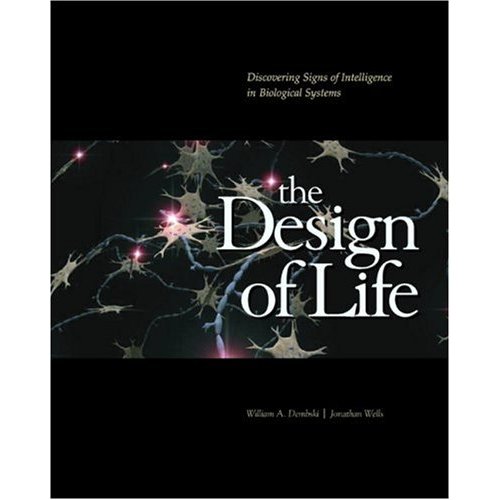
I just finished reading The Design of Life: Discovering Signs of Intelligence in Biological Systems by William Dembski and Jonathan Wells (which someone was kind enough to buy me from my Ministry Resource List!).  This book was a joy to read!  I’ve been following the Intelligent Design vs. Darwinism debate for a long time, and I’ve read a good number of books and countless articles and blog entries on the subject.  So to be honest, I wasn’t expecting to glean a lot of additional insight from The Design of Life.  But I couldn’t have been more wrong.  My highlighter got a real workout with this book!

The Design of Life is essentially a textbook on Intelligent Design.  Most of the resources I have read on the topic deal with a specific subject: Darwin’s Black Box looks at irreducible complexity as an indication of intelligence; Edge of Evolution examines the power of random mutation and natural selection to produce novel biological changes; Signature in the Cell examines the origin-of-life, etc.  The Design of Life, however, is a more comprehensive look at ID.  But don’t think “comprehensive” means it only provides a little information about a lot of topics.  Not at all!  I was quite impressed with the balance achieved between comprehensiveness and detail.

The book covers human origins, genetics and macroevolution, the fossil record, the origin of species, homology, irreducible complexity, specified complexity, and the origin of life.  It even has a supplementary CD containing additional details on the topics covered in the book.  If you are looking for a good, well-rounded book to learn more about the claims of and evidence for ID, I would highly recommend this book!

Wesley Smith pointed my attention to a wonderful article by Joe Carter detailing how in a period of just 40 years, the Dutch went from allowing voluntary euthanasia for the terminally ill, to allowing it for the chronically ill, to allowing non-voluntary euthanasia for the disabled, to allowing for voluntary euthanasia for the depressed, to allowing for non-voluntary euthanasia of severely handicapped newborns, to debating whether or not healthy elderly people should be able to choose suicide simply because they are sick of living (“suffering through living”).  

This is what happens when you abandon the idea of innate human value, and swallow the pill that says there is such a thing as a life unworthy of life.  Sadly, America has begun its journey down this same road.  Euthanasia begins to be accepted out of sympathy for those suffering with severe pain who are near death, but the logic of euthanasia always expands the circle of those who can be killed so that eventually, it includes many people and situations that no one in the beginning ever wanted to include.

I think a good argument can be made for the existence of God based on the existence of the universe.  We know the universe began to exist.  Given that whatever begins to exist requires a cause external to itself to bring it into existence, there must be a cause external to the universe to explain why it came into being.  Whatever brought time, space, and matter into existence cannot itself be temporal, spatial, and material, and thus the cause of the universe must be eternal, non-spatial, and immaterial.  Furthermore, the cause must be personal in nature since there are only two known sources of causation—events and personal agents—and it is impossible to explain the first event in terms of a prior event.  Therefore, an agent must be the cause of the universe.  A personal, eternal, non-spatial, and immaterial being is what most theists mean by “God.”

While I think this argument demonstrates the existence of the divine, it cannot tell us anything about the number of divine beings responsible for creating the universe.  There could be one, or there could be billions.  An additional argument is needed if one is going to prove the existence of one and only one God.  In the past I argued for monotheism on the basis of divine omnipotence.  I reasoned that the property of omnipotence cannot belong to more than one being, for if two or more beings have to share power, then neither being can be said to have “all” power.  So God, then, must be one if He is omnipotent.

(more…)

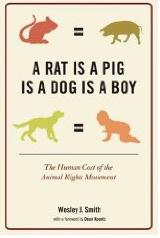
PETA president, Ingrid Newkirk, is famous for having said, “A rat is a pig is a dog is a boy.”  And now Wesley Smith will become famous for using that disturbing line as the title for his new book exposing the radical nature of the animal rights movement Ms. Newirk et al represent.

I have not read Smith’s book yet, but I have followed his blog for a long time, and have found his thoughts on this topic to be excellent.  Smith argues that humans are exceptional among animals, not just another animal on the farm.  Human dignity belongs to all humans in virtue of their identity as humans.  While animals are valuable and should be treated humanely, they are not the moral equivalents to human beings, and treating them as such does more to demean human dignity than to elevate animal dignity.

Smith pointed his readers to a review of his book that I found helpful and on-target.  I wanted to recommend it to you, as well as share a few teaser quotes:

(more…)

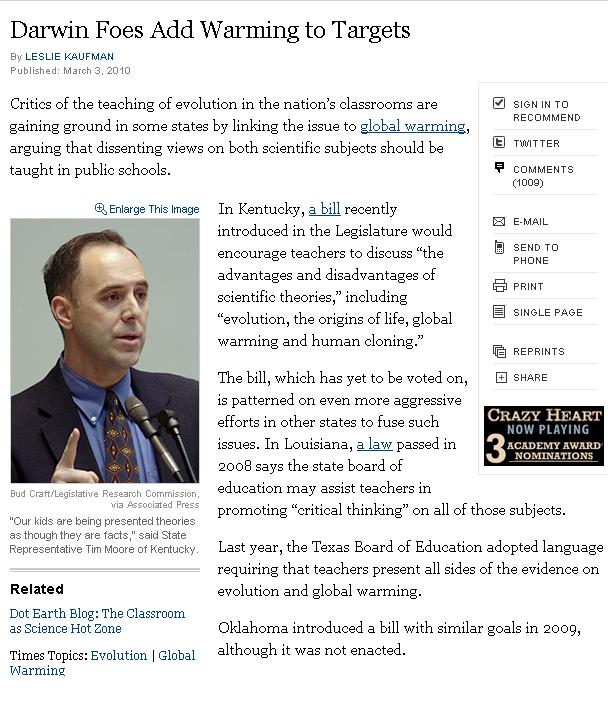
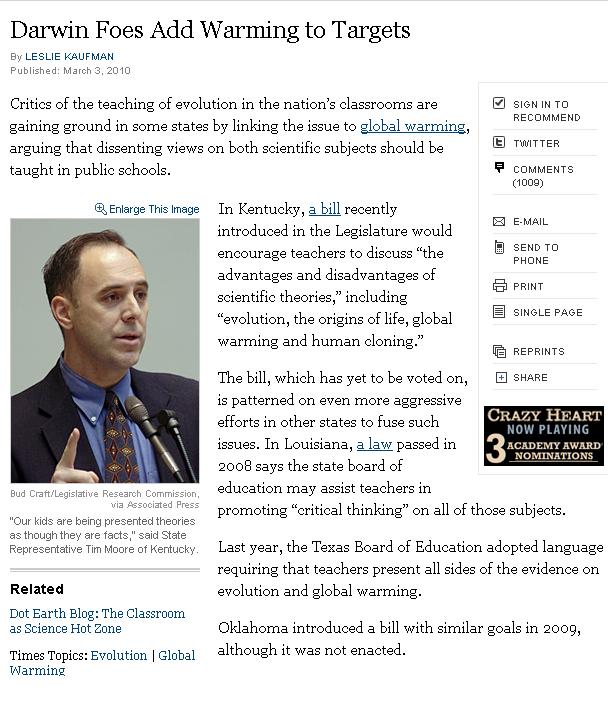
The New York Times ran an article on their front page about academic freedom bills that are popping up in some states.  Some of these bills require that teachers teach both the evidence for and against certain scientific issues (such as evolution and global warming), or at least allow them to do so.  Who could oppose such bills?  You would be surprised!  But I digress.  

The one part of the article that irked me the most was their mischaracterization of intelligent design as “the proposition that life is so complex that it must be the design of an intelligent being.”  What’s so disturbing about it is that they have been told by the Discovery Institute (the main ID think-tank) in the past that this definition is inaccurate, and yet they refuse to characterize ID accurately time and time again. 

I decided to comment on the article to set the record straight and vent my frustrations with the NYT.  Seeing that my comment, if it is approved, will be #1010-ish, I doubt it will get read by too many people, including those at the NYT (but I feel much better now).  Here is what I wrote:

(more…)

Many people think that as one grows in knowledge of science, they will give up their faith in God.  There are probably several reasons for this belief.  For one, many of the scientists that are household names are atheists.  For example, Stephen J. Gould and Richard Dawkins.  Also, we have probably known individuals who have abandoned their faith after studying science (even if just a course or two in school).  But the idea that the majority of scientists are atheists or agnostics is not true.

In May-June of 2009, the Pew Research Center conducted a survey of the religious beliefs of members of the American Association for the Advancement of Science.  They discovered that 51% believe in God or some higher power.  Only 41% do not.  Interestingly, the number of scientists who believe in God is higher today than 100 years ago.  In 1914 a survey of 1000 leading U.S. scientists revealed that 42% believed in a personal God, while 42% did not.[1]

No doubt, the number of practicing scientists who believe in God is far less than the number of non-scientists who believe in God (92% of Americans), but the fact remains that unbelief in the scientific community is not as rampant as many believe.  One is just as likely to meet a believing scientist as an unbelieving one.

This data ought to dispel the myth that science and theism are necessarily at odds with one another.  They are not.  Indeed, many would argue that science is serving to confirm the existence of God.  I agree.  Science is a friend of Christianity, not an enemy.


[1]Admittedly, the sources chosen for these various surveys may skew the results at times.  For example, a survey of members of the National Academy of Sciences found that 95% of them were either atheists or agnostics.  There is also evidence to show that belief in God is more prevalent in some scientific disciples over others (more in physics, less in biology).  Overall, however, most of these surveys show that a large minority of scientists—if not a slight majority—believe in a divine being(s) of some sort.

Here is part 2 of my summary of Stephen Meyer’s response to key objections raised against ID (read part 1).  This post will conclude my review/summary of Meyer’s book.  Links to the entire series: 1, 2, 3, 4, 5, 6, 7a.

“ID is an argument from ignorance”

Not at all.  Arguments from ignorance take the following form: X cannot explain Y, therefore Z does.  That is not the form of ID arguments.  ID does not reason that if all naturalistic proposals fail, ID must be true by default.  There are positive evidences provided for inferring design in the universe/biology.  We are not ignorant of how information arises.  We also know from experience that only intelligent designers are capable of producing information (functional, complex specificity).  So postulating an intelligent designer to explain the biological information we observe in the cell is based on what we know, not what we don’t.  If chance and necessity are not adequate to explain the origin of biological information, whereas intelligent agency is, then it is reasonable to view intelligence is the best explanation.[1]

“Doesn’t this presuppose a naturalistic explanation won’t be found in the future?” 

No, it doesn’t.  It merely recognizes that our conclusions should be based on the evidence available to us in the present, not hypothetical evidence that might possibly be discovered in the future.  We must reason to the best explanation given our current data, and our current data gives us no reason to believe life originated by purely naturalistic means, but good reason to believe its origin is due to the activity of a designing intelligence. 

(more…)

Stephen Meyer addressed key objections to the design hypothesis that I will share.  Each objection could be answered in much greater detail, but I’ll stick to offering short summaries of key points.  Because of the abundance of objections, I’ll break part 7 into 2 posts. 

“Intelligent Design is not science” 

This is a red herring in that it shifts the focus away from the merits of ID arguments to the classification of those arguments; from the truth of ID to the definition of science.  As Thomas Nagel has written, “A purely semantic classification of a hypothesis or its denial as belonging or not to science is of limited interest to someone who wants to know whether the hypothesis is true or false.”[1]  Arguably, ID is science and should be classified as such.  But even if all parties agreed that it should not be considered science, that does not mean it is false.  It could be that ID is true, but not a scientific truth.  

This objection also presumes that there is a standard definition of science.  There isn’t.  This is called the “demarcation problem.”  Philosophers of science do not agree that there is a single, standard definition of science.  According to Larry Laudan, “There is no demarcation line between science and non-science, or between science and pseudoscience, which would win assent from a majority of philosophers.”[2]  Similarly, philosopher Martin Eger wrote, “Demarcation arguments have collapsed.  Philosophers of science don’t hold them anymore.  They may still enjoy acceptance in the popular world, but that’s a different world.”[3] 

(more…)

Wesley Smith alerted me to an article in the Winnipeg Free Press (Canada) by Dr. Joel B. Zivot, an associate professor in the department of anesthesiology at the University of Manitoba in Canada.  Dr. Zivot writes about “Baby Isaiah,” a child born with brain damage due to the lack of oxygen during a long birthing process.  Unable to breathe regularly on his own, the baby is hooked up to a ventilator.  A legal battle has ensued when the parents were told last month by Alberta Health Services that all treatment would be withdrawn for baby Isaiah, and that such an action was “medically reasonable, ethically responsible and appropriate.”  Dr. Zivot’s words get to the heart of the debate over human value, showing just why we need to avoid making subjective “quality of life” assessments to determine who should live and who should die:

As a physician, I specialize in the management of the weak and disabled. My task is clear: restore an individual’s health if I am able, and protect my patient’s rights as a human being. … Although the issue before the court is the degree of brain injury incurred by Isaiah, I realize that it is Isaiah’s status as a human being that is on trial. In contemporary thought, once born, humanity is considered automatic and should not be revoked by disability. The yardstick of being a human being is set too high for Isaiah. Discussion on the prediction of degree of disability, including mental capacity, is not relevant as are counter-arguments based on the physical appearance of normalcy. All that really matters, to be blunt, is if Isaiah is dead or alive. … If Isaiah is alive, which includes everything but brain dead, he is entitled to the full rights and privileges of any living Canadian citizen.

(more…)

William Lane Craig has written a “fairly” condensed article (30 pages) consisting of five arguments for God’s existence, and examines how the new atheists such as Richard Dawkins have responded to these arguments.  This is probably the most lay-accessible, condensed written treatment I have seen from Craig on this topic.  Highly recommended.  

You can read it in HTML, PDF, or at Scribd.

HT: Justin Taylor

A Matter of Days is a book on the young-earth vs. old-earth creationism debate written by astronomer and Christian apologist, Hugh Ross.  Ross is an old-earth creationist, meaning he rejects both Darwinism and theistic evolution.  He argues that both the scientific and Biblical data support an ancient universe.  Not only does he provide evidence for his view, but he interacts with and critiques the arguments and objections raised by young-earth creationists.

If you are interested in the old-earth vs. young-earth debate, this is a must-read book.

« Previous PageNext Page »