Same-sex Marriage


My last post was about the importance of the debate over same-sex marriage.  While many people (including Christians) think it does not matter, I argued that the legalization of same-sex marriage will have a large impact on society as a whole, as well as Christian freedoms.

In that vein, I just read this story today coming out of Britain.  A Christian husband and wife, Eunice and Owen Johns, have been denied the right to serve as foster parents due to their convictions against homosexuality.  While they have provided foster care to 15 children in the past, social workers recommended that they not be allowed to care for children in the future because they would not agree to instruct those children that homosexuality was morally acceptable.  According to the article “Lord Justice Munby and Mr Justice Beatson ruled that laws protecting people from discrimination because of their sexual orientation ‘should take precedence’ over the right not to be discriminated against on religious grounds.”

(more…)

When it comes to controversial subjects, it’s not often that those of one persuasion will cede the objections offered by those of a contrary persuasion.  The cogency of some objections is so strong, however, that those of one persuasion will cede the merits of their opponents’ objection even though they do not cede the merit of their opponents’ position.  I have found this to be the case with the debate over same-sex marriage.  Many opponents of same-sex marriage cede some of their opponents’ objections to prohibiting the legal recognition of same-sex partnerships as “marriage.”  While several come to mind, the one I want to discuss is what I call the irrelevancy objection: recognizing same-sex relationships as “marriage” will not affect your marriage or society-at-large, so why make a big deal about it?

Is the debate over same-sex marriage irrelevant?  What do we stand to gain or lose in this cultural/moral/political battle?  What would the fallout be if same-sex marriage becomes the law of the land?  I think we would feel the effects in two main areas: (more…)

The Pew Research Center released a major social trends report in November 2010 on the topic of marriage and family titled “The Decline of Marriage And Rise of New Families” (you may have heard about the cover article on this report featured in Time magazine).  They attempted to evaluate how Americans’ views of marriage have changed over the last 50 years.[1] Some of their findings merely confirmed what most see as common knowledge, but some of their findings were quite surprising.

It took me a number of lunch breaks to read through the report, but it was well worth the time spent seeing how it is chalked full of valuable social statistics.  While I would encourage you to read the full report, here are some of the most significant findings (organized by subject):

(more…)

Same-sex marriage advocates—including the courts—often argue that marriage is a fundamental right, and therefore same-sex couples must be granted access to the institution even if that requires changing the definition of marriage itself.[1]

There are three problems with this argument.  First, it proves too much.  If marriage is a fundamental right, such that the qualifications for and definition of the institution must be revised to accommodate those who want access to the institution but do not qualify based on the traditional definition, then the institution will have to be revised to accommodate more than just same-sex couples.  It will need to be revised every time any one wishes to participate in the institution, but does not qualify based on the legal definition in use at the time.  Indeed, if the right to marriage is so fundamental that it requires society to change its definition of marriage to match the desires of hopeful participants, then society is left without a principled basis for declining anyone’s request to have their own idea of marriage recognized by the State.  The State must change the definition of marriage to match every new request, whether we approve of their concept of marriage or not.

(more…)

Apparently Iowans didn’t like the idea of their Supreme Court forcing same-sex marriage on the state.  In last night’s elections, the voters ousted all three Supreme Court justices who were up for re-election—justices, who in 2009, declared same-sex marriage to be a constitutional right.  This is the first time any sitting Iowa Supreme Court justice has not been retained on the bench when put up for re-election.  The voters have sent a clear message to the supreme judiciary in their state: interpret the constitution, don’t reinvent it in your own image.  Of course, on a practical level this move will do nothing in the immediate future to change the status of same-sex marriage in Iowa.

Many proponents of same-sex marriage assume that opposition to same-sex marriage comes almost exclusively from religious citizens.  A simple math calculation exposes the error of this assumption: religious believers account for approximately 95% of the population, and yet only 48% oppose same-sex marriage (41% favor).  Clearly not all opposition to same-sex marriage is coming from religious believers.  Who, then, is it coming from?

(more…)

Whenever I make my case against same-sex marriage to a same-sex marriage proponent, invariably they will raise a particular objection to my argument.  The objection is so common that I want to devote a lengthy blog post to rebutting it.  But before I do, let me briefly summarize my argument against same-sex marriage:

The primary reason human governments across time and cultures have chosen to regulate, privilege, and encourage one particular kind of human relationship over all others is because they have a vested interest in what that kind of relationship can produce: socialized children to perpetuate society.  Apart from that, there is no reason for the government to meddle itself in personal, sexual relationships. They are not interested in promoting friendships or romantic love; they are interested in social self-preservation. They are interested in producing a new generation of responsible, socialized citizens to replace the existing generation. Optimal socialization involves both natural parents, so the state is interested in keeping the natural parents together as well. That is why marriage comes with legal responsibilities, and until recently, was difficult to dissolve.

(more…)

Catching up on old news….  Argentina legalized same-sex marriage July 15, 2010.  They are the first country in Latin America to do so.  The legal recognition of same-sex unions as “marriage” continues to spread.

In November 2008, five months after the CA Supreme Court legalized same-sex marriage, the people of CA passed a constitutional amendment (52% to 48% ) to define marriage as a union between men and women only.  The constitutionality of the law was challenged, and the CA Supreme Court ruled that it was constitutional (it’s hard to say something in the constitution is not constitutional!).  That decision was appealed, and a federal judge just ruled yesterday that the constitutional amendment violates the U.S. Constitution.  Anyone surprised?  This is the way the gay agenda is always advanced: through the courts.  Why?  Because the democratic process isn’t working in their favor.

I have not read the judge’s decision, but I’ve read the decision of other courts who have made similar rulings and the legal rationale is usually the same.  I don’t buy the legal rationale one bit.  I do find it interesting that the judge who ruled on this gay happens to be gay.  That fact itself doesn’t necessarily mean he let his own personal biases or political agenda influence his decision, but only a fool would think it played no part at all.

The decision will be appealed.  And to whom will the case go?  None other than the Ninth Circuit Court of Appeals, the most liberal appellate court in the nation.  I wonder how they’ll vote!?!  There’s no question in my mind that they’ll upheld the decision of the federal judge and this will be appealed all the way to the U.S. Supreme Court.  We’ll have to wait to see what happens.

Hawaii’s Senate approved a bill providing civil unions to same-sex and opposite-sex couples in January 2010.  Yesterday, their House of Representatives approved it as well.  It remains to be seen whether the governor will veto it.

President Obama has instructed the Health and Human Services Department to draft rules that grant patients the right to designate who can visit them in the hospital.  Not only would this open the door for non-relatives to visit their loved ones in the hospital, but also gay partners.  I support this law for several reasons.  First, I have always found it ridiculous that hospitals, not patients, determine who can visit the patient.  Secondly, this will remove one of the standard arguments for same-sex marriage (SSM).  Many proponents of SSM argue that SSM is necessary to give them the right to visit their partners when hospitalized.  Apparently, SSM isn’t needed for that after all.  Like so many other practicalities, these privileges can be ascertained via other legal means wholly apart from marriage.

Updated 1/19/10

Greg Koukl has a really good response to those who say “Who are you to say?” in response to our disapproval of same-sex marriage:

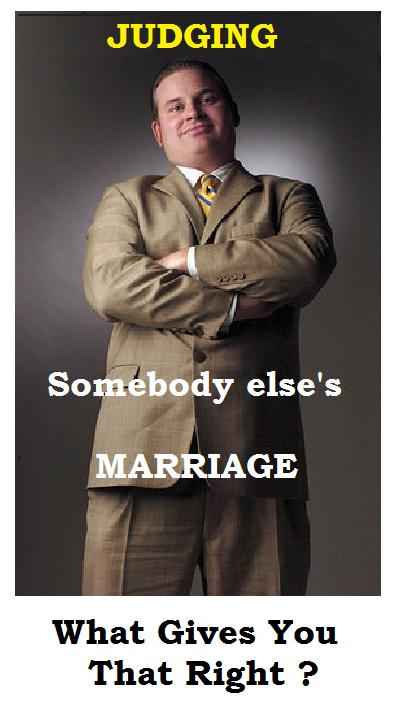
Who are you to say?”  That challenge works both ways.  First, if my disapproval isn’t legitimate, then why is my approval legitimate?  If I don’t have the right to judge something wrong…, I certainly don’t have the right to judge it right….  Second, why is it that I can’t make a moral judgment here, but apparently you can?

The appeal for a change in marriage laws is an attempt to change the moral consensus about homosexuality.  You invite me to make a moral judgment, then you challenge my right to make a judgment when I don’t give the answer you want.

Building on Greg’s thoughts, I think the most concise, tactical response to the “Who are you to say it’s wrong?” challenge is simply to ask in return, “And who are you to say it’s acceptable?”  This response makes it clear that both parties are making claims, and those claims need to be justified.  The burden of proof is not just on the person in favor of prohibition, but is also on the person in favor of permission.

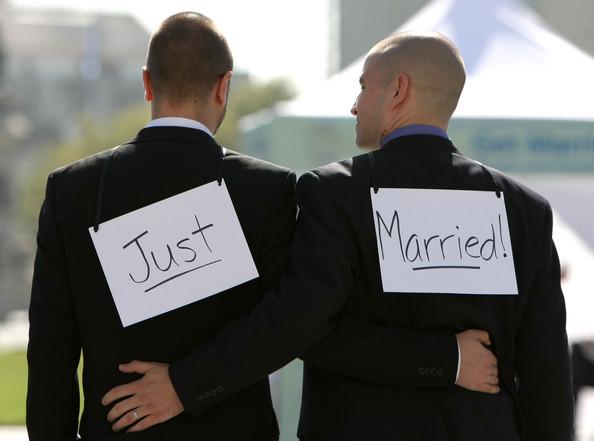
Well, kind of.  In 2006 the NJ Supreme Court ruled that the state’s legislature had to provide equal benefits to same-sex couples as it did to heterosexual couples seeking legal recognition of their relationship.  The legislature complied, but chose to call same-sex unions “civil unions” rather than “marriage” (which was an upgrade from the “domestic partnerships” they implemented in 2004).  A bill introduced last year sought to make it law that same-sex unions be termed “marriages” rather than “civil unions.”  Today, the NJ Senate voted 20-14 against that bill.  

I say the Senate “kind of” voted against same-sex marriage because same-sex marriage already exists in New Jersey; it’s just called by a different name.  Same-sex couples would not have gained anything material had this bill passed, and they have not been denied anything material with its defeat.  They have merely been denied being able to call their state-recognized relationships “marriage.”  While there is something to be said about the value of a name, the fact of the matter is that the fight over same-sex marriage is not (or at least should not be) over who gets to use the “M” word, but over the legal recognition and sanction of same-sex relationships.  If you give same-sex couples all of the benefits and privileges of opposite-sex couples, you have de facto legalized same-sex marriage, whatever you call it.  Marriage by any other name is still marriage.

In May of this year the District of Columbia passed a law recognizing the legality of same-sex marriages performed in states where they are legal.  Today, they voted 11-2 to legalize same-sex marriages performed in D.C.  The mayor of D.C., Adrian Fenty, has vowed to sign it.  Because of D.C.’s unique status, the U.S. Congress has 30 legislative days to review the bill.  If they do not act to overturn it during that time, it becomes law (and there’s not much chance they will).  It looks like D.C. will be the sixth jurisdiction in the U.S. to legalize same-sex marriage.

I must say I am a little shocked at this one given how liberal NY is, but the NY Senate rejected a same-sex marriage (SSM) bill that passed in the NY House.  The voted it down by a vote of 38-24.  

So as of December 2009 five states allow for SSM: Iowa, Connecticut, Massachusetts, New Hampshire and Vermont.  California was once on the list when the CA Supreme Court forced the CA legislature to legalize SSM (of course, SSM was already legal in practice, although not in name), but the CA voters amended their constitution in November 2008 to overturn the Supreme Court’s ruling.  Maine was also on the list until last month, when the voters of Maine overturned a congressional law that passed in May of this year legalizing SSM.

The NJ Senate is expected to vote on a SSM bill next week, so we’ll have to wait and see what happens there.

I just became aware of another referendum related to same-sex partnerships, this one in Washington State.  In May 2009 Washington’s legislature approved a bill that expanded the rights of domestic partners to include all the same rights as married couples, lacking only the name “marriage.”  Again, this was put to the voters as a referendum, and the citizens said, “Yes.”  The final vote was 51% to 49%. 

I find it interesting that those who supported the referendum to expand domestic partnership rights, raised nearly 1.1 million dollars for their efforts.  Those who opposed the referendum, however, only raised $60,000.  And yet still, the vote was within 2% points.

Once again, when the question of same-sex marriage is put to the voters, the voters say “No” (the 31st time).  Last spring, Maine’s legislature passed a law making same-sex marriage legal in that state.  The law was stayed, however, until the people had a chance to vote on it yesterday.  And they said no, but not by much (53%).

A judge in Dallas Texas has decided that two men who married in Massachusetts who now reside in Texas can get a divorce in Texas.  What’s interesting about this is that Texas does not recognize same-sex marriages.  In the eyes of the law of Texas, these men are not married, so how can that same state grant them a divorce?  What is the legal basis?  According to the judge, the basis is the fact that Texas’ law opposing same-sex marriage is unconstitutional.  You see how this works?!  Many voices prophesied that this would happen: same-sex couples marry in a state that recognizes same-sex marriage, move to a state that does not recognize same-sex marriage, and then successfully challenge that state’s marriage laws by filing for divorce. 

As I understand it, the judge’s decision does not, in fact, invalidate the law.  If I am understanding it correctly, it merely challenges the law, which, if pressed, could require a constitutional review by the Supreme Court of Texas, who could overturn it if they agree that it is unconstitutional.  If anyone knows more about the story, more about the judge’s decision, or more about the legal matters involved here, please step in and either correct me or fill in the blanks.

During the ongoing debate over same-sex marriage, it’s common to hear conservatives speak of the “definition of marriage,” but what exactly do we mean by the “definition” of marriage.  Are we talking about the purpose of marriage, its form, or both?  Most Americans (including conservatives) seem to be referring to marriage’s form: one man and one woman (for life).  I submit to you that this is the wrong place to begin the debate.  If we allow the discussion to center on marriage’s form, we are sure to lose.

I am persuaded that one of the main reasons we are facing the social and moral predicament we are is because we have reduced the “definition of marriage” to its form, losing sight of its purpose.  Without understanding the particular purpose of civil marriage in society, its traditional form is not necessary.  When we understand the purpose of civil marriage, however, the traditional form logically follows.

(more…)

J. Budziszewski noted that sometimes we deny what we know to be morally true by improperly pitting two moral principles against one another.  Consider marriage and fairness.  We recognize both to be moral goods.  Those who advocate for same-sex marriage, however, pit them against one another, arguing that if we are going to be fair we must permit same-sex couples to participate in the institution of marriage.

The problem is in their understanding of fairness.  They understand fairness to mean everyone must be treated exactly the same.  This definition is flawed, however.  Fairness requires that we do not arbitrarily treat people differently, or arbitrarily treat them the same.  In the case of same-sex marriage, we are not arbitrarily treating same-sex couples differently than heterosexual couples.  There is a principled reason for our discrimination: as a rule, heterosexual couples procreate while same-sex couples do not (and the principal reason government is involved in regulating marriage in the first place is because they are interested in the production and socialization of children).  To say it is unfair to preclude same-sex couples from marrying is like saying it’s unfair to allow one baseball team to beat another.  The purpose of baseball is competition, so it is fair to allow them to compete.  Likewise, the purpose of marriage is procreation, and it would be unfair to treat relationships that cannot procreate as equal to those that can.

« Previous PageNext Page »