Same-sex Marriage


It appears the NH House finally agreed to at least some of the religious protections Governor John Lynch demanded.  The governor signed the bill into law last Wednesday.  It will not take effect until January 1, 2010. 

If anyone knows the precise differences between the bill that was just passed by the House, and the bill that was rejected by them a couple of weeks ago, please note them in the comments section.  I am interested to see what they gave and what they took.

house_of_cards3Michael Medved makes a compelling argument that the existing “religious protections” being written into same-sex marriage laws – that provide legal protection for religious groups who object to same-sex marriage – are a house of cards just waiting to be toppled: 

The drive for same sex marriage stalled in New Hampshire over insistence by Governor John Lynch that the legislation must include strong protections for religious institutions and individuals who oppose such unions. This tactic – now adopted by gay marriage advocates across the country – may provide office holders with political cover but will offer very little legal security for defenders of traditional marriage. Legislative “conscience” provisions won’t survive lawsuits by agitators or judgments by activist jurists. If gay marriage is a fundamental human and constitutional “right,” then how could faith-based groups or religious individuals legally discriminate against the exercise of that right? If a florist declines to provide services to a same sex wedding, or a religious club refuses to rent its facility for a gay nuptial, there will be immediate and aggressive legal action to guarantee “equal protection of the laws.” If laws (like the provisions endorsed by Governor Lynch) authorize discrimination against same sex couples, it’s easy to envision judicial decisions invalidating them as unconstitutional. It’s now a well-established point of law that theological doctrine can’t protect institutions or individuals if they discriminate on the basis of race. … If gay identity is equivalent to racial identity (a key contention of the gay marriage movement), logic requires that unequal treatment based on sexual orientation should receive no more sanction than unequal treatment based on race.

I think Medved is right.  Including such religious protections is just a way of pacifying religious conservatives.  Once same-sex marriage has been entrenched in the law, however, any opposition to it will be litigated against.  Indeed, this is the pattern of the pro-homosexual lobby.  In the beginning, they lobbied for civil unions.  Then they lobbied for civil unions to have the same rights and obligations as marriage.  But they were not content with that.  In addition to having all the same rights as married couples, they wanted their relationship to be designated by an equal name: marriage.  They said that anything less than full equality in every respect is discrimination.  And the courts have bought it every step of the way.  So why wouldn’t they also buy the argument that allowing religious groups to decline participation in same-sex marriage ceremonies is an example of discrimination on the basis of sexual orientation, comparable to discriminating on the basis of race?  They can, and mark my words…they will.  “How will same-sex marriage affect you?” people say.  It will eventually prevent us from opposing it in deed, and possibly speech.  That’s how.

prop8Yesterday, in a 6-1 decision, the California Supreme Court upheld the voter initiative to amend the California Constitution to define marriage as between a man and woman only.  This is the same court that forced same-sex marriage on California last year, when they overturned a 2000 law defining marriage as between a man and woman only, as being unconstitutional.  Now that the voters amended the Constitution to define marriage in such a fashion, what could they do?  It’s difficult to say the Constitution is unconstitutional!

The National Organization for Marriage (NOM) has found that the following one-liner is the most effective way of communicating support for traditional marriage: “Gays and Lesbians have a right to live as they choose, [but] they don’t have the right to redefine marriage for all of us.”  I like it.  It communicates two important things:

  1. Opposition to recognizing same-sex marriage is not tantamount to opposition against homosexual behavior itself.  Many advocates of traditional marriage are content to let gays and lesbians engage in homosex in the privacy of their own homes (tolerant), but do not consent to letting gays and lesbians redefine the historic understanding of marriage in order to ascertain a sense of social respectability.
  2. Same-sex marriage advocates are forcing their views on the majority through political lobbying and the courts, which is both unfair and undemocratic.

One minor improvement to this statement would be to preface it with “I believe in tolerance, so I think….”  Using the actual word “tolerance” will help us communicate to an audience who thinks of tolerance as one of the prime virtues.

NOM highly suggests that we avoid speaking of “banning same-sex marriage” because it is unnecessary, and this language has a negative connotation.  Indeed, there is no need to ban same-sex marriage so long as the traditional definition is left intact.  Instead, we should speak of being opposed to “redefining marriage” or supportive of “marriage as the union of husband and wife.”

bridesIn a previous post I said the New Hampshire legislature had passed a bill legalizing same-sex marriage, and it was just waiting for the governor’s uncertain signature to be signed into law.  As it turns out, the CNN article from which I obtained my information was misleading.  The bill had not passed both houses.  It had only passed the NH House (March 26).  The Senate had not yet approved it.  They just did so yesterday, 14-10 (May 20).  Apparently, however, they changed some of the provisions in the bill, necessitating a new vote in the House.  Within hours, the House voted to reject the bill (188-186), so it is not yet on its way to the governor. 

This may sound like good news, but it’s not.  The reason the House rejected the Senate version of the bill is disconcerting.  The governor stated he would not sign the bill unless there was a strong provision protecting the rights of religious groups to decline participation in same-sex marriage ceremonies.  The Senate added such a provision, and that is why it was rejected by the House!  Pro-same-sex marriage Democrats jointed Republicans in opposing the bill because of this provision.  In doing so, they have made it clear to anyone who is listening that they do not want to allow religious people the right to decline to participate in same-sex marriage ceremonies.  They want to force religious institutions to perform same-sex marriage ceremonies under the threat of law, in violation of their religious beliefs! 

This is a clear violation of our first amendment rights.  Those of us who have been arguing against same-sex marriage have been saying all along that one of the effects of such legislation would be an infringement on religious liberty.  Many thought our argument was unfounded alarmism.  And yet here we are, already seeing elected leaders expressing their intent to deny religious believers the right to decline participation in same-sex marriage ceremonies.  We weren’t just crying wolf.  We saw the wolf making his way to the chicken coup.  And how he is here. 

These people, who promote same-sex marriage in the name of tolerance, don’t know how to exercise tolerance themselves.  Not only do they want to force same-sex marriage on an unsupportive populace, but they also want to force religious institutions to participate in ceremonies that are prohibited by their religious beliefs.  While most opponents of same-sex marriage are highly tolerant of the right of homosexuals to live as they choose in the privacy of their own home, homosexual advocates rarely exercise such tolerance in return.  Their desire and goal is to suppress all opposition – the first amendment and democratic process be damned.


HT: Stand to Reason

Update: In the opening paragraph there is an error.  Indeed, the Senate had approved the bill with a religious liberties amendment on 4/29.  Because they amended the House version, it had to go back to the House for re-approval.  The House passed it on 5/6 and sent it to the governor.  The governor, however, sent it back saying he would not sign it unless the religious liberties amendment was strengthened.  The Senate did so on 5/20, but the House would not approve the additional language.  See the comments section of this post for more information.

US-POLITICS-GAY MARRIAGEThis one completely escaped my attention.  Last week (5/6/09) Maine and New Hampshire’s legislative bodies approved bills legalizing same sex marriage.  Maine’s governor, John Baldacci, immediately signed the bill into law, making Maine the fifth state to legalize same sex marriage (the second to do so democratically).  If New Hampshire’s governor signs the legislation, New Hampshire will become the sixth. 

New England has quickly become the same-sex marriage capital of the United States.  As much as it pains me to say it, given the trends in public opinion toward the support of same-sex marriage, and given the recent spate of victories for this cause, I have little hope that we will be able to stem the tide.  Other states will follow the trend either legislatively or judicially.  We are losing the culture war on this issue, and we can only blame ourselves for not standing up and giving a principled defense for traditional marriage, and against same-sex marriage.  If we hope to hold the fort in the remaining states, we must present our case in the public square in a reasonable, charitable manner.


Update (5/21): While the CNN article I linked to above seemed to indicate that both houses of the New Hampshire legislature had passed the bill, such was not the case.  The Senate passed the bill (14-10) on 5/20, but the same bill failed to pass the House (188-186) just hours later.  So this bill is not awaiting a signature from New Hampshire governor, John Lynch…yet.  The NH Senate and House are working on revising the bill so that it will be acceptable to the House.  A revised bill could pass, and then be sent to the governor.  So long as the bill contains protections for religious groups opposing same-sex marriage, Governor Lynch has indicated he will sign it.

Liberals talk about tolerance, but can never seem to practice it.  Whenever someone disagrees with their liberal positions, they are vilified.  Such is the case with the recent Miss USA competition.  Miss California, Carrie Prejean, was asked by pageant judge Perez Hilton (an openly gay man) whether she thought “gay marriage” should be legalized throughout the U.S.  Prejean responded: “Well, I think it’s great that Americans are able to choose one or the other. We live in a land where you can choose same-sex marriage or opposite marriage.  And you know what, in my country, in my family, I think that I believe that a marriage should be between a man and a woman.  No offence to anybody out there, but that’s how I was raised and that’s how I think it should be – between a man and a woman. Thank you very much.”

Granted, I think this was a horrible defense of her position, but I’m not here to critique her answer.  I’m here to critique the way liberals have responded to her for stating her support for traditional marriage.  Perez Hilton responded by calling her a “dumb b**ch” on his blog, and describing her as having “half a brain.”  According to Hilton, her answer cost her the competition.  Did you hear that?  She was discriminated against because she gave an answer Hilton didn’t like.  Why ask an open-ended question that you will only accept one answer for?

E! News anchor Giuliana Rancic twittered, “I know i’m a journalist, and i should be objective … but she is an ignorant disgrace and she makes me sick to my stomach.”

Even the director of the Miss California pageant, Shanna Moakler, quickly distanced herself from Ms. Prejean.  She twittered, “This is why we have judges at Miss USA, so we find the girl to rep us ALL,” and “I don’t know how you can call a gay man or woman your friend and not want them 2 have the same joys as yourself. In my family we believe in equal rights for all, I am sad and hurt, I agree with Perez 100 [percent]. It’s one thing to have an opinion I am very opinionated n have dealt with backlash from it, it’s another to alienate people who cared about u.”  After the pageant, she even refused to meet her backstage and congratulate her for being runner-up.  It sounds to me that it is Prejean’s “friends” who are choosing to alienate, not Prejean.

Do these people not recognize that the majority of Americans still oppose same-sex marriage?  Miss California’s answer reflects the thinking of mainstream America, but by the liberal reaction one would think her views represent a tiny minority, as if she denies the Holocaust or believes the Earth is flat.

How has Prejean responded?  Has she villified all those who have called her names and turned their backs on her for holding to a different point of view?  No.  Regarding Hilton she said, “I can only say to him that I will be praying for him.  I feel sorry for him, I really do. I think he’s angry, I think he’s hurt. Everybody is entitled to their own opinion. He asked me specifically what my opinion was on that subject, and I gave him an honest answer.”  That is true tolerance.  And I don’t think it is any coincidence that a person who holds to Christian values is the one expressing it.

Vermont is first again!  They were the first to enact civil unions in 2000.  Now they are the first state to democratically enact same-sex marriage (rather than having the courts impose it on the people).  The Vermont legislature voted today to legalize same-sex marriage, barely overriding the governor’s veto with a 2/3 majority in both houses.  From the polls I have seen, this reflects the will of the people.  While I am staunchly against legalizing same-sex marriage, at least Vermont went about doing it the right way: democratically.

In 2005 the Iowa state law defining marriage as between a man and woman only was challenged.  A county judge struck the law down in 2007.  On Friday 4/3/09 the Iowa Supreme Court upheld that ruling, making Iowa the third state to sanction same-sex marriage (via the courts).

Mark Simpson, a gay writer from the UK, had some interesting words to say about California’s Prop 8-a proposition CA voters passed last month to amend the CA constitution to define marriage as between a man and woman only: 

Gay marriage is being presented by many gay people and liberals on both sides of the Atlantic as the touchstone of gay equality. … But not all gay people agree. This one [the author] sees gay marriage so much as a touchstone as a fetish. A largely symbolic and emotional issue that in the US threatens to undermine real, non-symbolic same-sex couple protection: civil unions bestow in effect the same legal status as marriage in several US states – including California. … Amidst all the gay gnashing of teeth about the inequality of Proposition 8, it’s worth asking: when did marriage have anything to do with equality? Respectability, certainly. Normality, possibly. Stability, hopefully. Very hopefully. But equality? 

First of all, there’s something gay people and their friends need to admit to the world: gay and straight long-term relationships are generally not the same. How many heterosexual marriages are open, for example? In my experience, many if not most long term male-male relationships are very open indeed. Similarly, sex is not quite so likely to be turned into reproduction when your genitals are the same shape. Yes, some gay couples may want to have children, by adoption or other means, and that’s fine and dandy of course, but children are not a consequence of gay conjugation. Which has always been part of the appeal for some. 

More fundamentally who is the “man” and who is the “wife” in a gay marriage? Unlike cross-sex couples, same-sex partnerships are partnerships between nominal equals without any biologically, divinely or even culturally determined reproductive/domestic roles.

It’s always nice to hear the opposition making the same points you do.  Simpson is right.  Granting “marriage” to same-sex couples is not about rights; it’s about respect.  And like Elton John, he doesn’t think homosexuals need marriage.  Furthermore, same-sex relationships are not the same as heterosexual relationships.  They do not function the same way in society, and they are inherently different (both biologically and behaviorally).  Why, then, should they be identified by the same name?

Same-sex marriage advocates gain a lot of support for their position by painting the opposing side as anti-gay homophobes.  Nobody wants to be thought of as anti-gay, a homophobe, or discriminatory.  To avoid such labels and associations, they acquiesce to the cause of same-sex marriage.  Much could be said in response to this tactic, but I will limit my response to four related points. 

First, as Dennis Prager recently observed, opposition to same-sex marriage is no more anti-gay than opposition to incestual marriage is anti-family.  What one thinks about the union of parts cannot be extrapolated to reflect their thoughts on each component of that union when considered apart from the union.  In the same way that opposition to incestual marriages does not mean one hates brothers and sisters, opposition to same-sex marriage does not mean one hates gays.  One can be opposed to social recognition of same-sex relationships as “marriage,” while fully supportive of gay individuals. 

Secondly, this claim ignores the fact that an argument can be made against same-sex marriage independent of any moral assessment of homosex or sexual orientation.  I have made such a case in “I Now Pronounce You Man and Husband?”: An Argument Against Same-Sex Marriage.

Thirdly, some homosexuals have publicly argued for homosexual rights, but oppose same-sex marriage because they believe it would be bad for society.  This proves that opposition to same-sex marriage cannot be equated with opposition to homosexuality.

Finally, few people who oppose homosexuality, yet alone same-sex marriage, are homophobic.  A homophobe is someone who fears homosexuals.  I have never met such an individual.  I have met a multitude of people, however, who object to homosex on moral and social grounds.  So the next time someone wants to equate your opposition to same-sex marriage with being anti-gay, challenge them on it.

I was reading the San Francisco Examiner the other day, when I ran across a “Viewpoints” article by Wayne State University professor of philosophy, John Corvino (the November 10th edition, page 13).  Mr. Covino was opining on the passage of Proposition 8, a proposition in California that amended the state’s constitution to define marriage as being between a man and woman only (and overturning the state Supreme Court’s recent decision to extend the institution of marriage to same-sex couples).  

In essence, his viewpoint was that this was only a temporary setback.  The tide is on the side of those who favor same-sex marriage, and they will ride that tide in due time.  I hate to admit it, but he is probably right.  Prop 8 passed by a mere 2%.  That’s hardly a safe margin of victory.  What’s worse, popular support for traditional marriage dropped 10% from 2000, when California voters passed a similar proposition (it passed by 62%).  Given the fact that opposition to same-sex marriage is fading by an average of 1.25% each year, and given the fact that those who oppose same-sex marriage tend to be older and more religious, there is good reason to believe same-sex marriage would be approved by the electorate if put to a vote four years from now.  Why?  Older people die at higher rates than younger people, so the anti-same-sex marriage voting block will lose supporters at a faster rate than the pro-same-sex marriage voting block, even if no one in either camp changes their position in the future.  Furthermore, religious conviction is a major reason people oppose same-sex marriage.  Given the fact that religion plays a less significant role in the political views of younger Americans, and it is the largely the young who become new voters, it is unlikely that those who age-in to the social debate will object to same-sex marriage.  Only a major public education campaign and/or religious revival can stop the eventual legalization of same-sex marriage in the United States.  

Given the length of the above paragraph, one might think my purpose in writing this post was to evaluate the future of marriage in California.  It’s not.  What I found particularly interesting about Corvino’s article was the following statement: 

A bare majority of California voters sent a discriminatory message: You are not good enough for marriage.  Your relationships-no matter how loving, how committed, how exemplary-are not “real” marriage.  But “real” marriage transcends state recognition of it.  And that’s another reason why this debate will continue.  Because it’s not just about what California should or should not legally recognize.  It’s also about what sort of relationships are morally valuable, and why.  And that’s a debate that, slowly but surely, gay-rights advocates are winning.

Corvino’s claim could not be more clear: same-sex marriage is a right that transcends human law.  This is quite a claim.  Rights have to be grounded in something.  Rights come in two forms: those belonging to us by nature, and those given to us by those in power.  The right to drive is an example of the latter, while the right to life is an example of the former.  To say homosexuals have the right to marry someone of the same gender, even if the political powers that be do not wish to extend them that right is to say the right to same-sex marriage is a natural right that transcends human law, and to which human law has an obligation to conform (i.e. if human law denies homosexuals the right to marry, a moral injustice is being done).  But from whence cometh this right?  What is it grounded in?

It cannot be a natural right, like the right to life, the right to procreate, or the right to believe what one chooses to believe.  Why?  Because marriage is not a fundamental right.  Civil marriage is just society’s way of managing procreation for the good of, and in the interest of society.  But society is under no moral obligation to formally recognize and regulate anybody’s relationships.  They do so only in their own self-interest.  In fact, if they got out of the marriage business tomorrow, people would continue to fall in love, make relational commitments to one another, and continue to have children just as before.  Nothing would stop them from doing so.  If marriage itself is not a fundamental right, then by no means can one argue that same-sex marriage in particular is a fundamental right.

The only other source in which to ground a transcendent right is God.  The problem with this is that no major religion claims God approves of homosex, yet alone same-sex marriage.  It’s kind of hard to ground the right to same-sex marriage in God, when God doesn’t recognize the right! 

If same-sex marriage is not a right that can be grounded in God or nature, then it is not a transcendent right.  It is a legal right, and a legal right depends entirely on the will of the people to grant it.

Election results did not favor the pro-life cause, but they did favor the traditional marriage cause.  Here is a brief survey of the most important issues:

Abortion

California’s Prop 4 sought to require parental notification prior to a minor receiving an abortion.  It was defeated (52% to 48%).

Colorado’s Colorado Definition of Person Initiative of 2008 (aka Amendment 48) sought to define all human beings from the moment of fertilization as “persons.”  It was defeated (73% to 27%).

Obama was elected President of the United States.  If he does what he says he will do given the chance, he will repeal virtually every restriction on abortion (including partial birth abortion), will repeal the ban on using federal tax dollars to fund abortion, will repeal the ban on funding abortions outside the U.S., and will nominate liberal justices to the Supreme Court (ensuring that Roe v Wade will not be overturned for at least another 20-30 years).  This is probably the greatest setback to the pro-life cause since the Supreme Court re-affirmed Roe in 1992 (Planned Parenthood v Casey).  Not only does he stand

Embryonic Stem Cell Research

Michigan passed a constitutional amendment authorizing the use of “leftover” embryos for stem cell research by a margin of 53% to 47%.

Assisted Suicide

The voters in Washington passed Washington Initiative 1000, a bill legalizing assisted suicide.  It passed with a 59% to 41% margin.  Washington is now the second state to pass such a law (Oregon is the other).

Same-Sex Marriage

Voters in California, Arizona and Florida approved constitutional amendments defining marriage only as the union of a man and woman.

California’s Prop 8 passed 52% to 48%
Arizona’s Prop 102 passed 56% to 44%
Florida’s Amendment 2 passed 62% to 38%

California’s win was particularly important, because the state Supreme Court had just forced same-sex marriage on the state by judicial fiat earlier this year.  California is the first state to rescind the right to same-sex marriage once it has been created by a judiciary.

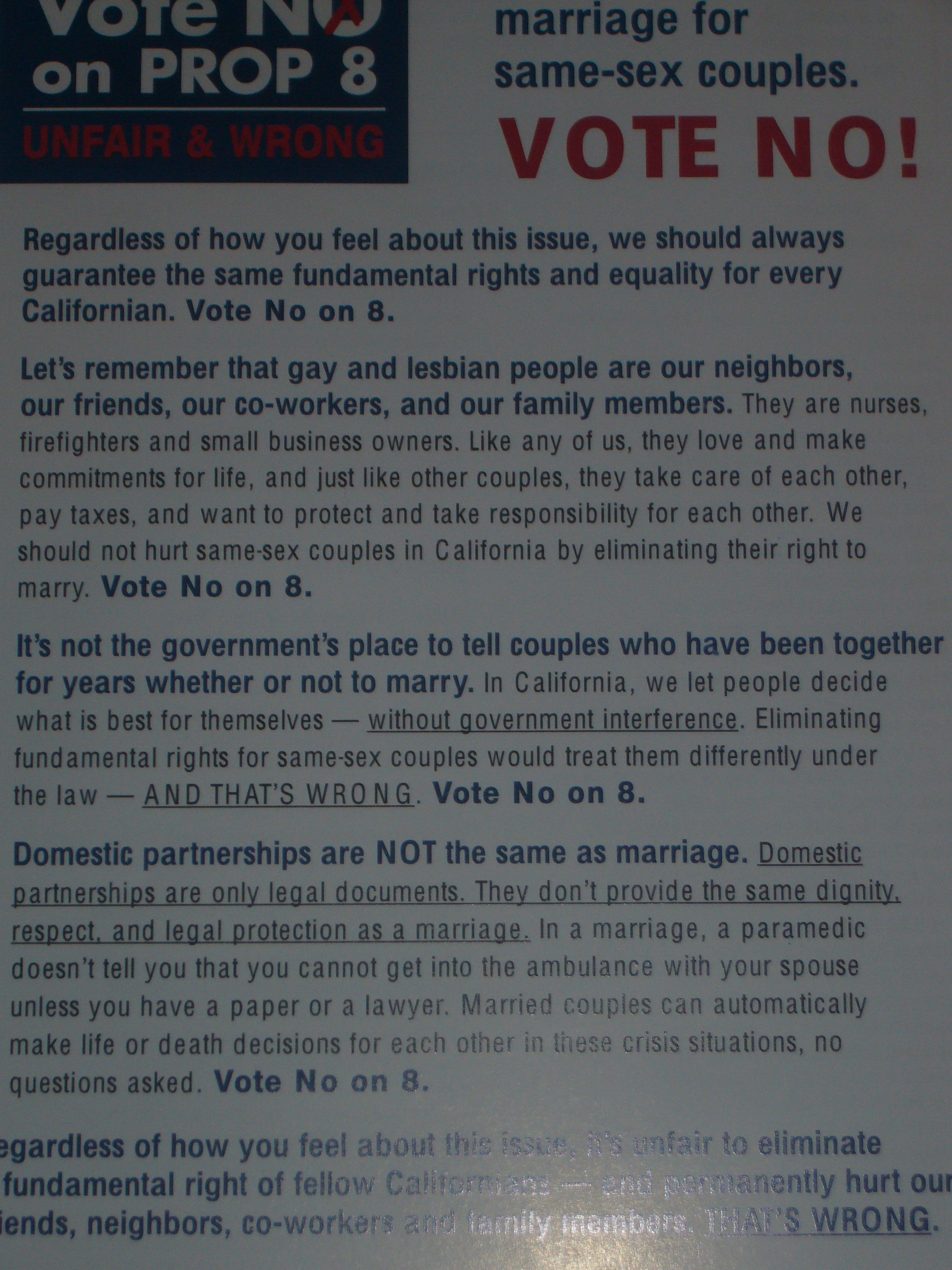
While leaving work today I was handed a “No on Prop 8” leaflet.  For those of you not living in CA, prop 8 seeks to undo our state Supreme Court’s recent decision to remove gender requirements from the institution of marriage.  In CA, same-sex couples in a domestic partnership already had identical rights and obligations as their married counterparts.  Their “package” was simply being called by a different name (domestic partnership vs. marriage).  In effect, the Supreme Court simply demanded that they be given a name change.  And they have been, against the express will of the people.  In response, the people of CA organized a ballot initiative to amend our state constitution to define marriage as being between one man and one woman only.  The people handing out the leaflet I received today oppose this initiative.

As I expected, the leaflet was a propaganda piece full of half-truths and sophistry.  Rather than reproducing this piece, I’ll just refer you to the picture above.  To read the text just click the picture (it will magnify it).  I would like to bring some of the most blatant rhetoric to your attention.  There are five paragraphs, but I will only respond to the first four:

#1 They claim same-sex marriage is a fundamental right, but since when?  It has not been recognized by any society in history until a decade ago.  A right no one recognized until 10 years ago can hardly be considered fundamental.  Just because a handful of people in black robes declare it to be a fundamental right by judicial fiat, does not make it one in reality.

As for equality, I agree.  But the law already afforded equality to all Californians.  Everyone had an equal right to marry a non-relative of the opposite sex.  The law did not stipulate that homosexuals could not marry.  Homosexuals are just as free to take advantage of the institution of marriage as are heterosexuals, but if they wish to avail themselves of this right, they need to marry someone of the opposite sex.  The fact that they choose not to afford themselves of this right is not grounds for radically changing the historic understanding of marriage.

#2 Yes, same-sex couples are our neighbors, but what follows from that?  People in Utah have polygamists as their neighbors, but does that mean society must redefine the number of participants in a marriage?  No, so why should the fact that we have gay neighbors cause us to redefine the gender requirements of civil marriage?

They claim that same-sex couples are hurt by not giving their legally-recognized unions the name “marriage,” but how?  Because they are not accorded the same social approval?  First, we do not alter fundamental social institutions so that some people won’t feel bad.  Second, marriage is a social institution intended to provide social support to relationships society deems important to the success of society.  People in society are free to choose whom to give their support to and whom to deny it.  And many do not wish to extend it to same-sex couples because they do not think their relationships are beneficial to the social fabric (indeed, they may be detrimental).

#3 No, “it’s not the government’s place to tell couples who have been together for years whether or not to marry,” but that is not the issue.  This sentence was either framed poorly, or strategically, because the government isn’t telling anyone-heterosexual or homosexual-whether or not to marry.  It only tells them the requirements they must meet if they wish to marry.  But if they were to have worded it this way, it is clearly wrong.  The government represents the people, and the people of this country have the right to define the requirements for marriage; i.e. which relationships they will and will not extend their social approval and support to.  That’s not to say they can be arbitrary in their definition, but clearly that is not the case in this country.  There are principled reasons we define marriage the way we do, and those reasons make no room for same-sex couples.

They claim we let people decide what’s best for themselves in CA.  No, we don’t.  I decided it’s best for me to be able to talk on my cell phone in my car, but the government decided it wasn’t.  Taken at face-value, what they are advocating is anarchy.  And I find it ironic that the pro-Prop 8 prop are speaking negatively of “government interference” when they have been working ferociously over the last 20 years to intimately involve government in this issue.  If they truly eschewed government interference, they would not be asking for the state of CA to recognize and regulate their relationships.

#4 In one sense it’s true that domestic partnerships are not the same as marriage.  But where do they differ?  You might be surprised to know that in CA they are the same in all but the name.  Domestic partnerships afford same-sex couples all the same rights and responsibilities as marriage.  That’s why it is disingenuous on their part to bring up the issue of medical power-of-attorney.  Domestic partnerships already give same-sex couples such rights.  The only thing domestic partnerships do not afford same-sex couples is “the same dignity” and “respect.”  But why ought they be given such when their relationships do not function in the same way in society, and when many people consider their sexual mores immoral?  I see no reason to.

I hope my fellow Californians will join me in voting YES on prop 8.

It’s official.  Connecticut is now the third state in the nation to legalize same-sex marriage.  Just as Massachusetts and California, this was the result of a ruling by the state Supreme Court, not an expression of the will of the people.  It’s amazing how these courts keep discovering rights in their constitutions that hundreds of justices had not seen before!  I’m sure this will not be the last court to do so.  This seems to be a trend, and I see no end in sight.

According to the AP, the civil union law CT passed in 2005 essentially granted same-sex couples all the rights and benefits available to heterosexual married couples, so as I noted in my comments on the CA case in which same-sex marriage was legalized, it only makes sense to extend the name “marriage” to the package of benefits already conceded.  We are finding ourselves in the bed of our own making.  Did we honestly think we can give legal recognition and benefits to same-sex couples, and yet deny them the name by which we identify that packet of benefits?

In an article published yesterday at Townhall, Frank Turek writes about same-sex marriage and how it will affect society. Not only did Frank advance a nearly-identical argument to the one I have been advancing here on this blog (a secular, rather than religious argument), but he brought to my attention a pro-homosexual advocate who has written a book opposing same-sex marriage for many of the same reasons.

In his book, The Future of Marriage, David Blankenhorn argues that “Across history and cultures . . . marriage’s single most fundamental idea is that every child needs a mother and a father. Changing marriage to accommodate same-sex couples would nullify this principle in culture and in law.” Blankenhorn sees this as a problem.

Why? It’s not because people will stop having children. It’s because the parents will not be tied to the children as they are in a marriage. Dissolution rates of non-married parents are 2-3 times greater than married parents. And the social ills resulting from broken families are enormous.

I couldn’t agree more. And I am glad that a pro-gay Democrat is making this argument. It shows that one does not need to be religious or morally conservative to see why same-sex marriage is not good for society. Marriage is about children, but same-sex relationships are not about children: they are about the couple themselves.

Blankenhorn recognizes that there is a difference between allowing homosexuals to engage in homosex and establish lasting relationships with each other, and officially recognizing those relationships as an example of marriage.

Here’s a couple of quote-worthy statements from Turek. Turek on why the legal recognition of same-sex couples is detrimental to the institution of marriage:

“There’s no question that liberalized marriage laws will help change our attitudes and behaviors about the purpose of marriage. The law is a great teacher, and if same-sex marriage advocates have their way, children will be expelled from the lesson on marriage.”

Turek on the notion that marriage is not about children:

“Well, if marriage isn’t about children, what institution is about children? And if we’re going to redefine marriage into mere coupling, then why should the state endorse same-sex marriage at all? Contrary to what homosexual activists assume, the state doesn’t endorse marriage because people have feelings for one another. The state endorses marriage primarily because of what marriage does for children and in turn society. Society gets no benefit by redefining marriage to include homosexual relationships, only harm as the connection to illegitimacy shows. But the very future of children and a civilized society depends on stable marriages between men and women. That’s why, regardless of what you think about homosexuality, the two types of relationships should never be legally equated.”

Why do governments involve themselves in the regulation and promotion of marriage? Are they interested in promoting romantic love? Are they interested in personal happiness and fulfillment? While romance, personal happiness, and fulfillment may be part of marriage, these are not the reasons government involves itself in the marriage business. They regulate and promote marriage because they have a vested interest in the production and socialization of children. Children are needed for the perpetuation of society, and those children need to be properly socialized so they can be productive members of society. Heterosexual couples, and heterosexual couples alone are capable of delivering on these government interests, and thus their relationship has been privileged, promoted, and regulated by the government.

Apart from children there is no reason for the government to sanction or regulate any private relationship in any official capacity, including same-sex relationships. Seeing that same-sex relationships have nothing to do with the purpose for which civil marriage is enacted; therefore, same-sex relationships are not entitled to the benefits of marriage. They may enjoy the same love and commitment heterosexual couples enjoy, but they are not equally situated to heterosexual couples because they cannot produce children. Their relationships do not serve the same function in, and for society, and thus there is no need to officially recognize their relationships anymore than there is a need for the government to officially recognize friendships. As important as we might deem these relationships to be, they do not need, nor do they deserve the same sort of social support as marriage.

How We Got Here, and What We Can Do About It

The reason our society has come to give official recognition to same-sex relationships in varying degrees is because we have redefined the purpose of marriage so that children stand at the periphery, rather than the center. Marriage is now being defined in terms of love, commitment, and personal fulfillment rather than children. Given this redefinition it is no wonder we have considered it “only fair” to extend marriage benefits to same-sex couples.

We will only succeed in saving marriage to the degree that we can restore a cultural understanding that marriage is fundamentally about children. Unfortunately, most Christians have bought into the cultural redefinition of marriage themselves, which is why many have been fooled into believing that so long as we retain the exclusive use of the word “marriage” to describe our legally recognized relationship, we have succeeded in preserving the historic definition of marriage. While this may preserve the form of marriage (one man, one woman), it does so only at the expense of abandoning its purpose (procreation and socialization). Given the fact that the historic form of marriage is logically tied to its historic purpose, if we cede that purpose we have no further basis on which to argue for its form. It does us little good to fight over who gets to use the “M” word to describe their legally recognized relationship unless we also fight to reclaim the historic purpose of marriage, and its exclusive right to legal recognition and social support.

For a fuller treatment, including answers to the most common objections, see my article “I Now Pronounce You Man and Man?”: An Argument Against Same-Sex Marriage

Speaking of same-sex marriage, in a 4-3 decision the CA Supreme Court has declared that same-sex couples have the right to have their legally recognized relationships called “marriage.” We are only the second state in the nation to do so (MA was the first back in 2004).

The headlines and news articles are saying the Court approved same-sex marriage, but that is not true. What they did was all that was left for them to do: to give the name “marriage” to those who are already married in the practical sense of the word. Domestic partnerships in CA were already identical to marriage in every respect, but without the name. While on a practical level, then, this ruling doesn’t mean much, it is huge in terms of political and social significance. While not much more than a name (marriage) separated domestic partnerships from marriage in CA, there is a lot in a name! Now that same-sex couples have the benefits as well as the name “marriage,” they have made a huge step forward in achieving social approval. Furthermore, as goes CA, so goes the nation.

I have not read the opinion of the court (it hasn’t been released yet to my knowledge), but the news article reported this little excerpt from the majority opinion (penned by Chief Justice Ronald George: “In contrast to earlier times, our state now recognizes that an individual’s capacity to establish a loving and long-term committed relationship with another person and responsibly to care for and raise children does not depend upon the individual’s sexual orientation.” Say what? Nothing in the wording of the constitution has changed in regards to this issue, so what does earlier versus later times have to do with anything? Oh, I forgot. These judges don’t think it’s their job to interpret the Constitution. They think it is their job to institute progressive public policy when the public is apparently too stupid to do so. Infuriating!

While the law is a moral enterprise on its face, it is not possible, nor is it wise to legislate against every kind of moral wrong.For example, while it is morally wrong to deliberately harm one’s body, and smoking cigarettes deliberately harms one’s body, it is generally not advisable to deny one the freedom to smoke cigarettes by outlawing smoking.The general principle is that we should only legislate against moral wrongs that have a major impact on the common good, or interfere with the exercise of the fundamental rights of our fellow citizens.A certain measure of liberty should be left to the individual to choose even those things that are morally wrong, because outlawing that evil may result in an overall increase in evil, and because it is practically impossible for the State to legislate against every form of moral wrong, yet alone to enforce it.

Some attempt to employ this principle as an argument for the legalization of same-sex marriage.It is argued that since liberty is to be preferred to constraint unless an exercise of liberty is to the detriment of the common good, the liberty of marriage should be extended to same-sex couples (even though same-sex marriage is immoral) because same-sex relationships are not detrimental to the public good.How might opponents of same-sex marriage respond to this argument?

While it is true that we should not legislate against all instances of moral wrong, this principle cannot be employed indiscriminately.If it were, no laws aimed at prohibiting immoral behavior could be passed!The burden of proof is on the person arguing we should not legislate against this or that particular moral wrong, to show why we should not do so.In this case, it is being argued that same-sex marriage, though morally wrong, does not negatively affect the public good.Like smoking, then, it should not be prohibited.Is it true that same-sex marriage will not impact the public good in a negative way?There are good reasons to think this is false.

First, extending the institution of marriage to same-sex couples is social declaration that homosexual sex/relationships and heterosexual sex/relationships are equal.This is manifestly false.The purpose of heterosexual sex and homosexual sex are very different (the former is for procreation and recreation, while the latter is only for recreation), as well as the health risks involved with both behaviors.There are virtually no health risks for engaging in monogamous heterosexual sex, but there are many health risks for engaging in (even) monogamous homosexual acts.

Second, it is a social declaration that moms and dads are not necessary for optimal child development.There is no denying the fact that the legal recognition of same-sex couples to adopt and rear children naturally and legally follows from the legal recognition of same-sex relationships as a valid form of civil marriage (in some instances the legal right to adopt actually precedes the legal recognition of same-sex relationships as a valid form of civil marriage).Granting marriage rights to same-sex couples, then, has ramifications for child-rearing.To recognize same-sex relationships as civil marriage is a tacit admission that moms and dads are not necessary for optimal child development—that two moms or two dads will equally suffice.This is wrong.Both moms and dads are needed for optimal child development.

This argument also fails because it ignores the critical difference between allowing people to participate in certain immoral behaviors without the threat of law, and actively declaring through the law that such behaviors are legally protected.The law is a moral teacher.To enshrine something into law is to make a moral declaration about that something: that it is good, or that it is bad.To give legal sanction to same-sex marriage where such sanction did not exist previously would require the creation of new legislation to redefine the institution of marriage.This legislation would have the effect of actively declaring that our society finds same-sex marriage to be a moral good.This is utterly different than the situation we find ourselves in today, in which same-sex couples can openly engage in committed relationships with one another, but without the blessing of society.The difference is one of social approval.Allowing them to engage in committed relationships without the threat of law is to grant them liberty; sanctioning their relationships by enacting laws recognizing their relationships as valid instantiations of civil marriage is to grant them social acceptance.

Ultimately, then, the argument from liberty fails.We should not open up the institution of marriage to same-sex couples.Not only would same-sex marriage negatively impact the common good of our society, but doing so would have the implicit effect of teaching society that a moral wrong is a moral good.

An Iowa judge has ruled that Polk County’s marriage laws are unconstitutional because they forbid same-sex couples from the institution of marriage. Judges forcing same-sex marriage on the citizens is becoming so common. Hopefully the judges decision will be overturned on appeal.

« Previous PageNext Page »