Archaeology


Oded Golan with the James Ossuary

Oded Golan, an antiquities collector, and Robert Deutsch, an antiquities dealer, were acquitted today of forgery charges brought against them by the Israeli Antiquities Authority (IAA).  The IAA had charged these men with forging some of the most famous and recent finds related to Biblical archaeology including the James Ossuary, Jehoash Inscription, Ivory Pomegranate, and Three Shekels ostracon

The verdict does not prove that these artifacts are authentic. It only shows that the prosecution could not prove it beyond a reasonable doubt.  But given the fact that the trial lasted five years, there were 138 witnesses, and 400 exhibits, the fact that the IAA could not demonstrate that these artifacts are forgeries says a lot.  There are good reasons to think they are authentic, and there are world-renowned experts in the field who agree with this conclusion.

I wonder how the media will report this given the fact that most media outlets have been referring to the James Ossuary as a forgery simply based on the IAA’s charge.  If you see any media reports, please provide the link in the comments.
I’ve been sitting on this report for several months now….

The Merneptah Stele, dated to between 1210 – 1205 BC, has long been thought to contain the earliest extra-biblical reference to “Israel.”  However, there may be a reference to Israel in an artifact that is ~200 years older than Pharaoh Merneptah’s stele, but has been lying unnoticed in a museum storeroom for nearly 100 years.

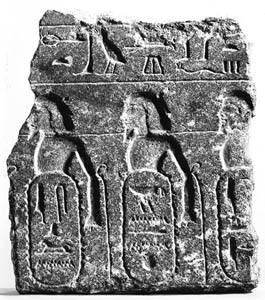
University of Munich Hebrew scholar and Egyptologist, Manfred Görg, recently discovered a small granite slab in the storeroom of the Egyptian Museum of Berlin that he and a couple of colleagues argue contains a reference to Israel that predates the Merneptah Stele by ~200 years.[1]

The 18” x 15.5” fragment is believed to have been part of a pedestal for a statue. It contains two wholly preserved and one partially preserved Egyptian “name rings.”  Pharaohs would often record their exploits by listing in rows the names of all the cities or peoples they conquered. The name of the city was written in a round-edged rectangle, and above this name ring was a pictorial representation of the people of that city – consisting of a head and upper torso.

(more…)

This slideshow requires JavaScript.

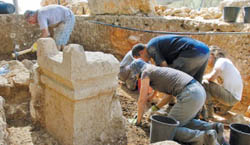
On July 27, 2011, the day after the announcement of the discovery of the Philistine horned altar, Francesco D’Andria, who has been excavating in the ancient city of Hierapolis for 32 years, announced the discovery of the tomb of the Apostle Philip.  The grave has not been opened yet, but he’s convinced it belongs to Philip.

There is a church dedicated to St. Philip on Martyr’s Hill in Hierapolis, but Philip’s grave was never found there.  But in June D’Andria unearthed another church just 131 feet away.  There, they discovered a tomb.  D’Andria believes Philip’s body was moved from the St. Philip church on Martyr’s Hill to this newly discovered church sometime in the 5th century.

(more…)

On July 26, 2011–just two days after the announcement of the golden bell discovery–archaeologists announced the discovery of a 3’ tall Philistine altar in the ancient city of Gath (the city of Goliath).  It has two horns, which is similar to the Israelite altars described in the Hebrew Bible (Exodus 27:1–2; 1 Kings 1:50).  Israel’s altars differed in that they had four horns.  The altar has been dated to the 9th century BC.

Significance:

  1. This is further confirmation of the fact that the authors of Scripture were intimately familiar with the cultures they wrote about, and thus must have lived relatively close in both geographical and temporal proximity to them.

Mk 12:41-44  And Jesus having sat down over-against the treasury, was beholding how the multitude do put brass into the treasury, and many rich were putting in much, 42 and having come, a poor widow did put in two mites (lepta), which are a farthing [kodrantes]. 43 And having called near his disciples, he saith to them, “Verily I say to you, that this poor widow hath put in more than all those putting into the treasury; 44 for all, out of their abundance, put in, but she, out of her want, all that she had put in — all her living.” (NLT)

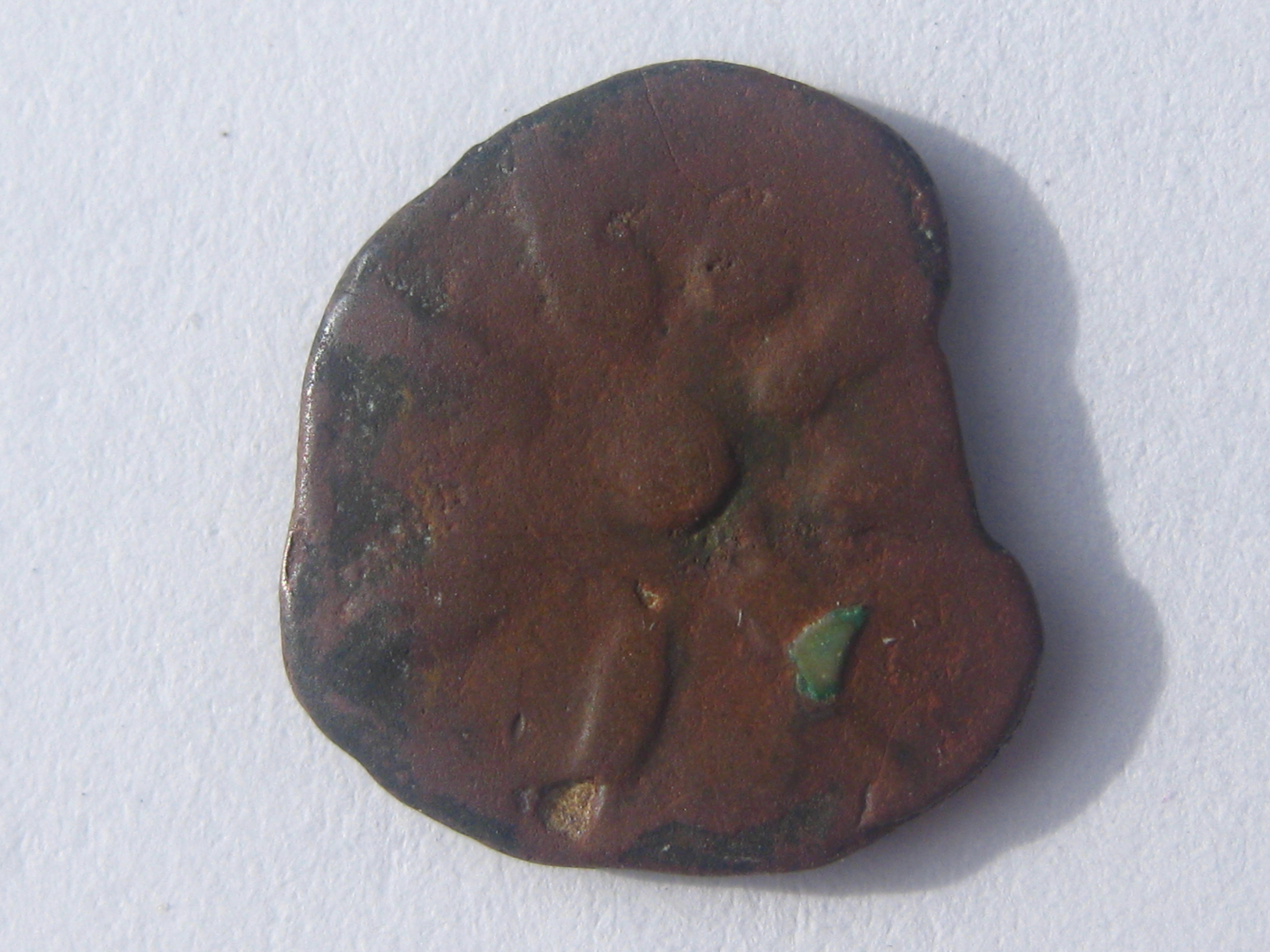
Previously I blogged on a Constantine I coin that was given to me. Now, I’ve been given a mite (also known as a lepton).  A mite was the smallest coin with the smallest monetary worth. It was worth half a quadrans. A quadrans was worth 1/64 of a denarius, which was a day’s wage, so a mite was worth 1/128 of a denarius.  In other words, this is what the average person would make for six minutes worth of work (assuming a 12 hour work day). How much was a mite worth, then? By today’s standards, it would be worth ~$0.56 (assuming a $6 per hour rate for 12 hours). Two mites, then, was little more than a dollar by today’s standards.  It is strange, then, that so many translations render Mk 12:41 as “penny,” “cent,” “less than a penny,” or something similar. The 2011 NIV and CEV are closest when they translate it as a few cents/pennies, but even this is severely undervalued. Whatever it may be worth, here is a picture of my mite:

Front of mite

(more…)

This slideshow requires JavaScript.

Ex 28:31-35  “You shall make the robe of the ephod all of blue. 32 It shall have an opening for the head in the middle of it, with a woven binding around the opening, like the opening in a garment, so that it may not tear. 33 On its hem you shall make pomegranates of blue and purple and scarlet yarns, around its hem, with bells of gold between them, 34 a golden bell and a pomegranate, a golden bell and a pomegranate, around the hem of the robe. 35 And it shall be on Aaron when he ministers, and its sound shall be heard when he goes into the Holy Place before the Lord, and when he comes out, so that he does not die. (ESV, see also Ex 39:26).

On July 24, 2011 it was announced that a 2000 year old golden bell was discovered in an ancient sewer inside the Old City walls of Jerusalem (a few paces from the Temple Mount) last week.  It is only one half inch in size.  It contains a small loop on the top so it can be sewn onto a garment.  Given the requirement for golden bells to be attached to the high priest’s robe, it is quite possible that this bell was once attached to the robe of one of the high priests.

Interestingly the bell still makes a sound!

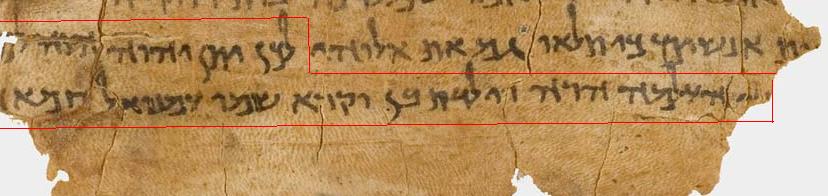
The Israel Museum teamed up with Google to make high-resolution, searchable images of the Dead Sea Scrolls available online.  It even provides a translation for you.  To begin with, only five scrolls are available for viewing.  Two of them are Biblical documents: the Great Isaiah Scroll, the Habakkuk commentary.  This is really cool!

FYI, last month I posted a link to a site that allowed you to view the Great Isaiah Scroll.  That link is now connected to the Israel Museum/Google Dead Sea Scroll site.

The picture above is a picture of Isaiah 7:14 in the Great Isaiah Scroll.


Acts 14:5-6  When an attempt was made by both Gentiles and Jews, with their rulers, to mistreat them and to stone them, 6 they learned of it and fled [from Iconium] to Lystra and Derbe, cities of Lycaonia, and to the surrounding country. (ESV)

This passage was in historical dispute for many years because it says Lystra and Derbe were cities in the district of Lycaonia, implying that Iconium (from which Paul had just come) was not.  This conflicted with later Roman writers such as Cicero(106-43 BC), who said Iconium was in Lycaonia.  In the words of William Ramsay, this made as much sense as talk of leaving London to go to England.[1]

At this point in the story, many apologetic treatments of this will tell you that in 1910 Sir William Ramsay, the famed archaeologist, discovered an inscription which proved that Iconium was not part of Lycaonia, but part of Phrygia.  Some even add that it proved Iconium was in Phrygia between AD 37-72.  I have read this a million times.  In fact, I have even taught it.  But as I was preparing for this series I became skeptical of the claim for a few reasons.  First, I noticed that different sources provided different years for the discovery (1910 and 1911).  Secondly, no one ever quoted Ramsay himself.  If any footnotes were provided at all, it was always to some other source.  Thirdly, no one ever provided a translation of the inscription.  All of this made me think “urban legend.”  So I did some digging and discovered that the claim is a mixed back of truth and error.

(more…)

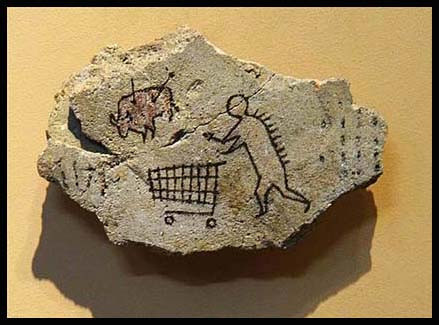
The earliest archaeological evidence for grocery shopping.

This slideshow requires JavaScript.

Acts 18:12-18  But when Gallio was proconsul of Achaia, the Jews made a united attack on Paul and brought him before the tribunal, 13 saying, “This man is persuading people to worship God contrary to the law.” 14 But when Paul was about to open his mouth, Gallio said to the Jews, “If it were a matter of wrongdoing or vicious crime, O Jews, I would have reason to accept your complaint. 15 But since it is a matter of questions about words and names and your own law, see to it yourselves. I refuse to be a judge of these things.” 16 And he drove them from the tribunal. 17 And they all seized Sosthenes, the ruler of the synagogue, and beat him in front of the tribunal. But Gallio paid no attention to any of this. (ESV)

Luke speaks of a Gallio who was proconsul of Achaia.  Scholars doubted his existence because it didn’t appear anywhere in the history books and no artifacts had been found bearing his name.  But in 1905 a doctoral student sifted through some inscriptions collected from Delphi.  He discovered nine fragments that formed a message from Emperor Claudius.  In the text Claudius writes “Gallio, my fr[iend] an[d procon]sul….”[1]  The inscription was etched into a stone that was likely attached to the Temple of Apollo.

(more…)

This slideshow requires JavaScript.

Mt 13:55  Is not this the carpenter’s son? Is not his mother called Mary? And are not his brothers James and Joseph and Simon and Judas? (ESV)

Gal 1:19  But I saw none of the other apostles except James the Lord’s brother. (ESV)

James the brother of Jesus became the first bishop of the Jerusalem church (Acts 15) and wrote a NT epistle.  He died in AD 62 when he was thrown from the temple and then stoned to death by the Sanhedrin.

In 2002, antiquities dealer Oded Golan rocked the archaeological world and caused a media stir when he announced the existence of an ossuary that was purported to belong to James, the brother of Jesus Christ.  What is his basis for this claim?  The side of the ossuary contains an Aramaic inscription that reads, “James son of Joseph brother of Jesus.”

(more…)

This slideshow requires JavaScript.

Matthew, Luke, and John record the role of Caiaphas the high priest in the trial and death of Jesus (Mt 26:3, 57; Lk 3:2; Jn 11:49, 18:13, 14, 24, 28; Acts 4:6).  Recently, we discovered his “coffin.”

In 1967, following the Six Day War, the Jerusalem Peace Forest was constructed to link the eastern and western parts of Jerusalem together.  In 1990, a project was undertaken to build a water park in the Peace Forest.  While digging, they hit the ceiling of an ancient room, and it collapsed.  Archaeologists were called in to investigate.  Upon investigation they determined that the room was an ancient tomb.  They found 12 ossuaries (little boxes used to store the bones of the deceased).  Ossuaries were only used by Jews between ~50 BC and AD 70, so they knew these ossuaries probably dated to the 1st century.[1]

(more…)

This slideshow requires JavaScript.

Pilate was the Roman Prefect over Judea from AD 26-36.  All four gospels record his involvement with the trial of Jesus, and his authorization to crucify Jesus.  The Bible, however, is not the only literary source for information about Pilate.  He is also attested to in the works of three men who lived in the first-century AD: Tacitus (Roman senator and historian, AD 56-117), Josephus (Jewish historian, AD 37-100), and Philo (Jewish philosopher and theologian, 20 BC – AD 50).  Tacitus writes: (more…)

Jn 19:31-33  Since it was the day of Preparation, and so that the bodies would not remain on the cross on the Sabbath (for that Sabbath was a high day), the Jews asked Pilate that their legs might be broken and that they might be taken away. 32 So the soldiers came and broke the legs of the first, and of the other who had been crucified with him. 33 But when they came to Jesus and saw that he was already dead, they did not break his legs. (ESV)

Jn 20:25  So the other disciples told him, “We have seen the Lord.” But he said to them, “Unless I see in his hands the mark of the nails, and place my finger into the mark of the nails, and place my hand into his side, I will never believe.”

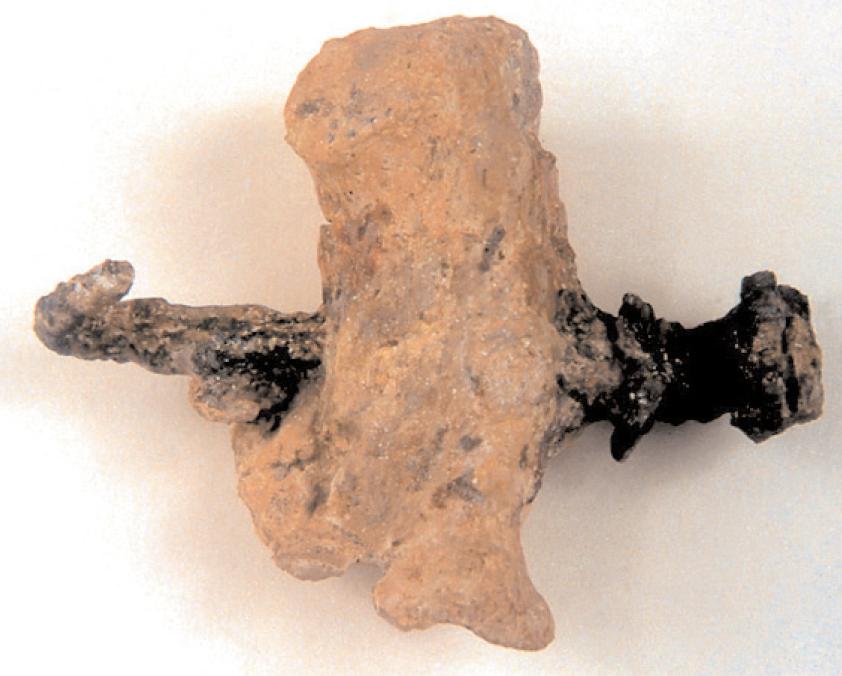
Some scholars used to think the crucifixion story was contrived because it was thought that the Romans used ropes, not nails, to secure victims of crucifixion to the cross.  It was also thought that such victims were only thrown in common graves, not given proper burials.  But in 1968 Vassilios Tzaferis found an ossuary containing the bones of Yohanan Ben Ha’galgol in northern Jerusalem.  It was contained in a tomb with ~35 other bodies.  Yohanan was killed by crucifixion sometime between AD 7-70.  He still had a 7” nail in his right heel and his legs were broken (as described in Jn 19:32-33).  Apparently the nail in his right heel had hit a knot in the wood of the cross and could not be removed from the ankle when attempting to remove Yohanan from the cross.  To get him off the cross they had to remove part of the cross itself, leaving the nail in his heel.

(more…)

This slideshow requires JavaScript.

Mark 1:29-34  And immediately he left the synagogue and entered the house of Simon and Andrew, with James and John. 30 Now Simon’s mother-in-law lay ill with a fever, and immediately they told him about her. 31 And he came and took her by the hand and lifted her up, and the fever left her, and she began to serve them. 32 That evening at sundown they brought to him all who were sick or oppressed by demons. 33 And the whole city was gathered together at the door. 34 And he healed many who were sick with various diseases, and cast out many demons. And he would not permit the demons to speak, because they knew him. (ESV)

In 1921 Franciscan archaeologists uncovered a 5th century building made up of three co-centric octagons[1] that was, by tradition, built over the site of Peter’s house.  It is only 84’ from the synagogue in Capernaum.  It was not until excavations were renewed in 1968 that they found an apse and a baptistery, making it possible to identify this structure as a basilica.

(more…)

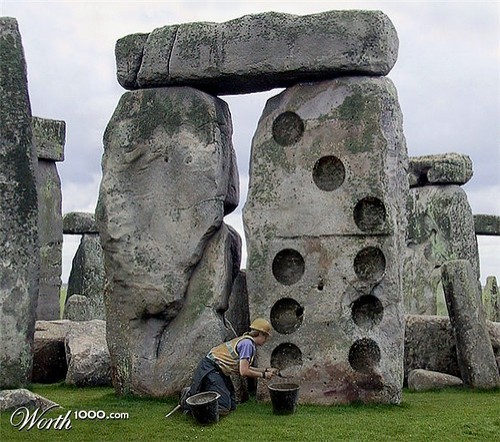
At long last archaeologists have finally determined the purpose of Stonehenge.

This slideshow requires JavaScript.

After being rejected in Nazareth (Luke 3:23; 4:16-30), Jesus went to Capernaum and stayed with Peter (Mt 4:13; Mk 2:1). Capernaum continued to be his base of operations for the rest of Jesus’ ministry.  Many important events occurred in Capernaum, some of them in the synagogue there. Capernaum is where:

  • Jesus taught in the synagogue (Mk 1:21; 3:1; Jn 6:59).
  • Jesus healed the man with the withered hand in the synagogue (Mk 3:1-6)
  • Jesus cast out a devil from a man in the synagogue (Lk 4:31-37)
  • Jesus said one must eat His flesh and drink His blood to have life (Jn 6:48-60)
  • the man with palsy was lowered through the roof (Mk 2:1-12)
  • the coin was found in the fish’s mouth to pay the tribute (Mt 17:24-27)
  • the centurion’s servant met Jesus to seek healing for his master’s beloved servant (Lk 7:1-10)

(more…)

Luke 3:1  In the fifteenth year of the reign of Tiberius Caesar, Pontius Pilate being governor of Judea, and Herod being tetrarch of Galilee, and his brother Philip tetrarch of the region of Ituraea and Trachonitis, and Lysanias tetrarch of Abilene. (ESV)

Luke mentions a “Lysanias” the tetrarch who was in power in AD 29, but there was no historical record of him outside of Luke’s account.  But then an inscription near Damascus was found reading, “For the salvation of the Au[gust] lords and of [all] their household, Nymphaeus, free[dman] of Ea[gle] Lysanias tetrarch established this street and other things.”

(more…)

This slideshow requires JavaScript.

Jn 9:6-11  [H]e spat on the ground and made some mud with the saliva. He smeared the mud on the blind man’s eyes 7 and said to him, “Go wash in the pool of Siloam” (which is translated “sent”). So the blind man went away and washed, and came back seeing. 8 Then the neighbors and the people who had seen him previously as a beggar began saying, “Is this not the man who used to sit and beg?” 9 Some people said, “This is the man!” while others said, “No, but he looks like him.” The man himself kept insisting, “I am the one!” 10 So they asked him, “How then were you made to see?” 11 He replied, “The man called Jesus made mud, smeared it on my eyes and told me, ‘Go to Siloam and wash.’ So I went and washed, and was able to see.” (NET)  See also Isaiah 8:6 and Nehemiah 3:15.

Historically there have been three pools called Siloam.  The first was built by Hezekiah (it has not been discovered).  The second was the one that existed in Jesus’ day, built in the early 1st century BC.  The third was the site at which Empress Eudocia built a church in the 5th century.

(more…)

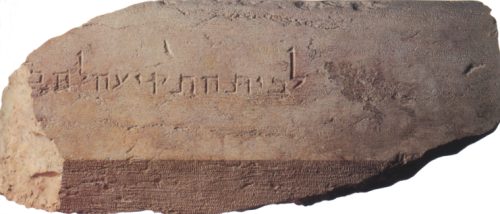
A stone measuring 8’ x 3’3” with a Hebrew inscription that reads “To the Trumpeting Place to [proclaim] [separate]” was excavated by Eilat Mazar at the southern foot of the Temple Mount in the 1970s.

The trumpeting place is where the priests would stand to blow trumpets announcing the beginning and end of the Sabbath.  This is believed to be a part of the Second Temple.  It is currently located in The British Museum.

Significance:

  1. This inscription is possibly part of the very temple Jesus regularly visited.

« Previous PageNext Page »