Archaeology


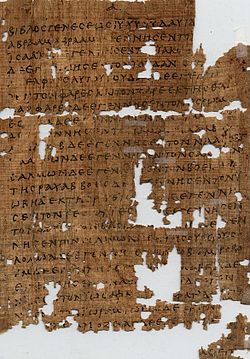
Papyrus 1 (p1) -- The first papyrus NT manuscript ever discovered

In ancient Egypt there was a city called Per-Medjed, which was the capital of the 19th Upper Egyptian Nome.  After the conquest of Egypt by Alexander the Great in 332 BC, the city was reestablished as a Greek town, called Oxyrhynchou Polis (“town of the sharp-snouted fish”).  In Hellenistic times, Oxyrhynchus was 3rd largest city in Egypt.  Outside the city was a series of garbage dump sites, at which the inhabitants of Oxyrhynchus would dump their garbage.  They dumped their garbage there for more than 1,000 years.

Beginning in 1896 archaeologists discovered 500,000 papyri buried in these dump sites.  Ten percent of the texts were literary documents.  The rest consisted of public and private documents: codes, edicts, registers, official correspondence, census-returns, tax-assessments, petitions, court-records, sales, leases, wills, bills, accounts, inventories, horoscopes, and private letters.  Some of literary texts were Christian documents: (more…)

This slideshow requires JavaScript.

Between 1947 and 1956 a total of 972 ancient documents were discovered in 11 different caves near Khirbet Qumran on the northwest shore of the Dead Sea (~13 miles from Jerusalem).[1]  Approximately 25% of the texts contain Biblical texts.  The rest were apocryphal texts (Tobit, Enoch, Jubilees, etc), or texts peculiar to the community that copied them (Community Rule, War Scroll, etc.).  Every book of the Hebrew Bible, except Esther and Nehemiah[2], is among them. 

The manuscripts are written in Hebrew, Aramaic, and Greek, and are dated between 250 BC and AD 70.

(more…)

This slideshow requires JavaScript.

2 Kings 25:26  Then all the people, both small and great, and the captains of the forces arose and went to Egypt, for they were afraid of the Chaldeans. (ESV)

Nehemiah 2:17-19  Then I said to them, “You see the trouble we are in, how Jerusalem lies in ruins with its gates burned. Come, let us build the wall of Jerusalem, that we may no longer suffer derision.” 18 And I told them of the hand of my God that had been upon me for good, and also of the words that the king had spoken to me. And they said, “Let us rise up and build.” So they strengthened their hands for the good work. 19 But when Sanballat the Horonite and Tobiah the Ammonite servant and Geshem the Arab heard of it, they jeered at us and despised us and said, “What is this thing that you are doing? Are you rebelling against the king?” (ESV)

(more…)

This slideshow requires JavaScript.

Ezra 1:1-4  In the first year of Cyrus king of Persia, that the word of the Lord by the mouth of Jeremiah might be fulfilled, the Lord stirred up the spirit of Cyrus king of Persia, so that he made a proclamation throughout all his kingdom and also put it in writing: 2 “Thus says Cyrus king of Persia: The Lord, the God of heaven, has given me all the kingdoms of the earth, and he has charged me to build him a house at Jerusalem, which is in Judah. 3 Whoever is among you of all his people, may his God be with him, and let him go up to Jerusalem, which is in Judah, and rebuild the house of the Lord, the God of Israel—he is the God who is in Jerusalem. 4 And let each survivor, in whatever place he sojourns, be assisted by the men of his place with silver and gold, with goods and with beasts, besides freewill offerings for the house of God that is in Jerusalem.”  (See also 2 Chron 36:22-23 and Is 44:28)

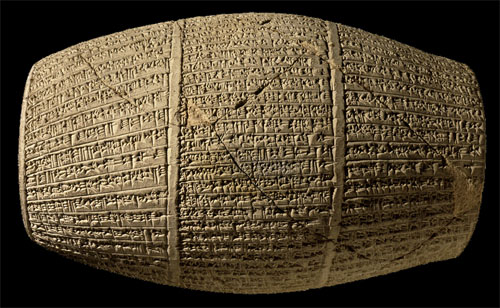
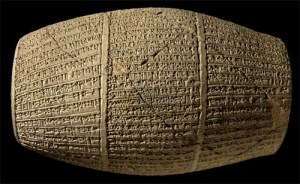
In 1879 a 9” long clay cylinder was discovered in ancient Babylon.  Dating to 539 BC, it records Cyrus’ conquest of Babylon and his decree to let captives return to their lands and restore their temples.  It reads:

(more…)

Daniel 5:1,5-6,13,16-31  King Belshazzar made a great feast for a thousand of his lords and drank wine in front of the thousand. … 5 Immediately the fingers of a human hand appeared and wrote on the plaster of the wall of the king’s palace, opposite the lampstand. And the king saw the hand as it wrote. 6 Then the king’s color changed, and his thoughts alarmed him; his limbs gave way, and his knees knocked together. … 13 Then Daniel was brought in before the king. The king answered and said to Daniel, “You are that Daniel, one of the exiles of Judah, whom the king my father brought from Judah. … 16 But I have heard that you can give interpretations and solve problems. Now if you can read the writing and make known to me its interpretation, you shall be clothed with purple and have a chain of gold around your neck and shall be the third ruler in the kingdom.” 17 Then Daniel answered and said before the king, “Let your gifts be for yourself, and give your rewards to another. Nevertheless, I will read the writing to the king and make known to him the interpretation. 18 O king, the Most High God gave Nebuchadnezzar your father kingship and greatness and glory and majesty. 19 And because of the greatness that he gave him, all peoples, nations, and languages trembled and feared before him. Whom he would, he killed, and whom he would, he kept alive; whom he would, he raised up, and whom he would, he humbled. 20 But when his heart was lifted up and his spirit was hardened so that he dealt proudly, he was brought down from his kingly throne, and his glory was taken from him. 21 He was driven from among the children of mankind, and his mind was made like that of a beast, and his dwelling was with the wild donkeys. He was fed grass like an ox, and his body was wet with the dew of heaven, until he knew that the Most High God rules the kingdom of mankind and sets over it whom he will. 22 And you his son, Belshazzar, have not humbled your heart, though you knew all this, 23 but you have lifted up yourself against the Lord of heaven. And the vessels of his house have been brought in before you, and you and your lords, your wives, and your concubines have drunk wine from them. And you have praised the gods of silver and gold, of bronze, iron, wood, and stone, which do not see or hear or know, but the God in whose hand is your breath, and whose are all your ways, you have not honored. 24 “Then from his presence the hand was sent, and this writing was inscribed. 25 And this is the writing that was inscribed: Mene, Mene, Tekel, and Parsin. 26 This is the interpretation of the matter: Mene, God has numbered the days of your kingdom and brought it to an end; 27 Tekel, you have been weighed in the balances and found wanting; 28 Peres, your kingdom is divided and given to the Medes and Persians.” 29 Then Belshazzar gave the command, and Daniel was clothed with purple, a chain of gold was put around his neck, and a proclamation was made about him, that he should be the third ruler in the kingdom. 30 That very night Belshazzar the Chaldean king was killed. 31 And Darius the Mede received the kingdom, being about sixty-two years old.

(more…)
Remember the discovery reported in all of the news outlets earlier this year of lead codices that would shed new light on early Christianity?  I blogged back in April that these codices appeared to be forgeries.  Since then, more evidence has come rolling in that is decisive in this regard.  The best summary of the evidence is presented in this YouTube video.

http://www.youtube.com/watch?v=HGw0orL78I4&feature=colike

Jeremiah 39:1-3  In the ninth year of Zedekiah king of Judah, in the tenth month, Nebuchadnezzar king of Babylon and all his army came against Jerusalem and besieged it. 2 In the eleventh year of Zedekiah, in the fourth month, on the ninth day of the month, a breach was made in the city. 3 Then all the officials of the king of Babylon came and sat in the middle gate: Nergal-sar-ezer, Samgar-nebu, Sar-sekim the Rab-saris, Nergal-sar-ezer the Rab-mag, with all the rest of the officers of the king of Babylon. 

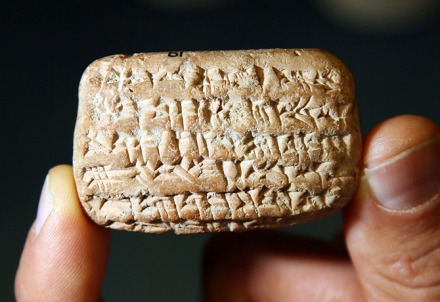
Nebo-Sarsekim was an official under Nebuchadnezzar II, present for destruction of Jerusalem in 586 BC.  He was only known from the Biblical record until his name was discovered in 2007 on a tiny clay cuneiform tablet (2.13”) uncovered in Sippar (one mile from Baghdad) in the 1870s.  It was acquired by the British Museum in 1920, but lay dormant until 2007 when Michael Jursa—associate professor at the University of Vienna—rediscovered it and revealed its contents to the world.

(more…)

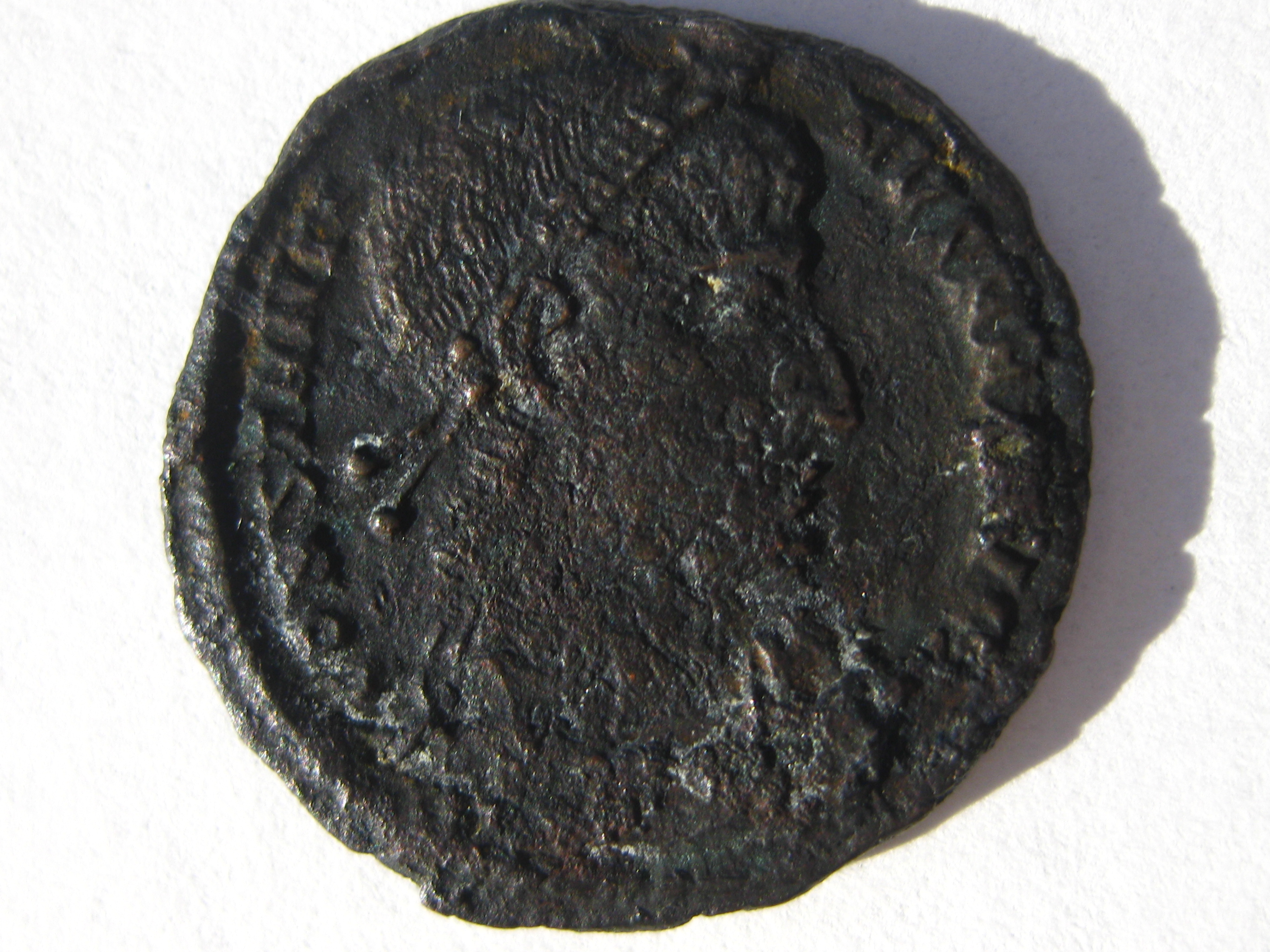
I spent five weeks teaching a series on Biblical archaeology recently (hence all the posts on Biblical archaeology).  Seeing my interest in ancient artifacts, one of the men from our church, Tony, gave me a coin of Constantine I.  Not only was Constantine I the first Christian Roman emperor, but he was also the first Roman emperor to legalize Christianity (technically Emperor Galerius legalized Christianity two years before Constantine, but Galerius’ edict did not restore the Christians’ confiscated property).  Christianity had been an illegal religion for nearly 250 years before Constantine.  He was also the one who called for the first church council at Nicea in AD 325.  And I am the owner of one of the coins minted with his image on it!

(more…)

Jehucal Bulla

Jeremiah 37:3; 38:1-6  King Zedekiah sent Jehucal the son of Shelemiah, and Zephaniah the priest, the son of Maaseiah, to Jeremiah the prophet, saying, “Please pray for us to the Lord our God.” 38:1 Now Shephatiah the son of Mattan, Gedaliah the son of Pashhur, Jucal the son of Shelemiah, and Pashhur the son of Malchiah heard the words that Jeremiah was saying to all the people, 2 “Thus says the Lord: He who stays in this city shall die by the sword, by famine, and by pestilence, but he who goes out to the Chaldeans shall live. He shall have his life as a prize of war, and live. 3 Thus says the Lord: This city shall surely be given into the hand of the army of the king of Babylon and be taken.” 4 Then the officials said to the king, “Let this man be put to death, for he is weakening the hands of the soldiers who are left in this city, and the hands of all the people, by speaking such words to them. For this man is not seeking the welfare of this people, but their harm.” 5 King Zedekiah said, “Behold, he is in your hands, for the king can do nothing against you.” 6 So they took Jeremiah and cast him into the cistern of Malchiah, the king’s son, which was in the court of the guard, letting Jeremiah down by ropes. And there was no water in the cistern, but only mud, and Jeremiah sank in the mud. (ESV)

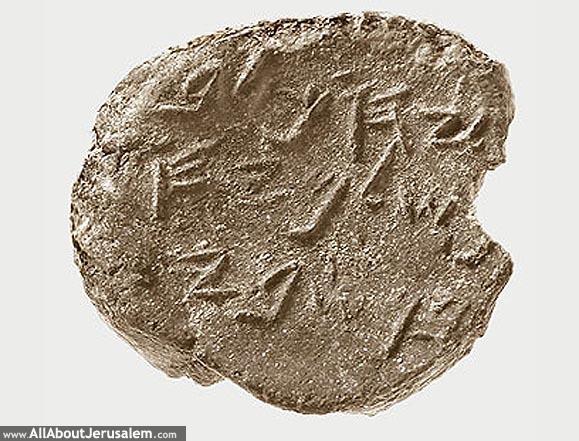
In 2005 Eilat Mazar discovered a bulla bearing Jehucal’s name inside a stone complex (that she thinks is the remains of David’s palace) in Old City Jerusalem, near the Dung Gate.  It is only 0.4”, and dates to the 6th century BC.  (more…)

This slideshow requires JavaScript.

Jeremiah 36:1-2  The Lord spoke to Jeremiah in the fourth year that Jehoiakim son of Josiah was ruling over Judah. 2 “Get a scroll. Write on it everything I have told you to say about Israel, Judah, and all the other nations since I began to speak to you in the reign of Josiah until now. … 4 So Jeremiah summoned Baruch son of Neriah. Then Jeremiah dictated to Baruch everything the Lord had told him to say and Baruch wrote it all down in a scroll. (NET)

In 1975 approximately 200 clay bullae turned up in the hands of a Palestinian antiquities dealer.  One of those bullae (measuring 0.67” x 0.63”) contained an inscription in Paleo-Hebrew on three lines: “Belonging to Berechiah (Baruch) son of Neriah the scribe.”  Berechiah is the name Baruch with the abbreviated divine name (yah) attached at the end.  The bulla is dated to the late 7th or early 6th century BC.

(more…)

2 Chron 32:9a  Afterward King Sennacherib of Assyria, while attacking Lachish with all his military might, sent his messengers to Jerusalem. (NET)

Jer 34:6-7  The prophet Jeremiah told all this to King Zedekiah of Judah in Jerusalem. 7 He did this while the army of the king of Babylon was attacking Jerusalem and the cities of Lachish and Azekah. He was attacking these cities because they were the only fortified cities of Judah which were still holding out. (NET)

In the 1930s archaeologists discovered 21 ostracons in a guard room next to the outer gate at Lachish(~25 miles southwest of Jerusalem).  The ostracons were written by Hoshaiah (Nehemiah 12:32, Jeremiah 42:1, 43:2), a military officer stationed near Jerusalem, and addressed to Joash, the commanding officer at Lachish.

(more…)

2 Kings 24:12; 25:27-30  King Jehoiachin of Judah, along with his mother, his servants, his officials, and his eunuchs surrendered to the king of Babylon. The king of Babylon, in the eighth year of his reign, took Jehoiachin prisoner. [597 BC] … 27 In the thirty-seventh year of the exile of King Jehoiachin of Judah, on the twenty-seventh day of the twelfth month [March 22, 561 BC], King Evil-Merodach [Amel-Marduk] of Babylon [son of Nebuchadnezzar, 562-560 BC], in the first year of his reign, pardoned King Jehoiachin of Judah and released him from prison. 28 He spoke kindly to him and gave him a more prestigious position than the other kings who were with him in Babylon. 29 Jehoiachin took off his prison clothes and ate daily in the king’s presence for the rest of his life. 30 He was given daily provisions by the king for the rest of his life until the day he died.

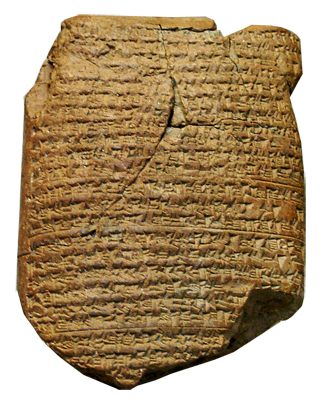
During his excavation of Babylon in 1899-1917, Robert Koldeway discovered a royal archive room of King Nebuchadnezzar near the Ishtar Gate.  It contained tablets dating to 595-570 BC.  The tablets were translated in the 1930s by the German Assyriologist, Ernst Weidner. Four of these tablets list rations of oil and barley given to various individuals—including the deposed King Jehoiachin—by Nebuchadnezzar from the royal storehouses, dated five years after Jehoiachin was taken captive.

One tablet reads:

(more…)

2 Kings 24:1,6,8a,10-17  During Jehoiakim’s reign, King Nebuchadnezzar of Babylon attacked. Jehoiakim was his subject for three years, but then he rebelled against him. 6 He passed away and his son Jehoiachin replaced him as king. … 8 Jehoiachin was eighteen years old when he became king, and he reigned three months in Jerusalem. … 10 At that time the generals of King Nebuchadnezzar of Babylon marched to Jerusalem and besieged the city. 11 King Nebuchadnezzar of Babylon came to the city while his generals were besieging it. 12 King Jehoiachin of Judah, along with his mother, his servants, his officials, and his eunuchs surrendered to the king of Babylon. The king of Babylon, in the eighth year of his reign, took Jehoiachin prisoner. 13 Nebuchadnezzar took from there all the riches in the treasuries of the Lord’s temple and of the royal palace. He removed all the gold items which King Solomon of Israel had made for the Lord’s temple, just as the Lord had warned. 14 He deported all the residents of Jerusalem, including all the officials and all the soldiers (10,000 people in all). This included all the craftsmen and those who worked with metal. No one was left except for the poorest among the people of the land. 15 He deported Jehoiachin from Jerusalem to Babylon, along with the king’s mother and wives, his eunuchs, and the high-ranking officials of the land. 16 The king of Babylon deported to Babylon all the soldiers (there were 7,000), as well as 1,000 craftsmen and metal workers. This included all the best warriors. 17 The king of Babylon made Mattaniah, Jehoiachin’s uncle, king in Jehoiachin’s place. He renamed him Zedekiah. (NET)

(more…)

This slideshow requires JavaScript.

Numbers 6:22-26  The Lord spoke to Moses: 23 “Tell Aaron and his sons, ‘This is the way you are to bless the Israelites. Say to them: 24 “The Lord bless you and protect you; 25 The Lord make his face to shine upon you, and be gracious to you; 26 The Lord lift up his countenance upon you and give you peace.’” (NET)

In 1979 Gabriel Barkay was excavating an area on the outskirts of Jerusalem in the backyard of St. Andrews church.  He had a group of 12 and 13 year old kids helping him.  They discovered some tombs, but they were empty—having been looted long ago.

One boy, Nathan, was given the task of cleaning out the dirt from the nooks under the burial benches.  Like a true boy, he started banging the nook with a hammer.  It broke, revealing an entrance to a secret chamber containing more than 1000 objects.  There were 125 objects of silver, 40 iron arrowheads, gold, ivory, glass, bone, 150 semi-precious stones, and skeletons.  The objects dated to the late 7th and early 6th centuries BC.  Among the objects were two, tiny rolled-up silver scrolls 1” long.

(more…)

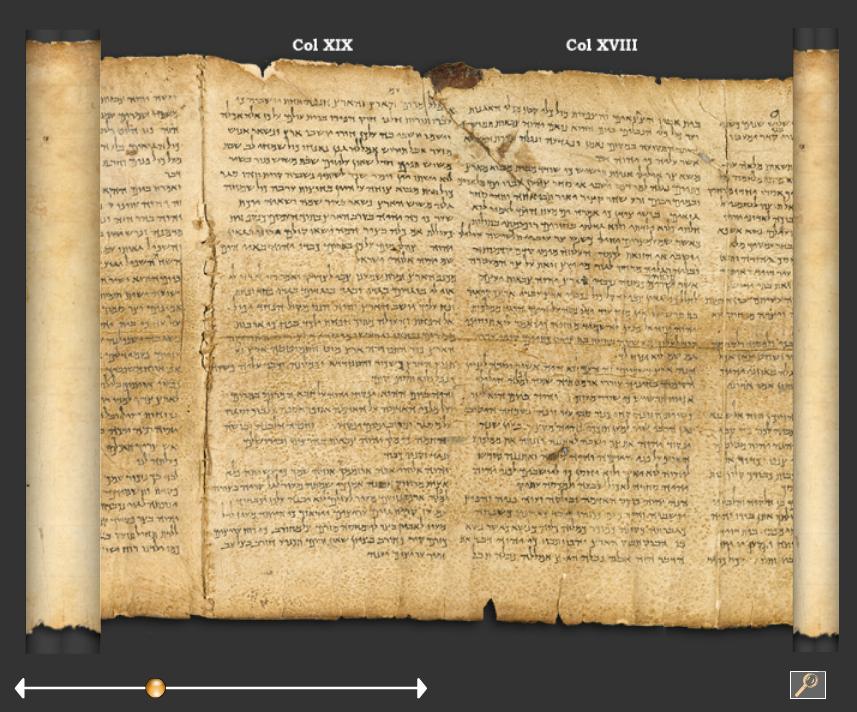
While doing some research on the Dead Sea Scrolls I discovered a website that shows the entire Great Isaiah Scroll found in Qumran.  The site allows you to literally scroll through the scroll, and provides a zoom feature as well.  Very cool!

This slideshow requires JavaScript.

Forty-two years after the discovery of Hezekiah’s tunnel (1880), two boys discovered a Hebrew inscription on the wall near the center of the tunnel.  Analysis of the writing, C-14 dating of the plant life killed by the construction of the tunnel, and dating of the stalactites/stalagmites that grew after the tunnel was constructed all converge at a date of 2700 years before present (~700 BC).  When translated, it became clear that it was written by one of the teams who constructed the tunnel, celebrating its completion as the two teams met in the middle.  The inscription reads:

[…when] (the tunnel) was driven through. And this was the way in which it was cut through: While […] (were) still […] axe(s), each man toward his fellow, and while there were still three cubits to be cut through, [there was heard] the voice of a man calling to his fellows, for there was an overlap in the rock on the right [and on the left]. And when the tunnel was driven through, the quarrymen hewed (the rock), each man toward his fellow, axe against axe; and the water flowed from the spring toward the reservoir for 1200 cubits, and the height of the rock above the head(s) of the quarrymen was 100 cubits.”

The inscription was cut from the wall of the tunnel not long after by looters and broken into fragments.  They were later recovered.  Today it resides in The Archaeological Museum in Istanbul, Turkey.

Significance:

  1. Confirms the Biblical account of Hezekiah’s preparations for an Assyrian siege.


This slideshow requires JavaScript.

2 Kings 20:20  The rest of the events of Hezekiah’s reign and all his accomplishments, including how he built a pool and conduit to bring water into the city, are recorded in the scroll called the Annals of the Kings of Judah. (NET)

2 Chron 32:2-6,32  When Hezekiah saw that Sennacherib had invaded and intended to attack Jerusalem, 3 he consulted with his advisers and military officers about stopping up the springs outside the city, and they supported him. 4 A large number of people gathered together and stopped up all the springs and the stream that flowed through the district. They reasoned, “Why should the kings of Assyria come and find plenty of water?” 5 Hezekiah energetically rebuilt every broken wall. He erected towers and an outer wall, and fortified the terrace of the City of David. He made many weapons and shields. 6 He appointed military officers over the army and assembled them in the square at the city gate. 30 Hezekiah dammed up the source of the waters of the Upper Gihon and directed them down to the west side of the City of David. (NET)

(more…)

This slideshow requires JavaScript.

2 Kings 18:1-3  In the third year of Hoshea son of Elah, king of Israel, Hezekiah the son of Ahaz, king of Judah, began to reign. 2 He was twenty-five years old when he began to reign, and he reigned twenty-nine years in Jerusalem. His mother’s name was Abi the daughter of Zechariah. 3 And he did what was right in the eyes of the Lord, according to all that David his father had done. (ESV)

Professor Avigad, a distinguished epigrapher, published a book in 1986 titled Hebrew Bullae from the Time of Jeremiah: Remnants of a Burnt Archive.  The book featured a hoard of bullae discovered from the time of Jeremiah, preserved by the fires that destroyed Jerusalem in 586 BC.  He always hoped to find a seal or bullae of a Judahite king, not knowing that one of the bullae featured in his book was just such a find.

(more…)

This slideshow requires JavaScript.

2 Kings 18:1,7,13-16; 19:5-7,20-21,28,32-36  In the third year of the reign of Israel’s King Hoshea son of Elah, Ahaz’s son Hezekiah became king over Judah. 7 The Lord was with him; he succeeded in all his endeavors. He rebelled against the king of Assyria and refused to submit to him. 13 In the fourteenth year of King Hezekiah’s reign, King Sennacherib of Assyria marched up against all the fortified cities of Judah and captured them. 14 King Hezekiah of Judah sent this message to the king of Assyria, who was at Lachish, “I have violated our treaty. If you leave, I will do whatever you demand.” So the king of Assyria demanded that King Hezekiah of Judah pay three hundred talents of silver and thirty talents of gold. 15 Hezekiah gave him all the silver in the Lord’s temple and in the treasuries of the royal palace. 16 At that time King Hezekiah of Judah stripped the metal overlays from the doors of the Lord’s temple and from the posts which he had plated and gave them to the king of Assyria. [in verses 17-36 the Assyrian emissaries taunt Jerusalem, saying YHWH can’t save them, so Hezekiah sends servants to inquire of Isaiah the prophet] 19:5 When King Hezekiah’s servants came to Isaiah, 6 Isaiah said to them, “Tell your master this: ‘This is what the Lord says: “Don’t be afraid because of the things you have heard – these insults the king of Assyria’s servants have hurled against me. 7 Look, I will take control of his mind; he will receive a report and return to his own land. I will cut him down with a sword in his own land.’'”” … 20 Isaiah son of Amoz sent this message to Hezekiah: “This is what the Lord God of Israel says: ‘I have heard your prayer concerning King Sennacherib of Assyria. 21 This is what the Lord says about him: … 28 Because you rage against me, and the uproar you create has reached my ears; I will put my hook in your nose, and my bridle between your lips, and I will lead you back the way you came.” 32 So this is what the Lord says about the king of Assyria: “He will not enter this city, nor will he shoot an arrow here. He will not attack it with his shield-carrying warriors, nor will he build siege works against it. 33 He will go back the way he came. He will not enter this city,” says the Lord. 34 I will shield this city and rescue it for the sake of my reputation and because of my promise to David my servant.’” 35 That very night the Lord’s messenger went out and killed 185,000 men in the Assyrian camp. When they got up early the next morning, there were all the corpses. 36 So King Sennacherib of Assyria broke camp and went on his way. He went home and stayed in Nineveh. (NET)   See also 2 Chron 32:1-23 and Isaiah 36-37.

Colonel R. Taylor discovered a clay prism in ancient Nineveh in 1830.  The six-sided prism contains 500 lines of text written in the Akkadian language describing the exploits of King Sennacherib (705-681 BC).  Dated to 689 BC, it is only 15” x 5.5”.  Of Biblical significance is Sennacherib’s account of his invasion of Judah and siege of Jerusalem in 701 BC.[1]  The prism reads:

(more…)

« Previous PageNext Page »