Archaeology


John Hoopes of the University of Kansas claims to be a scientist, but it is clear to me that he’s no scientist!  How do I know?  Because he has concluded that some intelligent designer is responsible for producing 300 of these:

Surely he knows scientists cannot appeal to intelligent agency as an explanation for natural phenomenon.  Besides, there is no need to appeal to any intelligent designer.  Natural processes such as wind and water erosion are fully capable of producing the spherical shape of these rocks over billions of years.  To appeal to some “rock-designer-of-the-gaps” is to give up on science.  Currently, we may not know the exact pathway by which nature produced these spherical rocks, but given the past successes of science, I am sure we will discover it in the near future.  

If these rocks are the products of some intelligent designer as Hoopes claims, then let him tell us who designed the designer.  Guess what, he doesn’t know!  Clearly, then, these rocks can’t be designed.

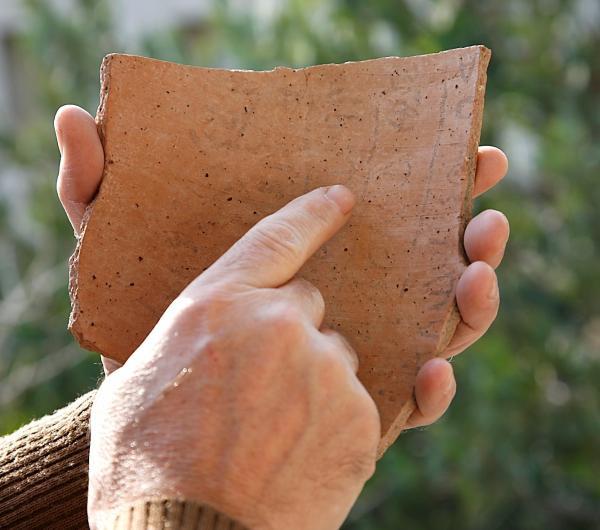
Approximately 18 months ago archaeologists discovered a 3,000 year old pottery shard containing an ink inscription written in proto-Canaanite script.  That script has now been positively identified as Hebrew, making this the oldest extant Hebrew writing ever found.  It is from the 10th century BC, which would be around the time of King David’s reign.  Interestingly, it was discovered 18 miles west of Jerusalem in a building near the city gate at Elah Fortress, in the valley where the Bible describes David’s historic battle with Goliath.

The translation of the text is:

1 you shall not do [it], but worship the [Lord].
2 Judge the sla[ve] and the wid[ow] / Judge the orph[an]
3 [and] the stranger. [Pl]ead for the infant / plead for the po[or and]
4 the widow. Rehabilitate [the poor] at the hands of the king.
5 Protect the po[or and] the slave / [supp]ort the stranger.

The importance of this discovery is two-fold.  First, it proves that Israelites had the ability to write in the 10th century, silencing critics who claim that certain books of the Bible could not have been written as early as the internal witness suggests because the Israelites lacked the ability to write.  Secondly, it proves that the fortified city in which it was discovered was a city of the Israelites (the most ancient Judean city discovered to-date).  Its massive size indicates the presence of a strong kingdom, and thus this would serve as physical evidence for the existence of an early united monarchial kingdom in Israel (a fact denied by many skeptics).

A house from the days in which Jesus walked the streets of Nazareth has been uncovered.  Amazing!

Archaeologist Eilat Mazar claims to have discovered what is likely King David’s palace.  If the discovery pans out, this would put a nail in the coffin to those who claim David and/or a vast Davidic and Solomonic kingdom is a Jewish myth.

When the charge of “forgery” was brought against the James Ossuary, many wrote it off.  The judge who is presiding over the trial, however, has apparently recommended to the prosecution that they drop the case based on a lack of evidence.  The James Ossuary may be genuine after all.

A week or so ago, it was reported that archaeologists uncovered what they believed to be the world’s oldest surviving church, in Jordan. The archaeologists dated it to the 1st century, and due to a mosaic with the inscription “the 70 beloved by God and the divine” on the floor, they suggested the cave church was started by the 70 disciples of Christ who fled Jerusalem due to persecution.

I was extremely skeptical of the claim upon hearing of it. While I held out the possibility that this cave was a gathering of 1st century believers, I found it beyond belief that it was started by the 70 disciples of Christ. It appears my skepticism is warranted. National Geographic has an article detailing the counter-arguments of critics. They not only dispute the claim that this cave church was started by the 70 disciples of Christ, but that it was a first century church as well. This appears to be another instance of archaeological sensationalism.

Herod the Great’s tomb may have been discovered in Israel.

Archaeologists recently discovered a stone with unknown markings in Mexico. While the meaning of the symbols is unknown, archaeologists did not hesitate to identify it as a written language—probably the oldest in the Americas. Stephen Houston of Brown University explained:


When I saw the block, as did the rest of us, we knew we were in the presence of something very special…. It had completely unknown signs, but they were arranged in these long sequences we felt just had to be a new form of writing…. It’s not just a set of symbols that might be placed together the way you might see on, let’s say, a medieval French or English painting. Rather, they are arranged in a sequence that is meant to reflect a language with grammatical elements and with a word order that makes sense.<!–[if !supportFootnotes]–>[1]<!–[endif]–>

Houston experienced what design theorists call a “design inference.” The specification and complexity of the markings made it clear that an intelligent agent, rather than chance processes, produced it. The fact that the identity of the designer is unknown (although it is believed to be from the Olmec civilization), and the design itself is currently unintelligible to us, does not mitigate our intuitive awareness that it was in fact designed. In the same way these archaeologists detected design on nature, we can detect design in nature: empirically. This is all the more so when you consider the multiplicity of the complexity and specification of the universe over these stone markings.


I previously mentioned that archaeologists believe the Olmec civilization is responsible for the stone markings. But how do the archaeologists know they were the creators of this stone writing? Did they see anyone from the Olmec civilization writing on this stone? No. Do they possess written records from a nearby tribe ascribing these sorts of markings to the Olmec civilization? No. Then why are they suggesting the Olmec civilization is responsible for creating the markings? I would imagine it’s because that was the only civilization of human beings living in that region at the time. But this presupposes that the markings were the product of intelligence, rather than chance natural processes. There is no evidence that this is true. No one has a date-stamped photograph of an Olmecian tribesman writing on the stone. The only basis for ascribing the stone markings to the Olmecs—or any other intelligent agent for that matter—is a design inference. The stone markings bear the marks of an intelligent designer, therefore—they reason—it must have been designed. And since the Olmecs were the only ones in that region at the time, they reason that they must be the designers. Again, design in the universe is just as easily inferred from what we know about the universe as it is inferred from what we know about this stone. Design is empirically detectable. Design inference is a scientific discipline.


<!–[if !supportFootnotes]–>


<!–[endif]–>

<!–[if !supportFootnotes]–>[1]<!–[endif]–>Christopher Joyce, “Earliest New World Writing Discovered”, NPR; available from http://www.npr.org/templates/story/story.php?storyId=6077734; Internet; accessed 21 September 2006.

Several of you have asked about my take on the Gospel of Judas. I spent a lot of time researching the document over the past few weeks. The fruit of my research is presented as the cover article in this week’s edition of Ninetyandnine.com. You can read the article here.

« Previous Page