Albert Mohler examines an article in U.S. News & World Report that is quite troubling. It appears the Obama administration requires those who offer prayers before an Obama speech, to vet it with the White House first for their approval. This is quite clearly a government entanglement with religion. Don’t get me wrong, I don’t think there is a need to even have someone offer a prayer prior to an Obama speech, but if you are going to have prayer be offered, it should not have to be reviewed and possibly edited by the White House. This goes beyond political correctness into theological arbitration. As Mohler wrote, “When a White House approves or edits prayers, it has entered theological territory and takes on a theological function. The President of the United States is our Commander in Chief, not our Theologian in Chief.”
Politics
February 27, 2009
White House Vetting Prayers
Posted by Jason Dulle under Political Incorrectness, Politics, Religions[16] Comments
February 5, 2009
January 22, 2009
 A U.S. District judge ruled that an Illinois law requiring a moment of silence is unconstitutional because it “is a subtle effort to force students at impressionable ages to contemplate religion.” While I do not think the Constitution requires the elimination of prayer from schools, neither am I an advocate of having school-led prayer. But a moment of silence is hardly a prayer, and hardly constitutes religion.
Basically this ruling says people cannot even be afforded a few seconds by school officials to offer up their own silent prayers to the god of their choice, if they so choose. This is militant secularism. And of course, the lawsuit was filed by a militant atheist. And they think it’s the Christians who are intolerant. Nothing says tolerance like “you can’t pray at school in silence if you want to.”
November 12, 2008
Same-Sex Marriage is not a Transcendent Right
Posted by Jason Dulle under Apologetics, Politics, Same-sex Marriage1 Comment
I was reading the San Francisco Examiner the other day, when I ran across a “Viewpoints” article by Wayne State University professor of philosophy, John Corvino (the November 10th edition, page 13). Mr. Covino was opining on the passage of Proposition 8, a proposition in California that amended the state’s constitution to define marriage as being between a man and woman only (and overturning the state Supreme Court’s recent decision to extend the institution of marriage to same-sex couples).
In essence, his viewpoint was that this was only a temporary setback. The tide is on the side of those who favor same-sex marriage, and they will ride that tide in due time. I hate to admit it, but he is probably right. Prop 8 passed by a mere 2%. That’s hardly a safe margin of victory. What’s worse, popular support for traditional marriage dropped 10% from 2000, when California voters passed a similar proposition (it passed by 62%). Given the fact that opposition to same-sex marriage is fading by an average of 1.25% each year, and given the fact that those who oppose same-sex marriage tend to be older and more religious, there is good reason to believe same-sex marriage would be approved by the electorate if put to a vote four years from now. Why? Older people die at higher rates than younger people, so the anti-same-sex marriage voting block will lose supporters at a faster rate than the pro-same-sex marriage voting block, even if no one in either camp changes their position in the future. Furthermore, religious conviction is a major reason people oppose same-sex marriage. Given the fact that religion plays a less significant role in the political views of younger Americans, and it is the largely the young who become new voters, it is unlikely that those who age-in to the social debate will object to same-sex marriage. Only a major public education campaign and/or religious revival can stop the eventual legalization of same-sex marriage in the United States.
Given the length of the above paragraph, one might think my purpose in writing this post was to evaluate the future of marriage in California. It’s not. What I found particularly interesting about Corvino’s article was the following statement:
A bare majority of California voters sent a discriminatory message: You are not good enough for marriage. Your relationships-no matter how loving, how committed, how exemplary-are not “real” marriage. But “real” marriage transcends state recognition of it. And that’s another reason why this debate will continue. Because it’s not just about what California should or should not legally recognize. It’s also about what sort of relationships are morally valuable, and why. And that’s a debate that, slowly but surely, gay-rights advocates are winning.
Corvino’s claim could not be more clear: same-sex marriage is a right that transcends human law. This is quite a claim. Rights have to be grounded in something. Rights come in two forms: those belonging to us by nature, and those given to us by those in power. The right to drive is an example of the latter, while the right to life is an example of the former. To say homosexuals have the right to marry someone of the same gender, even if the political powers that be do not wish to extend them that right is to say the right to same-sex marriage is a natural right that transcends human law, and to which human law has an obligation to conform (i.e. if human law denies homosexuals the right to marry, a moral injustice is being done). But from whence cometh this right? What is it grounded in?
It cannot be a natural right, like the right to life, the right to procreate, or the right to believe what one chooses to believe. Why? Because marriage is not a fundamental right. Civil marriage is just society’s way of managing procreation for the good of, and in the interest of society. But society is under no moral obligation to formally recognize and regulate anybody’s relationships. They do so only in their own self-interest. In fact, if they got out of the marriage business tomorrow, people would continue to fall in love, make relational commitments to one another, and continue to have children just as before. Nothing would stop them from doing so. If marriage itself is not a fundamental right, then by no means can one argue that same-sex marriage in particular is a fundamental right.
The only other source in which to ground a transcendent right is God. The problem with this is that no major religion claims God approves of homosex, yet alone same-sex marriage. It’s kind of hard to ground the right to same-sex marriage in God, when God doesn’t recognize the right!
If same-sex marriage is not a right that can be grounded in God or nature, then it is not a transcendent right. It is a legal right, and a legal right depends entirely on the will of the people to grant it.
November 6, 2008
Important Election Results
Posted by Jason Dulle under Abortion, Apologetics, Bioethics, Euthanasia, Politics, Same-sex Marriage, Stem Cell ResearchLeave a Comment
Election results did not favor the pro-life cause, but they did favor the traditional marriage cause. Here is a brief survey of the most important issues:
Abortion
California’s Prop 4 sought to require parental notification prior to a minor receiving an abortion. It was defeated (52% to 48%).
Colorado’s Colorado Definition of Person Initiative of 2008 (aka Amendment 48) sought to define all human beings from the moment of fertilization as “persons.” It was defeated (73% to 27%).
Obama was elected President of the United States. If he does what he says he will do given the chance, he will repeal virtually every restriction on abortion (including partial birth abortion), will repeal the ban on using federal tax dollars to fund abortion, will repeal the ban on funding abortions outside the U.S., and will nominate liberal justices to the Supreme Court (ensuring that Roe v Wade will not be overturned for at least another 20-30 years). This is probably the greatest setback to the pro-life cause since the Supreme Court re-affirmed Roe in 1992 (Planned Parenthood v Casey). Not only does he stand
Embryonic Stem Cell Research
Michigan passed a constitutional amendment authorizing the use of “leftover” embryos for stem cell research by a margin of 53% to 47%.
Assisted Suicide
The voters in Washington passed Washington Initiative 1000, a bill legalizing assisted suicide. It passed with a 59% to 41% margin. Washington is now the second state to pass such a law (Oregon is the other).
Same-Sex Marriage
Voters in California, Arizona and Florida approved constitutional amendments defining marriage only as the union of a man and woman.
California’s Prop 8 passed 52% to 48%
Arizona’s Prop 102 passed 56% to 44%
Florida’s Amendment 2 passed 62% to 38%
California’s win was particularly important, because the state Supreme Court had just forced same-sex marriage on the state by judicial fiat earlier this year. California is the first state to rescind the right to same-sex marriage once it has been created by a judiciary.
October 30, 2008
“No on Prop 8” Rhetoric
Posted by Jason Dulle under Apologetics, Politics, Same-sex Marriage[9] Comments
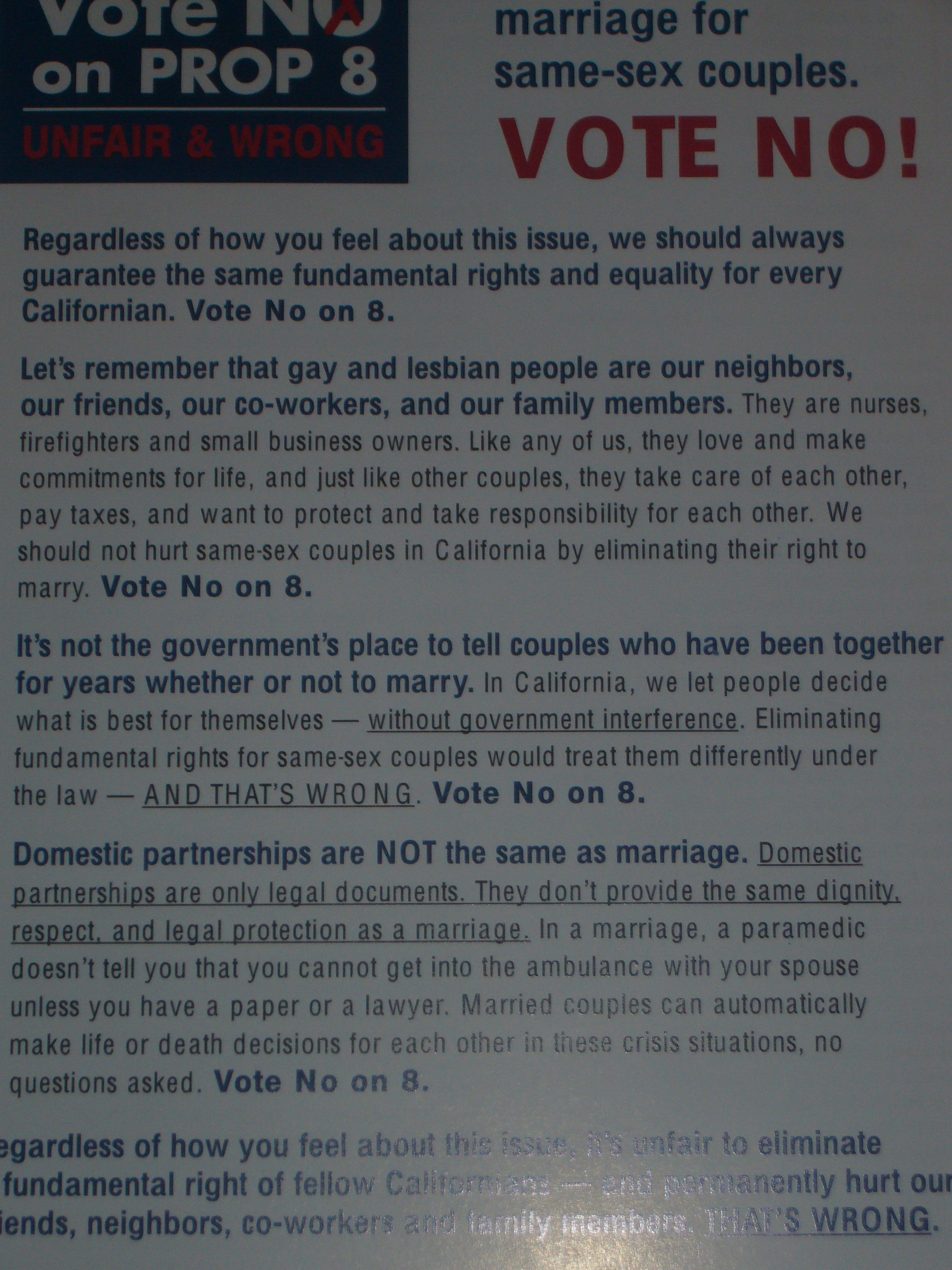
While leaving work today I was handed a “No on Prop 8” leaflet. For those of you not living in CA, prop 8 seeks to undo our state Supreme Court’s recent decision to remove gender requirements from the institution of marriage. In CA, same-sex couples in a domestic partnership already had identical rights and obligations as their married counterparts. Their “package” was simply being called by a different name (domestic partnership vs. marriage). In effect, the Supreme Court simply demanded that they be given a name change. And they have been, against the express will of the people. In response, the people of CA organized a ballot initiative to amend our state constitution to define marriage as being between one man and one woman only. The people handing out the leaflet I received today oppose this initiative.
As I expected, the leaflet was a propaganda piece full of half-truths and sophistry. Rather than reproducing this piece, I’ll just refer you to the picture above. To read the text just click the picture (it will magnify it). I would like to bring some of the most blatant rhetoric to your attention. There are five paragraphs, but I will only respond to the first four:
#1 They claim same-sex marriage is a fundamental right, but since when? It has not been recognized by any society in history until a decade ago. A right no one recognized until 10 years ago can hardly be considered fundamental. Just because a handful of people in black robes declare it to be a fundamental right by judicial fiat, does not make it one in reality.
As for equality, I agree. But the law already afforded equality to all Californians. Everyone had an equal right to marry a non-relative of the opposite sex. The law did not stipulate that homosexuals could not marry. Homosexuals are just as free to take advantage of the institution of marriage as are heterosexuals, but if they wish to avail themselves of this right, they need to marry someone of the opposite sex. The fact that they choose not to afford themselves of this right is not grounds for radically changing the historic understanding of marriage.
#2 Yes, same-sex couples are our neighbors, but what follows from that? People in Utah have polygamists as their neighbors, but does that mean society must redefine the number of participants in a marriage? No, so why should the fact that we have gay neighbors cause us to redefine the gender requirements of civil marriage?
They claim that same-sex couples are hurt by not giving their legally-recognized unions the name “marriage,” but how? Because they are not accorded the same social approval? First, we do not alter fundamental social institutions so that some people won’t feel bad. Second, marriage is a social institution intended to provide social support to relationships society deems important to the success of society. People in society are free to choose whom to give their support to and whom to deny it. And many do not wish to extend it to same-sex couples because they do not think their relationships are beneficial to the social fabric (indeed, they may be detrimental).
#3 No, “it’s not the government’s place to tell couples who have been together for years whether or not to marry,” but that is not the issue. This sentence was either framed poorly, or strategically, because the government isn’t telling anyone-heterosexual or homosexual-whether or not to marry. It only tells them the requirements they must meet if they wish to marry. But if they were to have worded it this way, it is clearly wrong. The government represents the people, and the people of this country have the right to define the requirements for marriage; i.e. which relationships they will and will not extend their social approval and support to. That’s not to say they can be arbitrary in their definition, but clearly that is not the case in this country. There are principled reasons we define marriage the way we do, and those reasons make no room for same-sex couples.
They claim we let people decide what’s best for themselves in CA. No, we don’t. I decided it’s best for me to be able to talk on my cell phone in my car, but the government decided it wasn’t. Taken at face-value, what they are advocating is anarchy. And I find it ironic that the pro-Prop 8 prop are speaking negatively of “government interference” when they have been working ferociously over the last 20 years to intimately involve government in this issue. If they truly eschewed government interference, they would not be asking for the state of CA to recognize and regulate their relationships.
#4 In one sense it’s true that domestic partnerships are not the same as marriage. But where do they differ? You might be surprised to know that in CA they are the same in all but the name. Domestic partnerships afford same-sex couples all the same rights and responsibilities as marriage. That’s why it is disingenuous on their part to bring up the issue of medical power-of-attorney. Domestic partnerships already give same-sex couples such rights. The only thing domestic partnerships do not afford same-sex couples is “the same dignity” and “respect.” But why ought they be given such when their relationships do not function in the same way in society, and when many people consider their sexual mores immoral? I see no reason to.
I hope my fellow Californians will join me in voting YES on prop 8.
October 27, 2008
Abortion Restrictions Reduce Abortions
Posted by Jason Dulle under Abortion, Apologetics, Bioethics, Politics1 Comment
If anyone doubts this, see this piece in Public Discourse from The Witherspoon Institute (Princeton).
Some pro-lifers are arguing that the US Supreme Court is highly unlikely to overturn Roe, and thus we need to quit basing our vote largely on a candidate’s position on abortion. Even if I agreed with this assessment of the future of Roe (I don’t), it does not follow that a politician’s position on abortion is irrelevant. As the article makes clear, pro-life politicians who have passed laws restricting abortion are largely responsible for the declining abortion rates in this country. Does anyone think pro-abortion politicians would have passed such restrictions? Does anyone think that if pro-abortion politicians dominate public offices, they will not seek to undo those restrictions, and hence increase the number of abortions? You betcha!
We have a choice between Obama and McCain for president. Even if I granted that McCain will not appoint strict constructionists to the bench (as some say), or that those he appointed would not overturn Roe because of stare decisis, the fact remains that there would be fewer legal abortions under a McCain presidency than under an Obama presidency. Each candidates’ position on abortion is relevant! Obama has vowed to sign the Freedom of Choice Act if he becomes president. What would that do? It would repeal every restriction on abortion in every state in the union, including partial birth abortion. He would also repeal the Hyde amendment which prevents the government from spending tax dollars to fund elective abortions. A vote for Obama, then, is not equal to a vote for McCain. The fact of the matter is that a vote for Obama will result in more dead babies than a vote for McCain, wholly apart from the future fate of Roe.
October 20, 2008
All-or-Nothing for South Dakota Right to Life
Posted by Jason Dulle under Abortion, Apologetics, Bioethics, PoliticsLeave a Comment
Two years ago I reported on the outcome of South Dakota’s attempt to ban all abortions that were not necessary to save the life of the mother. The initiative was narrowly defeated (56% no; 44% yes). Polls indicated that a majority of voters would have supported the initiative if it included an exception for rape and incest as well. I wrote back then, that while I agreed with the initiative as written, tactically and practically speaking, SD would have been better off to include the exceptions for rape and incest.
Why? Is it because I believe children conceived by rape and incest do not deserve the protection of the law? No. They do. It’s because to date, we have not been able to persuade a majority of our fellow citizens that the circumstances surrounding conception make no moral difference to the question of abortion. But many people, including those in South Dakota, recognize that abortion should be outlawed in all other circumstances. So why not write an initiative that outlaws the abortions that a majority of people agree should be outlawed, and then work on outlawing the rest later? Considering the fact that less than 1% of abortions are due to rape or incest (for 2006, only 0.004% of abortions in SD were due to rape/incest), such a bill would save 99% of babies currently being aborted.
It just so happens that SD has an initiative on the November ballot similar to the 2006 version, but adding exceptions for rape and incest. In a perfect world I would not support such a bill, but in an imperfect world I would-and I think all pro-lifers should. But not all pro-life groups see it this way. South Dakota Right to Life does not support the initiative because of the rape/incest exceptions. For them, it’s all-or-nothing. Since this bill does not go for a complete ban on abortion, they do not support it.
I think this approach is wrong-headed. It makes a statement, but does not effect change. An incremental approach to outlawing abortion is better than an all-or-nothing approach, because an incremental approach has the effect of preventing a lot of abortions, whereas the all-or-nothing approach has proven to prevent none! If we are truly pro-life, we should support any bill that has the effect of saving babies. It is morally indefensible to vote against a bill that would save 99% of aborted babies from abortion, just because less than 1% will not be protected by the bill.
While I do not doubt the sincerity of those who oppose incremental legislation like the one SD is proposing, I do doubt their wisdom. They seem more interested in making a moral statement than they do with making a moral difference in our world. This is morally irresponsible. Being pro-life is not a position. It is a goal, and to get to that goal we have to chip away at the culture of death bit-by-bit, just like William Wilberforce did to slavery in England. We should not be opposed to steps that are taken in the right direction, just because they do not take us to the destination we see as ideal.
But isn’t this about conscience? Some will argue that their conscience will not allow them to vote for a bill that would explicitly allow the abortion of some babies. I do not doubt that this is true, but I do doubt that such a person has a properly informed conscience. After all, if one’s conscience commends them for voting no on a bill that could have saved thousands upon thousands of innocent babies from medical execution, on the basis that they stood up for the right principle, something is seriously wrong with their conscience. Yes, they stood up for the ideal principle, but they did not advance life when they had the chance to do so. A properly informed conscience would condemn such an act as an abandonment of the very people we say we want to save. Allowing thousands to die when we have the chance to stop it is hardly pro-life.
October 16, 2008
Some Christians plan to sit out this presidential election because none of the viable presidential candidates reflect their conservative ideals, and think casting a vote for any of them would be morally wrong. While I am somewhat sympathetic to this position, ultimately I think it is unwise, and possibly even immoral. This is a serious charge, and I do not make it lightly. Allow me to substantiate my charge with a reasonable argument (credit, for which, goes largely to Greg Koukl of Stand to Reason ministries).
The time to vote according to one’s ideals and conscience is the primary election, not the general election. In a general election our options are narrowed down to two viable candidates, and we vote for the best available candidate. It may be that neither candidate represents our ideals, and we are tempted to sit out the general election for conscience’ sake, or to send a message to the political parties that we do not like the candidates they are advancing (protest vote). Whatever the motivation might be, the fact remains that one of the two major candidates will be elected whether we vote or not, and they will have an impact on the issues that matter to us. Sitting out the election will do nothing to change that. Sitting out the election, however, can determine whether some of our ideals will be advanced or attacked.
It may be the case in a general election that both candidates equally fail to represent our ideals, but in most cases, one candidate will better represent our ideals than the other. For example, candidate A may share with us 3 out of 10 ideals, while candidate B may only share 2 out of 10. While neither comes close to representing our ideals, candidate A more closely resembles our ideals than candidate B, and is more likely to promote our ideals than candidate B. If we take our ideals seriously—meaning we want to see them advanced for the good of our fellow Americans—we should be interested in electing those who will do the most to promote them. As such, we have a moral responsibility to vote for the candidate who will act to promote a greater amount of good, and work to prevent a greater amount of evil. Failing to vote, however, may result in candidate B being elected over candidate A, which in turn may increase the net amount of evil in the world. To see how this is so, let me illustrate.
Let’s say candidate A (the better of the two bad candidates) has 51% of the popular vote (of registered, likely voters), and candidate B has 49% of the popular vote. If 4% of conservative Christians refuse to vote for candidate A because he does not match up to their ideals, they shift the vote to the other candidate. Now, candidate A only has 47% of the popular vote, and candidate B has 53% of the popular vote. Ironically, then, sitting out an election may result in the increase of evil, by throwing the election to the worse of the two candidates. In other words, sitting out could have the unintended consequence of increasing evil.
One might respond that choosing the lesser of two evils is evil. I disagree. Choosing the lesser of two evils is a moral good because it results in the greater good. In fact, when we have the ability to reduce evil in the world, and our inaction would have the effect of increasing evil, we are morally culpable if we do nothing. If not voting will cause greater evil, then we have a moral obligation to vote. We are not obligated to vote for the best candidate, but the best candidate available.
What about one’s conscience? While I would never advise someone to violate their conscience, neither can I pretend the conscience that demands one do something that would increase evil is a properly functioning conscience. Only a misinformed conscience could demand such a thing of a person. Any conscience that demands we do something that will result in increased evil needs to be informed by a different set of moral principles.
If you don’t care for your presidential choices, you are not alone. I don’t care much for them either. But I recognize that one of them is better than the rest when measured against conservative ideals: John McCain. While this individual is not my ideal, his presidency would result in more good and less evil than the presidency of the other candidates, and that is why I will vote for him in the general election. I hope you will vote as well. Remember, all it takes for evil to prevail is for good men to do nothing.
October 14, 2008
Robert George on Obama and Abortion
Posted by Jason Dulle under Abortion, Apologetics, Bioethics, PoliticsLeave a Comment
Robert George has an excellent article discussing Obama’s abortion extremism. For those of you not familiar with George, he is a top-notch legal scholar and bioethicist. He teaches jurisprudence at Princeton University, and is a member of the President’s Council on Bioethics.
October 13, 2008
Connecticut Supreme Court Imposes Same-Sex Marriage
Posted by Jason Dulle under Apologetics, Politics, Same-sex MarriageLeave a Comment
It’s official. Connecticut is now the third state in the nation to legalize same-sex marriage. Just as Massachusetts and California, this was the result of a ruling by the state Supreme Court, not an expression of the will of the people. It’s amazing how these courts keep discovering rights in their constitutions that hundreds of justices had not seen before! I’m sure this will not be the last court to do so. This seems to be a trend, and I see no end in sight.
According to the AP, the civil union law CT passed in 2005 essentially granted same-sex couples all the rights and benefits available to heterosexual married couples, so as I noted in my comments on the CA case in which same-sex marriage was legalized, it only makes sense to extend the name “marriage” to the package of benefits already conceded. We are finding ourselves in the bed of our own making. Did we honestly think we can give legal recognition and benefits to same-sex couples, and yet deny them the name by which we identify that packet of benefits?
August 29, 2008
Last Friday Obama announced Joe Biden as his VP. That was somewhat of a shocker for me. But I guess the only thing better than one egomaniac on the ticket is two egomaniacs! (Clearly, I’m showing my political hand here!)
Today, McCain has announced his VP pick: Sarah Palin, governor of Alaska. I haven’t exactly been thrilled over John McCain, but his VP choice isn’t going to make it much easier for me to vote for him (but I will, as I am much much less thrilled over Obama).
Why am I not excited over Mrs. Palin? After all, from what I know of her so far, she seems pretty conservative, both morally and fiscally. What more could one ask for in a candidate? Experience! Substantive ideology needs to be matched with experience, particularly when they job they are “applying” for is the second highest position of power in this country (with a chance of taking the top spot if their boss kicks the bucket or behaves illegally). Not only is Mrs. Palin very young, but she has very little political experience. She has only been governor for a little over a year and a half. Sure, she was a two-term mayor as well, but she was mayor of a city with a population of less than 10,000. Running a small town, and running the most powerful country in the world aren’t exactly the same. I don’t have any reason to believe Mrs. Palin is prepared to be president of this country.
I’m also disappointed that McCain picked a woman. No, it’s not because I am a chauvinist. It’s because McCain seems to have picked a woman for strategic reasons, rather than because Mrs. Palin was the most qualified for the job. Surely, there were other Republicans more qualified. Why didn’t McCain pick one of them? Dare I say it’s because he’s hoping to women voters, particularly those who were Hillary supporters? It’s not a bad strategy when you think about it. A lot of women vote Democrat, and many were rooting for Hillary as the first woman president. Well, we all know that boat didn’t float. So McCain comes along and gives women another chance at getting one of their own into the White House. The hitch is that they have to vote for the other party. Brilliant!
In one sense I love it, because it gives McCain better odds at beating Obama, and I want nothing more than to see that happen. An Obama presidency would be a disaster in my opinion. But in another sense, I am not at all thrilled with the prospect of “President Palin” in the event John McCain dies in office. But who knows. Maybe my initial judgment of Mrs. Palin is wrong. Maybe she has wisdom beyond her years, and beyond her political experience that will make her a good vice president, and possibly a good president. We’ll see.
August 25, 2008
Abortion Should be A Right Even if the Unborn are Human Beings
Posted by Jason Dulle under Abortion, Apologetics, Bioethics, Politics[6] Comments
This is how Nancy Pelosi answered Tom Brokaw’s question about when life begins: “I would say that as an ardent practicing Catholic this is an issue that I have studied for a long time, and what I know is over the centuries the doctors of the Church have not been able to make that definition. And St. Augustine said three months. We don’t know. The point is it that it shouldn’t have an impact on a woman’s right to chose.”
Does she really mean to say that if we did know when life begins (which we do), and it turns out life begins prior to the time abortions are allowed, that this should not impact a woman’s right to have an abortion? Is Pelosi so pro-abortion, that even in when the evidence is clear that what is being aborted is a living human being, that the right to an abortion trumps the life guaranteed to that human being in the Constitution? Talk about a radical position!
HT: Justin Taylor
May 15, 2008
CA Supreme Court Rules Domestic Partnerships Must be Called "Marriage"
Posted by Jason Dulle under Apologetics, Politics, Same-sex Marriage[10] Comments
Speaking of same-sex marriage, in a 4-3 decision the CA Supreme Court has declared that same-sex couples have the right to have their legally recognized relationships called “marriage.” We are only the second state in the nation to do so (MA was the first back in 2004).
The headlines and news articles are saying the Court approved same-sex marriage, but that is not true. What they did was all that was left for them to do: to give the name “marriage” to those who are already married in the practical sense of the word. Domestic partnerships in CA were already identical to marriage in every respect, but without the name. While on a practical level, then, this ruling doesn’t mean much, it is huge in terms of political and social significance. While not much more than a name (marriage) separated domestic partnerships from marriage in CA, there is a lot in a name! Now that same-sex couples have the benefits as well as the name “marriage,” they have made a huge step forward in achieving social approval. Furthermore, as goes CA, so goes the nation.
I have not read the opinion of the court (it hasn’t been released yet to my knowledge), but the news article reported this little excerpt from the majority opinion (penned by Chief Justice Ronald George: “In contrast to earlier times, our state now recognizes that an individual’s capacity to establish a loving and long-term committed relationship with another person and responsibly to care for and raise children does not depend upon the individual’s sexual orientation.” Say what? Nothing in the wording of the constitution has changed in regards to this issue, so what does earlier versus later times have to do with anything? Oh, I forgot. These judges don’t think it’s their job to interpret the Constitution. They think it is their job to institute progressive public policy when the public is apparently too stupid to do so. Infuriating!
May 13, 2008
Should same-sex marriage be legal, even if it is immoral?
Posted by Jason Dulle under Apologetics, Homosexuality, Politics, Same-sex Marriage[6] Comments
While the law is a moral enterprise on its face, it is not possible, nor is it wise to legislate against every kind of moral wrong.For example, while it is morally wrong to deliberately harm one’s body, and smoking cigarettes deliberately harms one’s body, it is generally not advisable to deny one the freedom to smoke cigarettes by outlawing smoking.The general principle is that we should only legislate against moral wrongs that have a major impact on the common good, or interfere with the exercise of the fundamental rights of our fellow citizens.A certain measure of liberty should be left to the individual to choose even those things that are morally wrong, because outlawing that evil may result in an overall increase in evil, and because it is practically impossible for the State to legislate against every form of moral wrong, yet alone to enforce it.
Some attempt to employ this principle as an argument for the legalization of same-sex marriage.It is argued that since liberty is to be preferred to constraint unless an exercise of liberty is to the detriment of the common good, the liberty of marriage should be extended to same-sex couples (even though same-sex marriage is immoral) because same-sex relationships are not detrimental to the public good.How might opponents of same-sex marriage respond to this argument?
While it is true that we should not legislate against all instances of moral wrong, this principle cannot be employed indiscriminately.If it were, no laws aimed at prohibiting immoral behavior could be passed!The burden of proof is on the person arguing we should not legislate against this or that particular moral wrong, to show why we should not do so.In this case, it is being argued that same-sex marriage, though morally wrong, does not negatively affect the public good.Like smoking, then, it should not be prohibited.Is it true that same-sex marriage will not impact the public good in a negative way?There are good reasons to think this is false.
First, extending the institution of marriage to same-sex couples is social declaration that homosexual sex/relationships and heterosexual sex/relationships are equal.This is manifestly false.The purpose of heterosexual sex and homosexual sex are very different (the former is for procreation and recreation, while the latter is only for recreation), as well as the health risks involved with both behaviors.There are virtually no health risks for engaging in monogamous heterosexual sex, but there are many health risks for engaging in (even) monogamous homosexual acts.
Second, it is a social declaration that moms and dads are not necessary for optimal child development.There is no denying the fact that the legal recognition of same-sex couples to adopt and rear children naturally and legally follows from the legal recognition of same-sex relationships as a valid form of civil marriage (in some instances the legal right to adopt actually precedes the legal recognition of same-sex relationships as a valid form of civil marriage).Granting marriage rights to same-sex couples, then, has ramifications for child-rearing.To recognize same-sex relationships as civil marriage is a tacit admission that moms and dads are not necessary for optimal child development—that two moms or two dads will equally suffice.This is wrong.Both moms and dads are needed for optimal child development.
This argument also fails because it ignores the critical difference between allowing people to participate in certain immoral behaviors without the threat of law, and actively declaring through the law that such behaviors are legally protected.The law is a moral teacher.To enshrine something into law is to make a moral declaration about that something: that it is good, or that it is bad.To give legal sanction to same-sex marriage where such sanction did not exist previously would require the creation of new legislation to redefine the institution of marriage.This legislation would have the effect of actively declaring that our society finds same-sex marriage to be a moral good.This is utterly different than the situation we find ourselves in today, in which same-sex couples can openly engage in committed relationships with one another, but without the blessing of society.The difference is one of social approval.Allowing them to engage in committed relationships without the threat of law is to grant them liberty; sanctioning their relationships by enacting laws recognizing their relationships as valid instantiations of civil marriage is to grant them social acceptance.
Ultimately, then, the argument from liberty fails.We should not open up the institution of marriage to same-sex couples.Not only would same-sex marriage negatively impact the common good of our society, but doing so would have the implicit effect of teaching society that a moral wrong is a moral good.
May 9, 2008
Ignorance About Life = Government Neutrality re: Abortion?
Posted by Jason Dulle under Abortion, Apologetics, PoliticsLeave a Comment
When the topic of abortion comes up, invariably the question of when life begins is put forth. And invariably, someone will claim that no one knows when life begins (most often, but not always, this will be the person supporting abortion rights). And invariably, they will use this “fact” as the basis on which to argue that the decision to abort or not abort is a personal decision that government should not meddle in.
This logic has always struck me as odd. It seems to me that ignorance of when a human life begins is the best reason not to abort the unborn, and the best reason for government to step in and put a moratorium on the procedure until the question is finally and fully answered. But that is not what I want to focus on here. I want to focus on a quick tactical response to the assertion that ignorance regarding when life begins requires the government not to interfere with a woman’s choice to abort.
We might respond to this assertion by asking, “Does that mean that if it could be determined when life begins, and we discover that it begins at conception, you would agree that government should interfere in the choice of others to abort their babies?” If they say no, then it exposes their argument as a front. They think women should have the legal right to choose an abortion even if the unborn is a human being.
If they say yes, then point out to them that the question of when life begins has been settled for decades. A new, distinct human life begins at conception. Offer proof, such as quotes from standard texts on embryology. If they truly think the right to abortion free from government interference is justified on the basis of ignorance about when life begins, they should change their mind on the matter upon confirming the evidence. If they persist in their pro-abortion anti-government-involvement stance, chances are their argument was just a front for a deeply held belief/desire they have no intention of giving up. They are pro-abortion for reasons other than what they stated: emotional and preferential, rather than rational. In my own personal experience I have found that most pro-abortion advocates will maintain their belief in abortion rights, even when all of their rational arguments have been demonstrated to be fallacious or mistaken. But even with these people, at least the question serves to get to the heart of the matter, and expose their true commitments for what they are.
May 5, 2008
Don’t Hold Your Breath: It’s Doubtful the Supreme Court Will Outlaw Abortion
Posted by Jason Dulle under Abortion, Apologetics, Politics[2] Comments
In a recent 60 minutes interview, U.S. Supreme Court Justice Antonin Scalia shared his thoughts on abortion. In response to a question about how his Catholicism affects his judicial decisions, Scalia said:
“I’m a law-and-order guy. I mean, I confess I’m a social conservative, but it does not affect my views on cases. On the abortion thing for example, if indeed I were, you know, trying to impose my own views, I would not only be opposed to Roe versus Wade, I would be in favor of the opposite view, which the anti-abortion people would like adopted, which is to interpret the Constitution to mean that a state must prohibit abortion. … There’s nothing there. They did not write about that.”
A little later he continued in the same vein:
“My job is to interpret the Constitution accurately. And indeed, there are anti-abortion people who think that the constitution requires a state to prohibit abortion. They say that the Equal Protection Clause requires that you treat a helpless human being that’s still in the womb the way you treat other human beings. I think that’s wrong. I think when the Constitution says that persons are entitled to equal protection of the laws, I think it clearly means walking-around persons. You don’t count pregnant women twice.”
I’m not so sure I agree with Scalia’s hyper-originalism here (I think a good case can be made that abortion is unconstitutional), but pro-life advocates need to take notice of what he said. Some pro-life supporters are not only hoping for Roe v Wade to be overturned by the Supreme Court in the near future, but they are hoping the Supreme Court will completely reverse itself, and declare that the Constitution protects the life of the unborn as well as the born. This would invalidate all democratically instituted abortion laws, just as Roe invalidated all democratically instituted anti-abortion laws. Scalia is one of the most conservative judges on the Supreme Court. If he does not think abortion is unconstitutional, there is virtually no chance the Supreme Court will ever decide as much in our lifetime, if ever. At best the Supreme Court will overturn Roe, returning the issue of abortion back to the states, and giving us the opportunity to persuade our fellow citizens to outlaw abortion in our state, in every state across the nation.
February 13, 2008
Not all Evangelicals Are Republican Conservatives
Posted by Jason Dulle under Politics, StatisticsLeave a Comment
All Evangelicals are conservative Republicans, right? Evangelicals are a political force for the Right, right? That’s what the media would have you believe. This is not true. The Center for American Progress Action Fund (CAPAF) and Faith in Public Life (FIPL) discovered that the major network’s exit polls only ask Republican primary voters to identify themselves as “born-again or Evangelical Christian.” The same question does not appear on Democratic exit polls.
CAPAF/FIPL commissioned Zogby International to fill in the gap of our knowledge by doing post-election polling in the states of Missouri and Tennessee. The results are stunning for all those who have bought into the idea that Evangelicals are a mindless voting bloc for the Republican party, and that Evangelicals are only concerned about abortion and same-sex marriage.
One out of three voting white Evangelicals, voted in the Democratic primary. Indeed, 19% of all voting Democrats in Missouri, and 29% of all voting Democrats in Tennessee were white Evangelicals.
What are white Evangelicals concerned about? In Missouri, 30% of white Evangelicals ranked jobs and the economy as the most important issue, while only 14% ranked abortion and same-sex marriage as the most important issue. In Tennessee 34% of white Evangelicals ranked jobs and the economy as the most important issue, while only 19% ranked abortion and same-sex marriage as the most important issue.
So not only are 1/3 of voting white Evangelicals voting for Democrats, but as a group, they are twice as concerned about economic matters as they are moral matters (if we take MO and TN as representative of the nation as a whole). This is extremely significant. Of all Christian groups, Evangelicals are the most conservative, both theologically and morally. When that group is twice as concerned about their own pocketbook as they are about issues of moral justice, we are in trouble!
February 4, 2008
What the Military Would Look Like if Hillary Were President
Posted by Jason Dulle under Fun, Politics1 Comment
This one is just for fun.
January 30, 2008
Let’s take the Democrats. Is it acceptable for a woman to vote for Hillary Clinton simply because Hillary is a woman? You might think this is acceptable. But let me ask you this: Is it acceptable for someone to not vote for Hillary simply because she is a woman? I imagine you would say no–that such is sexist. What about Barack Obama? Is it acceptable for an African-American to vote for Obama simply because he is black? You might think this is acceptable. But let me ask you this: Is is acceptable for someone to not vote for Obama simply because he is black? I imagine you would say no–that such is racist. Greg asked, if it is sexist to refuse to vote for Hillary on the basis of her gender, is it not equally sexist to base one’s vote for Hillary on her gender? And likewise, if it is racist to refuse to vote for Obama on the basis of his race, is it not equally racist to vote for Obama on the basis of his race? I think a reasonable conclusion is that it is equally sexist, and equally racist. To vote for a candidate simply because of their gender or race is not a good basis for voting.
What about the Republicans? Can the same thing be said for a vote for or against Romney, or for or against Huckabee? Yes and no. Unlike race and gender, religion is ideological in nature. Race and gender are ideologically neutral. Because religion is ideological in nature, it affects the way people view the world, and the decisions they make. Romney’s religious views and Huckabee’s religious views may cause them to make decisions that would differ from the other, as well as from the other candidates. As such, one’s religious persuasions can play a legitimate factor in who we cast our vote for.
But in another sense, basing one’s vote on a candidate’s religion is just as misguided as basing one’s vote on a candidate’s gender or race. We must ask ourselves how–on a practical level–one’s religious views might affect their ability to perform the function of an executive and commander-in-chief. What matters is their ability to perform their job, and that job is not that of a spiritual adviser. When we elect a president we are not electing a national pastor. We are electing someone to command the army, enforce the Constitution, pass/deny legislation into law, nominate federal justices, and be our diplomatic representative to the nations. So the real question is how one’s theological persuasions will have a bearing on those particular job functions. In most cases, I think it has very little to do with it.
Many Evangelicals are tempted to vote for Huckabee because of his religious beliefs, and against Romney because he is a Mormon, even though they prefer the policies of Romney over Huckabee. They reason that they cannot vote for Romney because he is part of a Christian cult. I think this is terribly misguided. Again, we are not electing a national pastor. We are electing an executive. How would Romney’s Mormonism affect his ability to do the job of the president of the U.S.? The only area one’s religious views might have a bearing on their job as president would be on issues of morality and social justice. Does s/he believe abortion, same-sex marriage, and embryonic stem cell research is wrong. What is s/he willing to do to fight those moral evils? And just because one is of a particular religion does not mean that they will automatically hold the same moral values as us. Think Jimmy Carter. And just because they hold the same moral values as us does not mean they will fight for those values. Think of the many politicians who claim they are personally opposed to abortion, but do not believe abortion should be made illegal. Think Giuliani. What matters is the candidate’s position on the issues that are pertinent to the job of the president; not their religious beliefs or religious affiliation. Remember that when you cast your vote in the primaries, and in the general election in November.

 Thinking to Believe