Statistics


Gallup just released a new poll on abortion.  Historically, more Americans have identified themselves as “pro-choice” than “pro-life.”  This trend reversed in 2009.  For example, last year 47% of American adults identified themselves as “pro-life,” and 45% identified themselves as “pro-choice.”  The new poll indicates that the tables have reversed themselves again.  Now a slight majority self-identify with the pro-choice label (49% vs 45%).

While labels are helpful in gauging public opinion, people have different understandings of what “pro-life” and “pro-choice” mean.  For example, someone could understand these terms to refer to one’s position on the legality of abortion, in which case a person who is personally opposed to all abortion but thinks people should have the legal right to an abortion may identify as “pro-choice.”  The real test of Americans’ views on abortion comes to light when more specific questions are asked.  For example, when asked whether abortion is morally wrong, 51% agreed while only 39% disagreed.  This confirms that many adopting the pro-choice label do so as a reflection of their political views related to abortion, not their moral views.

(more…)

That is the finding of the Public Religion Research Institute.  Not only do Catholics support same-sex marriage in higher numbers than other religious groups, but they even support same-sex marriage in higher numbers than the non-religious (even though the percentage of support for SSM is higher among the non-religious than Catholics–56% vs. 42%–since there are more Catholics than non-religious Americans, the actual number of Catholics who support SSM is higher than the number of non-religious citizens who support SSM).

According to PRRI: (more…)

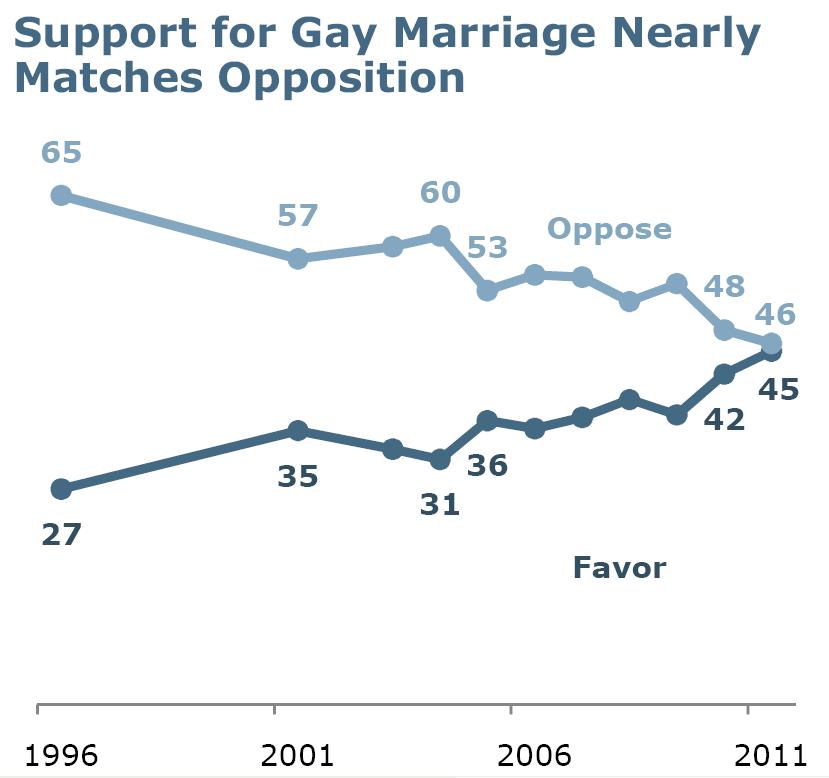
The most recent polling data from the Pew Research Center has found that support same-sex marriage has risen to 45%, up from 42% last year.  Opposition currently stands at 46%.  As you can see from the chart, support for same-sex marriage has steadily increased, and opposition has steadily decreased since 1996.  It doesn’t take a prophet to predict that unless social conservatives start making a persuasive case in the public square real quick, those who oppose same-sex marriage will be in the minority within two years.  In some parts of the country (Northeast, West), this has already happened.

Support for abortion rights has also risen back to 2008 levels, after a substantial dip in 2009 (47% in 2009, 54% now).  I have a feeling the dip in 2009 was due to some sort of sampling error.  It seems too unlikely to me that public opinion would change so fast, and then change back just as quickly.

One of the distinct features of the canonical gospels is the amount of geographical and temporal details they contain.  They do not just tell you the things Jesus said and did, but they tell you where and when He did them.  This is in stark contrast to many of the Gnostic gospels such as The Gospel of Thomas which provide few (if any) details regarding geography and time.

I have spent a lot of time in the past six months studying and comparing the four Gospels.  In the course of my studies, I noticed that certain evangelists seem to provide more geographical and temporal markers than other evangelists, so I thought it would be interesting to catalogue all of the geographical and temporal markers in the Gospels to determine who provided the most detail.

(more…)

The National Council of Church’s report on church membership lists the following organizations as the top ten biggest religious denominations in the U.S.A.: 

  1. The Catholic Church: 68.5 million
  2. Southern Baptist Convention: 16.1 million
  3. The United Methodist Church: 7.8 million
  4. The Church of Jesus Christ of Latter-day Saints: 6 million
  5. The Church of God in Christ: 5.5 million
  6. National Baptist Convention, USA: 5 million
  7. Evangelical Lutheran Church in America: 4.5 million
  8. National Baptist Convention of America: 3.5 million
  9. Assemblies of God: 2.9 million
  10. Presbyterian Church (USA): 2.7 million

I was surprised by the large gap between the number one and number two slots, and I was astounded to learn that Mormonism is the 4th largest denomination in America.  

HT: Theology in the News

The Pew Research Center released a major social trends report in November 2010 on the topic of marriage and family titled “The Decline of Marriage And Rise of New Families” (you may have heard about the cover article on this report featured in Time magazine).  They attempted to evaluate how Americans’ views of marriage have changed over the last 50 years.[1] Some of their findings merely confirmed what most see as common knowledge, but some of their findings were quite surprising.

It took me a number of lunch breaks to read through the report, but it was well worth the time spent seeing how it is chalked full of valuable social statistics.  While I would encourage you to read the full report, here are some of the most significant findings (organized by subject):

(more…)

A recent survey in England revealed that 64% of women want a husband who makes more money than them, and 69% would prefer to stay home to be a full-time mother if they were financially able to do so.  

I bet the only people surprised by this are social liberals who thought that if you tell a woman long enough that a successful business career will be more meaningful to her than raising a family, she will believe it.  Apparently women aren’t buying it.  Don’t get me wrong, I’m not saying a woman who wants to work outside the home should not do so.  But that is not where most women find their fulfillment in life.  God designed men and women differently.  Most women find their greatest fulfillment in caring for and raising a family, while most men find their greatest fulfillment in being productive in industry for the benefit of their families.  That’s just human nature, and it can’t be socially engineered otherwise.

Justin Taylor pointed to a 2003 essay by Robbie Low in Touchstone magazine discussing a 1994 study in Switzerland on how the church attendance habits of moms and dads affects the future attendance of their children:

  • If dad does not go to church = only 1 out of 50 kids will become a regular churchgoer
  • If dad is a regular churchgoer (regardless of mom’s attendance) = 66-75% of kids will become regular or irregular churchgoers
  • If dad is an irregular churchgoer (regardless of mom’s attendance) = 50-66% of kids will become regular or irregular churchgoers
  • If dad is a regular churchgoer but mom is not = >66% of kids will become regular or irregular churchgoers
  • If dad does not go to church but mom is a regular churchgoer = only 33% of kids will visit a church
  • If neither mom nor dad go to church = only 20% of kids will visit a church

While I suspect American cultural differences could mean these statistics are not entirely transferable to America, clearly a lot rests on our shoulders dads!

A new Gallup poll reveals Americans’ views on creation:

  • 40% believe humans were specially created by God 10,000 years ago (creationism)
  • 38% believe God used evolutionary processes to create human beings from less advanced life forms over millions of years (theistic evolution)
  • 16% believe humans developed from less advanced life forms over millions of years without any aid from a divine being (naturalism/atheism).

The number of theistic evolutionists has not changed much over the past 30 years, while there has been a slight decrease in the number of creationists (down from 47% in 1993) and a slight increase in the number of naturalists/atheists (up 7% from 1982).

One of the weaknesses of this poll is that it presents these three views as if they were the only options.  Jay Richards wrote a short post elaborating on this point.  Nevertheless, it does illustrate an important point: the vast majority of Americans do not buy into the materialistic paradigm of Darwinism.

That’s what AOL News claims based on an article in the journal Pediatrics.  Kevin DeYoung smelled something fishy about this surprising statistic, so did a little investigating and found out that the claim is based on a misreading of the journal article.  DeYoung writes:

AOL speaks of 1 in 10 teens; the original article concludes 9.3% of sexually active adolescents reported a same-sex partner. There’s a big difference. The survey analyzed data from 17,220 teenagers. Of those, 7,261 (or 42%) reported having had sex. So according this study 58% of teens are not having sex with anyone and 9.3% of those have, had same-sex partners, or 3.9% of the total sample.

(more…)

Many proponents of same-sex marriage assume that opposition to same-sex marriage comes almost exclusively from religious citizens.  A simple math calculation exposes the error of this assumption: religious believers account for approximately 95% of the population, and yet only 48% oppose same-sex marriage (41% favor).  Clearly not all opposition to same-sex marriage is coming from religious believers.  Who, then, is it coming from?

(more…)

In May of this year Gallup polled Americans to determine what behaviors they found morally acceptable and unacceptable.  Sixteen behaviors were evaluated, and here are the results:

(more…)

Elaine Howard Ecklund has written a book titled Science vs Religion: What Scientists Really Think.  A summary of her research findings was published in USA Today (July 19, 2010): “Myths Widen the Science-Religion Divide.”

Ecklund surveyed 1,700 natural and social scientists and conducted interviews with 275 of them.  She found that: (more…)

The Kaiser Family Foundation released its latest report on media consumption in America.  Here are some interesting highlights as reported by Al Mohler:

  • Kid’s spend 7 ½ hours per day consuming media.  But because they multi-task their media, their consumption is actually closer to 11 hours per day.
  • 66% of kids have a cell phone, but only use it for talking 30 minutes per day.  Usually it is used for texting or accessing the internet for media
  • 76% of kids have an mp3 player
  • The average American home now contains 3.8 TVs, 2.8 DVD/VCR players, at least one DVR, 2 computers, 2.3 video game consoles
  • 71% of kids aged 8-18 have a TV in their room.  Half have a video game console and/or access to cable.  1 out of 3 have their own computer.

I found the following statistics from the Marriage Index quite interesting:

  • In 1970, 78.6 percent of adults age 20-54 were married. In 2008, it dropped to 57.2 percent
  • In 1970, 77.4 percent of first marriages were intact, but only 61.2 percent were intact in 2007
  • Today, only 60.3 percent of all babies are born to married couples, compared to 89.3 percent in 1970.
  • Half of all children born to cohabiting couples see those unions end by age five.
  • In 1970, 68.7 percent of all children lived with their own mother and father. In 2007, that percentage had dropped to 61.


HT: Al Mohler

I’m late to the game on this one, but I just discovered some great statistical information regarding changes in the religious identity of Americans between 1990 and 2008, as well as a great interactive online chart visually displaying the information.  Here is some of the most pertinent information:

  • Those who claim to have no religious affiliation (called “Nones”) have grown in every state since 1990. 
  • The west and northeast coasts dominate the no religion category.  VT comes in 1st with 34%.  CA ranks 15th with 18%.  MI ranks last with 5%. 
  • Non-Christian religions have grown in all but 6 states since 1990. 
  • Protestants have diminished in all but 4 states. 
  • Catholics have diminished in all but 20 states. 
  • Catholics have increased in CA from 27% in 1990 to 38% in 2008. 
  • The northeast has the highest percentage of Catholics (RI has 46%).  CA ranks 5th with 38%.  AL ranks last with 6%. 
  • The south is mostly Protestant (AL has 80%).  CA ranks 45th with 35%.  MA ranks last with 26%. 
  • CT has the most non-Christian religious adherents (8%).  CA ranks 6th with 5%.  Wyoming ranks last with 1%. 
  • For those who simply don’t know what to say their religious identity is, OR comes in 1st place with 7% (compared to 2% in 1990), and DE last with 2% (in 1990 they were ranked 1st with 6%).  CA has 5%.

The beliefs of Nones was broken down further:

  • 51% believe in a deity of some sort
  • ~24% believe in a non-personal God
  • ~27% believe in a personal God
  • ~36% are agnostic (~19% hard agnostics, ~17% soft agnostics)
  • ~7% are atheist
  • 22% of 18-29 year old are Nones

empty-pewsHere is the church, here is the steeple, open the door and…uh oh, where’s all the teen people?  It’s been observed that many teens graduate from church when they graduate from high school, but just how many do so, why do they do so, and what should we do about it?

First, how many are leaving?  Different studies show different results.  Figures range from 40% to 88%.  That’s quite a margin!  Some of the studies appear to be denomination-specific, and it’s not clear that the polling methodology is sound in every case.  The 2007 study from LifeWay Research appears to be the most thorough, accurate, and sound report on the subject to date.  They found that 70% of teens stop attending church for at least a year between the ages of 18-22.  That sound pretty bad, and it is.  But it is not as bad as some prophets of doom have made it out to be.

While upwards of 70% of Christian teens stop attending church upon becoming an adult, it’s not because all of them are giving up their faith.  In fact, according to the LifeWay study, 1/3 return by the time they are 30 (which means 53% of churched teens will still be in church by age 30), and another 30% begin attending church again once a month or less.  When LifeWay asked church dropouts why they stopped attending church, 97% cited some change in life situation such as their work schedule, not being close to a church, or being too busy (many go to college, after all).  Of course, 20% say that they intended to stop attending once they graduated, and 27% confessed that they just wanted a break from church (respondents could select more than one reason).

Pastor and/or church-related issues contributed to the departure of 58% of respondents.  Many felt the people in church were too hypocritical, or simply did not feel connected to the people.  Differences in religious, ethical, or political beliefs were a factor for 52% of teens.  About 1 in 10 (12%) stopped attending church because they were “unsure of the reasons behind my faith.”  Only 7% said they stopped believing in God.

While not every teen that stops attending church does so because s/he no longer believes Christianity is true, this isn’t to dismiss the fact that a sizable minority of teens do abandon their faith after high school, often for intellectual reasons.  Sociologists of religion, Christian Smith and Melinda Lundquist Denton, wrote a book titled Soul Searching: The Religious and Spiritual Lives of American Teenagers based on their research of teens’ religious beliefs, practices, and outlook.  They asked teens dropouts, “Why is it that you are no longer religious?”  Smith and Denton recorded the answers as given, and then categorized them by type.  The largest percentage — 32% — cited intellectual skepticism about the truthfulness of Christianity as the main reason they abandoned it (1 out of 3)!  The next closest response was “I don’t know,” coming in at 22%.

What do we need to do to prevent further bleeding?  Several things can be done.  First, I think we need to make apologetics a vital part of youth ministry.  We need to do more than indoctrinate and entertain our young people.  They need to be inoculated against the intellectual attacks often leveled against Christianity in the university and beyond.

We also need to show them how Christianity is relevant to their lives.  We need to live the faith we preach, and we need to actively involve them in the fabric of the church.  We need to cultivate their spiritual life, helping them to make their own connection to God so that Christianity is their religion, and not just their parents’.  We need to help them make spiritual disciplines such as prayer and Bible reading part of their daily routine.  And given the fact that many church dropouts return at the behest of their friends and family (60%), we would do well to encourage our young people to continue attending church during their post-graduation years, to help prevent their leaving in the first place.

According to a recent Barna survey, American Christians have some very non-biblical points of view:

  • 59% think Satan is not a real being, but only a symbol of evil
  • 39% think Jesus sinned
  • 58% think the Holy Spirit is a symbol of God’s power/presence, but not a living entity
  • 41% think the Bible, the Quran, and the Book of Mormon are just different expressions of the same spiritual truths.

While the figures weren’t so bad when isolated specifically to born-again believers, I think this goes to show that just because someone claims to be a Christian, it does not mean they hold to a Christian, Biblical worldview.

Many also hold conflicting points of view.  For example, only 28% reject the idea that evil spirit beings exist and can influence human behavior, and yet 59% reject the existence of Satan.  But Satan is an evil being who can influence human behavior, so why do 31% more people accept the existence of evil spirits than the existence of Satan?  No idea.

According to a recent report, teen pregnancy is on the rise again for the second year in a row, and 40% of all children born in this country are now born out of wedlock.  Not good signs of social strength.

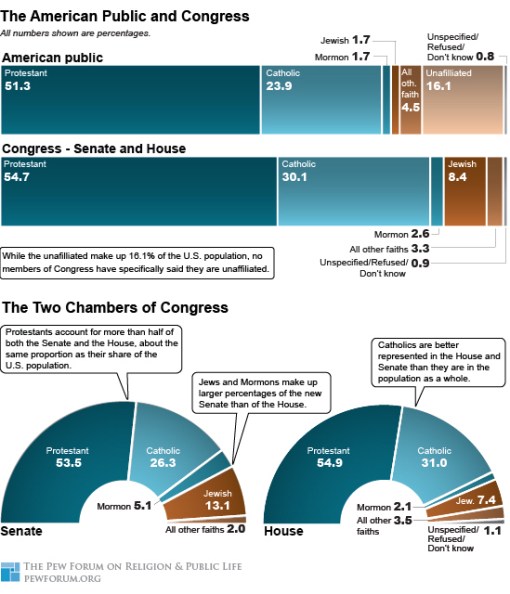
Ever want to know the religious makeup of Congress?  Pew has it for you:

cong1

« Previous PageNext Page »