Statistics


Last year the Pew Forum on Religion & Public Life released its findings on the religious beliefs and practices of Americans based on an extensive sampling (35,000 people).  I blogged on their findings, noting that 70% of religious Americans in general, and 57% of evangelicals in particular, believe many religions lead to eternal life.  

Many questioned the accuracy of the data due to the ambiguity of the question posed to respondents.  “Religions” could be interpreted to mean non-Christian religions, or other Christian denominations.  So in August 2008 Pew clarified the issue by re-asking the same question in expanded form to a sampling of 2908 people.  Not only did the number of evangelical who affirmed “many religions can lead to eternal life” drop from 57% to 47%, but of that number, only 72% had non-Christian religions in view.  That means “only” 34% of evangelicals believe non-Christian faiths can lead to eternal life (within all of American Christendom, that number is 52%).  So it’s not as bad as originally believed, but 1 in 3 is still bad!

When it is broken out by who these evangelicals thought could be saved apart from Christianity, the data is pretty scary.  A full 64% of them thought Jews could be saved; 35% thought Muslims could be saved; 33% Hindus; 26% atheists; 35% non-religious.  When 1 in 4 of them think somebody can deny God’s existence and still be saved, something is wrong!

On the positive side, the number of evangelicals who believe one must be a Christian has actually increased from 37% in 2007 to 49% in 2008.  From Pew: “Fewer than half of evangelicals (47%) say many religions can lead to eternal life, down nine points in the course of a year, while 49% say theirs is the one, true faith.”  So it appears that Christian particularlism is on the rise, and religious pluralism is on the decline in evangelical circles. 

Religious pluralism among religious believers of any stripe is also in decline, decreasing from 76% in 2002, to 65% in 2008.  These figures do not isolate “strong religious pluralists” from those who simply allow for the salvation of those in various factions of their own religion (“weak religious pluralists”).  When we isolate the strong from the weak religious pluralists, the numbers are smaller.  That subset constitutes a slim majority of religious Americans (52%).  The 2002 data did isolate this subset, but if we apply the 2008 ratios of strong-to-weak religious pluralists to the 2002 data, it would yield a figure of 61% strong religious pluralists.  A 9% reduction in religious pluralism over a 6 year period is significant indeed.

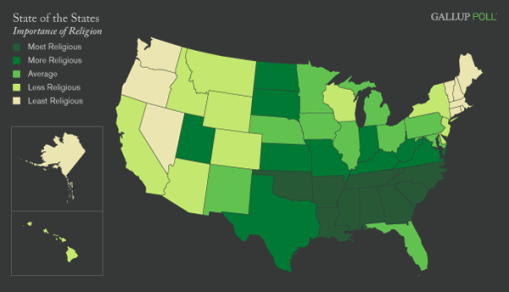
Gallup recently conducted a nationwide poll to see what states were the most and least religious.  People were asked if religion was an important part of their daily life.  The state with the highest religiosity is Mississippi, with 85% of those polled declaring religion to be an important part of their daily lives. Vermont is the least religious state, with only 42% of those polled affirming the same thing.  My own state of California came in at number 38 (57%), beating out Montana (56%) and New York (56%). 

gjork_anm0uczjmfa4f6ma

Here is a pictorial representation of religiosity levels in the US.  The darker the green, the more religious:

ztx77iknqkk8tksbouojiw1

Indeed, there is a Bible Belt in the U.S.  And then there is that Bible vacuum we call New England and the West Coast!

I don’t know which is more difficult: trying to change the beliefs of religious people, or trying to change the beliefs of those who are apathetic towards religion in general.  Either way, we’ve got our work cut out for us.


HT: Albert Mohler

In February I blogged on the first report issued by the Pew Forum on Religion & Public Life based on their expansive U.S. Religious Landscape Survey. The first report surveyed the religious affiliation of Americans. The second report, released a few weeks ago, focuses on the religious beliefs and practices of Americans, and how these relate to our social and political views.

I would highly recommend you read the 18 page summary report, if not the full 268 page report (personally I don’t have the stomach for the latter). But I would like to share some of the findings I found most interesting:

  • 70% of religious Americans say many different religions lead to God. Even 57% of evangelicals hold to this view. When more than half the members of the most conservative Christian group are religious pluralists, we have serious problems on our hands. Either the exclusivity of the Gospel is not being proclaimed in churches, or not being defended.
  • 78% of Americans believe in absolute moral values. This is much higher than figures posted by the Barna Research Group (22%), and is reassuring. I have to assume that such a large difference must be due to the way the question is worded in the respective surveys. I don’t know how Barna words his questions, but Pew worded theirs as follows: “There are clear and absolute standards for what is right and wrong.” The respondent was requested to rate their level of agreement with this statement. I think it is pretty straightforward. This, combined with the sheer number of participants, makes me lean toward Pew’s findings, and abandoning Barna’s as unrealistic.
  • 92% of Americans believe in God. Not everyone in a religious tradition believes in the existence of God. Buddhism, for example, is typically atheistic (although strangely enough, 75% of American Buddhists believe in God). But I would expect for all of the adherents of theistic religions to believe in God. Strangely enough, they don’t. Only 99% of evangelicals do, and 97% of Catholics. The only Christian group in which everyone polled believed in God was Mormonism. Oddly enough, 21% of atheists confessed to belief in God. I’ll never figure that one out!
  • 60% of adults believe God is personal; 25% believe he is an impersonal force.
  • Only 3 in 4 people believe in life after death, and heaven. This was lower than I expected, especially given the number of theists in this country (92%).
  • Six in ten Americans (59%) believe in hell. The gap between belief in heaven and hell has been reported to be much higher in other surveys I have read. It was interesting to see the gap between belief in heaven and hell in various religious traditions. While 95% of Mormons believe in heaven (the highest of any religious tradition), only 59% believe in hell. Jehovah’s Witnesses experience an even larger gap. Only 46% believe in heaven, but a measly 9% believe in hell (the lowest of any religious tradition—even lower than atheists!). I found this very ironic given the centrality these doctrines play in JW theology. Those who were most likely to believe in both heaven and hell were evangelicals (86% vs. 82%).
  • Christianity is not the only religion in which those who profess the name often do not confess to its doctrines. Only 62% of Buddhists believe in nirvana, and only 61% of Hindus believe in reincarnation. These are staple doctrines of these religions, so we would expect a higher number of adherents to these doctrines. This goes to show that there are many cultural adherents to other religions, who either do not know the teachings of their religion, or reject them.
  • 79% of Americans believe miracles occur today.
  • About 40% of Americans attend religious services weekly.
  • While more than twice as many people cite personal experience (34%) than religious views (14%) as the main influence on their political views, the researchers found a strong link between religious beliefs and political views.
  • Only half of Evangelicals identified themselves with the Republican party.
  • Those most opposed to abortion and homosexuality are Jehovah’s Witnesses, Mormons, and evangelicals. Those least opposed are Jews, Buddhists, agnostics, and atheists.
  • The more people pray, attend religious services, are certain of God’s existence, the more politically conservative they tend to be.

Some of you might have heard recently a statistic released by the CDC that 1 in 4 teenage girls has an STD. Many people were skeptical of this statistic when it was released. Come to find out, there is good reason for that skepticism. See this article for more information.

The headline in the Washington Post reads, “A Debunking on Teenagers and ‘Technical Virginity’”. They discuss a recent Guttmacher Institute study that supposedly debunks the myth that a lot of teens are engaging in oral sex rather than vaginal sex to preserve their virginity. What is their evidence? That oral sex is more common among those who have had vaginal sex than those who haven’t. A full 87% of those who have had vaginal sex have also had oral sex, whereas 23% of those who have not had vaginal sex have had oral sex.

I do not dispute the statistics, but I think the Guttmacher Institute is spinning the statistics into a lie. It is not surprising that those who engage in vaginal sex are more likely to engage in oral sex. After all, if you’ve “gone all the way,” oral sex is no big deal. What they are minimizing is the fact that 23% of virgins have had oral sex, rather than engage in vaginal sex. Did you catch that? How can it be a myth that teens are engaging in oral sex rather than vaginal sex to perverse their virginity when the study admits that nearly 1 in 4 virgins is having oral sex but not vaginal sex?!

Rather than being a myth, I think this study proves it is true that a large number of teens are engaging in oral sex to preserve their virginity (although I don’t know whether this proves it is “on the rise”). Of course, many more are engaging in oral sex who have chosen not to preserve their virginity, but again, this is not surprising. Unless I am missing something, I think the Guttmacher Institute is lying with the statistics. It is irresponsible to compare the 87% to the 23%. They are apples and oranges.

The Pew Forum on Religion & Public Life conducted an extensive poll measuring the religious landscape of the U.S. A summary of the report can be found here. They also created interactive tools to illustrate their findings. I must say they are quite impressive. Not only do they provide detailed information on a visual level (and by state), but it allows you to customize comparisons of statistics of religious traditions side-by-side.

Here is some of the most pertinent and interesting data:

–America is 78% Christian. 51% are Protestant, and 24% are Catholic. A full 26% of the country is Evangelical Protestant.

–Non-Christian religions constitute less than 5% of the nation. Jews take the lead at 1.7% of the population, followed by Buddhists (.7%), Muslims (.6%), and Hindus (.4%).

–16% of the country is not affiliated with any religion. Of this number, only 1.6% are atheists, and 2.4% agnostics. The rest are “nothing in particular.” These people can be secular or religious, but are not affiliated with any religion. A full 1 in 4 young people aged 18-29 claim no religious affiliation.

–The Catholic Church loses the most people to other religions, but their numbers remain static because of Catholic immigrants (mainly from Mexico). One in three adults in the Catholic Church are Latino.

–37% of married couples are married to someone of a different religion (or denomination).

–Only 37% of those who were raised Jehovah’s Witnesses are still JWs. JWs have the lowest retention rate of any religious group.

All Evangelicals are conservative Republicans, right? Evangelicals are a political force for the Right, right? That’s what the media would have you believe. This is not true. The Center for American Progress Action Fund (CAPAF) and Faith in Public Life (FIPL) discovered that the major network’s exit polls only ask Republican primary voters to identify themselves as “born-again or Evangelical Christian.” The same question does not appear on Democratic exit polls.

CAPAF/FIPL commissioned Zogby International to fill in the gap of our knowledge by doing post-election polling in the states of Missouri and Tennessee. The results are stunning for all those who have bought into the idea that Evangelicals are a mindless voting bloc for the Republican party, and that Evangelicals are only concerned about abortion and same-sex marriage.

One out of three voting white Evangelicals, voted in the Democratic primary. Indeed, 19% of all voting Democrats in Missouri, and 29% of all voting Democrats in Tennessee were white Evangelicals.

What are white Evangelicals concerned about? In Missouri, 30% of white Evangelicals ranked jobs and the economy as the most important issue, while only 14% ranked abortion and same-sex marriage as the most important issue. In Tennessee 34% of white Evangelicals ranked jobs and the economy as the most important issue, while only 19% ranked abortion and same-sex marriage as the most important issue.

So not only are 1/3 of voting white Evangelicals voting for Democrats, but as a group, they are twice as concerned about economic matters as they are moral matters (if we take MO and TN as representative of the nation as a whole). This is extremely significant. Of all Christian groups, Evangelicals are the most conservative, both theologically and morally. When that group is twice as concerned about their own pocketbook as they are about issues of moral justice, we are in trouble!

The Alan Guttmacher Institute has just released its report on abortion statistics for the years 2004-2005: Abortion in the United States: Incidence and Access to Services, 2005. The last time this report was released was in 2003 for the years 1999-2000. Overall, the picture looks good. Abortions and abortion providers are still on the decline. Here are some important snippets from the report:

Total number of abortions

“The number of abortions in the United States declined from 1.61 million (the all-time high) in 1990 to 1.31 million in 2000. Similarly, the abortion rate declined from 27 per 1,000 women aged 15–44 in 1990 to 21 per 1,000 in 2000, a level comparable to levels of the mid-1970s.”

“An estimated 1.2 million abortions were performed in the United States in 2005, 8% fewer than in 2000. The abortion rate in 2005 was 19.4 per 1,000 women aged 15–44; this rate represents a 9% decline from 2000.”

“Abortion rates declined faster between 2000 and 2005 than they had between 1996 and 2000 (5%). The abortion ratio indicates that 22% of pregnancies (excluding those ending in miscarriages) ended in abortion in 2005.”

Abortion providers

“There were 1,787 abortion providers in 2005, only 2% fewer than in 2000. … Indeed, if not for new providers offering only early medication abortion, the total number of providers would have decreased by 8% instead of 2% between 2000 and 2005.”

Number of medication (as opposed to surgical) abortions

“Early medication abortion, offered by an estimated 57% of known providers, accounted for 13% of abortions (and for 22% of abortions before nine weeks’ gestation).”

Legal restrictions on abortion are partially credited for slowing the abortion rate

“At the same time, during the last several years, a number of states have implemented restrictions that may have made it more difficult for women to access abortion services and for physicians to perform abortions. For example, between 2000 and 2004, five states enacted laws that impose burdens on abortion providers. These restrictions range from requiring abortions after 15 weeks to be provided in a licensed surgical center to requiring providers to have expensive ultrasound equipment on-site.”

The Gallup Poll released its 2007 polling data back in June regarding Americans’ views on 16 different moral issues: homosexual relations, the death penalty, premarital sex, unwed motherhood, abortion, divorce, doctor-assistance suicide, suicide, embryonic stem cell research, cloning humans, cloning animals, gambling, polygamy, extra-marital affairs, wearing fur, and medical testing using animals.


The poll is interesting on several counts. What do Americans see as morally wrong? In order of most wrong to least wrong:


  1. Extra-marital affairs (91% disapprove)
  2. Polygamy (90%)
  3. Cloning humans (86%)
  4. Suicide (78%)
  5. Cloning animals (59%)
  6. Abortion (51%)
  7. Homosexual relations (49%)
  8. Doctor assisted suicide (44%)
  9. Unwed motherhood (42%)
  10. Premarital sex (38%)
  11. Wearing fur (38%)
  12. Medical testing using animals (37%)
  13. Gambling (32%)
  14. Embryonic stem cell research (30%)
  15. Death penalty (27%)
  16. Divorce (26%)


What is morally acceptable? In order of most accepted to least accepted:


  1. Death penalty (66% accept)
  2. Divorce (65%)
  3. Embryonic stem cell research (64%)
  4. Gambling (63%)
  5. Medical testing using animals (59%)
  6. Premarital sex (59%)
  7. Wearing fur (58%)
  8. Unwed motherhood (54%)
  9. Doctor assisted suicide (49%)
  10. Homosexual relations (47%)
  11. Abortion (40%)
  12. Cloning animals (36%)
  13. Suicide (16%)
  14. Cloning humans (11%)
  15. Polygamy (8%)
  16. Extra-marital affairs (6%)


What surprised me

I was surprised to discover that while 78% of people oppose suicide, only 44% oppose doctor-assisted suicide. The only difference between the two is that in the former instance the person kills themselves without the aid of another person, whereas in the latter instance they seek a doctor’s help. But in both instances you have a person who chooses to end their life. So why the big gap in moral condemnation?


I was surprised that 6 in 10 people oppose cloning animals. I’m not sure what they find objectionable about that. I wasn’t at all surprised to see that 86% oppose human cloning, but the fact that there was only a gap of 27% between animal and human cloning tells me that American’s have an inflated view of animal value. This is especially the case given the fact that more Americans oppose animal cloning than they do abortion, homosexuality, and doctor assisted suicide!


Significant changes in opinion


The most significant change in opinion has been Americans’ increasing acceptance of homosexual relations and embryonic stem cell research. The former increased from 40% acceptance in 2001 to 47% acceptance today. The latter increased from 52% in 2002 to 67% today. We’ve got our work cut out for us in persuading the American public on these two issues. The tide of public opinion is working against us.


Where are we divided?


The data reveals that Americans are most polarized on homosexual relations, abortion, doctor assisted suicide, and unwed motherhood. The relatively even split of opinion means if we can make a persuasive case in the public square, we stand a chance of our views quickly gaining a majority status, thus effecting the realm of both morality and politics.


Abortion and embryonic stem cell research moral disconnect


The fact that there is a 21% difference between those who see abortion as morally wrong and embryonic stem cell research as morally wrong tells me that the public does not understand the logic of the pro-life position. If they did, they would see that the issue of abortion and the issue of embryonic stem cell research are morally tied at the hip. The fact that 1 in 5 do not see this tells me that we have to do a better job of explaining the pro-life logic, and specifically applying it to other areas of bioethics such as embryonic stem cell research.

The New York Post reports

on a new nationwide poll of Muslim beliefs about suicide bombings, Al Qaeda, and the U.S. led wars in the Middle East. The findings may scare you.It’s not a good sign when 26% of American Muslims under the age of 30 believe suicide bombings and other means of violence against innocent civilians can be justified on rare occasions “in order to defend Islam from its enemies.” Nor is it a good sign when 5% of American Muslims have a favorable view of Al Queda.

Given the fact that 60% of Muslims either deny or take no position that Arabs were involved in the September 11th attack, 75% oppose the war in Iraq, and 48% oppose the war in Afghanistan, it doesn’t take a leap to think some of these U.S. Muslims see the U.S. as an enemy. And given the fact that 5% of American Muslims (117,500 people) support Al Qaeda, and 1 out of 4 young American Muslims think suicide bombings against innocent civilians is justified to defend Islam from its enemies, we would be stupid beyond pale to close our eyes to the possibility of being attacked at home by U.S. Muslims because we don’t want to be politically incorrect.

Don’t get me wrong. I’m not saying Muslims are our enemies. There are many good Muslims who are pro-America, and would never think of doing anything to harm us. But there is obviously a viable minority among us who think otherwise, and we can’t shut our eyes to that fact. To do so would only be to our own peril.


One final note on the abortion poll…. Did you notice how support for aborting a baby because s/he was conceived due to rape or incest enjoys the same level of support as saving the life of the mother (70% vs. 75% respectively). While I am persuaded that the logic of the pro-life persuasion does not justify abortion in cases of rape/incest, at this point in time any attempt to outlaw abortion that does not make an exception for such cases is likely to fail. On a tactical level, we would do well to work towards passing legislation that limits abortion in those areas where the majority of Americans support such limitations. Once we have accomplished those limitations (which constitute 94-95% of all abortions), then we can take on the rape/incest justification. Of course, that is on a legal plane. In our personal, one-on-one pro-life evangelism we should demonstrate how the pro-life logic rules out rape/incest as morally justifiable exceptions as well.

Continued from below….


The Ayres, McHenry & Associates poll also gauged the public’s support for specific abortion rationales. Ironically, while a slight majority of Americans favor abortion rights, the vast majority of Americans reject the reasons for which the vast number of abortions are performed in this country. The majority of Americans think it should be illegal to obtain an abortion for the following reasons:


Legal / Illegal

  • The woman does not like the gender of the fetus 17% / 79%
  • The woman thinks a child would interfere with her education or career plans 24% / 72%
    The fetus has a physical abnormality that could be repaired, such as a cleft palate 28% / 66%
  • The woman feels she cannot afford to raise a child 31% / 65%
  • The woman has all the children she wants 32% / 64%
  • The woman feels she is not yet ready to raise a child 32% / 63%
  • The woman is not married 32% / 62%
  • The pregnancy could cause depression or pose other mental health problems 42% / 51%


What reasons do justify an abortion?:


Legal / Illegal

  • The pregnancy endangers the life of the woman 75% / 18%
  • The pregnancy poses a threat to the physical health of the woman 70% / 21%
  • The pregnancy resulted from rape or incest 70% / 24%
  • The fetus has a serious physical or mental deformity 55% / 36%

This is quite amazing. We know that only 5-6% of all abortions are obtained to protect the health of the mother (in which “health” is so broadly defined so as to include mental health, rather than just physical health), because of fetal abnormalities, or due to rape/incest. The other 95% are obtained because the child will interfere with the mother’s education (10.8%), will cause financial hardship (21.3%), the mother is not ready for children yet (29.6%), the mother does not want any more children (7.9%), etc. That means Americans actually oppose 94-95% of all abortions being performed in this country!! This tells me Americans don’t know what their support for abortion in general, and their support for Roe in particular, is actually accomplishing. We would do well to inform them that their support of Roe not only allows the 5-6% of abortions they think are legally justified, but also the 94-95% they think should be illegal. A reasonable response by the pro-abortion majority would be to call for the overturning of Roe, and then work in their state to restrict abortion rights to the particular circumstances they believe to be legally and/or morally justified. Of course, a reasonable response by the pro-life minority would be to restrict abortion even further according to our own persuasions of what abortions are morally justifiable.


In conclusion, while the majority of Americans support Roe, the margin would be reduced to a statistical wash if Americans were correctly informed of Roe’s real import. Furthermore, while the majority of Americans support abortion rights, they only do so for a slim fraction of all abortions. We would do well, then, to educate the public that overturning Roe will not make abortion illegal in the U.S., and that their support of Roe has the unintended effect of killing the very babies they think should be protected by law.

The Ethics and Public Policy Center and Judicial Confirmation Network suspected that many who support Roe do so because they are under the false impression that if Roe were overturned, abortion would become illegal in the United States. If the public were properly informed that overturning Roe would simply return the abortion issue back to the states to decide the matter for themselves, public support for Roe would decrease. To test their hypothesis they hired a national public relations firm, Ayres, McHenry & Associates, to conduct a poll that would gauge the genuine public support for Roe v Wade, as well as other abortion-specific questions. The findings are quite significant to our understanding of the supposed public support for abortion rights.


To discover if their suspicions were correct, respondents were asked twice to declare their support, or lack of support for overturning Roe: the first time without being informed, and the second time after being informed that overturning Roe would merely return the issue of abortion back to the states, allowing them to decide their own positions on abortion. The poll results confirmed the suspicions of the Ethics and Public Policy Center and Judicial Confirmation Network.


Prior to being informed of the import of Roe, 34% of respondents supported overturning Roe, while 55% did not. After being informed that overturning Roe would merely return the issue of abortion back to the states to decide, support for overturning Roe increased to 43%, while opposition decreased to 48%. The margin narrowed from 21% to 5% in favor of not overturning Roe. That is quite a shift! I think the media and pro-abortion advocacy groups like Planned Parenthood are largely to blame for the perception that overturning Roe would ban abortion in the U.S.


I will discuss what this poll tells us about how Americans really feel about abortion in a separate post.

Check out TIME magazine’s interactive webpage breaking America down by population, religion, etc. They have some amazing illustrative graphs and charts. Very good info.

The Associated Press ran a story about a recent study that examined the religious beliefs of college professors. The study found that approximately 25% of professors are atheist or agnostic (which is about double the national average). What about the other 75%? According to the AP article “the rest say they believe in God at least part of the time, or at least in some kind of higher power.” That’s right, they are part-time believers! From 8am-5pm they are atheists, but theists from 5pm-8am.


This was not a slip of the pen, either. “Believe in Higher Power or God some of the time” was an actual category in the study, in contrast to “believe in God.” Funny stuff!

The Pew Research Center has released its newest polling data concerning the American public’s view on a variety of moral issues such as abortion, stem cell research, same-sex marriage, and Plan B. Check it out here. Pew is always a reliable source for gauging Americans’ views on hot-topic moral issues.
The Barna Research Group’s latest study is concerns the unchurched adult population in America. They found that one third of adult Americans have not attended church in the last six months. Of the nonchurched population, 62% consider themselves Christians, and 24% atheist. Three out of ten non-churched are Catholics, 1 out of five are Baptist. The area of the country with the greatest amount of unchurced adults is the West (43%) and the Northeast (40%). Click here to read the article, to read more about the beliefs and practices of those we are trying to reach with the Gospel of Jesus Christ.


« Previous Page