Bible


That’s the claim Daniel Wallace made during his most recent debate with Bart Ehrman at UNC Chapel Hill.  In his summary of the debate at Parchment and Pen, Wallace writes:

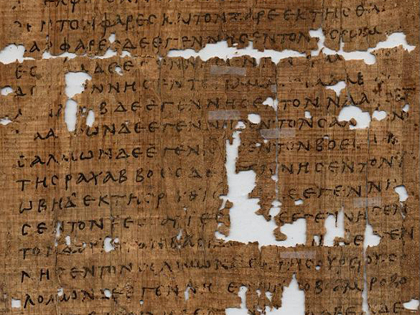
We have as many as eighteen second-century manuscripts (six of which were recently discovered and not yet catalogued) and a first-century manuscript of Mark’s Gospel! … Bart had explicitly said that our earliest copy of Mark was from c. 200 CE, but this is now incorrect. It’s from the first century. I mentioned these new manuscript finds and told the audience that a book will be published by E. J. Brill in about a year that gives all the data. … I noted that a world-class paleographer, whose qualifications are unimpeachable, was my source.”

Later he described the newly discovered manuscript as “just a small fragment.”  Nevertheless, if this is a manuscript copy of Mark’s gospel, and if it can be reliably dated to the 1st century AD, this would be the greatest NT manuscript find to date, surpassing even p52 (a small portion of John’s Gospel, dated to ~125 AD)!  We’ll have to wait and see.

UPDATE 2/16: Dr. Wallace has written specifically on this issue on the Dallas Theological Seminary website and added a tiny bit more information by saying “it was dated by one of the world’s leading paleographers. He said he was ‘certain’ that it was from the first century.” In the comments I have also quoted Dr. Ben Witherington III regarding the owner of the fragment, and a bit more detail about it.  Witherington made it sound as if it is much more than a “small fragment.” I guess we’ll have to wait until next year to see how small is small.
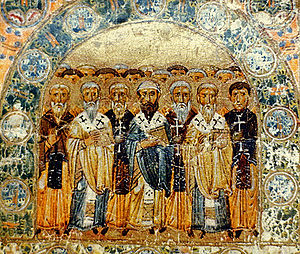
Have you ever heard it said—or said it yourself—that if all the Bibles and Biblical manuscripts in the world were destroyed tomorrow, we could reconstruct all but 11 verses of the NT from the writings of the Ante-Nicene Church Fathers alone?  Recently, while listening to an interview featuring NT textual critic, Daniel Wallace, I learned that this claim is demonstrably false.[1]  Unfortunately this has been repeated in one form or another by many individuals, including prominent NT textual critics.

Apparently this misinformation began to circulate widely in 1841 with the publication of Robert Philip’s memoir of John Campbell titled The Life, Times, and Missionary Enterprises of the Rev. John CampbellThe Life contains a written anecdote of Campbell, who was rehearsing a story told to him by Reverend Dr. Walter Buchanan pertaining to the research David Dalrymple conducted into the church fathers’ citations of the NT.  According to Campbell, Buchanan and Dalrymple were both in attendance at a literary party when someone raised the question: “Supposing all the New Testaments in the world had been destroyed at the end of the third century, could their contents have been recovered from the writings of the three first centuries?”  No one had an answer.  According to Campbell, two months later Dalrymple contacted Buchanan and reported to him that he had taken up the question raised at the party, researched the writings of the church fathers, and had an answer to the question.  According to Campbell, Buchanan told him that Dalrymple told Buchanan he discovered that all but 7 or 11 verses (Dalrymple could not recall the exact number) of the NT were quoted in the early church fathers.

(more…)

I recently taught on the historical reliability of the Gospels and the historical evidence for the resurrection of Jesus.  One of the areas I focused on was the apparent contradictions and errors in the Gospels, demonstrating how most of these are easily resolvable, and thus not contradictions/errors at all.  But not all Biblical difficulties are so easily resolved.  In fact, there are some for which I do not presently have a good answer.  If you are a careful reader of Scripture, I’d bet there are Biblical difficulties you have encountered for which you lack a good answer as well.  What are we to do with such difficulties given the doctrine of Biblical inerrancy?  What should our posture be toward the Christian faith once having discovered irresolvable difficulties in the text?

Some individuals respond by concluding that Christianity is not true.  Some go so far as to conclude that God does not even exist!  I submit to you that these responses are ill-founded; the result of elevating the doctrine of inerrancy to a status it should not be accorded in one’s theological taxonomy.  While the Bible is an indispensable aid to our faith and Christian growth, an inerrant Bible is not necessary for the truth of Christianity, and thus the doctrine of inerrancy—and Bibliology in general—should be subservient to more central doctrines such as the resurrection of Jesus in our theological taxonomy.  Let me explain.

(more…)

Frank Beckwith has made the observation that when people cannot refute your argument, they often trump it with spirituality. You know the kind of thing I’m talking about. You state your reasons for believing P rather than Q, and your Christian brother responds by saying, “I know that’s not true because God told me Q is true.”  Or your Christian sister responds, “You only believe that because you are carnal.” Don’t fall for this cheap tactic.

You could respond by saying to your brother, “Actually, God told me P is true, so I know you didn’t hear from God.” And to your sister you can respond, “Ok, I’m carnal. So can you tell this carnal brother of yours why my argument is wrong, and why I should believe your position/interpretation?”

Ben Witherington has written a short series of blog posts (part 1, 2, and 3) on the question of literacy in first-century Israel.  He makes an important point that is often overlooked in these discussions: There is a difference between being able to converse in a language, read a language, and write a language.  By today’s standards, literacy in a language refers to the ability to both read and write a language.  But if we apply this standard to antiquity—particularly to the Jewish people— we will minimize the number of people who were truly literate since many could read, but few could write.

Could Jesus read?  Yes.  The Jewish literacy rates were higher than the Greco-Roman world because of the Jews’ strong emphasis on male education for purposes of Torah-reading.  Furthermore, Jesus was not a peasant.  His family were artisans, and they owned land.   Evidence that Jesus could read is as follows:

A team of artists, medievalists, theologians, biblical scholars, and art historians headed up by Donald Jackson “brought together the ancient techniques of calligraphy and illumination with an ecumenical Christian approach to the Bible rooted in Benedictine spirituality” to produce an illuminated, hand-written Bible (New Revised Standard Version).  Such an undertaking has not been made in centuries.

Six scribes have been at work writing in a modern calligraphic script using hand-cut quills on calfskin vellum.  Each page is 3’ tall and 2’ wide.  Work began in 2000.  The final volume of seven volumes (includes the Pauline and catholic epistles and Revelation) was just recently completed on May 9, 2011.  The final product is ~1150 pages, contains 775,000 words, and weighs 165 pounds.  The project cost about 8 million dollars.  You can get a facsimile for the small sum of $140,000! Put that on your Christmas wishlist!

(more…)

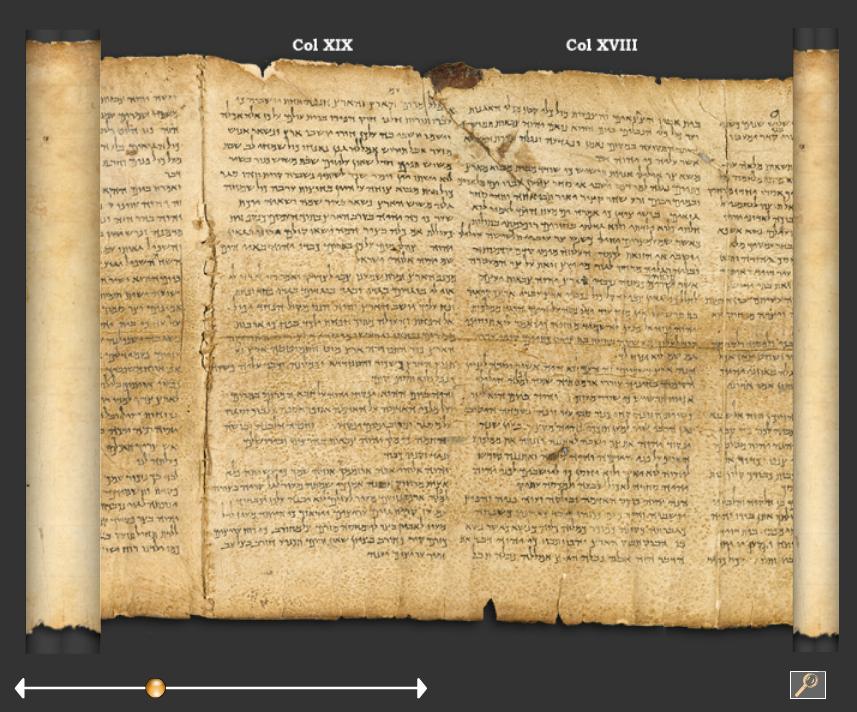
The Israel Museum teamed up with Google to make high-resolution, searchable images of the Dead Sea Scrolls available online.  It even provides a translation for you.  To begin with, only five scrolls are available for viewing.  Two of them are Biblical documents: the Great Isaiah Scroll, the Habakkuk commentary.  This is really cool!

FYI, last month I posted a link to a site that allowed you to view the Great Isaiah Scroll.  That link is now connected to the Israel Museum/Google Dead Sea Scroll site.

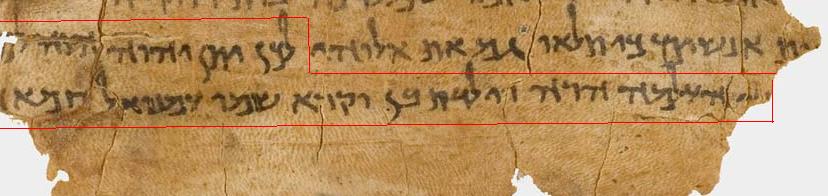
The picture above is a picture of Isaiah 7:14 in the Great Isaiah Scroll.


While doing some research on the Dead Sea Scrolls I discovered a website that shows the entire Great Isaiah Scroll found in Qumran.  The site allows you to literally scroll through the scroll, and provides a zoom feature as well.  Very cool!

Mt 6:5-6  “Whenever you pray, do not be like the hypocrites, because they love to pray while standing in synagogues and on street corners so that people can see them. Truly I say to you, they have their reward. 6 But whenever you pray, go into your room, close the door, and pray to your Father in secret. And your Father, who sees in secret, will reward you.” (NET)

Jesus’ words here have been interpreted by many to mean vocalized prayers in public settings should be avoided.  The only acceptable form of prayer in a public setting is silent prayer.  Is this what Jesus meant?  No, as Biblical examples of prayer make clear.

The first thing to observe is that Jesus went on to instruct the disciples how they should pray.  He told them they should say, “Our Father, who is in heaven…” (6:9)  Jesus’ use of the plural possessive implies that this prayer would be prayed aloud in a community setting.  There would be no need for a single person praying alone, or a single person praying silently in a group to use “our.”  In both cases “my Father” would be more appropriate.

(more…)

Updated 6/28/11

George Houston has addressed an interesting question that has direct applicability to the reliability of the NT documents: How long did manuscripts remain in use?  From the available evidence Houston concludes that some manuscripts continued to be used for 200-300 years before they were finally discarded, while the majority were used for at least 100 years.

While Houstonlooked at secular documents, Craig Evans had this to say about religious documents:

Most of the [Dead Sea] scrolls were one hundred to one hundred-fifty years old when the community ceased to exist. However, approximately 40 scrolls, many of them Bible scrolls, were 200 to 300 years old—and evidently still in use—when the community was destroyed. The same holds in the case of a number of Christian Bibles. Fourth-century Codex Vaticanus was re-inked in the tenth century, which shows that it was still being read and studied some six hundred years after it had been produced. Codex Sinaiticus was corrected in the sixth or seventh century. Codex Ephraemi Rescriptus, produced in the fifth century, was in use four or five centuries before being overwritten in the twelfth century. Retired and discarded mss were not corrected: only those still in use.

If this is true of the NT autographs as well, then the popular claim that the early transmission of the NT text was wild and erratic is false. The gap between the original autograph and our earliest copies would be largely bridged. Churches and scribes could have checked their manuscript copies against the originals for an extended period of time following the death of the apostles, correcting any errors that might have crept in.  There are two reasons to think the church preserved and continued to use the originals for some time.  First, manuscripts were valuable and would not be quickly discarded.  They would only be discarded once they had deteriorated from use.  Secondly, the NT autographs were viewed as authoritative documents, and as such they would have been preserved by their original recipients.  Indeed, Tertullian seems to affirm that at least some of the original manuscripts were extant in his day: “Come now, you who would indulge a better curiosity, if you would apply it to the business of your salvation, run over [to] the apostolic churches, in which the very thrones of the apostles are still pre-eminent in their places, in which their own authentic writings are read, uttering the voice and representing the face of each of them severally.” (AD 180 — it is possible that Tertullian was not claiming these churches had the original autographs, but rather that they had copies of the autographs that were not corrupted as were the copies used by heretics)

HT: Larry Hurtado

Traditionally, authorship of Deuteronomy has been ascribed to Moses.  While it has long been clear to me that Moses could not have written the last two chapters[1], I never had reason to seriously question Mosaic authorship of the other 32 chapters until recently.  I read a number of arguments against the traditional view in Peter Enns’ article, “When was Genesis Written and Why Does it Matter?: A Brief Historical Analysis.”  Enns notes that:

  • The book does not claim to be written by Moses[2];
  • Deuteronomy 1:1 says “these are the words Moses spoke on the other side of the Jordan.” (cf. Deut 1:5)  Such a comment presumes that the narrator is writing from the perspective of the land of Canaan—a place Moses never stepped foot on (Numbers 20:12; Deuteronomy 32:48-52).  At the very least this would seem to indicate at least part of the first chapter was not written by Moses, and perhaps more;
  • The book gives a third-person account of Moses’ words and deeds, as opposed to a first-person account as we might expect if Moses was the author (e.g. 1:5; 4:41,44; 5:1; 31:9).  (I should point out, however, that this is also true of Exodus, Leviticus and Numbers.  If this calls into question Mosaic authorship of Deuteronomy, it would equally call into question Mosaic authorship of the other books.  Clearly, it is not impossible that Moses purposely wrote from a third-person perspective.)

(more…)

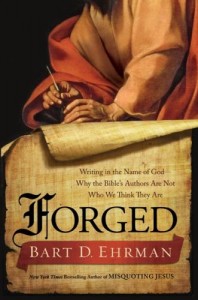
Bart Ehrman recently released his latest salvo attacking the Bible.  This time he is not just trying to undermine people’s confidence that what we read today is what the authors wrote back then.  Instead, he’s trying to undermine people’s confidence that the people we think wrote the NT documents actually wrote them.  In his view, fraudulent authors successfully deceived the NT church by forging documents in the name of ecclesiastical leaders.

Dr. Ben Witherington is currently doing a chapter-by-chapter review of the book.  He has already released four installments:

Part 1
Part 2
Part 3
Part 4

Witherington is well-qualified to interact with Ehrman’s work.  I would highly recommend that you read his review, and read his future installments.


One of the distinct features of the canonical gospels is the amount of geographical and temporal details they contain.  They do not just tell you the things Jesus said and did, but they tell you where and when He did them.  This is in stark contrast to many of the Gnostic gospels such as The Gospel of Thomas which provide few (if any) details regarding geography and time.

I have spent a lot of time in the past six months studying and comparing the four Gospels.  In the course of my studies, I noticed that certain evangelists seem to provide more geographical and temporal markers than other evangelists, so I thought it would be interesting to catalogue all of the geographical and temporal markers in the Gospels to determine who provided the most detail.

(more…)

Christians are often accused of being judgmental by non-Christians—and sometimes, even by fellow-Christians.  Indeed, it’s not uncommon to even hear non-Christians quote Jesus’ words in Matthew 7:1 against Christians: “Judge not, lest you be judged.” (even if they’ve never read a page from the Bible in their life!)  I am persuaded that both the church and the culture at large have failed to understand the Biblical teaching on judgmentalism.  Before I explain, let’s look at a few more Biblical passages often cited in support of non-judgmentalism:

1 Cor 4:3-5 But with me it is a very small thing that I should be judged by you or by any human court. In fact, I do not even judge myself. 4 For I am not aware of anything against myself, but I am not thereby acquitted. It is the Lord who judges me. 5 Therefore do not pronounce judgment before the time, before the Lord comes, who will bring to light the things now hidden in darkness and will disclose the purposes of the heart. Then each one will receive his commendation from God. (ESV)

1 Cor 5:12-13 For what have I to do with judging outsiders? Is it not those inside the church whom you are to judge? 13 God judges those outside. “Purge the evil person from among you.” (ESV) [talking about executing punishment]

James 4:11-12 Do not speak evil against one another, brothers. The one who speaks against a brother or judges his brother, speaks evil against the law and judges the law. But if you judge the law, you are not a doer of the law but a judge. 12 There is only one lawgiver and judge, he who is able to save and to destroy. But who are you to judge your neighbor? (ESV)

(more…)

A new website, The Ehrman Project, has launched.  It’s dedicated to evaluating and responding to Bart Ehrman’s claims.  It examines each of his three best-selling books: Misquoting Jesus, God’s Problem, Jesus Interrupted.  There are eight video responses to each book, each one covering a different topic.  There are also links to related books and articles. 

Participating scholars include Ben Witherington, Darrel Bock, D.A. Carson, Daniel Wallace, Alvin Plantinga, et al.  One of the coolest features of the site is that you can pose a question on the blog, and it will be answered by one of the scholars!  So if you have any difficult questions related to the issues Ehrman raises, now is the time to ask them.

HT: Ben Witherington

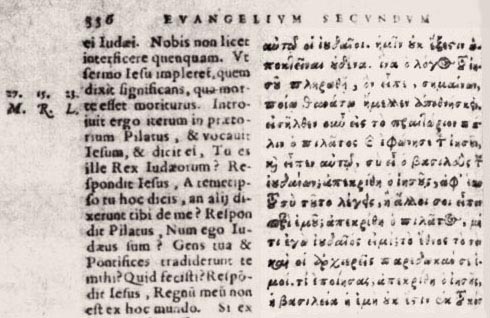
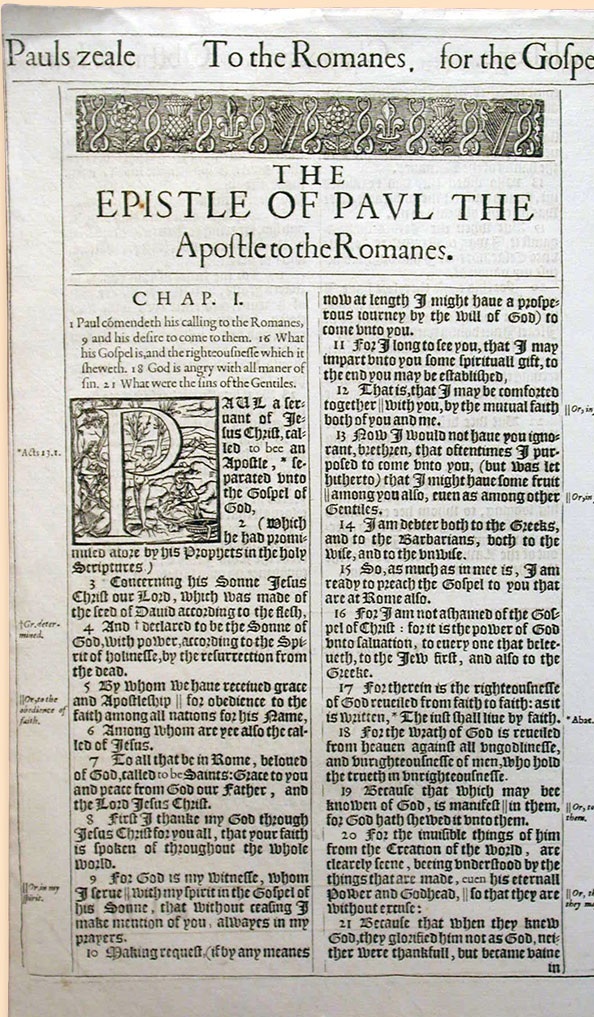
Many people are under the impression that the Textus Receptus (TR) printed by the Trinitarian Bible Society was the Greek text used by the KJV translators to translate the NT.  Not so.  The TR was not the Greek text used by the KJV translators.  Instead, it is a Greek text based on the KJV, created 270 years after the KJV was published!  To understand why, let’s explore the history of the TR in a little detail.

The story begins in 16th century Europe.  Catholicism was the religion of Europe, and Jerome’s Latin Vulgate was the Bible of the church—and had been for over 500 years.[1] In 1504, however, the Catholic humanist scholar by the name of Desiderius Erasmus came across a manuscript by the Italian humanist Lorena Valla (1407-57)—an event that would forever change Erasmus’ life, as well as the future of Bible translations.  Valla’s manuscript contained a host of annotations to the Vulgate, noting those places where it was not faithful to the Greek text.  Erasmus became enamored with Valla’s approach, and determined to carry on his work.

(more…)

In light of the 400 anniversary of the KJV, there will be a lot of discussion this year regarding the history of English Bible translations.  If you are interested in learning more about this topic, I would highly recommend Christopher Mulvey’s article “A full account of the Bible in English.”  Mulvey focuses on the period from A.D. 735 to the KJV in 1611.

Daniel Wallace also has an excellent series of articles covering the history of English translations from Wycliffe (A.D. 1382) to the NET Bible (2001).

translationA couple of months ago we had a guest preacher at our church.  He was a seasoned preacher, and overall, his message was edifying.  There was one point he made, however, that had me shaking my head.  He quoted John 14:2 where Jesus says “in my house are many mansions,” and then went on to explain that in the Greek this literally means “spiritual bodies.”

When we got home my wife asked me what I thought of the message.  I told her I liked it, except for his absurd interpretation of John 14:2.  She asked if I had looked up the Greek to know that this was the case.  I told her no.  She asked how I knew it was absurd, then.  Here is what I said, and what I want to share with you: If someone says the correct translation of a certain word is radically different than the translation appearing in mainstream translations, then you can bet your bottom dollar the person is mistaken. Think about it, what are the chances that hundreds of individuals who dedicated their entire lives to understanding the Biblical languages are going to miss the boat by a mile, but an individual who has no specialized training in Biblical languages is going to get it right simply by looking up a few words in Strong’s Concordance?

(more…)

Our earliest canonical Gospel, Mark, was probably written sometime in the early or mid50s, approximately 20-25 years after Jesus ascended to heaven.  Many have wondered why it took so long for Jesus’ followers to commit His teachings and deeds to writing.  The most common answer is that they did not feel the need because they expected the imminent return of Christ.  If Jesus was coming back soon, why bother?  This answer is not adequate, however.  First, it presumes that Jesus’ followers expected His imminent return.  This is debatable.  More importantly, we know from experience that groups expecting an impending apocalypse are often voluminous writers.  Consider the Qumran community in Jesus’ day.  They were expecting the imminent Day of the Lord, and yet they produced an abundance of written materials.  An even more pertinent example is modern believers who espouse to a pre-tribulation, “at-any-moment” understanding of the return of Christ.  Few have hotter print-presses than this group!

Why, then, did they not write sooner?  Perhaps they did, but those documents were not preserved.  Luke tells us that “many have undertaken [the task] to compile a narrative of the things that have been accomplished among us,” and he utilized at least some of those sources in the production of his own gospel (Luke 1:1-4).  Luke’s gospel was probably written in the late 50s or early 60’s.  For Luke to be aware of these other writings, they must have been written much earlier, possibly much earlier than Mark’s gospel.

(more…)

I’ve been researching and writing on the history of the Textus Receptus recently.  There is a data point that I can’t seem to pinpoint.  I’m hoping some of you might be able to help me find the answer.

Erasmus produced five editions of his Greek NT.  Stephanus used Erasmus’ text to create four more editions.  But what edition of Erasmus’ text did Stephanus use?  I don’t see this being addressed much in the literature, and when it is, I am getting conflicting info.  Some say he used Erasmus’ 3rd edition, while others say he used Erasmus’ 4th and 5th editions.  I’m thinking that perhaps Stephanus used Erasmus’ 3rd edition for his own first edition, but then switched course and used Erasmus’ 4th and 5th editions as the basis for his (Stephanus’) 1550 edition.

One thing I’m having trouble understanding is how the mistakes Erasmus introduced into the last six verses of Revelation have made their way into the modern Textus Receptus if Stephanus used Erasmus’ 4th and 5th editions since Erasmus fixed most of those mistakes in his 4th edition.

Is there anybody who has a lot of knowledge about the history of the TR who can help me out on these questions?

« Previous PageNext Page »