I thought you might be interested in seeing the oldest Greek manuscript containing Acts 2:38. It is found in Codex Sinaiticus, a mid-4th century manuscript. Here is the page of the codex it is found in (2nd column, middle):

November 11, 2010
October 15, 2010
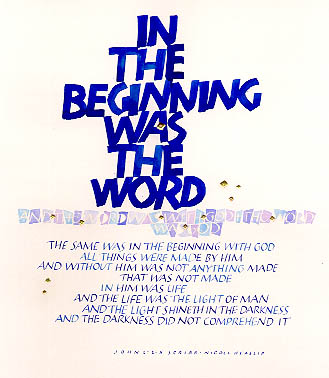 The Bible begins with one of the most famous proclamations of all time: “In the beginning God created the heavens and the earth” (Genesis 1:1). Theologians have historically understood “in the beginning” to refer to the very beginning of time itself. It was the boundary between timeless eternity and temporality.
Fast forward to the first century A.D. John opens his gospel about Jesus Christ with these words: “In the beginning was the Word, and the Word was with God, and the Word was God. 2 He was in the beginning with God. 3 All things were made through him, and without him was not any thing made that was made.” The resemblance to Genesis is unmistakable. Both Moses and John begin their work with “in the beginning,” and both speak of the creative word of God.
The question arises as to whether John is using “in the beginning” in the same way as Moses. For Moses it referred to the beginning of time and creation, but that’s how John is using it, then to say the Word was “in the beginning” seems to imply that the Word was not eternal, but a created entity who began to exist concomitantly with the created realm. Clearly this cannot be the correct interpretation because John 1:1 identifies the Word as being God (whom we know is eternal, and thus existed “prior to” the universe), and John 1:3 identifies the Word as the uncreated creator. Why, then, would John say the Word was “in the beginning?” Why not say Jesus was “before the beginning” or “before the ages?” What is your take on the matter?
April 19, 2010
In Isaiah 55:8-9 we read the word of YHWH: “For my thoughts are not your thoughts, neither are your ways my ways, declares the LORD. 9 For as the heavens are higher than the earth, so are my ways higher than your ways and my thoughts than your thoughts.”
In my experience, this Scripture is usually quoted in two contexts: (1) when we are ignorant of some knowledge; (2) when our position is being decimated by our opponent’s evidence, and we lack a sufficient response. Neither use is legitimate because both are taking the passage out of its context.
Verse 7 reads, “Let the wicked forsake his way, and the unrighteous man his thoughts; let him return to the LORD, that he may have compassion on him, and to our God, for he will abundantly pardon.” The Lord’s way/thoughts are contrasted to the ways/thoughts of the wicked, not the righteous. The Lord’s point is that His ways/thoughts are superior to the ways/thought of the wicked, not that His ways/thoughts are incomprehensible to mankind in general. That’s not to say we can fully understand God and His ways, but it is to say that this passage is not teaching divine incomprehensibility, but rather divine superiority.
January 14, 2010
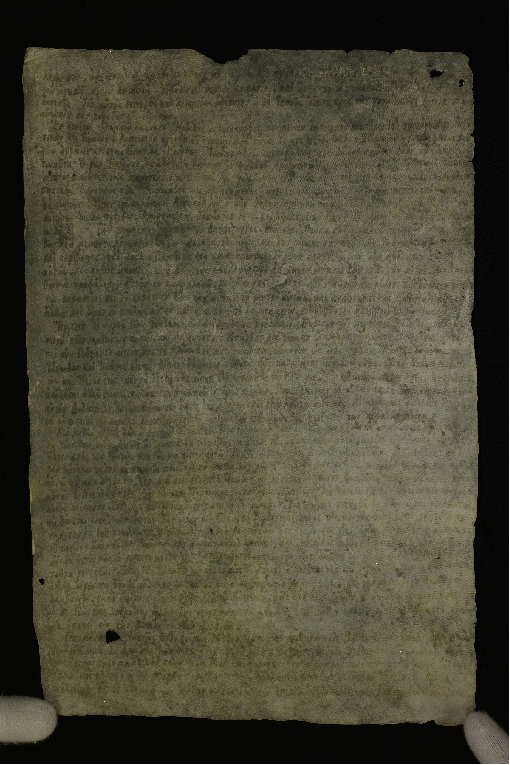 I just finished reading an interesting account of how The Center for the Study of New Testament Manuscripts was called in to investigate a newly discovered Biblical manuscript. If you have ever wondered how scholars go about determining the authenticity of manuscripts, this is a good read. It’s like a detective story. In the end, their detective work (along with the help of Google) revealed that it was a modern day forgery.
November 18, 2009
 I just finished reading a tremendous review of Bart Ehrman’s latest book, Jesus Interrupted, by Michael Kruger. I would highly recommend it. The last paragraph is literary gold in my book. It’s one of those summary paragraphs that I would have loved to have penned myself.
HT: Justin Taylor
November 9, 2009
There is a doctrine that has circulated within my fellowship for many years called the Shekel and a Half doctrine. Those espousing to this doctrine claim that in addition to paying tithes on ones income (10%), believers need to pay an additional 5%. It is often said that the additional 5% is for the upkeep of the church, or to fund a church building program. Exodus 30:11-16 is appealed to for Biblical support:
The Lord spoke to Moses: 12 “When you take a census of the Israelites according to their number, then each man is to pay a ransom for his life to the Lord when you number them, so that there will be no plague among them when you number them. 13 Everyone who crosses over to those who are numbered is to pay this: a half shekel according to the shekel of the sanctuary (a shekel weighs twenty gerahs). The half shekel is to be an offering to the Lord. 14 Everyone who crosses over to those numbered, from twenty years old and up, is to pay an offering to the Lord. 15 The rich are not to increase it, and the poor are not to pay less than the half shekel when giving the offering of the Lord, to make atonement for your lives. 16 You are to receive the atonement money from the Israelites and give it for the service of the tent of meeting. It will be a memorial for the Israelites before the Lord, to make atonement for your lives.”
October 8, 2009
I was having a conversation with some coworkers some time ago in regards to same-sex marriage. They brought up the relationship of homosexuality to the Christian religion, at which point I affirmed that the Bible—and hence Christianity—is opposed to homosexuality. Immediately I received the “Well, that’s just your interpretation” response. My response to this charge was to explain the process of exegesis, which took several minutes of my time and got us off the real issue at hand. In retrospect I thought of a more efficient and tactful response I would like to share with you.
The next time you are discussing some aspect of Biblical teaching with someone, and they give you the “Well, that’s just your interpretation” response, respond by saying something off-the-wall like, “So you are saying I don’t like pickles?!” A blank and confused stare is sure to follow proceeded by the expected question: “What?!?!” Explain to them that you have just demonstrated the fundamental principle of interpretation. Valid interpretation only comes about when the receiver accurately understands the intent of the sender/author. This is accomplished by correctly employing the use of grammatical and semantic rules, and considering the cultural/historical perspective of the sender. If the sender’s intent is not properly understood, communication has not occurred and the result is misinterpretation. If interpretation is rooted in authorial intent only one interpretation can be valid. As long as the interpreter employs the proper tools they can walk away with the correct interpretation.
The Bible is no different. There is a correct way and an incorrect way to interpret the Bible. The same tools and rules we use to correctly interpret our modern conversations and writings apply equally to the Bible. When those tools and rules are used properly the interpretation we walk away with is sound. No, it’s not just our interpretation. It is the meaning inherent within the text itself, discovered (not invented) by the interpreter using the universal rules and tools of language.
October 5, 2009
I have recently read some of the papers presented at the 2008 Urshan Graduate School of Theology Symposium. Notable was David Norris’s response to Patrick Dotson’s paper arguing that the Oneness movement must move beyond the King James Version if we hope to reach our modern generation with the Word of God. While others surely have done so, Norris is the first Apostolic minister I have encountered who has advocated for the use of other English translations, and made a case for the superiority of the Alexandrian text-type over the Byzantine text-type that undergirds the NT of the KJV.
September 27, 2009
This post has been updated to include additional content on 10/2
 Some Christians believe that while the Bible is without error when it speaks to spiritual matters (God, salvation), there may be errors in those sections that speak to scientific and historical matters, which should not concern us. This view of Biblical inspiration is often called limited inerrancy.
While it would be worthwhile to examine each of the purported scientific and historical errors in the Bible to determine if they are indeed errors, the notion of limited inerrancy can be evaluated in a more fundamental way. Greg Koukl has observed that it makes little sense to believe what the Bible says in matters we cannot test (such as miracles, resurrection, incarnation), when the Bible is shown to be untrustworthy in those matters we can test. That’s not to say the presence of errors would necessarily invalidate every truth claim the Bible makes, but it is to say that it would make it much more difficult to trust its spiritual claims. If God was not able to ensure that the Biblical authors accurately transmitted matters of history and science—which were naturally more accessible to them—why think He was able to ensure that they accurately transmitted spiritual matters? I see little reason to do so.
(The following content has been added as of 10/2)
It’s a credibility issue. Credibility is earned. It is gained by being right, and lost by being wrong. Limited inerrantists are telling us that we should trust everything the Biblical authors tell us about spiritual matters, but we cannot trust everything they tell us about non-spiritual matters because they have proven themselves to be mistaken in various ways on such matters. But if they have proven themselves to make mistakes in areas that we can test them on, why should we think they haven’t made any errors on matters that we can’t test them on? The limited inerrantist can’t respond by saying God’s involvement ensures that they will not err on such matters, because God is involved in the whole process. If He couldn’t keep the authors from erring on non-spiritual matters, there is no reason to think He could keep them from erring in spiritual matters.
A limited inerrantist might respond that God was only involved in those sections of Scripture dealing with spiritual matters. But this portrays an absurd picture of inspiration. Scripture goes back and forth between non-spiritual and spiritual claims. Surely God’s involvement was not iterant so that when the author writes a word about geography God checks out, but when he is about to write a few words on spiritual truth God checks back in! Even if this were possible, what reason would God have for deciding to inspire only those words dealing with spiritual matters? He knew that people would question the credibility of the religious claims if His authors flubbed up their facts on non-spiritual matters. So why wouldn’t God, in the interest of giving more credibility to the spiritual claims, superintend what His authors wrote about all matters?
September 9, 2009
The NT authors often quote an OT passage, and say it was fulfilled in Christ. Many Christians use these fulfillments as evidence for the veracity of the Christian faith. For example, I’ve heard it claimed that the probability of just one man fulfilling 48 different prophecies is something like 1:10157. It is reasoned that no man could match those odds unless the Biblical prophecies were divine in origin, and thus Jesus must be who He claimed to be. The problem with this apologetic is that the vast majority of these “messianic prophecies” are neither prophetic, nor messianic in their original context.
Consider, for example, Hosea 11:1 – “When Israel was a young man, I loved him like a son, and I summoned my son out of Egypt.” Matthew quotes this passage in reference to Jesus’ return to Nazareth, saying, “In this way what was spoken by the Lord through the prophet was fulfilled ‘I called my Son out of Egypt.’” (Matthew 2:14-15) When one examines the original context of Hosea 11:1, however, they will quickly recognize that this passage is neither prophetic nor messianic. It is a mere historical recounting of the Hebrews’ exodus from Egypt.
June 3, 2008
When someone asks you if you take the Bible literally, what they usually mean is do you take the Bible seriously? They want to know if you believe all that “crazy stuff” about talking snakes and resurrected messiahs.
Greg Koukl suggests that when someone asks if you take the Bible literally, do not respond with a simple “yes” answer. It is too ambiguous, and open to misinterpretation. Respond, “I take it in the sense the author intended it.” Then, you might expand a little bit to say, “If he meant it in a literal sense, I take it in a literal sense. If he meant it in a metaphorical sense, I interpret it accordingly, in an attempt to uncover the literal truth intended by the metaphor.” This is the same way we interpret all communication.
May 5, 2008
Ben Witherington III has a good video lesson on choosing a Bible translation. He gives some good, basic information on why there are so many translations, how they differ, what benefit each has, tips on how to choose the proper translation, and what to watch out for. Listening to the Australian paraphrase of Luke 1 is worth it alone!
April 28, 2008
Ben Witherington III has a good video lesson on choosing a Bible translation. He gives some good, basic information on why there are so many translations, how they differ, what benefit each has, tips on how to choose the proper translation, and what to watch out for. Listening to the Australian paraphrase of Luke 1 is worth it alone!
July 7, 2007
Most of the book of Proverbs was written by Solomon, but Proverbs 30 and 31 were authored by Agur and King Lemuel respectively. King Lemuel’s proverbs are said to reflect his mother’s teachings. When it comes to inspiration, when were these proverbs inspired: Was it when King Lemuel’s mother spoke it to Lemuel, when he wrote it down, or when the compiler(s) of the proverbs that became the canonical Book of Proverbs incorporated them into the book?
July 7, 2007
Psalm 72:20: “This collection of the prayers of David son of Jesse ends here.” Clearly these are the words of a later editor of the psalms, adding a structural marker to the Psalter. These are not the words of the inspired psalmist. Would you say this verse is the inspired word of God, or is it just an ancient editorial comment that is found in the Word of God?
July 7, 2007
Conservative Christians (such as myself) hold that the Bible is inspired by God. What we often do not think about, however, is how God inspired the Bible. We know God and man were involved in the final product, but what was the relationship between the two parties? I would venture to say that most conservative Christians picture the process of inspiration as some sort of mechanical dictation, in which God is telling the author precisely what to write, and the author writes it. Others hold to a conceptual model of inspiration in which God directs the author’s thoughts and concepts to reflect God’s intentions for the writing, but allows the author to clothe them with their own choice of words.
Can these models account for all we read in Scripture? It seems not. There are select passages of Scripture that seem to indicate that at least some of the authors were unaware that what they were writing was being inspired by the Spirit. Consider the following:
In I Corinthians 1:12-17 Paul addressed the issue of factions developing around certain high-profile Christian personalities. Some were claiming to be followers of Paul, while others claimed to follow Peter, and others Christ. To expose these factions as unchristian, Paul directed their attention back to their baptisms. Rhetorically, Paul asked if they had been baptized in his name. No. They were baptized in the name of Christ, and as such they must be followers of Christ, not Peter or Paul.
Not only were they not baptized in the name of Paul, but only a few of them were even baptized by Paul. Paul wrote, “I thank God that I baptized none of you, but Crispus and Gaius; lest any should say that I had baptized in mine own name” (vs. 14-15). This completes Paul’s thought. In the next verse, however, Paul adds another name to the list: “And I baptized also the household of Stephanas: besides, I know not whether I baptized any other” (v. 16). While Paul was writing verses 14-15, he only recalled baptizing two Corinthians, but then remembers one more and pens verse 16. Is that all Paul? He wasn’t so sure, so added a disclaimer that he does not recall baptizing anyone else.
Did God direct Paul to forget (or write as if he forgot), then remember baptizing the household of Stephanas, and to add a disclaimer to cover himself lest there be someone else he baptized that the Spirit directed him to forget? Is this a case of a divinely directed slip-of-the-mind? Was Paul aware of what the Spirit was doing? On a mechanical dictation model the answer is yes. I find that far-fetched. It seems highly unlikely that mechanical dictation was the means by which Paul inspired Paul to write, and unlikely that Paul was aware of the Spirit’s inspiration as wrote the epistle. He had a genuine experience of momentary forgetfulness.
Even if Paul was aware that he was being inspired by God as he wrote, how do we incorporate I Corinthians 1:14-16 into our view of inspiration? If the Holy Spirit was inspiring Paul to write, why didn’t the Holy Spirit bring back to Paul’s memory all of the people he baptized in Corinth, prior to writing those verses? Why allow Paul to record his forgetfulness? Doesn’t that cast doubt on the Holy Spirit’s superintendence of the writing? Could this mean that divine inspiration is not enough to overcome the human weaknesses of the authors? Could there be other places in which the author’s memory did not serve him well, but he was not able to correct himself as did Paul? How would you respond to these questions?
Or consider II Timothy 4:13. In a very personal letter to Timothy, Paul asked Timothy to bring him his cloak, books, and parchments when he comes to visit. If Paul realized this letter was being inspired for God, would he have made such personal comments? This is not to say God did not inspire Paul to write this, but it is to say it seems unlikely that Paul knew God was inspiring him to write it. From Paul’s perspective, this was a personal request to a friend, in a personal letter. I highly doubt Paul knew this letter was being superintended by the Spirit, and would be collected into a corpus of writings to be used by Christians everywhere for millennia to come.
What do you think? How does this affect your view of inspiration?
For further reading on my view of Biblical inspiration, go here.
May 3, 2007
It’s no surprise that the Gospels are full of Jesus’ sayings since they are dedicated to telling the account of what Jesus said and did. But it is surprising that Jesus’ followers don’t quote Him but a few times outside the Gospels. Considering the many theological and practical issues the apostles addressed in their epistles, why didn’t they invoke Jesus’ teachings to settle the matters? As strange as I find the phenomenon, it actually serves as a good argument against those who assert the disciples freely invented many sayings of Jesus. If the disciples were in the habit of inventing sayings of Jesus, why not do so when it would be most convenient: to settle theological arguments or moral quagmires not addressed by Jesus? The fact that the disciples did not appeal to a saying of Jesus to solve such matters argues for the historical veracity of Jesus’ sayings found in the Gospels. If the disciples would not put words into Jesus’ mouth in the epistles, they were not likely to do so in the Gospels either.
May 1, 2007
Elaine Pagels—famous for her promotion of Gnostic Christianity—was interviewed by David Ian Miller for the April 2, 2007 edition of the San Francisco Chronicle. Pagels was discussing the Gospel of Judas. Miller asked her if this gospel would change the way people observe Easter. Pagels answered in the affirmative. She wrongly asserted that Luke and John give different portrayals of Jesus’ resurrection body (one spiritual, one physical), and then went on to say the following:
And what was important to the authors of Luke and John was not to decide between those stories—the important thing is that we know in some sense that he is alive. That the resurrection happened. And that is affirmed. But one thing we can see in these other texts [such as the Gospel of Judas] is that you don’t have to take the resurrection literally to take it seriously. One can speak about Jesus alive after his death with conviction without necessarily meaning that his physical body got out of the grave.
Yes, we could speak of Jesus being alive after His death without meaning His body got out of the grave, but we could not call it a resurrection. Resurrection, like apple, refers to something specific. It does not refer to any sort of life after death, but in the words of N.T. Wright, life after life after death. In the ancient world the word was always bound up with the return to a bodily existence after a disembodied existence following death. We are not free to redefine words to our own fancy, no matter how much Pagels might wish to do so. If Pagels wants to believe in a spiritual ascension she is free to do so, but she is not free to call it a resurrection, nor is she free to say that those who believe such a thing have satisfied the Biblical requirement to believe in Jesus’ resurrection. You can’t evacuate a term of its meaning, and then assert that any content one might choose in its place satisfies the meaning of the word.
If resurrection can mean whatever one wants it to mean, then why is it important that we affirm it? And what are we even affirming? How about I postulate that Jesus’ resurrection means He survived death only in the memory of His followers? Is that an affirmation of His resurrection? Hardly. “Resurrection” means something.
A spiritual resurrection of Jesus makes no sense. It could not explain the rise of Christianity. If Jesus’ spirit merely survived death, there would be nothing extraordinary about Him. Other people experience the same. What made Jesus extraordinary was that His physical body came back to life, and was subsequently glorified. That is what the early church preached, and that is why Christianity was so scandalous. No pagan would have had a problem with a disembodied spirit ascending to heaven, but they had a big problem with a man returning from the dead, never to taste of death again.
But that’s all icing on the cake. My real focus is on her statement that we can take the Biblical texts seriously without taking them literally. While this is a nice sounding catchphrase that is popular in liberal Christianity, what exactly does this mean, and how does it play itself out in the real world? If the context makes it clear that a text is figurative in nature, then we are taking the text seriously when we understand it in a figurative sense. But when the context gives us every reason to believe the author is presenting something as historical fact, we are not taking the text seriously if we assign it a figurative meaning. When it comes to the gospels, we have every reason to believe that the events recorded are intended as genuine historical events. As such, it is impossible to take them seriously all the while denying their historicity.
Is Pagels prepared to treat other purported historical accounts in this fashion? Can she deny the historicity of slave trade in the early Americas while taking the texts that tell us about this horrendous practice seriously? Of course not! So why treat the Bible any differently? She is free to argue that while the gospels present themselves as genuine history, they are not historical events, but she is not free to deny their historicity all the while claiming to take the texts seriously. It is highly disingenuous.
February 22, 2007
Even with the proliferation of Bibles today, Christians are reading their Bibles less and less. I believe the evangelical church has only 50 years of life left…because of marginalization of the Word of God. We need another Reformation! The enemy of the gospel now is not religious hierarchy but moral anarchy, not tradition but entertainment. The enemy of the gospel is Protestantism run amock; it is an anti-intellectual, anti-knowledge, feel-good faith that has no content and no convictions. Part of the communal repentance that is needed is a repentance about the text. And even more importantly, there must be a repentance with regard to Christ our Lord. Just as the Bible has been marginalized, Jesus Christ has been ‘buddy-ized.’ His transcendence and majesty are only winked at, as we turn him into the genie in the bottle, beseeching God for more conveniences, more luxury, less hassle, and a life without worries or lack of comfort. He no longer wears the face that the apostles recognized. … The God we worship today no longer resembles the God of the Bible. Unless we return to him through a reading and digesting of the scriptures—through a commitment to the text, the evangelical church will become irrelevant, useless, dead.
I wholeheartedly concur.
I would also suggest you read his presentation (beginning here). It is an extremely informative history that I found fascinating. Few are better equipped to deal with this issue like Wallace.
October 9, 2006
Bart Ehrman, a leading NT textual critic, recently wrote a book by the above title that has been selling like hot-cakes. The book is an introduction to the field of NT textual criticism for a lay audience, but with a theological agenda. Ehrman, an ex-Evangelical turned liberal agnostic, portrays the reliability of the NT text as uncertain. While he makes concessions to the contrary, the emphasis in his book is on our doubts about the text rather than our amazing certainty. Such an emphasis has caused many lay readers to seriously doubt the veracity of the NT.
Daniel Wallace has written an excellent review of the book entitled “The Gospel According to Bart.” Wallace is well-versed in the field of NT textual criticism. I would highly recommend you read his review. It is thorough, and yet fairly concise. And as always, Wallace is fair and respectful.
 Theosophical Ruminations
 Thinking to Believe