 Trinitarians typically baptize in the name of the Father, Son, and Holy Spirit based on Matthew 28:19. In contrast, Oneness Pentecostals (OPs) typically baptize in the name of Jesus Christ based on Acts and the epistles. Which is the proper baptismal formula?
OPs have been debating this issue for over 100 years. It’s part of the movement’s DNA. Meanwhile, most Trinitarians are oblivious to the debate. Those on both sides who engage in the debate tend to focus only on the Biblical data. The historical data contained in the writings of the post-apostolic church fathers is typically ignored. When it is cited, it is often cherry-picked or misused. As a result, I have written a research paper that seeks to examine both the Biblical and historical data fairly.
 My podcast series on the resurrection is still going strong. I’ve recently started my last sub-series within the larger series, focused this time on the Shroud of Turin. If you have never heard of it before, it’s the purported burial cloth of Jesus Christ, bearing the image of a crucified man. Many Protestants have dismissed it as a fake Catholic relic, and most non-Christians have dismissed it as a medieval forgery due to carbon dating tests in the 1980s. However, interest in the Shroud has not gone away, and for good reason. There is much more to the story. In this sub-series, I’m examining the mountains of evidence for its authenticity, and I’ll address questions related to dating, and more.
 We have a hard time understanding how the Germans allowed the Holocaust to take place. How could people so easily and so readily disregard the humanity of an entire group of people? How could they so callously kill millions of people? How could so many people who disagreed with the actions of the state stand by and do nothing? It’s not that hard to see how, really.

 We are all searching for significance. We want to believe that our life matters. We want to feel like we are special. We want to know that our life has made a difference in this world. That’s why people seek to do extraordinary things. It’s why people seek fame. What we need to recognize is that we are already significant. We are made in the image of God. Our significance is rooted in God. We will never truly feel significant until we are in a close relationship with God.
 I’ve
I’ve 
 I’ve begun a new podcast series on the historical evidence for the resurrection of Jesus. The series will not only cover the historical evidence for Jesus’ resurrection, but also explore alternative (naturalistic) explanations, the evidence for Jesus’ existence, the theological and practical significance of the resurrection, questions and objections, our own future resurrection, an examination of the Shroud of Turin, and a harmonization of the gospel accounts of Jesus’ death and resurrection.
 Government was God’s idea. It has a divine purpose: justice. As such, good government requires the participation of the just. We should care about that which God cares about. That’s why Christians should be informed about and involved with politics. To that end, I have started a new podcast series on political theology. I will address the Biblical teaching concerning government, the relationship of Christians to politics, principles for voting, the separation of church and state, the Christian foundation of the United States, etc.
 Some people say that America has a mass incarceration problem: Too many people are in prison. That’s only possible if one of two things is true: (1) Large numbers of incarcerated persons were wrongly convicted; (2) We are incarcerating people for frivolous reasons.
 Four years ago, I wrote a post titled “
 A lot of modern evangelism focuses on the love God. We rarely hear it preached that God is angry at us because of our moral rebellion, and we rarely hear about the coming judgment. And yet, when you look at what the early church preached in Acts, it was a lot about judgment and not a word about the love of God or inviting people to have a relationship with God (see
  The final argument for God’s existence in my podcast series, Does God Exist?, is a version of the existential argument. I argue that our deepest existential longings can only be explained by and satisfied by a theistic God: the desire for meaning and purpose in life, objective morality, immortality, free will, and love. People must either (1) believe there is a God who can satisfy our deepest longings or (2) believe there is no God and that our deepest longings are misguided and can never be satisfied.
 An increasing number of professing Christians will acknowledge that the Bible is opposed to some practice, but then claim that God has evolved regarding the issue and the Spirit is speaking something different to the church today. Apart from the epistemological problems that such a claim entails, isn’t it interesting that the Spirit is always being more permissive today (just like our culture)? That’s quite strange, because when God has given new revelation in the past, it was not in the direction of moral permissiveness, but in the direction of moral stringency.
 The truth of a doctrine is not determined by its age or by a historical consensus, and yet we naturally assign great weight to doctrinal tradition. After all, there’s something to be said for a historical consensus, and it should not be dismissed lightly. We should not ignore the understanding and insights of the majority who have preceded us. And in general, we should not dismiss a doctrinal tradition unless we have compelling reasons to do so.
 The design argument for God’s existence that I presented in my “Does God Exist?” podcast series could be succinctly summarized as “the universe looks designed because it was designed.”
 “The one who states his case first seems right, until the other comes and examines him” (ESV).
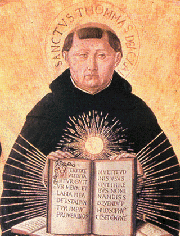 I just wrapped up my podcast discussion of Aquinas’ Five Ways by examining his Fourth and Fifth Ways. The Fourth Way argues that the grades of perfection we observe in the world can only be explained by the existence of a maximally perfect being. The Fifth Way argues for the existence of an intelligent being who guides everything towards their natural ends.

