Given the inadequacy of so many “old” philosophical arguments against God’s existence, atheists are increasingly turning to the “hiddenness of God” (HoG) to argue that God does not exist (or that His existence is highly improbable).  The essence of this argument is that God’s existence is not as obvious as it should be.  If God existed, we would expect to find more evidence of His existence than we in fact do.  Given the inadequacy of the evidence, rational persons should conclude that God (probably) does not exist.  Some HoG proponents go so far as to argue that if God existed He would prevent unbelief by making His existence obvious and undeniable.  He does not do so, therefore, He does not exist, or if He does exist, the fault of human unbelief is to be laid at His feet.

There are a number of ways to respond to the HoG argument.  One could agree with the HoG advocate that God’s existence is not as obvious as we might think it should be, but deny that the conclusion—“God (probably) does not exist”—follows from such an observation.  After all, absence of evidence is not evidence of absence.  Perhaps there is insufficient evidence on which to conclude that God exists, but God may exist nonetheless.  At best, an insufficient amount of evidence for God’s existence should result in agnosticism, not atheism.  To conclude that God does not exist one needs positive evidence against His existence, not a mere lack of evidence for it.

(more…)

Romans 8:26 Likewise the Spirit also helpeth our infirmities: for we know not what we should pray for as we ought: but the Spirit itself maketh intercession for us with groanings which cannot be uttered.

I have always heard this verse interpreted as a reference to praying in tongues.  This seems unlikely, however, since tongues can hardly be described as “groanings,” and tongues are “uttered.”  So what is Paul talking about?  I’ve heard people groaning before, but even those groans are uttered.  I can’t even make sense of an unutterable groan.

And who is doing the interceding?  It’s commonly understood that the Spirit is interceding through human beings, but as I read the text, the Spirit makes intercession “for” us, not “trough” us.  If so, what does it mean to say the Holy Spirit groans?

Does anyone have any insight on the meaning of this passage they would like to share?

A faster, safer, more productive method has been discovered for turning adult stem cells into an embryonic-like state (induced pluripotent stem cells).

I realized something the other day that I had never picked up on before.  Genesis opens up with an account of man’s creation and fall.  I’ve always taken it as obvious that Moses included the story because he wanted to detail the history of Israel all the way back to creation.  Additionally, however, I think Moses had a very practical reason for including the story: It served as a warning to the nation of Israel.  Just as God had prepared a garden for the first humans to live in, God had also prepared the land of Canaan for the Israelites to inhabit.  And just as God expelled Adam and Eve from the Garden of Eden because of their disobedience to God’s covenant with them, likewise God would expel the children of Israel from the land of Canaan if they disobeyed the covenant God had made with them.  Adam and Eve’s experience served as a literary and historical example for Israel to learn from, lest they experience the same fate in Canaan.

In a previous post I argued that chance cannot account for the origin of the first living cell because the odds are too low to have any reasonable chance of being met.  The odds of a single, functional protein forming by chance is 1 in 10164.  That’s 1 chance in 100 trillion trillion trillion trillion trillion trillion trillion trillion trillion trillion trillion trillion trillion trillion trillion trillion trillion trillion trillion trillion trillion trillion trillion trillion trillion trillion trillion.  But the simplest life form would need at least 250 different proteins, lowering the odds to 1 in 1041,000!

While the numbers appear staggering, many people will immediately raise the “lottery objection”: Just as the odds of winning the lottery are low, and yet people win the lottery all the time, so too the odds of forming life by chance may be low, but that doesn’t mean it is impossible.  While I understand the analogy, are the lottery and the OOL truly analogous?  No, not by a long shot.

(more…)

Justin Taylor posted a nice primer on a Biblical theology of the image of God in man.  Man was created in the image of God (Gen 1:26; 9:6; James 3:9).  Though that image became marred by sin, it was passed on to Adam’s posterity (Gen 5:3; 1 Cor 15:49).  In contrast to man who was made in the image of God, Jesus is the image of God (Col 1:15; 2 Cor 4:4).  The Christian hope is to be fully transformed into Christ’s image.  We have begun to experience that transformation already (Rom 8:29; 2 Cor 3:18; Col 3:10), and will see the fulfillment of the process at the return of Christ (1 Cor 15:49; 1 John 3:2).

Whenever I make my case against same-sex marriage to a same-sex marriage proponent, invariably they will raise a particular objection to my argument.  The objection is so common that I want to devote a lengthy blog post to rebutting it.  But before I do, let me briefly summarize my argument against same-sex marriage:

The primary reason human governments across time and cultures have chosen to regulate, privilege, and encourage one particular kind of human relationship over all others is because they have a vested interest in what that kind of relationship can produce: socialized children to perpetuate society.  Apart from that, there is no reason for the government to meddle itself in personal, sexual relationships. They are not interested in promoting friendships or romantic love; they are interested in social self-preservation. They are interested in producing a new generation of responsible, socialized citizens to replace the existing generation. Optimal socialization involves both natural parents, so the state is interested in keeping the natural parents together as well. That is why marriage comes with legal responsibilities, and until recently, was difficult to dissolve.

(more…)

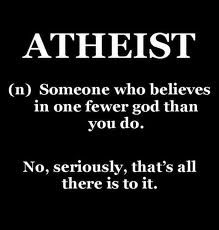
In recent days I have noticed several of the “new atheists” employing a clever and rhetorically effective soundbite while evangelizing for atheism.  Richard Dawkins and Christopher Hitchens come to the top of my mind, but no one has encapsulated this sound bite better than Stephen Roberts: “I contend we are both atheists, I just believe in one fewer god than you do. When you understand why you dismiss all the other possible gods, you will understand why I dismiss yours.”

I consider myself a fairly seasoned apologist, but I must admit that this little rhetorical gem stopped me dead in my tracks.  “How in the world should I respond to that?”, I thought.  Fortunately for me, others have been thinking about this as well.  Michael Patton has done a good job formulating the beginning of a response already.  I would encourage you to read his thoughts on the matter.  He even takes on the claim that belief in God is like belief in Santa Clause, so you get a “two-fer.”

I think my first response would be that the atheist’s claim that “I contend we are both atheists, I just believe in one less god than you” is a misuse of language.  To be an atheist means one does not believe in the existence of any God or gods, so it would be inappropriate to call Christians “atheists.”  The claim is rhetorically effective, however, because it makes it sound as if the Christian and atheist differ in only one minor detail (the Christian denies all gods but one, while the atheist denies all gods).  Nothing could be further from the truth.  A world in which even one deity exists is a radically different from a world in which no divine being(s) exists.

How would you respond to the claim?

Many Christians have a negative connotation of the words reason, logic, and philosophy.  Their negativity is not altogether unfounded.  After all, there’s been more than a few individuals who have rejected Christianity on the grounds that it is irrational and illogical.  And we’ve all known or heard of someone who studied philosophy only to lose their Christian faith.  The problem in all of these cases, however, is not reason, logic, or philosophy, but rather the improper use of reason, logic, and philosophy.  Indeed, all of us use reason and logic, and all of us subscribe to a particular philosophy even if we are unaware of it.  It is inescapable.  Reason and logic are God-given tools that allow us to think and obtain knowledge.  Logic and reason help us to order our thoughts, and enhance our ability to discern truth from error.  We can’t think without them, although we can misuse or abuse them in the process of thinking.  And that, I think, is where the real problem lies: the abuse of reason and logic.

(more…)

Some of you may have seen a news article circulating every major news outlet.  With provocative titles such as “God did not create the universe, says Hawking,” and “Why God Did Not Create the Universe,” one would expect to find some new scientific discovery/argument proving that the universe is capable of creating itself – no God needed.  After reading the articles, however, that expectation will quickly turn into disappointment.

Stephen Hawking is probably the most famous physicist alive.  While he is clearly a brilliant man, his case for the sufficiency of natural processes to account for the origin of the universe is truly embarrassing.  Consider the following claim: “Because there is a law such as gravity, the universe can and will create itself from nothing.  Spontaneous creation is the reason there is something rather than nothing, why the universe exists, why we exist.  It is not necessary to invoke God to light the blue touch paper and set the Universe going.”

Where to begin!  First, while Hawking is attempting to explain how something could come from nothing, he only explains how something (the universe) comes from something else (physical laws, namely gravity).  True nothingness is the absence of any and all existents, including physical laws.  So from whence come the physical laws?

(more…)

Many non-theists object to the concept of miracles on the grounds that miracles would require a violation of the laws of nature.  They reason as follows:

P1  The laws of nature cannot be violated
P2  A miracle would violate the laws of nature
C    Miracles are not possible

Both premises of this argument are flawed, and for the same reason: the laws of nature are construed as mind-independent, physical realities possessing causal properties.  I think this conception of natural laws is mistaken.

(more…)

 “Nothing happens that is not possible.”–Ellis Potter

Catching up on the news….

Last year (March 9, 20010) President Obama signed an Executive Order overturning President Bush’s stem cell policy that allowed federal funding for stem cell research on stem cell lines created prior to August 9, 2001, but not after.  President Obama wished to expand federal funding to include stem cell lines created after August 9, 2001.

Ironically, two days after issuing his EO, President Obama signed into law the annual appropriations bill which included the Dickey-Wicker amendment.  This amendment, which has appeared in every appropriations bill since 1996, specifically prohibits the use of federal funds for research that involves the destruction of human embryos.  The amendment reads:

(more…)

In May of this year Gallup polled Americans to determine what behaviors they found morally acceptable and unacceptable.  Sixteen behaviors were evaluated, and here are the results:

(more…)

Elaine Howard Ecklund has written a book titled Science vs Religion: What Scientists Really Think.  A summary of her research findings was published in USA Today (July 19, 2010): “Myths Widen the Science-Religion Divide.”

Ecklund surveyed 1,700 natural and social scientists and conducted interviews with 275 of them.  She found that: (more…)

I have devised a test to quickly determine whether someone holds to a Nestorian Christology.  Ask, “What would have happened to Jesus’ body if the Spirit would have departed from it prior to Jesus’ death on the cross?”  If they answer that Jesus would have continued to live and function, they hold to a Nestorian Christology.  Here’s why:

(more…)

Catching up on old news….  Argentina legalized same-sex marriage July 15, 2010.  They are the first country in Latin America to do so.  The legal recognition of same-sex unions as “marriage” continues to spread.

Atheists love to assert that there is no scientific evidence for the existence of God.  I have a couple of thoughts on this.  First, how do they come to this conclusion?  Generally speaking, this conclusion follows from their definition of science.  They define science as the search for naturalistic explanations for natural phenomena.  If science is defined so as to a priori exclude agent causation as a valid explanation for any natural phenomenon, then it is no surprise that “science” will never yield any evidence for the existence of God.  It can’t by definition.  To put it in the form an argument, the atheist reasons as follows:

(more…)

It is often believed that valid/sound deductive arguments can provide certainty.  This is not quite true.  The conclusion of a valid/sound deductive argument is certain in the sense that it follows necessarily from the premises.  It does not mean, however, that the conclusion is certainly true.  Why?  The premises are usually contingent truths discovered inductively, and thus the veracity of the logically certain conclusion depends on the veracity of the probabilistic premises.  The more confidence we have in the truth of the premises, however, the more confidence we can have in the veracity of the conclusion.

Catching up on old news….

Last month archaeologists announced the discovery of the oldest written document ever found in Jerusalem.  It is a small fragment of a 14th century BC clay tablet written in ancient Akkadian.  It only contains the words “you, you were, later, to do, them,” but because it appears to be a royal document, it demonstrates that Jerusalem was a major political center prior to Israel’s take-over of the land.