William Lane Craig has written a “fairly” condensed article (30 pages) consisting of five arguments for God’s existence, and examines how the new atheists such as Richard Dawkins have responded to these arguments.  This is probably the most lay-accessible, condensed written treatment I have seen from Craig on this topic.  Highly recommended.  

You can read it in HTML, PDF, or at Scribd.

HT: Justin Taylor

A Matter of Days is a book on the young-earth vs. old-earth creationism debate written by astronomer and Christian apologist, Hugh Ross.  Ross is an old-earth creationist, meaning he rejects both Darwinism and theistic evolution.  He argues that both the scientific and Biblical data support an ancient universe.  Not only does he provide evidence for his view, but he interacts with and critiques the arguments and objections raised by young-earth creationists.

If you are interested in the old-earth vs. young-earth debate, this is a must-read book.

I’ve read a good number of books since my last “What I’ve Been Reading” post, but have failed to write about them.  I hope to write about these books in the coming days or months, but for now I’ll just write about my most recent reading escapades.

I recently finished reading Christianity without the Cross: A History of Salvation in Oneness Pentecostalism (thank you Michael for purchasing this for me from my Ministry Resource List!).  Historian Thomas Fudge has written a well-researched history on the history of the doctrine of salvation in the United Pentecostal Church.[1] Fudge documents the evidence that those involved in the merger of the Pentecostal Church International (PCI) and the Pentecostal Assemblies of Jesus Christ (PAJC) into the United Pentecostal Church (UPC) in 1945 held two different views of salvation.  The majority believed that one is born again only after they have repented, been baptized in Jesus’ name, and baptized in the Spirit evidenced by speaking in tongues.  A sizable minority (mainly from the PCI), however, believed one was born again at the point of faith/repentance.  While they believed in baptism in Jesus’ name and receiving the Spirit evidenced by speaking in tongues, they understood such to be the result of salvation, not the cause of salvation.  The two groups agreed to fellowship their soteriological differences, not contending for their own views to the disunity of the new fellowship.

(more…)

It’s been a month, but I haven’t forgotten!  For new readers, this is part 6 in my series of posts summarizing Stephen Meyer’s argument for design from his new book, Signature in the Cell.  Past posts can be found here: Parts 1, 2, 3, 4, and 5.

In the last two installments we demonstrated that the OOL cannot be explained by either chance or necessity.  Now we’ll turn our attention to the possibility that the OOL can be explained by a combination of both chance and necessity.  While many models could be examined—and were examined by Meyer—I will only examine the RNA-first, a.k.a. the RNA World hypothesis, since this is the prevailing OOL model today.

The cell presents OOL researchers with a chicken-and-the-egg paradox of which came first: the DNA that makes proteins, or the proteins necessary for replicating DNA?  The paradox was insoluble, so another solution was required.  If neither DNA nor proteins could arise first, what did?

Carl Woese, Francis Crick, and Leslie Orgel proposed an RNA-first model in the late 1960s, followed by Walter Gilbert (Harvard biophysicists) who developed it in the 1980s and gave it its common name.[1]  This model proposes that the first cell consisted of a much simpler self-replicating, self-catalyzing RNA (RNA is similar to DNA, but it is a single strand rather than a double helix, and the nucleotide, thymine, is replaced by uracil).[2]  This model was largely fueled by the discovery of Thomas Cech and Sidney Altman in the early 1980s that sometimes RNA can catalyze chemical reactions like an enzyme does, and thus RNA could serve the dual purpose of information storage (like DNA) and enzymatic functions (like proteins).  “The paradox of the chicken and the egg was thus resolved by the hypothesis that the chicken was the egg.”[3]

(more…)

Something I was thinking about today.  While we think with language, thought is not dependent on language.  Thought precedes the development of language.  If that were not so, language would never develop.  Learning a language is the process of learning established signs and symbols that correspond to, and help us express our pre-existing thoughts.  If we had no thoughts, there could be no correspondence, and we would be incapable of using the signs and symbols of language to convey meaning.

So what would it be like to think without the use of language?  I don’t know.  Infants must do it, but none of us remember what it was like to be an infant, so I imagine this is an unanswerable question.  It’s interesting nonetheless.

Here is a funny video mocking the new iPad.

HT: Between Two Worlds

This makes my blood boil.  In the past two years, Nancy Pelosi has cost us taxpayers $2.1 million dollars so she can fly around in Air Force planes.  What’s even worse is that her in-flight food and alcohol expenses are $101,000!  Whatever your party affiliation, I think we can all agree that this is utter waste.

Al Mohler has written a good piece on the doctrine of hell.  He details the steps by which the doctrine has become liberalized in many churches:

  1. It ceases to be discussed
  2. It is revised and retained in a reduced form
  3. It is subject to ridicule
  4. The doctrine is reformulated (annihilationism, etc.)

I would add a possible fifth step as well: The doctrine is denied.

This same pattern can be applied to the liberalization of any Biblical doctrine.  We must be on guard so as not to follow this pattern.  The best way to guard against it is to preach and teach on the full spectrum of Biblical doctrines, rather than focusing on a handful and ignoring others.  In general, what ceases to be taught ceases to be believed.

Mohler also had some challenging words on the tendency to lament, or apologize for the doctrine of hell.  As Mohler describes it, there are Bible believing Christians who will affirm that the Bible teaches the doctrine of hell, but admit they do not like the doctrine and wish it were not true.  I think we’ve all been there, and understandably so.  But Mohler raises some good points against this disposition:

What does this say about God? What does this imply about God’s truth? Can a truth clearly revealed in the Bible be anything less than good for us? … Apologizing for a doctrine is tantamount to impugning the character of God.  Do we believe that hell is a part of the perfection of God’s justice? If not, we have far greater theological problems than those localized to hell.

Indeed.  As Dennis Prager once noted, it would be the epitome of injustice if the evil had the same fate as the righteous.  If we love God, then we will love righteousness and justice.  And if we love righteousness and justice, then the existence of hell is not something we should lament.

Back in Marcy 2009 I reported on the fact that teen pregnancy rates were on the rise again.  The Alan Guttmacher Institute (AGI) just released a report providing some details on this.  According to the AGI:

The teen pregnancy rate declined 41% between its peak, in 1990 (116.9 pregnancies per 1,000 women aged 15–19), and 2005 (69.5 per 1,000). Teen birth and abortion rates also declined, with births dropping 35% between 1991 and 2005 and teen abortion declining 56% between its peak, in 1988, and 2005. But all three trends reversed in 2006. In that year, there were 71.5 pregnancies per 1,000 women aged 15–19. Put another way, about 7% of teen girls became pregnant in 2006.

Among black teens, the pregnancy rate declined by 45% (from 223.8 per 1,000 in 1990 to 122.7 in 2005), before increasing to 126.3 in 2006. Among Hispanic teens, the pregnancy rate decreased by 26% (from 169.7 per 1,000 in 1992 to 124.9 in 2005), before rising to 126.6 in 2006. Among non-Hispanic white teens, the pregnancy rate declined 50% (from 86.6 per 1,000 in 1990 to 43.3 per 1,000 in 2005), before increasing to 44.0 in 2006.

They also report that teen abortion rates rose 1% in 2006 as well.

William Lane Craig and Chad Meister are the editors of and contributors to the new book God is Great, God is Good, which is a response to the New Atheists.  I have not read the book yet, but I have read a review of its contents that makes me think this is one of the best books to-date on this subject.  Not only can it boast of the contributions of top-notch scholars such as J.P. Moreland, Alister McGrath, Scot McKnight,  and Gary Habermas, but it covers a breadth of issues raised by the New Atheists.  If you are looking for a concise introduction and response to the new atheism, I would recommend this book.  It was also named best apologetics book by Christianity Today.

Theists often offer the moral argument in support of God’s existence.  While the argument can take many forms, the essence of the argument is that objective moral values exist, and are best explained by the existence of a transcendent, personal being whose very nature is good.  The common response offered by atheists is that one need not believe in God to be moral and loving.  “After all,” they say, “I am a moral person and I don’t believe in God.  Surely, then, belief in God is not necessary for morality.”

There are two things amiss about this response.  First, it misconstrues the theist’s argument.  He is not arguing that one must believe in God to recognize moral truths (a claim about moral epistemology) or to behave morally, but rather that God must exist for there to even be such a thing as morality (a claim about moral ontology).  God’s existence is necessary to ground moral values in objective reality.  If there is no God, there can be no such thing as objective moral values.  We might choose to call certain behaviors “good” and certain behaviors “evil,” but such ascriptions are subjective determinations by human communities; i.e. they merely describe the beliefs and preferences of human subjects, not some object that exists transcendent to them.

(more…)

Brett Kunkle, the student impact speaker from Stand to Reason, relates a story that typifies the point I was making in Getting to our Kids First:

After my final teaching session, the son approached me, quickly launching into a laundry list of objections to Christianity.  A lengthy conversation ensued, covering topics like objective moral truths, utilitarian ethical theory, Kant’s categorical imperative, retributive justice, divine hiddenness, intelligent design, and the experience of the Holy Spirit.  From the conversation, I guessed he was a graduate student in philosophy.  Wrong.  He was a high school senior.

His objections boiled down to this:  “I’ve been taught that Christianity’s truthfulness is confirmed by my experience.  I am no longer having powerful Christian experiences.  In addition, I’m reading arguments against Christianity.  I now wonder if it’s rational for me to remain a Christian.” 

Let’s hope this kid can be persuaded out of his doubts by the evidence, and let his story serve as a lesson for all of us parents and leaders.  We’ve got to get to our kids before the enemies of the faith do.

The Kaiser Family Foundation released its latest report on media consumption in America.  Here are some interesting highlights as reported by Al Mohler:

  • Kid’s spend 7 ½ hours per day consuming media.  But because they multi-task their media, their consumption is actually closer to 11 hours per day.
  • 66% of kids have a cell phone, but only use it for talking 30 minutes per day.  Usually it is used for texting or accessing the internet for media
  • 76% of kids have an mp3 player
  • The average American home now contains 3.8 TVs, 2.8 DVD/VCR players, at least one DVR, 2 computers, 2.3 video game consoles
  • 71% of kids aged 8-18 have a TV in their room.  Half have a video game console and/or access to cable.  1 out of 3 have their own computer.

In September I wrote about our tendency to justify the religious traditions and belief system we find ourselves in.  Things we would not believe, and evidence we would not be persuaded by if we were on the outside looking in, somehow seem so believable and persuasive when we are on the inside looking out.  As someone once said, the easiest person to deceive is yourself.  I think all of us are guilty of doing so in one matter or another.  There are strong social and emotional motivations for justifying the beliefs we were raised with, or the beliefs those in our social community collectively hold.  The cost of denying them is often too high to assess them as objectively as we should, and might otherwise do if we belonged to a different tradition.

I was reflecting further on this today as I was reading the attempts of a New Testament scholar to justify monism (the belief that man is only physical—he has no soul) from the Bible.  Such a position is so evidently contradicted by Scripture as to be near-laughable.  “How could anyone believe such a thing?,” I thought to myself.  Then I began to reflect on other attempts to justify positions that so manifestly contradict Biblical teaching.  There are those who attempt to argue that the Bible is neutral toward, or even positive about homosexuality.  Others argue that Jesus is a created deity.  The list could go on.

(more…)

Some theists and religious pluralists claim that God is wholly other; so transcendent as to be incomprehensible to finite minds.  They assert that nothing can be known about God – He is ineffable.  No propositions we humans can formulate about Him can be true.  

This perspective is fundamentally flawed.  Not only is it self-refuting and contradictory, to say no human concept of God can be true of God (since the concept of ineffability is a human concept), it also results in absurdities.  For example, if there can be no true propositions about God, then the proposition “God exists” cannot be a true proposition.  But surely this is absurd.  The ineffability of a being, X, depends on the existence of X.  If God is a real entity, then at the very least the proposition “God exists” must be a true proposition about God.  

If God’s transcendence means there is no congruence between the thoughts of God and the thoughts of man, so that whatever we know God does not know and vice versa, that would mean if we know the proposition “God exists,” God Himself cannot know it.  But surely any conscious being must be aware of its own existence, and thus it is false that our thoughts can never match God’s thoughts.  Indeed, as Christopher Neiswonger once noted, if we can’t know God’s thoughts, then we can’t know anything at all because God knows everything!

While humans cannot know every truth about God, this does not mean we cannot know any truths about God.  Indeed, on the Christian worldview, God is not wholly other, purely transcendent, and absolutely silent.  We are made in His image, He is immanent, and He has revealed Himself to mankind, communicating to us many truths about Him.  While we cannot comprehend the depths of these truths, they can be known and apprehended.

Updated 1/19/10

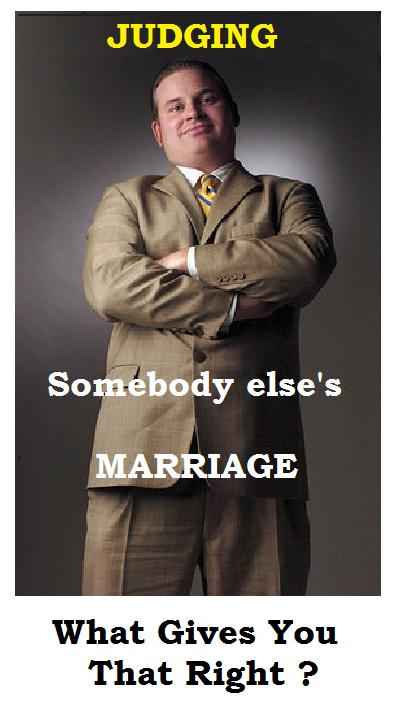
Greg Koukl has a really good response to those who say “Who are you to say?” in response to our disapproval of same-sex marriage:

Who are you to say?”  That challenge works both ways.  First, if my disapproval isn’t legitimate, then why is my approval legitimate?  If I don’t have the right to judge something wrong…, I certainly don’t have the right to judge it right….  Second, why is it that I can’t make a moral judgment here, but apparently you can?

The appeal for a change in marriage laws is an attempt to change the moral consensus about homosexuality.  You invite me to make a moral judgment, then you challenge my right to make a judgment when I don’t give the answer you want.

Building on Greg’s thoughts, I think the most concise, tactical response to the “Who are you to say it’s wrong?” challenge is simply to ask in return, “And who are you to say it’s acceptable?”  This response makes it clear that both parties are making claims, and those claims need to be justified.  The burden of proof is not just on the person in favor of prohibition, but is also on the person in favor of permission.

Wesley Smith drew my attention to an article in The Chronicle of Higher Education making the case that environmentalism has become a quasi-religion.  It is worth quoting at length:

There are indeed environmental challenges, and steps must be taken to ameliorate them. But there is another way to understand the unique passion surrounding our need to go green.

Friedrich Nietzsche was the first to notice that religious emotions, like guilt and indignation, are still with us, even if we’re not religious. … Now the secular world still has to make sense out of its own invisible, psychological drama—in particular, its feelings of guilt and indignation. Environmentalism, as a substitute for religion, has come to the rescue. Nietzsche’s argument about an ideal God and guilt can be replicated in a new form: We need a belief in a pristine environment because we need to be cruel to ourselves as inferior beings, and we need that because we have these aggressive instincts that cannot be let out.

Instead of religious sins plaguing our conscience, we now have the transgressions of leaving the water running, leaving the lights on, failing to recycle, and using plastic grocery bags instead of paper. In addition, the righteous pleasures of being more orthodox than your neighbor (in this case being more (more…)

This is a great quote:

“Gossip involves saying behind a person’s back what you would never say to his or her face.  Flattery means saying to a person’s face what you would never say behind his or her back.” – R. Kent Hughes, Disciplines of a Godly Man, p. 139.

HT: Justin Taylor

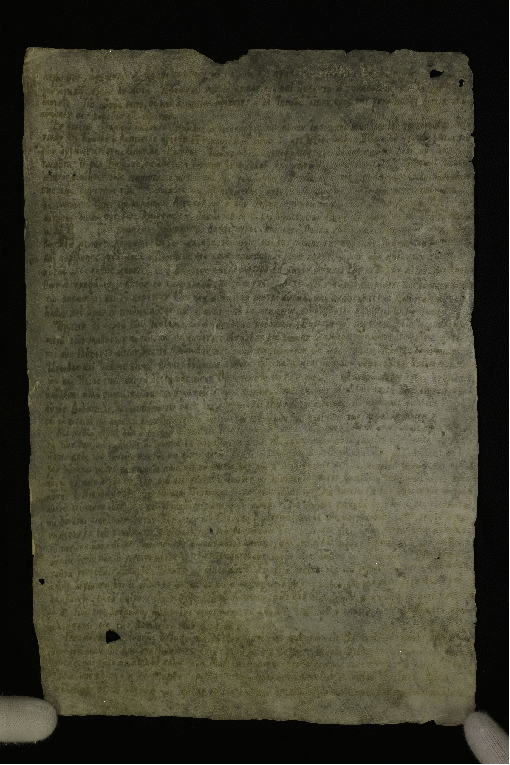
I just finished reading an interesting account of how The Center for the Study of New Testament Manuscripts was called in to investigate a newly discovered Biblical manuscript.  If you have ever wondered how scholars go about determining the authenticity of manuscripts, this is a good read.  It’s like a detective story.  In the end, their detective work (along with the help of Google) revealed that it was a modern day forgery.

Exodus 21:22 has been used by many pro-abortion advocates, Christian and non-Christian alike, to prove that the Bible is not opposed to abortion.  The passage reads, “If men strive, and hurt a woman with child, so that her fruit depart from her, and yet no mischief follow: he shall be surely punished, according as the woman’s husband will lay upon him; and he shall pay as the judges determine.” (KJV)

Greg Koukl has written a wonderful article demonstrating not only that this verse does not support such a conclusion, but that the pro-choice interpretation is based on a mistranslation of the Hebrew as found in some English translations (such as the one above). 

A free registration at www.str.org may be required to view the article.