I’m late to the game on this one, but I just discovered some great statistical information regarding changes in the religious identity of Americans between 1990 and 2008, as well as a great interactive online chart visually displaying the information. Here is some of the most pertinent information:
- Those who claim to have no religious affiliation (called “Nones”) have grown in every state since 1990.
- The west and northeast coasts dominate the no religion category. VT comes in 1st with 34%. CA ranks 15th with 18%. MI ranks last with 5%.
- Non-Christian religions have grown in all but 6 states since 1990.
- Protestants have diminished in all but 4 states.
- Catholics have diminished in all but 20 states.
- Catholics have increased in CA from 27% in 1990 to 38% in 2008.
- The northeast has the highest percentage of Catholics (RI has 46%). CA ranks 5th with 38%. AL ranks last with 6%.
- The south is mostly Protestant (AL has 80%). CA ranks 45th with 35%. MA ranks last with 26%.
- CT has the most non-Christian religious adherents (8%). CA ranks 6th with 5%. Wyoming ranks last with 1%.
- For those who simply don’t know what to say their religious identity is, OR comes in 1st place with 7% (compared to 2% in 1990), and DE last with 2% (in 1990 they were ranked 1st with 6%). CA has 5%.
The beliefs of Nones was broken down further:
- 51% believe in a deity of some sort
- ~24% believe in a non-personal God
- ~27% believe in a personal God
- ~36% are agnostic (~19% hard agnostics, ~17% soft agnostics)
- ~7% are atheist
- 22% of 18-29 year old are Nones
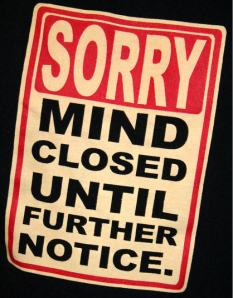 It’s common for those who reject the Christian worldview to accuse Christians of being closed-minded. Often this retort comes on the heels of a Christian’s outspokenness about his/her beliefs. How can you respond when someone tells you you’re being closed-minded, or that you need to be more open-minded?
 It wasn’t many months ago that a fossil named Ida graced the cover of every magazine and was the talk of all the news channels. There was a media blitz over what some called the “fossil that changes everything.” Extravagant claims were made about it being an ancient ancestor to humans, and proving beyond doubt the truth of evolution. Of course, many saw through the hype and exaggerated claims right away. It’s no surprise, then, that upon further study scientists are
  In his book, A Devil’s Chaplain: Reflections on Hope, Lies, Science, and Love, the ardent evolutionary atheist, Richard Dawkins, writes:
 We find ourselves in a world in which religious truth-claims have been demoted to private, subjective opinions or values. Religious knowledge is not considered “real” knowledge. In fact, religious truth-claims are not even testable, and thus must be taken on blind faith.
 ce is a two-way street, but in today’s world its application is typically one-way. In the name of tolerance we are told we must tolerate those who do not believe in God, are pro-abortion, pro-same-sex marriage, etc. Interestingly, however, those who hold to those viewpoints often refuse to tolerate us. We are forced to take down religious monuments because somebody is offended that they are forced to look at it. We are forced to forego prayers at school graduation ceremonies because someone who doesn’t believe in God may feel like an outsider. Guess what? The Constitution protects rights, not feelings. Frankly I’m not concerned with how they feel. It’s called disagreement. Everybody experiences it, and the mature person learns how to deal with it.
 Thinking to Believe