Toleran ce is a two-way street, but in today’s world its application is typically one-way. In the name of tolerance we are told we must tolerate those who do not believe in God, are pro-abortion, pro-same-sex marriage, etc. Interestingly, however, those who hold to those viewpoints often refuse to tolerate us. We are forced to take down religious monuments because somebody is offended that they are forced to look at it. We are forced to forego prayers at school graduation ceremonies because someone who doesn’t believe in God may feel like an outsider. Guess what? The Constitution protects rights, not feelings. Frankly I’m not concerned with how they feel. It’s called disagreement. Everybody experiences it, and the mature person learns how to deal with it.
When you disagree with someone you have one of three options: persuade them to adopt your view, pursue change through democratic initiatives, or suck it up and deal with it. Christians have to suck it up all the time. I disagree with atheists, and I disagree with the way religion is being forced out of the public square because of a few cry-babies supported by an out-of-control judiciary, but you don’t see me shouting “offense” because I didn’t get to participate in a public graduation prayer. No one seems to be concerned about how Christians feel. We are told to lump it when we cry, but when atheists and adherents to minority religions cry they get the whole world changed for them.
While liberals tell us we need to be tolerant, they have need of their own medication. They need to learn to tolerate public prayer, religious talk, religious monuments, and national recognition of the Creator on our money and in our pledge. It’s time they learn that tolerance means “deal with it!”

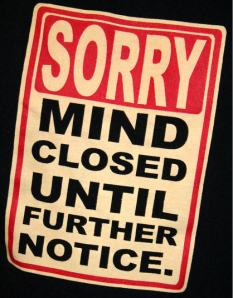 It’s common for those who reject the Christian worldview to accuse Christians of being closed-minded. Often this retort comes on the heels of a Christian’s outspokenness about his/her beliefs. How can you respond when someone tells you you’re being closed-minded, or that you need to be more open-minded?
 It wasn’t many months ago that a fossil named Ida graced the cover of every magazine and was the talk of all the news channels. There was a media blitz over what some called the “fossil that changes everything.” Extravagant claims were made about it being an ancient ancestor to humans, and proving beyond doubt the truth of evolution. Of course, many saw through the hype and exaggerated claims right away. It’s no surprise, then, that upon further study scientists are
  In his book, A Devil’s Chaplain: Reflections on Hope, Lies, Science, and Love, the ardent evolutionary atheist, Richard Dawkins, writes:
 We find ourselves in a world in which religious truth-claims have been demoted to private, subjective opinions or values. Religious knowledge is not considered “real” knowledge. In fact, religious truth-claims are not even testable, and thus must be taken on blind faith.

