A cosmological argument for theism looks something like this:

Everyone intuits the causal principle that every effect/event requires a sufficient cause.  What, then, is the cause of the universe?  What is causally sufficient to account for the observed effect?  Since the effect includes time, space, and matter, the cause must be timeless, non-spatial, and immaterial, not to mention intelligent and powerful to account for the specified complexity of the universe.  Only two things fit this description: abstract objects, or an unembodied mind.  Since abstract objects are causally impotent by definition (they do not stand in causal relations with concrete objects), they cannot be the cause of the universe.  That leaves us with an unembodied mind, who is a personal agent.  This makes sense.  Not only are we are intimately acquainted with the idea of immaterial minds causing physical effects, but it also makes sense of the design and order we see in the universe.

In response to this argument, some think we should reject the notion of a disembodied mind on the grounds that it is too abstract; i.e. it is something we are not acquainted with, and hence have no reason to believe is possible.  There are at least three reasons to reject this line of thinking.

First, there is nothing logically incoherent about a disembodied mind.  The notion may not be familiar to us, but we ought not confuse familiarity with plausibility.  A person raised in the remote parts of the jungle has never seen ice, but his lack of familiarity with ice does not mean the existence of ice is implausible.  Neither would it constitute good grounds on which for him to reject evidence being presented to him that ice exists.  Likewise, just because we are not personally acquainted with the idea of an unembodied mind does not mean an unembodied mind does not, or cannot exist.  Neither does it constitute good grounds on which to reject the evidence being presented for the existence of such a mind.  The cosmological argument provides warrant for believing in something we may not have thought probable otherwise.

Second, even if we are not personally familiar with unembodied minds, we are very familiar with the concept of mind (each of us has one), and its causal powers.  In other words, even if the specific form of the mind in question is unfamiliar to us, the function of a mind very familiar to us: minds exercise causal agency.  And I see no reason to think this capacity is dependent on our mind being embodied.  The property of causal agency belongs to the mind, not the body, so there is no reason to think an unembodied mind is too abstract a concept to be the cause of our universe.

One might respond that it would be impossible for an unembodied mind (immaterial) to cause effects in the physical realm.  This must be false.  Why?  Because our minds cause effects in the physical realm all the time, and our minds are an immaterial entity (it may stand in a causal relationship with the brain, but it cannot be reduced to the brain/physicality).  The only difference between our minds and an unembodied mind is embodiment, but I fail to see how embodiment is significant.  The fact remains that human minds, as well as a divine mind, are immaterial in nature, and a source of causation which produces effects in the physical world.

A case could even be made that human minds do not have to be embodied, and indeed, become disembodied upon death.  I am thinking in particular of empirical studies into near-death experiences.  While many of the experiences are unverifiable, a small minority are.  And in these instances, there are examples of continued consciousness, even after brain death.  In fact, in some cases the person is conscious of things happening outside of the room where their body lies (things they could not have possibly known, even if their body were functioning normally).  So I don’t think the idea of an unembodied mind is abstract, or that we are not acquainted with this.  Even if most of us are unacquainted with it experientially, we are acquainted with the concept, and there is nothing incoherent about the concept.  Strange, maybe, but incoherent, no.

Finally, those who wish to reject both abstract objects and an unembodied mind as the cause of the universe need to offer an alternative.  Given the criteria, I cannot fathom what that could be.  If no other alternative is possible, then they must either reject the causal principle and say the universe popped into existence uncaused, or else embrace an eternal universe.  Given the fact that the causal principle is one of our strongest metaphysical intuitions and enjoys undisputed empirical confirmation, and given the fact that the scientific evidence and philosophical arguments against an eternal universe are more than compelling, neither is a good option.  We have good reason, then, to think the cause of the universe was a powerful, intelligent, immaterial, non-spatial, eternal mind.  This is an apt description of what most theists have traditionally meant by the term “God.”
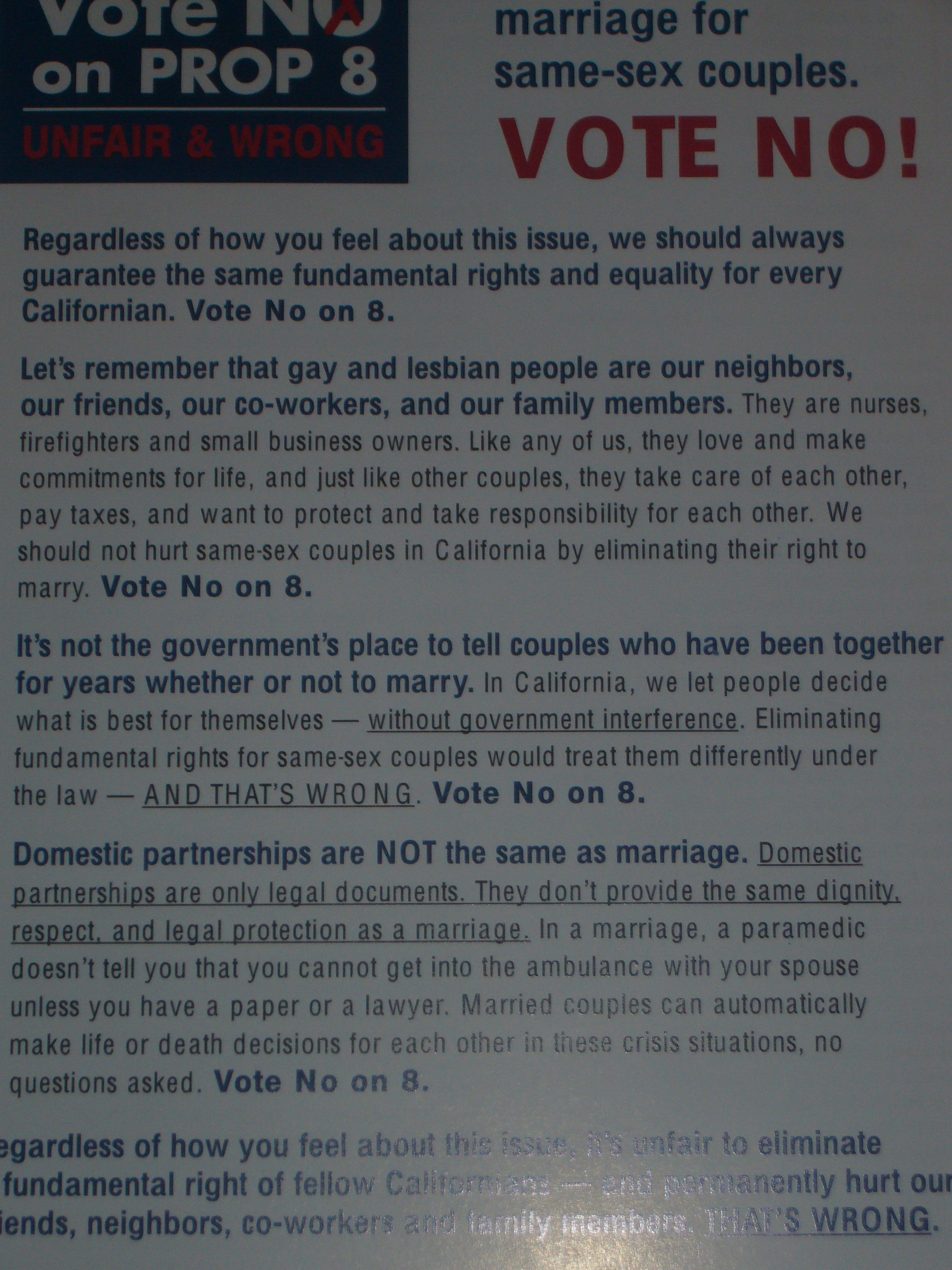
While leaving work today I was handed a “No on Prop 8” leaflet.  For those of you not living in CA, prop 8 seeks to undo our state Supreme Court’s recent decision to remove gender requirements from the institution of marriage.  In CA, same-sex couples in a domestic partnership already had identical rights and obligations as their married counterparts.  Their “package” was simply being called by a different name (domestic partnership vs. marriage).  In effect, the Supreme Court simply demanded that they be given a name change.  And they have been, against the express will of the people.  In response, the people of CA organized a ballot initiative to amend our state constitution to define marriage as being between one man and one woman only.  The people handing out the leaflet I received today oppose this initiative.

As I expected, the leaflet was a propaganda piece full of half-truths and sophistry.  Rather than reproducing this piece, I’ll just refer you to the picture above.  To read the text just click the picture (it will magnify it).  I would like to bring some of the most blatant rhetoric to your attention.  There are five paragraphs, but I will only respond to the first four:

#1 They claim same-sex marriage is a fundamental right, but since when?  It has not been recognized by any society in history until a decade ago.  A right no one recognized until 10 years ago can hardly be considered fundamental.  Just because a handful of people in black robes declare it to be a fundamental right by judicial fiat, does not make it one in reality.

As for equality, I agree.  But the law already afforded equality to all Californians.  Everyone had an equal right to marry a non-relative of the opposite sex.  The law did not stipulate that homosexuals could not marry.  Homosexuals are just as free to take advantage of the institution of marriage as are heterosexuals, but if they wish to avail themselves of this right, they need to marry someone of the opposite sex.  The fact that they choose not to afford themselves of this right is not grounds for radically changing the historic understanding of marriage.

#2 Yes, same-sex couples are our neighbors, but what follows from that?  People in Utah have polygamists as their neighbors, but does that mean society must redefine the number of participants in a marriage?  No, so why should the fact that we have gay neighbors cause us to redefine the gender requirements of civil marriage?

They claim that same-sex couples are hurt by not giving their legally-recognized unions the name “marriage,” but how?  Because they are not accorded the same social approval?  First, we do not alter fundamental social institutions so that some people won’t feel bad.  Second, marriage is a social institution intended to provide social support to relationships society deems important to the success of society.  People in society are free to choose whom to give their support to and whom to deny it.  And many do not wish to extend it to same-sex couples because they do not think their relationships are beneficial to the social fabric (indeed, they may be detrimental).

#3 No, “it’s not the government’s place to tell couples who have been together for years whether or not to marry,” but that is not the issue.  This sentence was either framed poorly, or strategically, because the government isn’t telling anyone-heterosexual or homosexual-whether or not to marry.  It only tells them the requirements they must meet if they wish to marry.  But if they were to have worded it this way, it is clearly wrong.  The government represents the people, and the people of this country have the right to define the requirements for marriage; i.e. which relationships they will and will not extend their social approval and support to.  That’s not to say they can be arbitrary in their definition, but clearly that is not the case in this country.  There are principled reasons we define marriage the way we do, and those reasons make no room for same-sex couples.

They claim we let people decide what’s best for themselves in CA.  No, we don’t.  I decided it’s best for me to be able to talk on my cell phone in my car, but the government decided it wasn’t.  Taken at face-value, what they are advocating is anarchy.  And I find it ironic that the pro-Prop 8 prop are speaking negatively of “government interference” when they have been working ferociously over the last 20 years to intimately involve government in this issue.  If they truly eschewed government interference, they would not be asking for the state of CA to recognize and regulate their relationships.

#4 In one sense it’s true that domestic partnerships are not the same as marriage.  But where do they differ?  You might be surprised to know that in CA they are the same in all but the name.  Domestic partnerships afford same-sex couples all the same rights and responsibilities as marriage.  That’s why it is disingenuous on their part to bring up the issue of medical power-of-attorney.  Domestic partnerships already give same-sex couples such rights.  The only thing domestic partnerships do not afford same-sex couples is “the same dignity” and “respect.”  But why ought they be given such when their relationships do not function in the same way in society, and when many people consider their sexual mores immoral?  I see no reason to.

I hope my fellow Californians will join me in voting YES on prop 8.

If anyone doubts this, see this piece in Public Discourse from The Witherspoon Institute (Princeton).

Some pro-lifers are arguing that the US Supreme Court is highly unlikely to overturn Roe, and thus we need to quit basing our vote largely on a candidate’s position on abortion.  Even if I agreed with this assessment of the future of Roe (I don’t), it does not follow that a politician’s position on abortion is irrelevant.  As the article makes clear, pro-life politicians who have passed laws restricting abortion are largely responsible for the declining abortion rates in this country.  Does anyone think pro-abortion politicians would have passed such restrictions?  Does anyone think that if pro-abortion politicians dominate public offices, they will not seek to undo those restrictions, and hence increase the number of abortions?  You betcha!

We have a choice between Obama and McCain for president.  Even if I granted that McCain will not appoint strict constructionists to the bench (as some say), or that those he appointed would not overturn Roe because of stare decisis, the fact remains that there would be fewer legal abortions under a McCain presidency than under an Obama presidency.  Each candidates’ position on abortion is relevant!  Obama has vowed to sign the Freedom of Choice Act if he becomes president. What would that do? It would repeal every restriction on abortion in every state in the union, including partial birth abortion.  He would also repeal the Hyde amendment which prevents the government from spending tax dollars to fund elective abortions.  A vote for Obama, then, is not equal to a vote for McCain.  The fact of the matter is that a vote for Obama will result in more dead babies than a vote for McCain, wholly apart from the future fate of Roe.

Two years ago I reported on the outcome of South Dakota’s attempt to ban all abortions that were not necessary to save the life of the mother.  The initiative was narrowly defeated (56% no; 44% yes).  Polls indicated that a majority of voters would have supported the initiative if it included an exception for rape and incest as well.  I wrote back then, that while I agreed with the initiative as written, tactically and practically speaking, SD would have been better off to include the exceptions for rape and incest. 

Why?  Is it because I believe children conceived by rape and incest do not deserve the protection of the law?  No.  They do.  It’s because to date, we have not been able to persuade a majority of our fellow citizens that the circumstances surrounding conception make no moral difference to the question of abortion.  But many people, including those in South Dakota, recognize that abortion should be outlawed in all other circumstances.  So why not write an initiative that outlaws the abortions that a majority of people agree should be outlawed, and then work on outlawing the rest later?  Considering the fact that less than 1% of abortions are due to rape or incest (for 2006, only 0.004% of abortions in SD were due to rape/incest), such a bill would save 99% of babies currently being aborted. 

It just so happens that SD has an initiative on the November ballot similar to the 2006 version, but adding exceptions for rape and incest.  In a perfect world I would not support such a bill, but in an imperfect world I would-and I think all pro-lifers should.  But not all pro-life groups see it this way.  South Dakota Right to Life does not support the initiative because of the rape/incest exceptions.  For them, it’s all-or-nothing.  Since this bill does not go for a complete ban on abortion, they do not support it. 

I think this approach is wrong-headed.  It makes a statement, but does not effect change.  An incremental approach to outlawing abortion is better than an all-or-nothing approach, because an incremental approach has the effect of preventing a lot of abortions, whereas the all-or-nothing approach has proven to prevent none!  If we are truly pro-life, we should support any bill that has the effect of saving babies.  It is morally indefensible to vote against a bill that would save 99% of aborted babies from abortion, just because less than 1% will not be protected by the bill. 

While I do not doubt the sincerity of those who oppose incremental legislation like the one SD is proposing, I do doubt their wisdom.  They seem more interested in making a moral statement than they do with making a moral difference in our world.  This is morally irresponsible.  Being pro-life is not a position.  It is a goal, and to get to that goal we have to chip away at the culture of death bit-by-bit, just like William Wilberforce did to slavery in England.  We should not be opposed to steps that are taken in the right direction, just because they do not take us to the destination we see as ideal.

But isn’t this about conscience?  Some will argue that their conscience will not allow them to vote for a bill that would explicitly allow the abortion of some babies.  I do not doubt that this is true, but I do doubt that such a person has a properly informed conscience.  After all, if one’s conscience commends them for voting no on a bill that could have saved thousands upon thousands of innocent babies from medical execution, on the basis that they stood up for the right principle, something is seriously wrong with their conscience.  Yes, they stood up for the ideal principle, but they did not advance life when they had the chance to do so.  A properly informed conscience would condemn such an act as an abandonment of the very people we say we want to save.  Allowing thousands to die when we have the chance to stop it is hardly pro-life.

England’s Department for Environment, Food and Rural Affairs has asked the media not to report on the findings of a government study related to diapers.  Apparently England has been pushing parents to use reusable diapers rather than disposable ones, to lessen their “carbon footprint” in the fight against global warming.  But the report found that the carbon footprint from disposable diapers is less than reusable diapers.  You would think that those who claim to be responding to the evidence of global warming would respond to this evidence as well, and tell people to use disposable diapers.  You would be wrong.  When the evidence is against you, I guess the appropriate response is to be against the evidence.

Some Christians plan to sit out this presidential election because none of the viable presidential candidates reflect their conservative ideals, and think casting a vote for any of them would be morally wrong. While I am somewhat sympathetic to this position, ultimately I think it is unwise, and possibly even immoral. This is a serious charge, and I do not make it lightly. Allow me to substantiate my charge with a reasonable argument (credit, for which, goes largely to Greg Koukl of Stand to Reason ministries).

The time to vote according to one’s ideals and conscience is the primary election, not the general election. In a general election our options are narrowed down to two viable candidates, and we vote for the best available candidate. It may be that neither candidate represents our ideals, and we are tempted to sit out the general election for conscience’ sake, or to send a message to the political parties that we do not like the candidates they are advancing (protest vote). Whatever the motivation might be, the fact remains that one of the two major candidates will be elected whether we vote or not, and they will have an impact on the issues that matter to us. Sitting out the election will do nothing to change that. Sitting out the election, however, can determine whether some of our ideals will be advanced or attacked.

It may be the case in a general election that both candidates equally fail to represent our ideals, but in most cases, one candidate will better represent our ideals than the other. For example, candidate A may share with us 3 out of 10 ideals, while candidate B may only share 2 out of 10. While neither comes close to representing our ideals, candidate A more closely resembles our ideals than candidate B, and is more likely to promote our ideals than candidate B. If we take our ideals seriously—meaning we want to see them advanced for the good of our fellow Americans—we should be interested in electing those who will do the most to promote them. As such, we have a moral responsibility to vote for the candidate who will act to promote a greater amount of good, and work to prevent a greater amount of evil. Failing to vote, however, may result in candidate B being elected over candidate A, which in turn may increase the net amount of evil in the world. To see how this is so, let me illustrate.

Let’s say candidate A (the better of the two bad candidates) has 51% of the popular vote (of registered, likely voters), and candidate B has 49% of the popular vote. If 4% of conservative Christians refuse to vote for candidate A because he does not match up to their ideals, they shift the vote to the other candidate. Now, candidate A only has 47% of the popular vote, and candidate B has 53% of the popular vote. Ironically, then, sitting out an election may result in the increase of evil, by throwing the election to the worse of the two candidates. In other words, sitting out could have the unintended consequence of increasing evil.

One might respond that choosing the lesser of two evils is evil. I disagree. Choosing the lesser of two evils is a moral good because it results in the greater good. In fact, when we have the ability to reduce evil in the world, and our inaction would have the effect of increasing evil, we are morally culpable if we do nothing. If not voting will cause greater evil, then we have a moral obligation to vote. We are not obligated to vote for the best candidate, but the best candidate available.

What about one’s conscience? While I would never advise someone to violate their conscience, neither can I pretend the conscience that demands one do something that would increase evil is a properly functioning conscience. Only a misinformed conscience could demand such a thing of a person. Any conscience that demands we do something that will result in increased evil needs to be informed by a different set of moral principles.

If you don’t care for your presidential choices, you are not alone. I don’t care much for them either. But I recognize that one of them is better than the rest when measured against conservative ideals: John McCain. While this individual is not my ideal, his presidency would result in more good and less evil than the presidency of the other candidates, and that is why I will vote for him in the general election. I hope you will vote as well. Remember, all it takes for evil to prevail is for good men to do nothing.

*Read previous post before reading this one.*

There is a difference between the question, Is existence necessary?, and Does X exist necessarily? The first question asks about existence in general, whereas the second asks about the existence of some specific thing within the larger domain of existence.

Regarding the first question, is it necessary that something exist? The answer to this question depends on whether one is speaking of historical possibility, or metaphysical possibility. Historically speaking, the answer is an emphatic yes. Something must exist, and must exist eternally. Why? Because something does exist. If there was ever a time when absolutely nothing existed, absolutely nothing would “exist” now, because nothing has no potentiality to ever become something. And yet there is something, so we know there has never been a time when nothing existed.

But from a metaphysical perspective, there is no reason to think existence itself is necessary. We can conceive of absolute nothingness. Furthermore, there is nothing logically incoherent about the concept of non-existence. Existence, then, is not necessary, but contingent, and contingent things require an explanation for their existence. What, then, is the explanation of existence? Why is there something, rather than nothing?

The second question is quite different. It does not ask whether existence itself is necessary, but whether the existence of some particular X is necessary. In cosmological arguments, X stands for the universe. Does the universe exist necessarily?

Some atheists assume the answer to this question is wrapped up in the first: Since something must exist eternally, the universe must be eternal. While it is true that something must have always existed, why think the universe is that something? Not only are there compelling scientific and philosophical reasons to think the universe exists contingently, but this begs the question in favor of atheism. It assumes materialism from the start (i.e. the universe is all that exists), reasoning that since something must be eternal, and the universe exhausts reality, then the universe must be eternal. But that the universe exhausts reality is what stands to be proven.

Secondly, thinking the universe exists by a necessity of its own nature is a grandiose claim that few philosophers are willing to countenance. To say the universe exists by a necessity of its own nature does not merely affirm the necessity of a universe in general, but the necessity of our universe in particular. It is an affirmation that the very fundamental particles of our universe–quarks, neutrons, electrons, etc.–are necessary, not just in kind, but in number and arrangement as well. But this is absurd. There is no reason to think the universe could not have been composed of a different set/number of fundamental particles, arranged in a different way, operating by a different set of physical laws, resulting in a totally different kind of universe. In fact, it is quite possible to conceive of a physically empty universe, or no universe at all. There is no physical or logical law that requires the universe to exist. So modal logic alone demonstrates the universe is not necessary. It is contingent, meaning it is metaphysically possible that it might have never been.

We can agree with the atheist that existence is necessary as a historical fact, and that the universe does not exist necessarily. But these two truths, coupled with the scientific and philosophic evidence for the finitude and contingency of the universe, provide a strong argument for a personal God. Something must exist eternally, and since the universe is not that something, it must be something else. Whatever caused the spatio-temporal-material universe to exist must itself be eternal, non-spatial, and immaterial.

Only two things fit such a description: abstract objects, or an unembodied mind. Since abstract objects are causally impotent by definition, they cannot be the cause of the universe, and thus are unlikely to be that which has always existed. That leaves us with an unembodied mind as the eternal reality. This makes sense. Not only are we are intimately acquainted with the idea of minds creating things, but it also makes sense of the design and order we see in the universe. An intelligent agent best explains why the universe exists as it does. Since an eternal, non-spatial, immaterial, intelligent mind is what most mean by “God,” it is best to conclude that God is that which exists eternally, and hence necessarily. He is a necessary being, who contains within Himself the sufficient reason for His own existence, and is the cause of everything else.

Something exists. For all but radical skeptics, this much is clear. But why does something exist? Why is there something rather than nothing at all? There is, after all, nothing logically incoherent about the concept of non-existence. It seems possible, at least, that nothing exist. So why is there something rather than nothing?

Interestingly, modern science has garnered several lines of empirical evidence highly suggestive that nonexistence was a historical reality. Cosmogonists hold that the physical universe came into being ex nihilo a finite time ago. Matter, space, and time all had their beginning at an absolute point of origin, before which there was no physical reality. While the scientific evidence does point to an absolute origin of physical reality, it does not preclude the possibility of a preexistent, immaterial reality from which the physical universe emerged-and thus does not require that physical existence emerge from absolute nonexistence. That question is left open, as it is beyond the realm of scientific inquiry.

Materialists, however, are only a little hesitant to deny the existence of such an immaterial reality, and subsequently affirm that the universe popped into being from literally nothing. As atheist and physicist, P.C.W. Davies wrote, “The coming-into-being of the universe as discussed in modern science…is not just a matter of imposing some sort of organization or structure upon a previous incoherent state, but literally the coming-into-being of all physical things from nothing.” This is echoed by physicists John Barrow and Frank Tipler: “At this singularity, space and time came into existence; literally nothing existed before the singularity, so, if the Universe originated at such a singularity, we would truly have a creation ex nihilo.” We have then, as a matter of historical fact, a point in time in which nothing existed-at least nothing physical. And yet now, physical reality exists. But why?

Traditionally, atheists punted on this question, responding that the existence of the universe is just a brute, inexplicable fact.1 As Bertrand Russell famously quipped, “The universe is just there, and that’s all.” This sort of response might work given an eternal universe, but it is preposterous to pass this off as an acceptable answer if the universe is finite and contingent. Everything that begins to exist has an external cause. If the universe began to exist, it stands to reason that it, too, requires an external cause. It is unbelievable and irrational to think the universe could just pop into existence uncaused from absolutely nothing.

When one reflects on it for a moment, however, Russell’s response is not rational even for an eternal universe. According to Leibnitz’s principle of sufficient reason, everything that exists has an explanation for its existence either in the necessity of its own nature, or in an external cause. An eternal universe cannot have an external cause, because that which is eternal is by definition uncaused. It exists by a necessity of its own nature. Given the principle of sufficient reason, then, the defender of an eternal universe must confess that the universe exists by a necessity of its own nature. And yet few atheists are willing to countenance the notion. And for good reason.

To say the universe exists by a necessity of its own nature does not merely affirm the necessity of a universe in general, but the necessity of our particular universe. It is an affirmation that the very fundamental particles of our universe-quarks, neutrons, electrons, etc.-are necessary, not just in kind, but in number and arrangement as well. But this is absurd. There is no reason to think the universe could not have been composed of a different kind/number of fundamental particles, arranged in a different way, operating by a different set of physical laws, resulting in a totally different kind of universe. In fact, it is quite possible to conceive of a physically empty universe, or no universe at all. There is no physical or logical law that requires the universe to exist.2 It is contingent, meaning it is metaphysically possible that it might have never been.

The defender of an eternal universe, then, is in the unusual spot of having to deny that the universe exists in virtue of an external cause, and not willing to accept that it exists by a necessity of its own nature. Whence does it exist, then? No sufficient reason is given, which is intellectually unacceptable. The atheist must offer an explanation for why the universe exists, or offer an explanation for why no explanation is necessary. Merely asserting that there is no explanation, or that the question is meaningless is not a satisfactory answer. Surely no atheist would accept this kind of answer for anything else. Indeed, atheists often challenge theists to explain why God exists, and are unwilling to accept the answer that He exists inexplicably. They rightly demand that His existence be explained, so on what grounds are they justified in exempting the universe from explanation?

To date, no atheist has provided a non-question begging explanation for why the universe does not require an explanation. Some argue that a cause of the universe is logically impossible, because any such cause would have to obtain prior to the universe. And yet, since nothing existed prior to the emergence of the universe, no cause can obtain. But this assumes all causal relations are temporal, and that the only possible state of affairs prior to the universe is a physical state of affairs. This begs the question in favor of materialism and atheism, and thus an explanation for why the universe needs no explanation still stands.

If no explanation as to why the universe does not require an explanation can be provided, then the atheist is under rational obligation to embrace an external cause as the sufficient reason for the universe, or the necessity of its own nature. Given the fact that the latter is absurd, it is more reasonable to embrace an external cause for the universe. In doing so, he will have to abandon his belief in an eternal universe, and embrace a finite universe, causing him to squarely face our original question: Why does the universe exist, rather than not?

Why and how did something emerge from nothing? The most basic ontological principle is that out of nothing, nothing comes; and yet in the case of the universe, out of nothing something came. There must be a sufficient cause for the universe to come into being, and that requires that something exist external to the universe. Given that whatever caused space, time, and matter to begin to exist cannot itself be spatial, temporal, or material, we are limited to two possible causes of the universe: abstract objects, or an unembodied mind.

Since abstract objects are causally impotent by definition, they cannot be the cause of the universe, and thus are unlikely to be that which has always existed. That leaves us with an unembodied mind as the eternal reality. This makes sense. Not only are we are intimately acquainted with the idea of minds creating things, but it also makes sense of the design and order we see in the universe. An intelligent agent best explains why the universe exists as it does.

Since an eternal, non-spatial, immaterial, intelligent mind is what most mean by “God,” it is best to conclude that God is that which has always existed. He is a necessary being, who contains within Himself the sufficient cause for His own existence, as well as the existence of everything else.

1. Some have also responded to the question of why the universe exists, that such a question is irrelevant. All that matters is that it does exist. But surely this is false. Imagine walking through the forest, and coming upon a translucent ball off the beaten path. Would it be relevant to ask why it exists, and from whence it came? Of course. An explanation of its existence is in order. It would be absurd to think there is no explanation for why it is there. Explicability would still be required even if we increased the size of the ball to the size of a planet, or even the size of the universe. Increasing its size does not remove the need for an explanation. Likewise, the universe begs for an explanation. Its size does not exempt it from the causal principle.
2. Even if there was such a law, it would itself have ontological existence, and thus we would still have to ask why it exists, ad infinitum.

If you have ever wondered whether it was possible for Christ to sin, please see my completely updated article on this topic at the Institute for Biblical Studies.  For those of you just looking for a quick answer, the answer is no.  If you want to know why, read the article!

Robert George has an excellent article discussing Obama’s abortion extremism.  For those of you not familiar with George, he is a top-notch legal scholar and bioethicist.  He teaches jurisprudence at Princeton University, and is a member of the President’s Council on Bioethics.

It’s official.  Connecticut is now the third state in the nation to legalize same-sex marriage.  Just as Massachusetts and California, this was the result of a ruling by the state Supreme Court, not an expression of the will of the people.  It’s amazing how these courts keep discovering rights in their constitutions that hundreds of justices had not seen before!  I’m sure this will not be the last court to do so.  This seems to be a trend, and I see no end in sight.

According to the AP, the civil union law CT passed in 2005 essentially granted same-sex couples all the rights and benefits available to heterosexual married couples, so as I noted in my comments on the CA case in which same-sex marriage was legalized, it only makes sense to extend the name “marriage” to the package of benefits already conceded.  We are finding ourselves in the bed of our own making.  Did we honestly think we can give legal recognition and benefits to same-sex couples, and yet deny them the name by which we identify that packet of benefits?

Atheists like to think theists alone bear the burden of proof when it comes to the question of God’s existence. They assume atheism is the default position unless, and until sufficient evidence for God’s existence can be mustered. This is simply not true. Atheism is a worldview (or, more accurately, is a component of many worldviews), just like Christianity, Buddhism, and Hinduism. All worldviews make truth-claims, and he who makes a truth-claim assumes the burden of proof to demonstrate the veracity of those claims, including atheists. Each worldview must stand on its own merits. The lack of evidence for other worldviews is not in itself evidence in favor of another. That’s why it is illegitimate to think a (supposed) lack of evidence for theism is itself evidence for atheism.

All worldviews are charged with explaining reality, both as it is, and as we experience it. Atheism is no exception. If anyone is to take their worldview seriously, atheists must explain the existence of the universe, free will, rationality, consciousness, and the like without reference to God. Indeed, they must show that an atheist explanation is superior, and more likely than other theistic alternatives. This project is doomed to failure. The explanatory scope and explanatory plausibility of atheism is inferior to theistic worldviews. How so?

Atheism requires that we believe the universe just popped into existence out of nowhere, caused by nothing. Theism, on the other hand, posits an eternal, intelligent agent who caused the universe to come into being. Unlike atheism, this is in line with our modal intuition that being only comes from being, not non-being.

Atheism requires that we believe free will is an illusion, because as mere physical stuff, humans are not exempt from the determinism inherent to purely physical systems. Theism, on the other hand, posits the existence of an immaterial entity within man, allowing him to transcend physical determinism, to freely choose among options undetermined by external physical constraints. Unlike atheism, this is in line with our experience of genuinely choosing A rather than B.

Atheism requires that we believe rationality developed by evolutionary means, and it is by pure accident that rationality helps us to discover truth about the world. Theism, on the other hand, posits that God is a rational being. Humans are rational because we are made in God’s image, and God desired to endow us with the means to discover true propositions about our world.

Atheism requires that we believe consciousness arise from non-conscious matter. Theism, on the other hand, posits that human consciousness arises from spiritual, rather than material substances. Consciousness is a function of the soul, and is derivative of the consciousness exemplified by a personal God.

Which worldview better explains the world and our experience of it? I think the answer is simple. Theism has greater explanatory scope and explanatory power than atheism, making theism the preferred worldview. Theism does not need to deny something so intuitive as the principle that being only comes from being, that every effect requires a prior cause, or that humans have causal powers undetermined by other material processes.

For further reading see my article titled Not so Fast: There is no Presumption of Atheism.

The recent spate of anti-religion books written by militant atheists such as Richard Dawkins and Christopher Hitchens make the charge that theism is not only wrong, but evil. It’s an interesting twist on the Biblical story of creation. According to Judaism and Christianity, in order to get evil out of the Garden man needed to be removed. According to the new atheists, in order to get evil out of the Garden we need to remove God Himself. Ironic?!

In several previous posts (here, here, and here) I addressed the problem of differences in the Gospels, pointing out that what are often taken for contradictions are really just examples of 21st century Westerners trying to impose unrealistic and modern standards of historical reporting on ancient Easterners.  I demonstrated this by pointing to examples in which two different passages within the same book report different information.  No one thinks of these as being contradictions because they come from the same author, and appear in the same literary document.

I found another example of this, but not in the Gospels this time.  This one appears in Acts.  Luke’s account of Jesus’ words to Paul on the Damascus road reads as follows: “Saul, Saul, why are you persecuting me? … I am Jesus, whom you are persecuting.  But rise and enter the city, and you will be told what you are to do.” (Acts 9:5b-6, ESV)

Paul, recounting the same event in Acts 26:14b-18, records Jesus’ words as:

“Saul, Saul, why are you persecuting me? It is hard for you to kick against the goads. … I am Jesus whom you are persecuting.  But rise and stand upon your feet, for I have appeared to you for this purpose, to appoint you as a servant and witness to the things in which you have seen me and to those in which I will appear to you, delivering you from your people and from the Gentiles-to whom I am sending you to open their eyes, so that they may turn from darkness to light and from the power of Satan to God, that they may receive forgiveness of sins and a place among those who are sanctified by faith in me.” (ESV)

Not only is Acts 22 much fuller in its account of what Jesus said to Paul, but there is little overlap between them as it pertains to Jesus’ instructions.  In Acts 9 Jesus instructs Paul to go to Damascus and wait to be told what to do.  In Acts 22 Jesus does not tell Paul to go to Damascus, but instead, instructs him in his mission on the spot!  If these two accounts appeared in two different books, critics would claim a contradiction.  But because they appear in the same literary work, no such charge is made.

Of course, a reasonable harmony can be made for the two accounts.  Acts 9 appears to be a summary of the much longer conversation, rather than a transcript of the actual words Jesus said (at least for His instructions; not His introduction and self-revelation).  Acts 22 is probably closer to an actual transcript of what was said to Paul.

The fact that Jesus discloses to Paul His purpose for his life there on the road does not contradict what Luke reports in chapter 9.  No specific instructions were given regarding what he should do next to fulfill that purpose.  Furthermore, in the context of Acts 9, it seems what Paul was “to do” in Damascus was receive salvation.  That is why the Lord spoke to Ananias in a vision to go pray for Paul to regain his sight and be filled with the Spirit (9:10-19).

“Agnosticism seems to be a more tenable commitment than atheism. Problem is, in action one must act as if God does not exist (etsi deus non daretur), or as if He does. In action one must make a commitment that one cannot quite make on purely intellectual grounds. It is by our deeds that we show what we most deeply believe.”[1] 


[1]Michael Novak, “Empathizing with Atheists

Euthanasia advocates begin their advocacy by assuring us suicide will only be permitted for the terminally ill who are suffering great pain.  That’s what they say.  But it’s not long after suicide is legalized that those same advocates push for expanding suicide to the non-terminally ill, and expand the definition of suffering to include emotional suffering.  We’ve seen this kind of thing in Belgium and the Netherlands.  In fact, in those two countries we’ve seen euthanasia expand from a voluntary choice, to non-voluntary, and even involuntary.  

England is pushing for Euthanasia.  Ironically, one of their leading bioethicists is being honest about what circumstances she thinks euthanasia should be legal in before “basic” euthanasia is legalized.  During a recent interview for the October 2008 edition of Life & Work-a Church of Scotland publication-Baroness Mary Warnock made the following assertions about the duty to die: “If you’re demented, you’re wasting people’s lives – your family’s lives – and you’re wasting the resources of the National Health Service.”  She is very clear that the right and duty to die is not tied to insufferable pain: “I’m absolutely, fully in agreement with the argument that if pain is insufferable, then someone should be given help to die, but I feel there’s a wider argument that if somebody absolutely, desperately wants to die because they’re a burden to their family, or the state, then I think they too should be allowed to die.”[1] 

Don’t buy into the “it will only be limited to the terminally ill and suffering” polemic.  It’s not true. 


HT: Al Mohler


[1]“A Duty to Die?” in Life and Work, October 2008; available from www.churchofscotland.org.uk.

That is the topic of the latest article I published at the Institute for Biblical Studies.  Check it out.

Here is your chance to talk about whatever you want to talk about.  Speak your mind in the comments section.  Or maybe suggest a topic you would like me to cover in a future post.  It’s open mic.

Some concepts are so heady that they are difficult to put into words.  For example, how does one talk about what God was doing before creation, when creation marks the beginning of temporality?  There cannot be a “before” the beginning, and yet we can conceive of God’s existence before time began.  While it is difficult to put this into words, one way of doing so is to speak of God existing “without the universe.”  Problem solved. 

There are other concepts, however, which are impossible to put them into words.  Consider “nothing.”  It is impossible for us to even imagine nothingness, yet alone to reduce it to words.  For example, according to the Big Bang theory of cosmic origins our universe came into existence from literally nothing about 13.7 billion years ago.  But to say our universe came into existence “from” nothing treats nothing as if it were somewhere from which the universe emerged.  It isn’t, and that’s not what scientists mean to say, but that is the picture that emerges when we try reducing this concept to words.  

We might even conceive of a “time when nothing existed,” but this too is unintelligible.  There cannot be a “time” when nothing existed, because a state of nothingness includes the absence of temporality.  I’ve done it again.  I referred to nothingness as a “state,” but it is not a state.  It is nothing!  The fact of the matter is that no matter how we choose to refer to the concept, the moment we do so, we reify it in the process.  We do the same thing for other concepts.  Consider darkness.  Darkness, as such, does not exist.  It is the absence of all light.  And yet the moment we refer to “darkness,” we reify it, as if it were an existent.  This is a shortcoming of language we have to live with, but we need to be cognizant of the fact that speaking of nothingness, or of something coming from nothing, does not mean nothing is something.  It means no-thing.

During Greg Koukl’s August 10th radio broadcast, he shared some thoughts about the criterion of falsifiability as it relates to theism, that I found worth passing on (with some expansion and commentary of my own).

Some claim theistic belief is not reasonable, because theism cannot be falsified.  For something to be falsifiable requires that there be an imagined set of circumstances that would demonstrate a particular view to be false.  For example, Christianity would be falsified if archaeologists ever unearthed Jesus’ body from a grave outside Jerusalem.  The idea behind the principle of falsifiability is that if, in principle, there can be no evidence that counts against a view, then it is not possible to have a reasonable conversation about the merits of the view.

While this is a useful principle, clearly it is not an absolute criterion for a theory/belief to be reasonable, nor is it necessary to have a reasonable conversation about its merits.  For example, consider the belief that you exist.  Can you imagine any set of circumstances that could convince you that you do not exist?  No.  It is inconceivable.  And yet we are fully reasonable in our belief that we exist.

While falsifiability is a useful way to evaluate a theory/belief, the merits of that theory/belief do not hang on its falsifiability.  Its merits hang on the evidence in its favor.  Theism has several lines of evidence in its favor.  That body of evidence serves as the basis for a reasonable dialogue concerning the veridicality of theism.

More to the heart of the matter, falsifiability cannot be an appropriate test for theism because it is impossible to falsify a universal negative.  And in order to falsify God’s existence, one would have to prove a universal negative: God does not exist.

To be fair, I should qualify my statement that a universal negative cannot be proven.  While a universal negative cannot be proven empirically, it can be proven logically.  If something is logically contradictory, or incoherent, we can be sure it does not exist.  For example, I can prove there are no square circles.  I cannot, and need not do so empirically, but I can do so logically.  The concept of a square circle is incoherent, and thus square circles cannot exist.  Some atheists contend that theism is logically incoherent, but few have been persuaded of their arguments.  In the past, the most common attempt to show theism was incoherent was the problem of evil.  It was reasoned that if God is all good and all powerful as theism claims, evil should not exist.  And yet it does, hence, theism must be false.  Philosophers have since come to realize that the existence of evil is logically compatible with the existence of an all-powerful and all-loving God.  It stands, then, that the very nature of theism is that it cannot be falsified, and thus this should not count against the view.  The focus should be on the evidence for theism, not its unfalsifiability.