Check out this new tool: Bible Mapper. You can build your own customized Bible maps, complete with distances, etc. You can select from 10 different time periods, from 2000 B.C. to A.D. 69. It takes some time to download, but it’s a great tool.

Many months ago I dialogued with an atheist-leaning agnostic about the existence of the soul. After I gave him persuasive reasons to believe that our sameness of identity through the process of physical change is grounded in a substantive soul rather than memory (a view held by some materialists) he responded, “I too am in search of a ‘meaning’ of ‘identity’ and the ‘afterlife.’” That was a strange twist to the conversation, but I used it as an opportunity to discuss Christianity with him. I had just finished reading William Lane Craig’s chapter, “The Absurdity of Life Without God” from his book Reasonable Faith, in which he lays out what is necessary for genuine meaning and purpose to exist in the world, and explains why atheism cannot provide it. I built on Craig’s thoughts to produce the following response that I hope you will find both stimulating and evangeliPublishstically useful:


John [not his real name],


You mentioned that you “too” were in search of meaning in life. I find your comment interesting considering the fact that I did not mention anything about my own search for meaning. It is true that we all search for meaning—including myself—but I hope you are not confusing my argument for a substantive soul with my psycho-spiritual desire to find meaning in life. While I may find the idea of a soul that grounds our personal identity and survives physical death to be personally meaningful, I hold to the notion—not because I find it meaningful—but because I find it to be the most rational among options.


Yes, we all search for meaning in life. We all want to know why we are here, what we are to do, and what will bring us ultimate fulfillment. Have you ever stopped to consider why that is? Why does man seek a purpose to life? What makes us ask Why? in the face of calamity? Why do we want to believe there is a grand purpose to everything? Why do we feel empty, as though something were missing in our lives? Why is it that the accumulation of material things cannot satisfy that emptiness? Why is it that what we think will bring us happiness and fulfillment in life—once obtained—fails to deliver as we had hoped, sending us looking for some other thing that will finally bring us fulfillment? I propose that it might be reasonable to conclude that there actually is purpose and meaning in the world. I propose that we seek purpose because we were created with purpose (to serve our Creator), but turned our back to it, and our souls will never rest until we return to fellowship with our Creator.


Some are uncomfortable with such talk, however. They wish to excise the world of a personal Creator, but still hold on to the notion of objective meaning in the world. What most people fail to realize, however, is that for there to be genuine purpose and meaning in life two things must be true: (1) God exists; (2) there is life beyond the grave (immortality). God is necessary because without Him there is no transcendent source from which to receive purpose and draw meaning, and immortality is necessary because without a continued existence beyond the grave our moral choices are ultimately irrelevant. Let me elaborate first on the latter.


Immortality


If there is no life beyond the grave it makes no ultimate difference whether one chooses to live like Hitler or Mother Theresa. “If there is no God, then your life ultimately means nothing. Since there is no enduring purpose to life, there’s no right or wrong way to live it.”<!–[if !supportFootnotes]–>[1]<!–[endif]–> As Dostoyevsky put it: “If there is no immortality then all things are permitted.” We are just left with the bare facts of cold existence. Molecules and atoms know neither right nor wrong, they just are. Richard Dawkins echoed this in his eloquent obituary for meaning, saying, “In a universe of blind physical forces and genetic replication some people are going to get hurt, other people are going to get lucky; and you won’t find any rhyme or reason in it, nor any justice. The universe we observe has precisely the properties we should expect if there is at the bottom no design, no purpose, no evil, and no good. Nothing but blind, pitiless indifference. DNA neither knows nor cares. DNA just is. And we dance to its music.”<!–[if !supportFootnotes]–>[2]<!–[endif]–>


If there is no life beyond the grave there are no ultimate consequences for our actions. Man’s evil deeds will go unpunished, and his good deeds will go unrewarded. The wrongs will never be righted, and justice will never be served. If we experience immortality, however, our moral choices on this side of the grave become extremely significant.


Without immortality our lives will be stomped out into non-existence, reduced to a fleeting moment in the sea of infinity. Like a candle in the wind our flame will be blown out in darkness, never to flicker again.


The Existence of God

Mere duration of existence beyond the grave, however, cannot make our lives meaningful. Ultimate significance requires the existence of God, for without God we would still be asking What is my purpose? and Why am I here?, but for time immemorial rather than for a mere lifetime. Without God we are just a cosmic accident who lives to contemplate just how meaningless our existence really is.


Atheism is inept to provide meaning and purpose to life. The message of atheism is that man came into existence for no purpose, and he will pass out of existence without purpose. The same purposeless cosmic process that brought us into existence will also be responsible for eradicating our existence. Peter Singer, an atheistic philosopher at Princeton University understood the implications of the atheistic worldview clearly when he said, “When we reject belief in a god we must give up the idea that life on this planet has some preordained meaning. Life as a whole has no meaning. Life began [in] a chance combination of molecules; it then evolved through chance mutations and natural selection. All this just happened; it did not happen for any overall purpose.”<!–[if !supportFootnotes]–>[3]<!–[endif]–> In a similar vein G.G. Simpson wrote, “Man is the result of a purposeless and materialistic process that did not have him in mind. He was not planned. He is a state of matter, a form of life, a sort of animal, and a species of the Order Primates, akin nearly or remotely to all of life and indeed to all that is material.”<!–[if !supportFootnotes]–>[4]<!–[endif]–>


In a purely materialist view of reality life is nothing more than a struggle to survive—a struggle that we ultimately lose in the end. Why is it that we continue with the struggle? Why do we want to survive? What is it that we live for? Atheism is incapable of answering these questions to our existential satisfaction. William Lane Craig wrote to this end:

“Who am I?” man asks. “Why am I here? Where am I going?” Since the Enlightenment, when he threw off the shackles of religion, man has tried to answer these questions without reference to God. But the answers that came back were not exhilarating, but dark and terrible. “You are the accidental by-product of nature, a result of matter plus time plus chance. There is no reason for your existence. All you face is death.” Modern man thought that when he had gotten rid of God, he had freed himself from all that repressed and stifled him. Instead, he discovered that in killing God, he had also killed himself. … For if there is no God, then man’s life becomes absurd. It means that life itself is absurd. It means that the life we have is without ultimate significance, value, or purpose.<!–[if !supportFootnotes]–>[5]<!–[endif]–>

On a naturalistic view of the world the end of man is the same as mosquitoes, and thus he is ultimately no more significant than mosquitoes. John Darnton, New York Times journalist and author of The Darwin Conspiracy, wrote in the San Francisco Chronicle: “For ultimately, if animals and plants are the result of impersonal, immutable forces…we are all of us, dogs and barnacles, pigeons and crabgrass, the same in the eyes of nature, equally remarkable and equally dispensable.”<!–[if !supportFootnotes]–>[6]<!–[endif]–>

Cornell’s William Provine, wrote:

How can we have meaning in life? When we die we are really dead; nothing of us survives. Natural selection is a process leading every species almost certainly to extinction and “cares” as much for the HIV virus as for humans. Nothing could be more uncaring than the entire process of organic evolution. Life has been on earth for about 3.6 billion years. In less that one billion more years our sun will turn into a red giant. All life on earth will be burnt to a crisp. Other cosmic processes absolutely guarantee the extinction of all life anywhere in the universe. When all life is extinguished, no memory whatsoever will be left that life ever existed.


Yet our lives are filled with meaning. Proximate meaning is more important than ultimate. Even if we die, we can have deeply meaningful lives. <!–[if !supportFootnotes]–>[7]<!–[endif]–>

The horror of modern man is that “because he ends in nothing, he is nothing.” It’s true that we may have a relative significance because of some impact we had on history, but still no ultimate significance because all will come to naught in the end. The activities of our lives, and even our very existence is utterly without enduring meaning. People may choose to pretend their life has meaning, but it is just that: pretending. The universe does not acquire value simply because we ascribe value to it. Bertrand Russell wrote of the abolition of meaning in this way:

That man is the product of causes that had no prevision of the end they were achieving. That his origin, his growth, his hopes and fears, his loves, his beliefs, are but the outcome of accidental collocations of atoms. That no fire, no heroism, no intensity of thought and feeling can preserve an individual life beyond the grave. That all the labours of the ages, all the devotion, all the inspirations, all the noonday brightness of human genius, are destined to extinction in the vast death of the solar system, and that the whole temple of man’s achievements must be inevitably be buried beneath the debris of a universe in ruins. All these things, if not quite beyond dispute, are yet so nearly certain that no philosophy which rejects them can hope to stand. Only within the scaffolding of these truths, only on the firm foundation of unyielding despair, can the soul’s habitation, henceforth, be safely built.<!–[if !supportFootnotes]–>[8]<!–[endif]–>

Borrowing from Theism

Unfortunately many atheists have not yet to come to terms with the nihilism inherent to their worldview like Russell did. Friedrich Nietzsche, the father of modern nihilism, was aware of this cognitive gap. He illustrates it beautifully in the story of the madman:


Have you not heard of that madman who lit a lantern in the bright morning hours, ran to the market place, and cried incessantly: “I seek God! I seek God!”—As many of those who did not believe in God were standing around just then, he provoked much laughter. Has he got lost? asked one. Did he lose his way like a child? asked another. Or is he hiding? Is he afraid of us? Has he gone on a voyage? emigrated? Thus they yelled and laughed.


The madman jumped into their midst and pierced them with his eyes. “Whither is God?” he cried. “I will tell you. We have killed him—you and I. All of us are his murderers. But how did we do this? How could we drink up the sea? Who gave us the sponge to wipe away the entire horizon? What were we doing when we unchained this earth from its sun? Whither is it moving now? Whither are we moving? Away from all suns? Are we not plunging continually? Backward, sideward, forward, in all directions? Is there still any up or down? Are we not straying, as through an infinite nothing? Do we not feel the breath of empty space? Has it not become colder? Is not night continually closing in on us? Do we not need to light lanterns in the morning? Do we hear nothing as yet of the noise of the gravediggers who are burying God? Do we smell nothing as yet of the divine decomposition? Gods, too, decompose. God is dead. God remains dead. And we have killed him.


“How shall we comfort ourselves, the murderers of all murderers? What was holiest and mightiest of all that the world has yet owned has bled to death under our knives: who will wipe this blood off us? What water is there for us to clean ourselves? What festivals of atonement, what sacred games shall we have to invent? Is not the greatness of this deed too great for us? Must we ourselves not become gods simply to appear worthy of it? There has never been a greater deed; and whoever is born after us—for the sake of this deed he will belong to a higher history than all history hitherto.”


Here the madman fell silent and looked again at his listeners; and they, too, were silent and stared at him in astonishment. At last he threw his lantern on the ground, and it broke into pieces and went out. “I have come too early,” he said then; “my time is not yet. This tremendous event is still on its way, still wandering; it has not yet reached the ears of men. Lightning and thunder require time; the light of the stars requires time; deeds, though done, still require time to be seen and heard. This deed is still more distant from them than most distant stars—and yet they have done it themselves.

It has been related further that on the same day the madman forced his way into several churches and there struck up his requiem aeternam deo. Led out and called to account, he is said always to have replied nothing but: “What after all are these churches now if they are not the tombs and sepulchers of God?”<!–[if !supportFootnotes]–>[9]<!–[endif]–>


What was Nietzsche’s point? His point was that those who deny the existence of God often fail to recognize the logical implications of that belief. The madman understood the significance of atheism, but those in the marketplace did not. The madman had come too early. While he recognized that the death of God meant the death of man as well, this had not yet reached the ears of his contemporaries. They were atheists by confession, but the full implications of that atheism had not yet sunken in. They were still drawing from the benefits of theism, all the while denying its intellectual foundation. They had not yet grasped that the metaphysician’s blade responsible for removing God from the universe also removed all meaning and purpose in life. The madman had come too soon. But Nietzsche predicted a day in which the cognitive gap between the death of God and the death of meaning would be bridged. Eventually man would realize what he had done, and the age of nihilism would be ushered in.

Man cannot live happily in such a state. The only way for him to achieve happiness in such a world is to act in a manner that is inconsistent with his worldview, supposing that the world has meaning, but without the proper foundation on which to build it. The atheist must borrow from the theistic worldview to avoid despair, deceiving himself into believing the Noble Lie: that we have value and purpose when in fact we have none. This blind leap into the recesses of personal fiction to find meaning for life will disappoint over time once it is realized that there is no solid ground on which to land.

One strength of the Christian message is found in its ability to provide what is necessary for genuine meaning and purpose in life. As William Lane Craig observed, “According to the Christian world view God does exist, and man’s life does not end at the grave. In the resurrection body man may enjoy eternal life and fellowship with God. Biblical Christianity therefore provides the two conditions necessary for a meaningful, valuable, and purposeful life for man: God and immortality. Because of this, we can live consistently and happily. Thus, biblical Christianity succeeds precisely where atheism breaks down.”<!–[if !supportFootnotes]–>[10]

This is not an appeal to believe in God on the basis that believing in God is emotionally satisfying. As emotionally satisfying as belief in God may be, the only reason to believe in God is because He exists in reality. My appeal is for you to reflect on why it is that you seek meaning and significance in life. Why do you feel the need to have a purpose, and be part of a purpose larger than yourself? Maybe it’s because you were created with purpose and meaning. Maybe it’s because there truly is meaning and value in life, but you have been searching for it in the wrong places.

The ability of Christianity to provide genuine meaning and purpose in life is not the only, nor the best reason to become a Christian, but it is a good one. Given the choice between atheistic materialism and theistic Christianity, the existential attractiveness of Christianity far outshines its competitor. Thankfully its intellectual viability far outshines its rivals as well, making Christianity not only existentially fulfilling, but rationally satisfying as well.


<!–[endif]–>

[1]Norman Geisler and Frank Turek, I Don’t Have Enough Faith to Be an Atheist (Wheaton, IL: Crossway Books, 2004), 20.

[2]Richard Dawkins, Out of Eden (New York: Basic Books, 1992), 133.

[3]Peter Singer, Practical Ethics, 2d ed . (Cambridge: Cambridge University Press, 1993), 331.

[4]G.G. Simpson, The Meaning of Evolution: A Study of the History of Life and of its Significance for Man [1949] (Yale University Press: New Haven CT, 1960 reprint) 344.

[5]William Lane Craig, “The Absurdity of Life Without God”; available from http://www.bethinking.org/resource.php?ID=129; Internet; accessed 02 September 2005. This is an online excerpt from Craig’s 1994 book, Reasonable Faith, pages 51-75.

[6]John Darnton, “Darwin paid for the fury he unleashed: How a believer became an iconoclast”, San Francisco Chronicle, September 25, 2005; available from http://sfgate.com/cgi-bin/article.cgi?f=/c/a/2005/09/25/INGAUERQK01.DTL&hw=darwin&sn=001&sc=1000; Internet, accessed 26 September 2005.

[7]William Provine, abstract of “Evolution: Free Will and Punishment and Meaning in Life”; available from http://fp.bio.utk.edu/darwin/1998/provine_abstract.html; Internet; accessed 12 October 2005.

[8]Bertrand Russell, Mysticism and Logic and Other Essays (London: Allen & Unwin, 1963), 41.

[9]Friedrich Nietzsche, The Gay Science (1882, 1887) para. 125; Walter Kaufmann ed. (New York: Vintage, 1974), pp.181-82.

[10]William Lane Craig, “The Absurdity of Life Without God”; available from http://www.bethinking.org/resource.php?ID=129; Internet; accessed 02 September 2005. This is an online excerpt from Craig’s 1994 book, Reasonable Faith, pages 51-75.

Here is a story you probably won’t hear about in the mainstream media (to my knowledge no mainstream U.S. British scientists from Newcastle University—in collaboration with U.S.
news media has even reported on it). scientists—have grown human liver tissue in the lab from umbilical cord blood stem cells (a moral source for stem cells).


It will still be about two years before the liver tissue can be used to test drugs, five years before the liver tissue can be implanted to repair minor damaged livers, 15 years before large portions of liver tissue could be implanted to repair major liver damage, and many more years before entire liver transplants will be possible. But this is far more advanced than anything embryonic stem cells have brought us. ESCs are as of yet uncontrollable. There are no human trials utilizing ESCs, and no treatments or cures resulting from ESCs. But you wouldn’t know the great scientific and medical advances using cord blood and adult stem cells, or the utter lack of scientific and medical advances using ESCs from listening to the mainstream media. You’ll only hear loud pronouncements of the promise of ESCR. Why is it “promising”? Because it’s not produced anything yet!

In the same vein as my post on Richard Dawkins’ comment…in Dennis Overbye’s New York Times review of What the Bleep, Down the Rabbit Hole (a documentary about quantum mechanics and [new age] religion) he explicated his take on free will given his materialist worldview: “Take free will. Everything I know about physics and neuroscience tells me it’s a myth. But I need that illusion to get out of bed in the morning. Of all the durable and necessary creations of atoms, the evolution of the illusion of the self and of free will are perhaps the most miraculous. That belief is necessary to my survival.”


That’s right. I know it’s not true, but I have to live as if it were. I feel the same way about trains. I know the train on the track is not real, but I feel forced to wait for it to pass the crossing as if it were really there! Has Overbye ever stopped to wonder why he needs the illusion of free will to get out of the bed in the morning; why it is necessary for survival? Overbye’s view is incoherent. When one’s worldview is inconsistent with their experience of reality, it is a sure sign that something is wrong with their worldview. Worldviews are snapshots of reality. If they do not help us navigate reality, maybe our snapshot is out of focus, and needs to be changed.


I thought atheists were atheists because atheism is so rational? Hardly! Atheists are atheists despite the irrationality of its implications.

This is old news, but this quote was brought to my attention again recently and I wanted to share it with you.


In 2005 Harvard University funded a $1 million project to find an explanation for the origin of life. Harvard professor of chemical biology, David Liu, said, “[M]y expectation is that we will be able to reduce this to a very simple series of logical events that could have taken place with no divine intervention.”


This is important for two reasons. First, it shows that scientists still don’t know how life arose from purely naturalistic processes. It’s too bad the media was not more forthcoming about this fact. The way scientists and reporters alike talk about evolution to the public one would think this problem has been resolved. You have to go to the scientific journals to find admissions of just how bleak the state of origin-of-life research really is.


Secondly, Liu’s statement shows just how ideologically driven science has become. Why spend all this money? To find a purely naturalistic origin of life. Clearly Harvard’s “scientific” pursuit is a pursuit to justify materialistic philosophy. By all accounts the best explanation of the origin of life is rooted in Intelligent Design. But since that contradicts materialistic philosophy, and science is currently ruled by materialists in either profession or practice, it is excluded from the start. No matter how unproductive the search for life’s origin is, materialists like Liu will continue to look, never considering the possibility of design. They will maintain their faith in materialism until the bitter end, if not beyond. Origin-of-life researchers, Robert Shapiro, wrote of this tendency:


We shall see that the adherents of the best known theory [soup theory, RNA world] have not responded to increasing adverse evidence by questioning the validity of their beliefs, in the best scientific tradition; rather, they have chosen to hold it as a truth beyond question, thereby enshrining it as mythology. In response, many alternative explanations have introduced even greater elements of mythology, until finally, science has been abandoned entirely in substance, though retained in name.[1]


Ouch!


[1]Robert Shapiro, Origins: A Skeptics Guide to the Creation of Life on Earth (Random House, 1986), 32.


William Dembski reported on his friend’s exchange with Richard Dawkins at a D.C. bookstore, where Dawkins was promoting his new book The God Delusion. Dembski’s friend “asked Dawkins if he thought he was being inconsistent by being a determinist while taking credit for writing his book.” The exchange was recorded. The transcript reveals the bankruptcy of atheism as a worldview:


Questioner: Dr. Dawkins thank you for your comments. The thing I have appreciated most about your comments is your consistency in the things I’ve seen you written. One of the areas that I wanted to ask you about and the places where I think there is an inconsistency and I hoped you would clarify it is that in what I’ve read you seem to take a position of a strong determinist who says that what we see around us is the product of physical laws playing themselves out but on the other hand it would seem that you would do things like taking credit for writing this book and things like that. But it would seem, and this isn’t to be funny, that the consistent position would be that necessarily the authoring of this book from the initial condition of the big bang it was set that this would be the product of what we see today. I would take it that that would be the consistent position but I wanted to know what you thought about that.

Dawkins: The philosophical question of determinism is a very difficult question. It’s not one I discuss in this book, indeed in any other book that I’ve ever talked about. Now an extreme determinist, as the questioner says, might say that everything we do, everything we think, everything that we write, has been determined from the beginning of time in which case the very idea of taking credit for anything doesn’t seem to make any sense. Now I don’t actually know what I actually think about that, I haven’t taken up a position about that, it’s not part of my remit to talk about the philosophical issue of determinism. What I do know is that what it feels like to me, and I think to all of us, we don’t feel determined. We feel like blaming people for what they do or giving people the credit for what they do. We feel like admiring people for what they do. None of us ever actually as a matter of fact says, “Oh well he couldn’t help doing it, he was determined by his molecules.” Maybe we should… I sometimes… Um… You probably remember many of you would have seen Fawlty Towers. The episode where Basil where his car won’t start and he gives it fair warning, counts up to three, and then gets out of the car and picks up a tree branch and thrashes it within an edge of his life. Maybe that’s what we all ought to… Maybe the way we laugh at Basil Fawlty, we ought to laugh in the same way at people who blame humans. I mean when we punish people for doing the most horrible murders, maybe the attitude we should take is “Oh they were just determined by their molecules.” It’s stupid to punish them. What we should do is say “This unit has a faulty motherboard which needs to be replaced.” I can’t bring myself to do that. I actually do respond in an emotional way and I blame people, I give people credit, or I might be more charitable and say this individual who has committed murders or child abuse of whatever it is was really abused in his own childhood. And so again I might take a …

Questioner: But do you personally see that as an inconsistency in your views?

Dawkins: I sort of do. Yes. But it is an inconsistency that we sort of have to live with otherwise life would be intolerable. But it has nothing to do with my views on religion it is an entirely separate issue.


Dawkins actually recognizes that his behavior and emotions are inconsistent with his worldview, and yet he cannot help but to behave and feel the way he does. In his words he can’t bring himself to blame molecules for bad behavior. But who else is there to blame if all we are is a combination of molecules? Dawkins wants to blame a free-will agent, while denying the existence of that which is necessary for free-will agency: an immaterial soul. Atheists are incapable of living out their worldview because their worldview is not true to reality.


Tom Magnuson remarked,


Richard Dawkins is a staunch materialist who simply cannot follow his worldview to its logical conclusions. He follows his innate moral intuition, which cannot be explained by material processes, and concedes that he cannot truly live out his worldview.

Dawkins’ naturalistic determinism requires that anything like consciousness, self-awareness, and freedom must be emergent properties of matter. Humans must deal with this “reality” as best they can. The concession is huge because it means Dawkins’ scientism has no place for “humanness”.


Well said.


Check out this funny clip of Stephen Colbert’s interview with Congressman Lynn Westmoreland. Westmoreland co-sponsored a bill that would require the posting of the 10 Commandments in the House and Senate because they are so integral to the direction of our society. But watch what happens when Colbert asks him to name the commandments. Funny!

In today’s USA Today there was an article about partial birth abortion titled “ ‘Partial-birth’ cases test abortion rights’ limits”. Several things struck me about this article.First, I was surprised at both the candor and callousness with which the D&X (partial birth abortion) method of abortion was described: “The methods involve dilating a woman’s cervix to allow most of the fetus to emerge into the vagina intact, rather than dismembering the fetus in the uterus by using forceps and other instruments. In the intact method, a doctor then suctions out the fetus’ brain to collapse the head and allow delivery.” One would think the author was describing something as mundane as demolishing a house.

Second, I was astonished at the logical reasoning of the U.S. Solicitor General Paul Clement. Clement will be arguing on behalf of the U.S. government to uphold the Partial Birth Abortion Ban of 2003. According to the article Clement claims the procedure is “gruesome” and “resembles infanticide.” I agree, and I support his moral outrage at the practice. But Clement doesn’t stop there. According to the author “Clement has said Congress’ ban is not unconstitutional because there are alternative methods of second-trimester abortions that would remain legal. Those include a standard D&E procedure in which a doctor dismembers the fetus in the uterus, and another method known as ‘induction,’ in which a woman is given drugs that cause her to go into labor and deliver the fetus.”

I am at a loss to understand this reasoning. How is it any less gruesome to dismember the baby in the womb and evacuate it, than it is to partially extract it intact, and then proceed to kill it? One seems just as bad as the other. The issue is not how close the fetus comes to breathing air, but the killing of a human life. Maybe Clement is arguing this way for legally strategic reasons, rather than for logical reasons. I don’t know.

I am going to make a prediction. Within the next five years the term “straight” will come under fire from the PC (political correctness) police. There will be a public campaign to ban the use of this word from the public square, and replace it with the more technical word: heterosexual. Why? Two reasons. Since “straight” carries with it the connotation of being right and good–and it is being used in contradistinction to someone who is gay–it implies that homosexuality is not right and good. If heterosexuals are straight, then homosexuals must be crooked. One is good, one is bad. It will be argued that the word implies the moral superiority of heterosexuality over homosexuality, and that is bad! (Of course it will go unnoticed that this is a claim of moral superiority of those who use “homosexual-heterosexual” language over those who use “straight-gay” language.)

Secondly, by forcing us to use the heterosexual/homosexual language in reference to people’s sexual proclivities, the distinction between the two becomes blurry (which is what the gay community wants). Why? Because when the two words sound similar, it de-emphasizes the difference in referents. I would contend that on a psychological level people tend to think of the two as more similar when similarly sounding language is used to describe each. Contrasting homosexuality to heterosexuality does not evoke nearly the difference in feeling as does contrasting gay to straight.

We’ll see if my prediction comes true. I have until October 2011 before you can stone me for being a false prophet!


If I was paid $1 for every time I have heard or read a homosexual advocate complaining that they are being denied human rights, or treated inhumanely, I would be a millionaire. Homosexual advocate, Andrew Sullivan, is just the latest example of this. Recently on the Steven Colbert show Sullivan said of the Republicans, “They’ll have to start treating us like humans.” Argh!


One of the things that tires me most about public debate is how superficial and deceptive it has become. Most everything comes in short soundbites rather than more substantive discourses and dialogues, and sound reason has been supplanted by spin and rhetoric. That is what Sullivan offered us: rhetoric. No one in this country is treating homosexuals inhumanely, and he knows it. To even suggest that they are belittles the very meaning of inhumane. No government forbids homosexuals to engage in their homosexual acts. Verbal assaults on homosexuals are rare, and physical assaults are even rarer. By and large our society has accepted the fact that gays are here to stay, but they don’t want it flaunted in their face, and they don’t want gays trying to pretend as if their relationships are equal to heterosexual relationships by granting them the status of “marriage.” Refusing to grant same-sex couples the right to marry is hardly inhumane. It might be argued that it is unjust, unfair, or something similar, but inhumane it is not. If homosexuals want to advance a serious debate on the issue they need to transcend such empty and false rhetoric. Otherwise there is no reason to take them seriously.

Transgender men…that is. That’s right, transgender men can now use the ladies’ room in New York’s transit system after the MTA was sued for arresting a transgender man for using the ladies’ room. According to the Daily News “the Metropolitan Transportation Authority agreed to allow riders to use MTA rest rooms ‘consistent with their gender expression’….” To beat the boat, the MTA is requiring that all their employees undergo transgender sensitivity training. Can you believe that? People have to undergo training because their moral compass and common sense tells them there is something wrong with those who want to be, and look/act like the opposite sex.

I don’t plan on developing my thoughts fully here, but in principle I strongly oppose any sort of sensitivity training. It is the logical outflow of what Pope Benedict XVI called the “dictatorship of relativism.” When relativism is the reigning moral philosophy, the tendency is to make evil out to be good, good out to be evil, and forcibly silence (if not punish) those who refuse to consider evil good like the rest of the “enlightened” society. Sensitivity training is a baby step toward the dictatorship of relativism in this country. It boldly proclaims that those with traditional moral values are wrong. While the sensitivity trainers cannot force people to change their beliefs, they can force them to keep silent about them, thus effectively allowing evil to reign supreme, unchallenged. Sensitivity training is the strong-arming of liberal morality on the morally conservative American people. And we let them do it….

Read the previous post for relevant context….

The headline read: “New Jersey High Court Leaves Gay Marriage Rights to Legislature.” When I first read the Fox News headline I thought to myself, “Wow! A court that refuses to legislate from the bench, and that respects the democratic process.” That was…until I read the article. I couldn’t have been more wrong.


I will say from the outset that I have only read news articles about the decision. I have not yet been able to read the 90 page decision itself. But from the quotes I am reading in the news articles, the NJ Supreme Court seems to have done almost the exact same thing the Massachusetts Supreme Court did three years ago in Goodridge: they have declared that same-sex couples must be given the same rights and benefits as married heterosexual couples, and have given the legislature 180 days to reflect this in the law. Unlike MA, however, the court said the NJ legislature can either amend the existing marriage laws to include same-sex couples, or create a separate statutory structure that offers identical benefits (without calling it marriage). MA insisted that same-sex couple unions be called marriage as well.


Even if the legislature opts to create “civil unions” rather than amend the marriage laws, the fact of the matter is that what’s been created by judicial fiat in NJ is same-sex marriage. Why? Because gay couples would have the same social recognition, the same responsibilities, the same obligations, and the same rights as heterosexual married couples. If two animals walk like ducks, talk like ducks, and look like ducks…they are both ducks. The NJ Supreme Court has de facto instituted same-sex marriage in the state, but is merely allowing the legislature to name this new right they just created: “The name to be given to the statutory scheme that provides full rights and benefits to same-sex couples, whether marriage or some other term, is a matter left to the democratic process.” I’m glad they left something to the democratic process!


They can call it marriage, or they can call it something else. It doesn’t really matter. What’s so ironic is that many conservatives will feel better if the legislature calls it a “civil union” rather than “marriage,” as if avoiding the “M” word is all that matters. I’ve said it before and I’ll say it again…the fight is not over who gets to use the “M” word, but about the social recognition of homosexual relationships. See my article titled “Marriage by Any Other Name is Still Marriage”.


While I am bothered by many of the excerpts I have read thus far, two are very troubling to me (this is how this post ties into the previous post):


  • “The issue is not about the transformation of the traditional definition of marriage, but about the unequal dispensation of benefits and privileges to one of two similarly situated classes of people.”
  • “We conclude that denying to committed same-sex couples the financial and social benefits and privileges given to their married heterosexual counterparts bears no substantial relationship to a legitimate governmental purpose.”

How can it be said that homosexual relationships are “similarly situated” to heterosexual relationships? How can they say there is no rational basis for privileging heterosexual marriage? There is a clear rational purpose. I wrote about it in my last post. But it doesn’t even need to be clear. Under rational basis scrutiny (which it seems the court used to decide the case) all that needs to be demonstrated to uphold the constitutionality of a law is that it is possible to conceive of a legitimate governmental purpose. Is it possible to conceive that privileging heterosexual marriage bears a rational relation to some legitimate end? Of course it does. Then how can the court say there is no legitimate governmental purpose for the unequal dispensation of benefits and privileges?


Justice Cordy, in his dissenting comments to the Massachusetts Supreme Court’s Goodridge ruling, addressed the assertion that there is no rational basis for privileging heterosexual marriage:


Paramount among its many important functions, the institution of marriage has systematically provided for the regulation of heterosexual behavior, brought order to the resulting procreation, and ensured a stable family structure in which children will be reared, educated, and socialized. … The institution of marriage provides the important legal and normative link between heterosexual intercourse and procreation on the one hand and family responsibilities on the other. The partners in a marriage are expected to engage in exclusive sexual relations, with children the probable result and paternity presumed. … The marital family is also the foremost setting for the education and socialization of children. Children learn about the world and their place in it primarily from those who raise them, and those children eventually grow up to exert some influence, great or small, positive or negative, on society. The institution of marriage encourages parents to remain committed to each other and to their children as they grow, thereby encouraging a stable venue for the education and socialization of children.

Civil marriage is the product of society’s critical need to manage procreation as the inevitable consequence of intercourse between members of the opposite sex. Procreation has always been at the root of marriage and the reasons for its existence as a social institution.<!–[if !supportFootnotes]–>[1]<!–[endif]–> (italics mine)


Justice Cordy made it clear that there is only one reason the government has promoted and protected marriage: they produce the next generation of society. Only opposite sex couples can “be the biological parents of shared children. Tying those parents to those children is a crucial social objective.”<!–[if !supportFootnotes]–>[2]<!–[endif]–> Apart from a concern for children the government has no reason to regulate private relationships. If there are no children involved, there is no reason for the government to regulate and protect the relationship (which is why the government does not regulate friendships). How can the NJ court not see that? I would argue it’s because their decision was not motivated by the text of their state constitution, but by their own opinions on the matter. I’ll have to read the opinion for myself to see if that assessment holds true.

<!–[if !supportFootnotes]–>


[1]Available from http://news.findlaw.com/hdocs/docs/conlaw/goodridge111803opn.pdf

<!–[if !supportFootnotes]–>[2]<!–[endif]–>Justin Katz, “Scandinavian Marriage by the Numbers”; available from http://dustinthelight.timshelarts.com/lint/000460.html; Internet, accessed 16 September 2004.

An anonymous lesbian expressed why she wants to marry. Her sentiments are representative of many gays:


“I want to know that if I have children with my partner that they will not be taken away from their parent if I die. I also want to know that if I do die that my partner can make that [sic] decisions for a funeral as she knows I would want it. I want to know that my insurance will cover my partner who may not have the luxury of having a job that provided insurance. I also want to know that if I die my partner and children will not be ripped from our home because they are not my ‘family’. These are the rights that you ‘straits’ get from marriage. You don’t have to acknowledge me…but I do serve this country and pay my taxes just as you do, I deserve the same rights as you do, nothing more, nothing less.”


Does she deserve the right to marry?


Same-sex couples think they are entitled to the legal, financial, and social benefits of the institution of marriage. When they are denied access to the institution of marriage and its attendant benefits they cry Discrimination! just as this anonymous lesbian did. But why think they are entitled to the institution and benefits of marriage in the first place? On what grounds are they entitled to them? Is it because they are given to others? That’s not a good reason. Most governmental benefits are given to some but not others.


For example, the government offers welfare benefits only to those who fall below certain income thresholds. Why? Because our government has an interest in helping the poor of our society. The economic stability of the poor is necessary for the good of society. Is it discriminatory for our government to withhold welfare benefits from Tom Cruise? Yes, but the discrimination is justified because Tom does not meet the criterion. Should the criterion be changed so as to include Tom simply because he wants to be included? No, because his inclusion is unrelated to the purpose for which the benefits exist in the first place.


Are same-sex couples entitled to the institution and benefits of marriage because they love one another? As important as love may be, the government is not interested in promoting romantic love. (Besides, marriage neither brings nor secures love. Just ask all the cohabiting and divorced couples!) Love is unrelated to the reason our government regulates and affords benefits to those willing to enter into a marriage contract. The reason the institution of marriage has been privileged by our government is because the pairing of a man and woman is the only thing that produces what every society needs for survival: children. The only way to produce children is by the pairing of a man and woman. And because the government has a vested interest in having those children raised in a stable environment, they want to promote the long-term pairing of the man and woman who created those children. The best way to accomplish these goals is by reward those who are willing to take on the obligations and responsibilities that come along with marriage and children.


Given the reason our government privileges marriage, why should the institution of marriage be opened up to include same-sex couples, and how is it that they qualify for the benefits of marriage? Do homosexual couples fulfill the purpose of marriage? Do they have anything to offer society that society could not obtain from them if their relationships are not recognized by the government? No. Then society is justified in denying them access to the benefits and institution of marriage, in the same way we are justified in barring Tom Cruise access to welfare benefits.


The demand of same-sex couples to have their relationships recognized as marriage on the grounds that they love one another is tantamount to my demand that the government pay for my education because I have blonde hair. The color of my hair is unrelated to their subsidizing of my education. In the same way, the love homosexual couples have for one another is unrelated to the purpose of marriage. Benefits are given to those who deserve them; to those who fulfill the purpose for which the benefits exist in the first place. So long as homosexuals are unable to produce children without the help of the opposite sex, society has no reason to privilege their relationships the way they do heterosexual relationships. It’s simply good social policy.


That leads me to what I want to talk about: New Jersey’s Supreme Court ruling on same-sex marriage. I will create a separate post for this.


P.S. The rights Ms. Anonymous wants can be secured through legal means wholly apart from marriage.

I often engage what’s going wrong with culture, so when something good happens it would be good to talk about that as well. I’m sure most of you have already heard of Madonna’s recent adoption of a small child from Malawi, Africa. Apart from what you may think of Madonna, I think this is an admirable deed. While many people adopt children, they usually do so only because they cannot have children of their own. Madonna has two children. She did not need a child, and yet she chose to adopt an orphan.


While I’m praising Madonna I should take the time to praise Angelina Jolie as well. She was so moved by what she saw in poverty-stricken countries abroad that she has adopted two foreign children: one from Cambodia and one from Ethiopia. She even gives 1/3 of her income to charity.


I think both women are immoral in many ways, but they have acted honorably in these acts. My question for the Christian community: How many of us are willing to do what these women have done? We rightly refuse to emulate their evil, but will we also refuse to emulate their good?

A group called Majority Action produced a commercial supporting embryonic stem cell research. It specifically targets U.S. Congressman Jim Walsh (NY). I have to admit that the commercial is an example of marketing genius, but it is very deceptive and employs very poor reasoning and tactics. Can you spot the incorrect facts? How about the poor tactics and reasoning?

This is a must-see short interview. For those of you familiar with Steven Colbert, you know how funny he is. Now just imagine him interviewing Richard Dawkins on his new book, The God Delusion. You will be rolling with laughter!


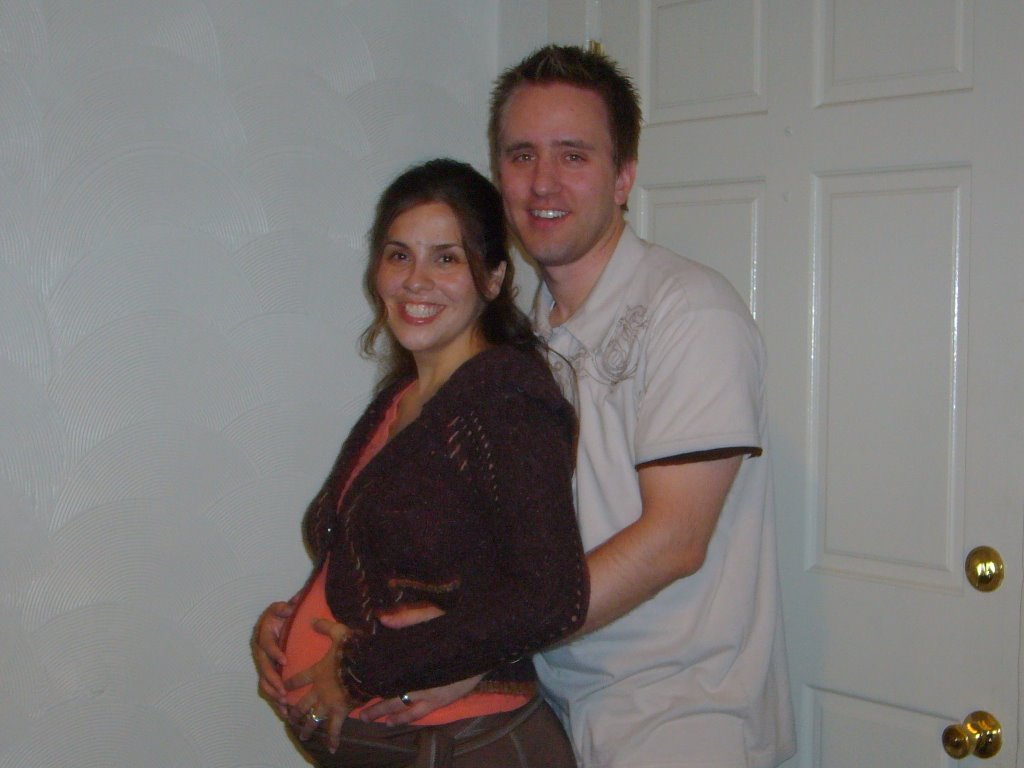
Here is a picture of my beautiful wife one month ago when she was 5 1/2 months pregnant. Who is that stud with her? 🙂 


And here she is again last weekend. 


I really need to find out who that guy is. He needs to keep his hands off my wife!

And by the way…that’s Martinelli’s!

Check out TIME magazine’s interactive webpage breaking America down by population, religion, etc. They have some amazing illustrative graphs and charts. Very good info.


NT scholar Andreas Kostenberger argues that this is the wrong question to ask:

Would you say that you have a good marriage? Some of you might answer this question in the affirmative (hopefully your spouse would, too); others might acknowledge that there remains a lot of work to do before you would claim to have a good marriage.

But why aspire to having a good marriage in any case? Just to be able to feel good about having a good marriage? And what does it mean to have a “good marriage”? When is a marriage a good marriage? If it is better than most other marriages of the people we know?

I submit to you that “Do you have a good marriage?” is the wrong question to ask. A better question to ask would be, “Does your marriage glorify God?” Is yours a God-glorifying, God-honoring marriage?

Rather than viewing having a good marriage as an end in itself, or using a human, relative standard of comparing our marriages with those of others or with some ideal set up by some popular current book on the subject, the goal of a God-glorifying marriage grounds the relationship with our spouse where it ought to be grounded: in the eternal, sovereign plan of God.

What, then, is a God-glorifying marriage, according to Scripture? Among other things, it means this:

(1) Both spouses are growing in Christ (“in all things grow up into him who is the head, that is, Christ,” Eph. 4:15)—not just the husband (husbands have a God-given responsibility to nurture their wives spiritually, Eph. 5:25–28) or just the wife (a sad reality in many marriages where the husband is spiritually passive).

(2) Both spouses exhibit fruit, both physically (children) and spiritually (they are engaged in Christian service, individually and jointly). For a couple to be fruitful and multiply is at the very heart of God’s purpose in creation (Gen. 1:26–28), and we should not sinfully put self above having and bringing up children in the nurture and admonition of the Lord (or consider adoption if a couple cannot have children).

(3) The marriage is between Spirit-filled disciples of Christ (Eph. 5:18) who are committed to his Lordship and authority over all things. He is the center of God’s plan, not them, or even their marriage (Eph. 1:10). A truly God-honoring marriage does not (ultimately) focus on the family; it focuses on God in Christ.

In a marriage like this, the husband and wife are too busy growing in Christ and serving him in tandem, and with their family, than to ask, “Do we have a good marriage?” A good marriage they have, but not because having a good marriage is ultimately their aspiration, but because anything we do in life that seeks to bring honor and glory to God (including how we conduct our marriage) will result in blessing. May God be increasingly glorified in our marriages, for his greater glory and for our good.

Well said!

In a recent debate with the Planned Parenthood of CA, pro-life apologist Scott Klusendorf spoke of the legal absurdities involving abortion in CA. I thought they were worth sharing. He said (reproduced by Scott in note form on his blog):


In California, public tax-dollars are used for what we’re all told is a totally “private” choice.

At the same time, minor children can’t smoke or drink soda pop at school, but they can be driven by school officials to get an abortion without their parent’s knowledge or consent. In short, PP believes your kids can’t be trusted to eat right but they can be trusted to abort without you knowing a thing about it.

Meanwhile, the state of California spends millions on television ads warning pregnant women not to harm their unborn offspring with cigarette smoke–an admirable goal indeed–but then turns right around and spends even more money paying for poor women to destroy the very unborn humans the ads were designed to save.

Indeed, in a majority of states, a woman may not harm her unborn offspring with alcohol or drug abuse, but she may kill it with legalized abortion. If that’s not crazy enough, imagine this scenario: A woman is driving to the abortion clinic when her car is accidentally broadsided by the same man who is scheduled to perform her abortion a few minutes later. Because of the accident, the fetus dies. Guess what the abortionist is charged with in a majority of states? You got it: homicide. Yet if the woman makes it to the clinic, that same abortionist can kill her offspring at any point in the pregnancy with no penalty at all.

Bottom line: In America today, unborn humans have a right to life if and only if their mothers want them.