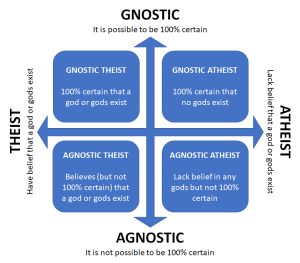
 It’s been common in the last couple of decades for atheists to attempt to redefine atheism as a “lack of belief in God” as opposed to “a belief that God does not exist.” I’ve examined the errors of this endeavor before (here, here, and here).
From time-to-time, you’ll also see atheists getting even more creative with their labels. One that has interested me is the label “agnostic atheist.” This so-called position takes the redefinition of atheism as its starting point, and then adds to it the uncertainty that is implied by “agnostic.” An agnostic atheist, then, is someone who lacks a belief in God but does not know for sure whether God exists or not.*
 It’s not uncommon to hear some people characterize atheism as a religion. Is it? It depends, in part, on how one defines religion. That’s a tricky subject that does not have widespread agreement. Be that as it may, I think most people would say atheism can’t be categorized as a religion because religions worship deities, and atheism explicitly denies the existence of any deity. However, that’s not accurate. Most forms of Buddhism could be categorized as atheist or agnostic. There is no worship of any deity, and yet Buddhism is properly categorized as a religion.
 When Christians offer arguments for the existence of God based on the beginning of the universe or the objective nature of morality, some atheists will respond by asking, “Why can’t we just say we don’t know what caused the universe or what the objective source of morality is?” How might a thoughtful Christian respond?
 When it comes to evangelism, some of the hardest people to work with are those who are apathetic toward spiritual things. They simply don’t care whether God exists. This is often a conversation stopper. If you want to press on a bit more, however, there are some tactics for doing so. I’ve offered some thoughts on this in the past (
 Have you ever tried striking up a conversation with someone about the existence of God only to find that they have no interest in the question? Trying to continue the conversation is like trying to talk to a two year old about quantum mechanics. Strategically, you must find a way to get the unbeliever to see that the question of God’s existence is relevant to his/her life. I think the most effective approach is to appeal to common existential questions that every human wonders about. This could include:








 Thinking to Believe