Cosmological Argument


Here is my most concise summary of the contingency argument for God’s existence: Things that don’t have to exist, but do, can only be explained by something that does have to exist.

Here is a version that is more fleshed out:

Things that did not have to exist, but do exist (contingent beings), require an explanation for why they exist, and that explanation must be found in some external cause. If everything that exists had an external cause, however, then there would have to be an infinite number of beings and an infinite regress of causes, and ultimately there would be no explanation for why anything that exists, exists. To explain why things that did not have to exist do exist, there must be at least one being that must exist and cannot not exist. This necessary being has being in Himself, and gives being to all other contingent beings.
(more…)

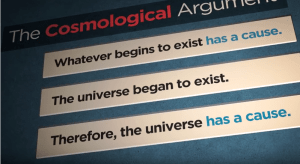
Here is a very concise version of the Kalam Cosmological Argument:

Things that begin to exist require an external cause. The universe began to exist, so it requires an external cause. As the cause of all physical reality, the first cause cannot itself be part of physical reality, but must be immaterial, non-spatial, eternal, powerful, and personal, which is a basic description of the theistic God.

Here is another way of presenting the gist of the argument without the technical-sounding language:

(more…)

Now that I have concluded my podcast discussion of six major arguments for God’s existence, I’m going to post short summations of each argument. Today’s summation is for the argument from the impossibility of nothingness:

If there was ever a time when nothing existed, there would still be nothing because nothing has no potential to become something. Something exists, however, so we know that something must have always existed. The universe is not that something since it originated at the Big Bang, so the eternal “something” must transcend the universe. The eternal something must be immaterial, spaceless, personal, and eternal, which is the basic description of a theistic God.

Here is another, more conversational way of putting it:

(more…)

The fourth argument I offer for God’s existence in my “Does God Exist?” podcast series is the Contingency Argument.

The contingency argument for God’s existence is a cosmological argument, but unlike the kalam argument, it does not require a temporally finite universe. The contingency argument holds that even an eternal universe requires a cause, and that cause is God.

(more…)

The third argument I offer for God’s existence in my “Does God Exist?” podcast series is the Kalam Cosmological Argument. This is my favorite argument for God’s existence.

The argument reasons to God based on the temporal finitude of the universe. The essence of the argument is that temporally finite things require a cause for their existence. Since the universe began to exist in the finite past, it also requires a cause. An examination of the properties required of such a cause match the properties of the theistic God.

(more…)

If there was ever a time when nothing existed then there would be nothing still, because nothing has no potential to become something. Out of nothing, nothing comes. And yet there is something, so we know there has never been a time when nothing existed. Something has always existed. What is that something?

Could the universe be eternal? No, as evidenced by the thermodynamic properties of the universe. The energy in the universe is finite and increasing toward entropy. If the universe were infinitely old, we would have reached a state of entropy an infinite time ago. And yet we have not reached a state of entropy, therefore the universe is not infinitely old. It began to exist a finite time ago.

(more…)

When Christians offer arguments for the existence of God based on the beginning of the universe or the objective nature of morality, some atheists will respond by asking, “Why can’t we just say we don’t know what caused the universe or what the objective source of morality is?” How might a thoughtful Christian respond?
I would suggest that you turn the question around. Ask them, “Why can’t we just admit that God best explains the origin of the universe and the objective nature of morality?” The atheist wants to plead ignorance, but we are not ignorant on these matters. It’s not as if we don’t know what the options are. We do. And it’s not as if the evidence is equal for all options. We have solid scientific, philosophical, and logical evidence that points to God as the cause of the universe and ground of morality. In other words, we have knowledge, not ignorance. So why not just say we don’t know? It’s because that would be a false statement. We do know. The evidence clearly favors the theistic hypothesis.

(more…)

eternityA simple reflection tells us that something must be eternal.  After all, if you start with nothing, you’ll always end up with nothing.  But we ended up with something, which means we must have started with something.  Put another way, since something exists now something must have always existed.  There could never be a time when absolutely nothing existed.  Something must be eternal, but what is that something?
There are good scientific and philosophical reasons to conclude that physical reality has not always existed, so physical reality can’t be the eternal something.  Since things which begin to exist must be caused to exist by something else, physical reality had to be caused by something else, and perhaps the cause of the physical world is the eternal something we are looking for.  How would we know?

(more…)

Atheists claim that nature is all that exists. If nature made us, then what made nature?  After all, the scientific evidence tells us physical reality had a beginning.  Things which begin to exist need a cause, so nature needs a cause.  That cause must be supernatural (beyond nature) by definition.  God is what made nature.

But if God made nature, what made God?  Nothing.  Unlike nature, God is eternal.  Things that are eternal never begin to exist, so they do not need a cause.  How do we know God is eternal?  Time is a feature of the physical world, so it began to exist when nature began to exist.  That which brings time into existence cannot itself be temporal, but must be eternal.  God is eternal.  Nature is not.  That’s why nature needs a cause but God does not.

William Lane Craig’s ministry, Reasonable Faith, has released another excellent video illustrating a major argument for God’s existence.  This time it’s the argument from contingency.  Of the four released thus far (kalam, moral, cosmic fine-tuning), this is probably the most difficult to follow, but it also has the best graphics.  Take a look:

Brute Facts Yellow Garbage CanCaleb Clanton wrote an article in the most recent volume of Philosophia Christi in defense of the cosmological argument.[1] More precisely, he argued for the principle of sufficient reason that undergirds the argument, and against the existence of brute facts which undercuts the argument. Here is a brief summary of his argument.

A contingent being is one whose existence is derived from a source outside of itself.  Everything we see around us is a contingent being: trees, rocks, planets, stars, and even the universe itself.  How did the set of all contingent beings originate?  While the vast majority of all contingent beings can be explained by appealing to a prior contingent being, this cannot go on ad infinitum because an infinite regress is logically absurd.  It follows, then, that the entire set of contingent beings cannot be explained by appealing to another contingent being because as the set of all contingent beings, there can’t be any additional contingent beings.  Only a being that is not contingent can explain the set.  A being that is not contingent is a necessary being, meaning it does not derive its existence from anything outside of itself, but has existence in and of itself by a necessity of its own nature.  Theists identify this necessary being as God. (more…)

Here’s another great video from William Lane Craig, this time on the fine-tuning of the universe for the existence of life (see also his video on the kalam cosmological argument).

https://www.youtube.com/watch?v=UpIiIaC4kRA

Multiverse 2Scientists differ among themselves regarding the scientific status of multiverse theories. Some, such as George Ellis, don’t think multiverse theories are testable, and hence not scientific. Others, think multiverse models are (or could be) testable, and hence are scientific. Many Christian apologists have sided with Ellis et al and rejected the multiverse as a valid scientific theory on the grounds that it is not testable. Some, including myself, have argued that multiverse theories are not based on the evidence, but ad hoc theories invented by cosmologists to get around the theistic implications of fine-tuning in physics.

Jeff Zweerink from Reasons to Believe wrote a short article addressing the scientific nature of and foundation for multiverse theories. He argues that some multiverse models do make testable predictions (even if we are currently unable to test those predictions empirically), and thus should be “included in the realm of scientific investigation (while stopping short of taking a firm position on the demarcation question –whether multiverse theories qualify as scientific).

More importantly, he argues that at least some multiverse theories are based on other scientific findings, and not invented whole-cloth for the purpose of answering the fine-tuning problem:

(more…)

A or BIf you’re looking for an explanation of the universe, which is a collection of contingent beings, there are only two possibilities: 1) The explanation is found in a necessary being that transcends the universe; 2) There is no explanation.

Regarding 1), every physical entity is a contingent being. The “universe” simply refers to the whole collection of physical, contingent beings.  One cannot explain why the universe exists by appealing to another physical, contingent being because there can be no physical, contingent beings outside of the collection of all physical, contingent beings.  “But,” one might say, “perhaps it could be explained by a prior non-physical, contingent being.  Perhaps, but even if so, as a contingent being, that non-physical, contingent entity would also require an explanation for its existence.  To avoid an infinite regress, one must ultimately arrive at a necessary being that transcends the universe, and explains why the universe exists.

(more…)

Not scienceMany believe science has disproven God.  This is not possible, even in principle.[1]  The truth of the matter is that advances in science are providing more reasons to believe in God, not less.  While scientific discoveries cannot prove God’s existence, they can be used to support premises in arguments that have theistic conclusions/implications. For example, science has discovered that the universe began to exist.  Anything that begins to exist requires an external cause.  Since the universe encompasses all physical reality, the cause of the universe must transcend physical reality.  It cannot be a prior physical event or some natural law, because there was nothing physical prior to the first physical event, and natural laws only come into being once the natural world comes into being.  Whatever caused the universe to come into being must be transcendent, powerful, immaterial, spaceless, eternal, and personal, which is an apt description of God.

(more…)

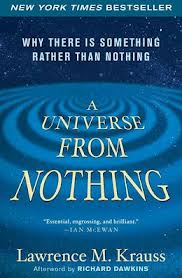
Universe from NothingLast year theoretical physicist and atheist, Lawrence Krauss, wrote a book titled A Universe from Nothing: Why There is Something Rather than Nothing. As the title suggests, Krauss wrote the book to answer the age-old question of why there is something rather than nothing. The book was heralded by many atheists as the definitive answer to theists who claim God is necessary to explain the existence of physical reality. Indeed, in the afterward Richard Dawkins claimed that Krauss’ book devastates theistic arguments based on cosmology just as Darwin’s On the Origin of Species devastated theistic arguments based on design in biology. Other reviewers, however – including scientists, philosophers, and theologians – beg to differ. Having read the book myself (not just once, but two times now), I can see why they were less than impressed with Krauss’ argument.

While my overall assessment of Krauss’ argument is not positive, truth be told, most of the book was quite enjoyable and informative.  That’s because the first 2/3 of the book is a lesson on the historical development of modern cosmology.  Krauss doesn’t make his case for why there is something rather than nothing until the last four chapters.  Unfortunately, that’s where the book falls apart.

(more…)

Reasonable Faith, the ministry of William Lane Craig, recently released a great new visual depiction of the kalam cosmological argument.


You can view the video above (from YouTube), as well as on the kalam cosmological argument page at Reasonable Faith.

ContingencyWhile in discussion with A. C. Grayling on the March 25 edition of the Unbelievable radio program, Peter S. Williams provided a nice, concise presentation of the cosmological argument from contingency:

Once you’ve made the distinction between things that have causes and…things that don’t have causes, if something exists it either is the kind of thing that requires something outside of itself to exist, or it’s not.  If it’s not possible for there to be an infinite regress of things that do require causes outside of themselves, and it is true that something exists which does require a cause outside itself [the universe, and everything in it]…,there can’t be an infinite regress of such causes, and therefore you have to have a termination of that regress.  [God is the best explanation for the termination of that regress.]

For those of you for whom this to be a bit too concise, let me flesh it out a bit.

(more…)

Bear in mirrorAll of the scientific evidence points to the temporal finitude of physical reality, even if physical reality extends beyond the Big Bang (see here and here).  And yet, scientists continue to come up with mathematical models that permit an eternal universe/multiverse, and atheists continue to promote them because both are under the mistaken presumption that if physical reality is eternal, then there is no need for a transcendent cause, and thus no need for God.  As David Berlinski observed, “While an eternal universe makes it meaningless to ask when the universe began to exist, since its existence is not necessary it is still meaningful to ask why it exists.”  The fact that physical reality is contingent means that even if the universe/multiverse is eternal, it still needs a cause.

(more…)

ImperviousThe kalam cosmological argument (KCA) for God’s existence can be stated as follows:

(1) Anything that begins to exist requires a cause
(2) The universe began to exist
(3) Thus, the universe requires a cause

Additional logical inferences allow us to identify this cause as God.  Whatever caused space, time, and matter to begin to exist cannot itself be spatial, temporal, or material.  Furthermore, whatever caused our orderly, life-permitting universe to come into being a finite time ago must be immensely powerful, intelligent, conscious, and hence personal.  These are apt descriptions of a being theists have long identified as God.

Both premises have been challenged on scientific grounds.  Premise one is typically challenged on the basis of quantum mechanics, while premise two is challenged by new cosmological models that seek to restore an eternal universe.  I am going to argue that neither premise of the argument can be undermined by scientific evidence, and thus the argument itself is impervious to scientific refutation.  Only philosophical arguments are capable of undermining either premise of the argument.

(more…)

Next Page »