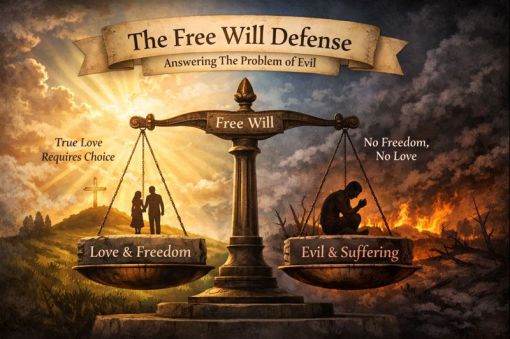
 My series on the problem of evil will be wrapping up soon. The last two episodes (186-187) have focused on a potential flaw in the Free Will Defense (FWD), which is arguably one of the best answers to the problem of evil.
The FWD assumes that it is logically impossible to create free creatures who are incapable of freely choosing evil and hate. However, God is free and God can love, but cannot choose evil. So not only is it logically possible to be both free unable to sin, but it’s a metaphysical reality as well. It would seem, then, that God could have created us both free and unable to sin. If so, the FWD fails.
I examined the objection in great detail, and ultimately conclude that the objection fails and the FWD succeeds. If you want to know why, listen to the two episodes wherever you get podcasts or at https://thinkingtobelieve.buzzsprout.com. Or, you can read the paper I wrote on the topic below.
If none of that interests you, perhaps you will be interested by my discussion of why Christians will not sin in heaven – also covered in the podcast and paper. What does that have to do with the FWD? Listen to episode 187 or read the paper to find out.
A Potential Flaw in the Free Will Defense
 Scientists could never discover that free will does not exist via scientific experimentation, because in a deterministic world, the result of the experiment would, itself, be determined. The conclusion that there is no such thing as free will would not be arrived at because the scientists chose to set up the experiment in a good way and reasoned correctly about the data they received. Instead, physics would determine both the study’s structure and conclusions. As such, the conclusion cannot be trusted.
 If God is omniscient, then He knows everything that will happen in the future – including everything you will ever do. God knows that on x date at time t1 you will stub your toe, and on q date at time t5 you will forget where you placed your keys. God has had such knowledge from eternity past. Since God cannot be mistaken, it is certain that you will stub your toe on x date at time t1 and forget your keys on q date at time t5. How, then, can our “choices” be free? Does God’s knowledge of the future eliminate free will, reducing us to mere actors who simply perform the parts of a cosmic play written for us by God from eternity past? Are we puppets with no control over our own destiny? Is our experience of free choice illusory? Darwinist, Robert Eberle, sums up the problem nicely:
 If God knows every choice we’ll make from eternity past, doesn’t that mean our choices are not free – that God has caused us to do what we do? No. Knowledge is not a cause. Knowing what someone will choose to do in advance of their actually doing it does not cause them to do it. While it’s true that if God knows X will happen, X will most certainly happen, but it’s not God’s knowledge of X that makes X happen. It’s our choice to do X. God merely knows what we will freely choose in advance. While God’s knowledge is chronologically prior to our acts, our acts are logically prior to God’s knowledge. If we would have chosen A rather than B on October 12, 2006, God would have known A rather than B. The reason He knew B would happen from eternity past is because He knew we would freely choose B from eternity past. God’s foreknowledge does not determine our choices, but is informed by our choices. In other words, God’s foreknowledge is not the cause of our actions; our actions are the cause of God’s foreknowledge.





 Thinking to Believe