Intelligent Design


A new Gallup poll reveals Americans’ views on creation:

  • 40% believe humans were specially created by God 10,000 years ago (creationism)
  • 38% believe God used evolutionary processes to create human beings from less advanced life forms over millions of years (theistic evolution)
  • 16% believe humans developed from less advanced life forms over millions of years without any aid from a divine being (naturalism/atheism).

The number of theistic evolutionists has not changed much over the past 30 years, while there has been a slight decrease in the number of creationists (down from 47% in 1993) and a slight increase in the number of naturalists/atheists (up 7% from 1982).

One of the weaknesses of this poll is that it presents these three views as if they were the only options.  Jay Richards wrote a short post elaborating on this point.  Nevertheless, it does illustrate an important point: the vast majority of Americans do not buy into the materialistic paradigm of Darwinism.

In a previous post I argued that chance cannot account for the origin of the first living cell because the odds are too low to have any reasonable chance of being met.  The odds of a single, functional protein forming by chance is 1 in 10164.  That’s 1 chance in 100 trillion trillion trillion trillion trillion trillion trillion trillion trillion trillion trillion trillion trillion trillion trillion trillion trillion trillion trillion trillion trillion trillion trillion trillion trillion trillion trillion.  But the simplest life form would need at least 250 different proteins, lowering the odds to 1 in 1041,000!

While the numbers appear staggering, many people will immediately raise the “lottery objection”: Just as the odds of winning the lottery are low, and yet people win the lottery all the time, so too the odds of forming life by chance may be low, but that doesn’t mean it is impossible.  While I understand the analogy, are the lottery and the OOL truly analogous?  No, not by a long shot.

(more…)

(Note: Read Part 3a of the series before reading this post)

Viruses

The HIV virus mutates at the evolutionary speed limit: 10,000 times faster than most cells such as malaria.[1] And its genome is rather small (nine genes versus thousands in malaria).[2] Its small size combined with a short generation time (1-2 days) and super-rapid mutation rate means every single nucleotide in the HIV genome will mutate 10,000 to 100,000 times in every infected person every day, and thus double point mutations like the one that made malaria immune to Chloroquine occur in every person every day.  In fact, over the past several decades every possible combination of up to six point mutations has occurred in HIV somewhere in the world.  If RM drives macroevolutionary changes in organisms, then we should observe macroevolution in the HIV virus since it experiences more mutations than any other organism.  But we don’t.  HIV has run the gamut of all possible mutations to its genome, and yet with all of these mutations in a population of 100 billion billion viruses, no new cellular machinery has been created, and no new organism has developed! HIV is still HIV.  It still contains the same number of proteins, still performs the same function, and still binds to its host the same way it always has.  There have been no significant biochemical changes.  Even gene duplication has failed to produce any new biological information.

(more…)

(Read parts 1 and 2 in the series)

The heart of the neo-Darwinian synthesis is that evolution advances via the process of natural selection working on random mutations (RM+NS).  Natural selection itself lacks any creative power – it only eliminates what doesn’t work.  Eliminating the unfit, however, does nothing to “explain the origin of the fit”![1]  The burden falls entirely on RM to create the biological novelties required by Darwinism to drive evolution forward.  It must be asked, then, whether RM has the creative power required by Darwin’s theory.  Can RM produce the new biological information necessary to drive evolution forward and explain the diversification of all life?  What exactly can RM do? 

When the neo-Darwinian synthesis was set forth some 70 years ago, answers to these questions could not be ascertained.  While the theory was plausible on a conceptual level, there was no real way of testing its biological plausibility.  Over the last 30 years, however, we have been able to observe both the power and limits of RM+NS at the biological level.  What have we discovered?  We discovered that while RM can produce variability within an organism, it is not capable of producing the kind of changes required by Darwin’s theory.  RM is severely limited in what it can accomplish. 

(more…)

(For part 1 in the series, click here)

If macroevolution occurs, it must do so at the biochemical level.  Additional genetic information is needed to build the new proteins and biological systems required for large-scale changes.  Where does the new biological information come from?  Mutations?  No.  Point mutations such as inserting, inverting, or substituting nucleotides in existing genes cannot increase the information content of DNA even if they occur in protein-coding regions, and even if the mutations are beneficial to the organism.  At best they can only replace existing information/function with different information/function, so that the overall information content is merely preserved.[1]  For macroevolution to occur a net increase of information is required, not just a change in existing information.

The origination of new genetic information requires new proteins, which requires hundreds of additional nucleotides arranged in a highly specified order.  How likely is it that chance processes can get the job done?  Next to none.  The chances of producing a functional amino acid sequence of a mere 150 nucleotide bases (which would sequence one of the smallest proteins) is 1:10167.[2]  To put this number in perspective, consider that there have only been 10139 events in the entire universe since the Big Bang.[3]  So even if every event in the history of the universe was devoted to building a single functional protein, the number of sequences produced thus far would be less than 1 out of a trillion trillion of the total number of events needed to give it even a 50% chance of success!  Any reasonable person must conclude, then, that it is beyond the reach of chance to create even the smallest amount of new biological information in an organism.  Add to this the fact that many new proteins are needed to produce new biological systems, and the scenario becomes all the more fantastical.  If chance alone cannot produce the gene for even one protein—yet alone many—macroevolution becomes impossible.

(more…)

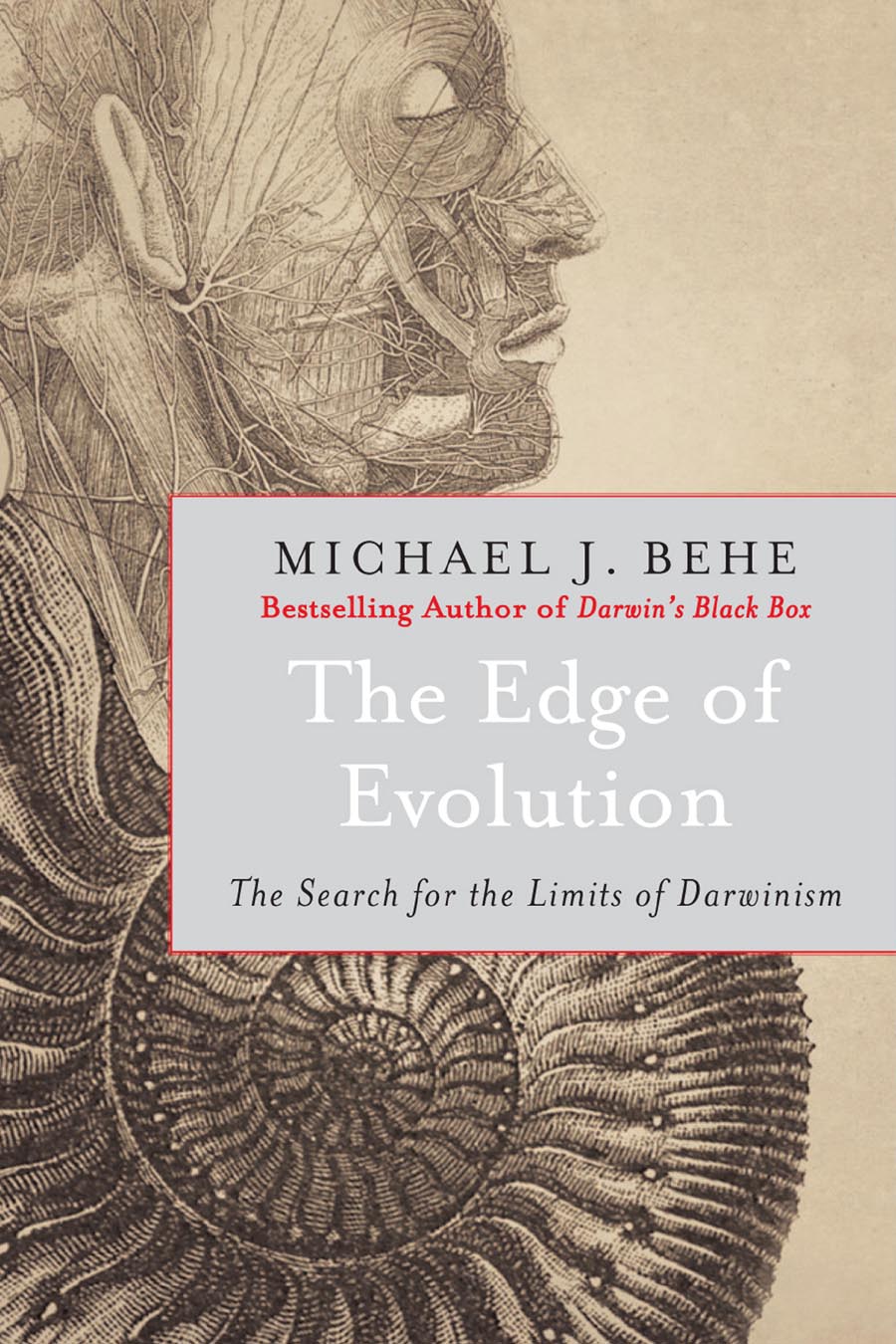
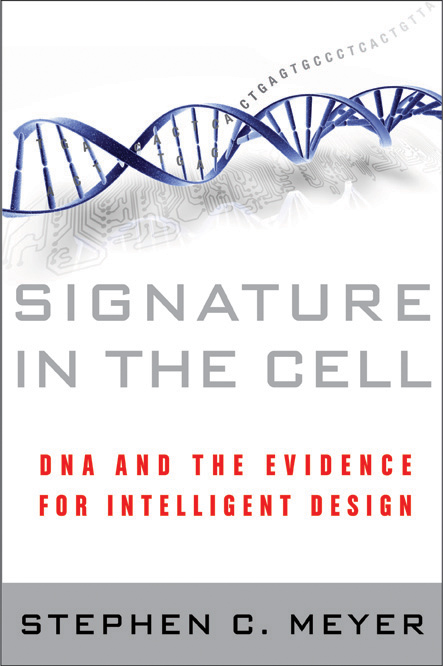
Several months ago I blogged my way through Stephen Meyer’s Signature in the Cell, summarizing his devastating critique of naturalistic origin-of-life theories and powerful argument for the intelligent design of the first life (parts 1, 2, 3, 4, 5, 6, 7a, 7b).  But what about the proliferation of life?  Can a fully naturalistic theory like neo-Darwinian evolution account for the proliferation and variety of life once it began?  To answer this question I am going to summarize Michael Behe’s key argument against a Darwinian account of evolution in The Edge of Evolution (paperback only $6 through Amazon right now, regular $15). 

What Needs to be Explained

To properly evaluate Darwin’s theory of the evolution of life, we must clarify what is meant by “evolution.”  Evolution can refer merely to small biological changes within a species over time.  Called “microevolution,” or the special theory of evolution, this definition of evolution is relatively uncontroversial and has been confirmed empirically (e.g. drug resistance in bacteria, changes in the size of finch beaks, etc.).  Evolution can also refer to large-scale biological changes[1] that, over time, transform one species into another into another ad infinitum.  This kind of evolution is called macroevolution, or the general theory of evolution.  Darwin’s theory entails this latter definition, and thus proof for his theory requires evidence that there are no natural limits to the amount of variation an organism can experience.

(more…)

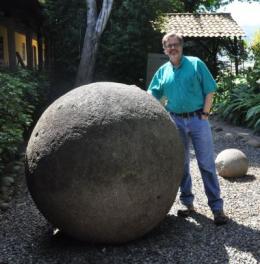
John Hoopes of the University of Kansas claims to be a scientist, but it is clear to me that he’s no scientist!  How do I know?  Because he has concluded that some intelligent designer is responsible for producing 300 of these:

Surely he knows scientists cannot appeal to intelligent agency as an explanation for natural phenomenon.  Besides, there is no need to appeal to any intelligent designer.  Natural processes such as wind and water erosion are fully capable of producing the spherical shape of these rocks over billions of years.  To appeal to some “rock-designer-of-the-gaps” is to give up on science.  Currently, we may not know the exact pathway by which nature produced these spherical rocks, but given the past successes of science, I am sure we will discover it in the near future.  

If these rocks are the products of some intelligent designer as Hoopes claims, then let him tell us who designed the designer.  Guess what, he doesn’t know!  Clearly, then, these rocks can’t be designed.

In the human genome, only 1.5% of our 3.2 billion base pairs of DNA codes for proteins.  For a long time evolutionists though the other 98.5% was “junk” DNA: DNA that was preserved in the genome, but had no function; the byproduct of billions of years of aimless mutations.  Over the past seven years, however, scientists keep discovering more and more function for this “junk.”  For example, it has been discovered that ~90% of our genome codes for RNA products.  Junk DNA also:

  1. Regulates DNA replication
  2. Regulates transcription
  3. Marks sites for programmed rearrangement of genetic material
  4. Influences the proper folding and maintenance of chromosomes
  5. Controls the interactions of chromosomes with the nuclear membrane
  6. Controls RNA processing, editing, and splicing
  7. Modulates translation
  8. Regulates embryological development
  9. Repairs DNA
  10. Aids in fighting disease[1]

And now, biologist Richard Sternberg has brought my attention to a very interesting find related to a specific kind of “junk” DNA called Short Interspersed Nuclear Elements (SINEs).  SINEs are mobile DNA that can insert themselves in various locations within the genome, and are thought to be functionless according to evolutionary biologists.

The rat and mouse are said to have diverged from one another 22 million years ago.  Since that time, each is thought to have experienced hundreds of thousands—if not millions—of SINE insertion events.  Given so many insertion events, we would expect for the location of SINEs to be very different in the mouse genome than in the rate genome (in the same way we would expect a moon that split in two 22 million years ago to evidence a very different asteroid bombardment pattern on its surface).  And yet, when we compare the location of SINEs in the mouse and rate genomes this is what we find:

They are virtually identical!  This is not what we would expect from a degenerative process like mutations and random insertions over millions of years.  We would expect radical divergence, not a nearly-identical pattern.  While the SINE sequences are not the same in the rat and mouse genomes, the placement of the SINEs is nearly identical (and they are concentrated in gene-coding regions of the genome).

How do we account for this pattern?  Can it be the result of a degenerative process?  Surely not.  Patterns are indicative of design, and hence purpose.  Contrary to the expectations of evolutionary biologists, SINEs do have purpose and function, even if we are only beginning to understand them.


[1]Stephen C. Meyer, Signature in the Cell: DNA and the Evidence for Intelligent Design (New York: Harper One, 2009), 404-7.

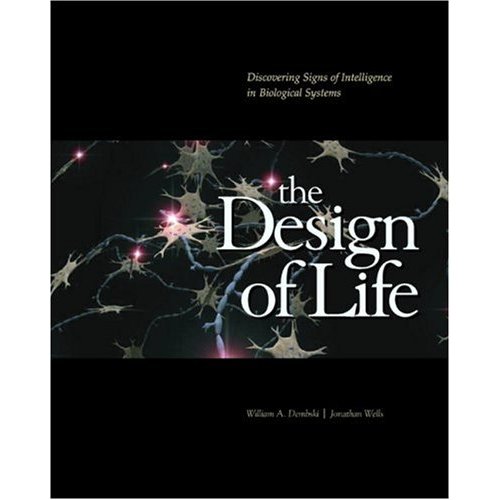
I just finished reading The Design of Life: Discovering Signs of Intelligence in Biological Systems by William Dembski and Jonathan Wells (which someone was kind enough to buy me from my Ministry Resource List!).  This book was a joy to read!  I’ve been following the Intelligent Design vs. Darwinism debate for a long time, and I’ve read a good number of books and countless articles and blog entries on the subject.  So to be honest, I wasn’t expecting to glean a lot of additional insight from The Design of Life.  But I couldn’t have been more wrong.  My highlighter got a real workout with this book!

The Design of Life is essentially a textbook on Intelligent Design.  Most of the resources I have read on the topic deal with a specific subject: Darwin’s Black Box looks at irreducible complexity as an indication of intelligence; Edge of Evolution examines the power of random mutation and natural selection to produce novel biological changes; Signature in the Cell examines the origin-of-life, etc.  The Design of Life, however, is a more comprehensive look at ID.  But don’t think “comprehensive” means it only provides a little information about a lot of topics.  Not at all!  I was quite impressed with the balance achieved between comprehensiveness and detail.

The book covers human origins, genetics and macroevolution, the fossil record, the origin of species, homology, irreducible complexity, specified complexity, and the origin of life.  It even has a supplementary CD containing additional details on the topics covered in the book.  If you are looking for a good, well-rounded book to learn more about the claims of and evidence for ID, I would highly recommend this book!

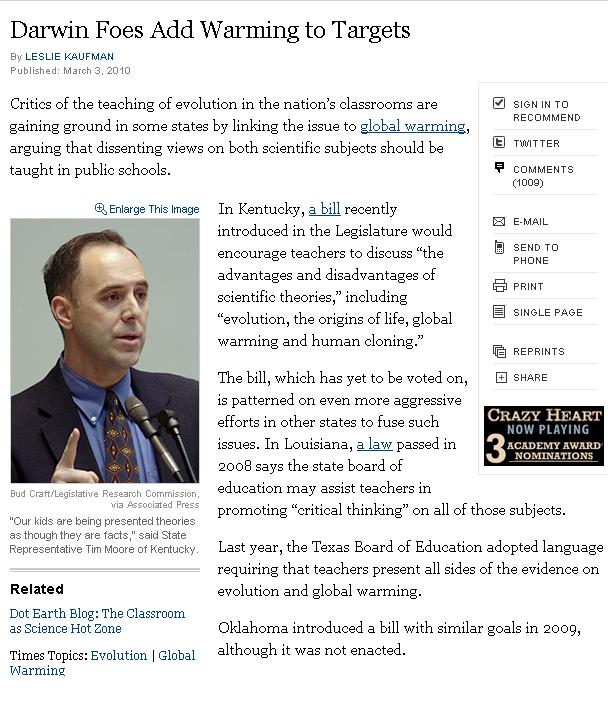
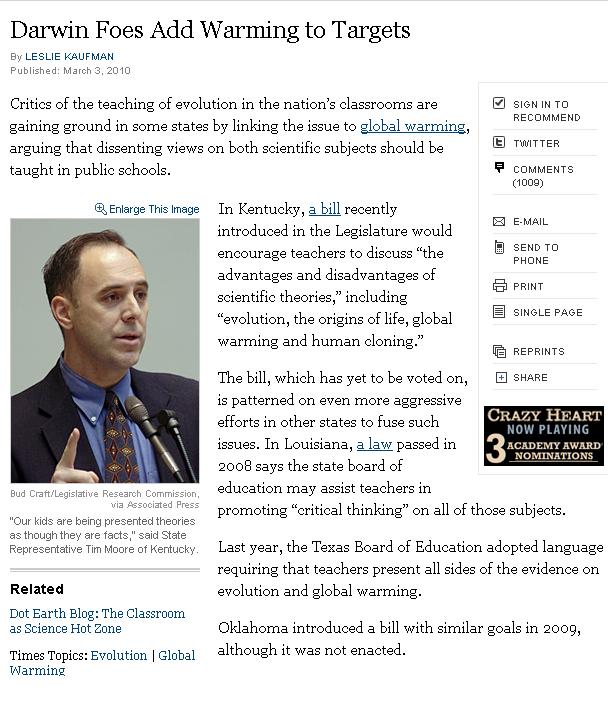
The New York Times ran an article on their front page about academic freedom bills that are popping up in some states.  Some of these bills require that teachers teach both the evidence for and against certain scientific issues (such as evolution and global warming), or at least allow them to do so.  Who could oppose such bills?  You would be surprised!  But I digress.  

The one part of the article that irked me the most was their mischaracterization of intelligent design as “the proposition that life is so complex that it must be the design of an intelligent being.”  What’s so disturbing about it is that they have been told by the Discovery Institute (the main ID think-tank) in the past that this definition is inaccurate, and yet they refuse to characterize ID accurately time and time again. 

I decided to comment on the article to set the record straight and vent my frustrations with the NYT.  Seeing that my comment, if it is approved, will be #1010-ish, I doubt it will get read by too many people, including those at the NYT (but I feel much better now).  Here is what I wrote:

(more…)

Here is part 2 of my summary of Stephen Meyer’s response to key objections raised against ID (read part 1).  This post will conclude my review/summary of Meyer’s book.  Links to the entire series: 1, 2, 3, 4, 5, 6, 7a.

“ID is an argument from ignorance”

Not at all.  Arguments from ignorance take the following form: X cannot explain Y, therefore Z does.  That is not the form of ID arguments.  ID does not reason that if all naturalistic proposals fail, ID must be true by default.  There are positive evidences provided for inferring design in the universe/biology.  We are not ignorant of how information arises.  We also know from experience that only intelligent designers are capable of producing information (functional, complex specificity).  So postulating an intelligent designer to explain the biological information we observe in the cell is based on what we know, not what we don’t.  If chance and necessity are not adequate to explain the origin of biological information, whereas intelligent agency is, then it is reasonable to view intelligence is the best explanation.[1]

“Doesn’t this presuppose a naturalistic explanation won’t be found in the future?” 

No, it doesn’t.  It merely recognizes that our conclusions should be based on the evidence available to us in the present, not hypothetical evidence that might possibly be discovered in the future.  We must reason to the best explanation given our current data, and our current data gives us no reason to believe life originated by purely naturalistic means, but good reason to believe its origin is due to the activity of a designing intelligence. 

(more…)

Stephen Meyer addressed key objections to the design hypothesis that I will share.  Each objection could be answered in much greater detail, but I’ll stick to offering short summaries of key points.  Because of the abundance of objections, I’ll break part 7 into 2 posts. 

“Intelligent Design is not science” 

This is a red herring in that it shifts the focus away from the merits of ID arguments to the classification of those arguments; from the truth of ID to the definition of science.  As Thomas Nagel has written, “A purely semantic classification of a hypothesis or its denial as belonging or not to science is of limited interest to someone who wants to know whether the hypothesis is true or false.”[1]  Arguably, ID is science and should be classified as such.  But even if all parties agreed that it should not be considered science, that does not mean it is false.  It could be that ID is true, but not a scientific truth.  

This objection also presumes that there is a standard definition of science.  There isn’t.  This is called the “demarcation problem.”  Philosophers of science do not agree that there is a single, standard definition of science.  According to Larry Laudan, “There is no demarcation line between science and non-science, or between science and pseudoscience, which would win assent from a majority of philosophers.”[2]  Similarly, philosopher Martin Eger wrote, “Demarcation arguments have collapsed.  Philosophers of science don’t hold them anymore.  They may still enjoy acceptance in the popular world, but that’s a different world.”[3] 

(more…)

It’s been a month, but I haven’t forgotten!  For new readers, this is part 6 in my series of posts summarizing Stephen Meyer’s argument for design from his new book, Signature in the Cell.  Past posts can be found here: Parts 1, 2, 3, 4, and 5.

In the last two installments we demonstrated that the OOL cannot be explained by either chance or necessity.  Now we’ll turn our attention to the possibility that the OOL can be explained by a combination of both chance and necessity.  While many models could be examined—and were examined by Meyer—I will only examine the RNA-first, a.k.a. the RNA World hypothesis, since this is the prevailing OOL model today.

The cell presents OOL researchers with a chicken-and-the-egg paradox of which came first: the DNA that makes proteins, or the proteins necessary for replicating DNA?  The paradox was insoluble, so another solution was required.  If neither DNA nor proteins could arise first, what did?

Carl Woese, Francis Crick, and Leslie Orgel proposed an RNA-first model in the late 1960s, followed by Walter Gilbert (Harvard biophysicists) who developed it in the 1980s and gave it its common name.[1]  This model proposes that the first cell consisted of a much simpler self-replicating, self-catalyzing RNA (RNA is similar to DNA, but it is a single strand rather than a double helix, and the nucleotide, thymine, is replaced by uracil).[2]  This model was largely fueled by the discovery of Thomas Cech and Sidney Altman in the early 1980s that sometimes RNA can catalyze chemical reactions like an enzyme does, and thus RNA could serve the dual purpose of information storage (like DNA) and enzymatic functions (like proteins).  “The paradox of the chicken and the egg was thus resolved by the hypothesis that the chicken was the egg.”[3]

(more…)

As a result of the failure of the chance hypothesis to explain the origin of life, Dean Kenyon and Gary Steinman proposed a novel solution: life’s origin is due to physical necessity, not chance (Biochemical Predestination, 1969).  Like many others in their day, Kenyon and Steinman were proponents of the protein-first model, maintaining that the first life was based on proteins rather than DNA (DNA came later).  They got around the utterly implausible odds of forming proteins by chance by just denying that chance was involved at all.  They suggested that law-like processes direct the self-organization of chemicals, making the origin of life inevitable, not some lucky happenstance.  Just like electrostatic forces draw sodium and chloride together in ordered patterns to form crystals, some (yet-to-be-discovered) natural law organized biochemicals to form the biological information that makes life possible. 

As evidence for their view that proteins could self-organize to form the basis of life, they pointed to the fact that amino acids bond with certain other amino acids better than others, making certain sequences more likely than others.  This explained how the biological information necessary for life could arise without DNA, RNA, and the transcription-translation process.[1]

Eventually, however, Kenyon came to question his model.  He recognized that even if it could explain the origin of biological information, he still needed to explain the origin of DNA as well as how protein synthesis transformed itself from a self-organizing and self-originating process to one that depended entirely on DNA transcription and translation.  He dismissed the possibility that proteins constructed DNA because the information flow in modern cells is unidirectional, and it’s in the complete opposite direction: information flows from DNA to proteins, not vice-versa.  Because DNA wholly determines the amino acid sequencing of proteins, and because there is no evidence suggesting or reason to think this order was ever different in the past he eventually abandoned the protein-first model.  DNA must have come first.  But based on his knowledge of its chemical properties, he doubted that DNA possessed the same sort of self-organizational properties he thought were present in amino acids.  He was forced by the evidence to abandon his proposal that life originated by necessity.

(more…)

Now that we have established what needs explaining (biological information, and the origin and functional interrelatedness of cellular machinery) and the scientific method biologists employ to formulate an explanation, we turn our attention to the four possible explanations for life’s origin: (1) Chance; (2) Necessity; (3) Combination of chance and necessity; (4) Intelligent agency.  In this post I will examine the possibility that life can be explained in terms of chance processes alone.

Just like the lottery, specific probabilities can be assessed for the origin of life by chance.  To illustrate how probabilities are assessed, consider a combination lock.  What are the chances of someone guessing the correct combination of a lock with four dials containing 10 digits each?  To determine the chances one must multiply the number of digits on each dial (10) by itself four times (because there are four dials): 10 x 10 x 10 x 10 = 10,000 different possible combinations.  The chances of guessing the correct combination, then, are 1 in 10,000.  If one more dial was added to the lock, it would decrease the odds by a factor of 10 (1 in 100,000).  If one is given only one try, the odds of getting the right combination are overwhelmingly against him—so much so that if the lock opened everyone would suspect that his selection was not random, but based on intelligence, or that the lock was faulty.  The odds of cracking the combination increase, however, as one increases the number of attempts.  If one is given 100,000 tries to guess the combination, then the odds are that he will eventually guess the combination through random attempts alone (if each try took 10 seconds, you could crack the 4-dial code in about 28 hours, and the 5-dial code in about 11 days).

(more…)

What is the scientific method?  Everyone who sat through grade-school science class knows the answer to this question, right?: observation, hypothesis, prediction, experimentation, conclusion.  What may surprise you is that there is no such thing as the scientific method.  There are a variety of methods scientists employ in their quest to discover the truth about the natural world, none of which can be claimed as the scientific method.  Which method a scientist uses depends on what he is studying.  While the method outlined above works well for “experimental scientists” such as chemists and physicists, it doesn’t apply to “historical scientists” (i.e. those who study the past) such as paleontologists, astronomers, and evolutionary biologists.  Those in the historical sciences require a different method.

Historical scientists study the past, not the present.  They seek to discover the historical causes responsible for past events – effects that we observe in the present.  For such a task the scientific method outlined above simply won’t work.  It’s the wrong tool.  To explain the structure of the fossil record, for example, one cannot engage in experimentation.  Likewise, there is no need for making predictions since predictions address the future, not the past.  How, then, do historical scientists test their theories?

(more…)

In my first post on Meyer’s Signature in the Cell I discussed information theory, and claimed that the cell exhibits functional information—information that cannot be explained in terms of the physical machinery of the cell.  In this post I want to provide some background on the machinery and inner workings of the cell to provide evidence for the claim that the cell contains complex specified information (functional information), and explain why biologists have come to recognize that DNA stores and transmits “genetic information,” contains a “genetic blueprint” with “assembly instructions,” and expresses a “digital code.” 

The two most basic components of the cell are DNA and proteins.  DNA is made up of a 4 character chemical alphabet: adenine, thymine, guanine, cytosine (these are called nucleotides).  These nucleotides always appear in complimentary pairs: adenine is paired with thymine, and guanine is paired with cytosine. 

Proteins—the workhorses of the cell—are composed of amino acids.  The cell contains 20 different kinds of amino acids.  To create functional proteins, these amino acids must be sequenced together in a specific order, forming a “chain” of amino acids (proteins come in varying lengths, with shorter proteins consisting of ~100 amino acids, most proteins consisting of several hundred, and some as large as 34,350 [titin]).  While there are a number of ways in which amino acids can be sequenced, the vast majority of combinations are functionless.  They sequence must be specified if the protein is to have function (functionality also requires the protein to be folded into a particular shape).

(more…)

It’s not often that a book on Intelligent Design becomes a best-seller, or is opined (in print) to be one of the best books of the year by a prominent atheist philosopher.  And yet that is true of Stephen Meyer’s book, Signature in the Cell: DNA and the Evidence for Intelligent Design.  I must say it’s one of the best books I have read on the topic of the evidence for intelligent design in biology.  The information was presented in a very logical, systematic order, with each chapter building naturally on the former.  Not only was Meyer’s approach systematic, but he presented difficult concepts in very understandable ways.  Coming in at 561 pages of text, it is not a quick read, but the time spent is well worth it.

Meyer’s thesis is that the origin of life is best explained by an intelligent cause.  He begins his book by telling how the mystery of life’s origin was not recognized in Darwin’s day, but came to be realized in the decades that followed as knowledge of life’s complexity began to emerge.  That mystery has not been solved over the decades, but rather looms larger and larger the more we discover about the internal workings of the cell, and what is required for even the simplest of life. 

(more…)

RusePhilosopher of science, Michael Ruse, recently had a few choice words to say about the New Atheists:

Let me say that I believe the new atheists do the side of science a grave disservice. I will defend to the death the right of them to say what they do – as one who is English-born one of the things I admire most about the USA is the First Amendment. But I think first that these people do a disservice to scholarship. Their treatment of the religious viewpoint is pathetic to the point of non-being. Richard Dawkins in The God Delusion would fail any introductory philosophy or religion course. Proudly he criticizes that whereof he knows nothing. As I have said elsewhere, for the first time in my life, I felt sorry for the ontological argument. If we criticized gene theory with as little knowledge as Dawkins has of religion and philosophy, he would be rightly indignant. (He was just this when, thirty years ago, Mary Midgeley went after the selfish gene concept without the slightest knowledge of genetics.) Conversely, I am indignant at the poor quality of the argumentation in Dawkins, Dennett, Hitchens, and all of the others in that group. … I have written elsewhere that The God Delusion makes me ashamed to be an atheist. Let me say that again. Let me say also that I am proud to be the focus of the invective of the new atheists. They are a bloody disaster and I want to be on the front line of those who say so.

(more…)

Stop Watch AntiqueOn February 25, 2009, Hugh Ross and Fuzale Rana from Reasons to Believe debated Michael Shermer (of Skeptic magazine fame) on the question of the scientific testability of divine creation.  Gary Whittenberger wrote an article on the debate for eSkeptic, a weekly email report produced by Skeptic magazine.  According to Whittenberger, “Ross asserted that God caused the beginning of time at the moment of the Big Bang.  As other Creationists often do, Ross seems to ignore the fact that an act of a person causing something is itself an event in time, and so he backs himself into the corner of contradiction by implying there was time before the beginning of time. Of course this makes no sense, but Ross is unfazed; he simply imagines that there is a supernatural time and a natural time and supposes that this solves everything.”

While I am familiar with Ross’ work, I do not know enough about his views on time and God’s relationship to it to either defend or critique his position.  Instead, I would like to challenge Whittenberger’s claim that God’s causal act of creation requires a time before time, and thus is nonsensical.  God’s causal act of creation requires no such thing.

God’s causal act of creation constituted the first moment of time (i.e. it was a temporal act), being simultaneous to the effect of the universe coming into being.  God’s causal act could not have been an eternal act, because that would require the universe to be eternal as well.  Let me explain.  A cause cannot exist without its corresponding effect.  Take (more…)

« Previous PageNext Page »