Apologetics


The kalam cosmological argument (KCA) for God’s existence goes as follows:

(1) Anything that begins to exist requires a cause
(2) The universe began to exist
(3) Thus, the universe requires a cause

Additional reasoning leads us to conclude that the cause of the universe is God.  Given that whatever caused space, time, and matter to begin to exist cannot itself be spatial, temporal, or material.  Furthermore, whatever caused our orderly universe to come into being a finite time ago must be immensely powerful, intelligent, conscious, and hence personal.  These are apt descriptions of a being theists have long identified as God.

Some seek to undermine this causal argument for God’s existence by denying the first premise.  They point to quantum mechanics and virtual particles as evidence that there are exceptions to the causal principle.
(more…)

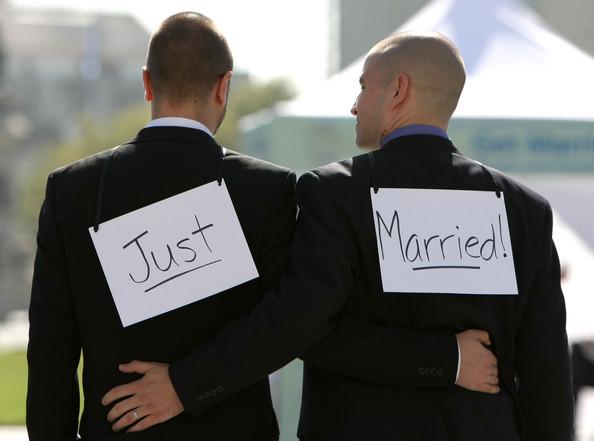
My last post was about the importance of the debate over same-sex marriage.  While many people (including Christians) think it does not matter, I argued that the legalization of same-sex marriage will have a large impact on society as a whole, as well as Christian freedoms.

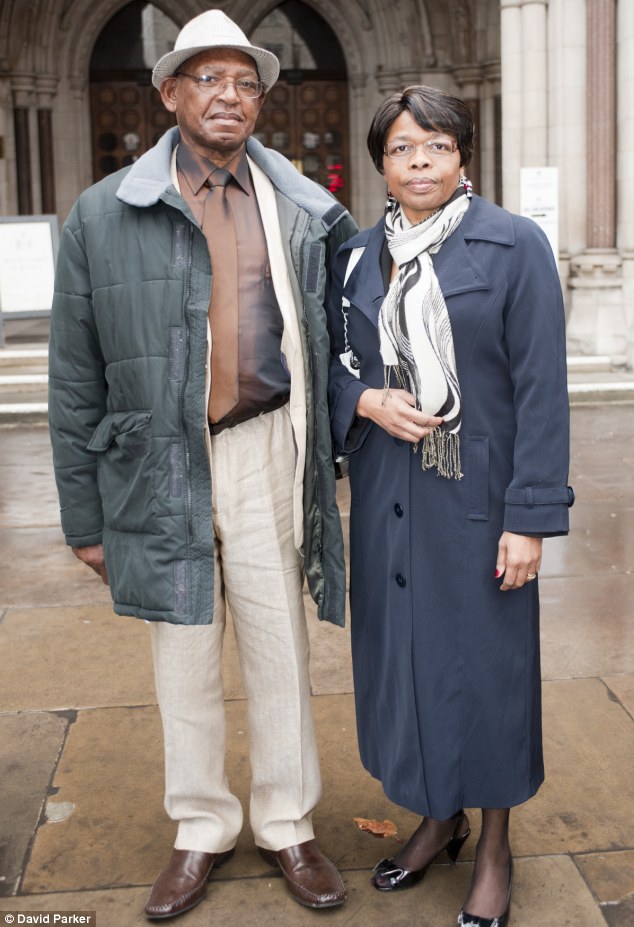
In that vein, I just read this story today coming out of Britain.  A Christian husband and wife, Eunice and Owen Johns, have been denied the right to serve as foster parents due to their convictions against homosexuality.  While they have provided foster care to 15 children in the past, social workers recommended that they not be allowed to care for children in the future because they would not agree to instruct those children that homosexuality was morally acceptable.  According to the article “Lord Justice Munby and Mr Justice Beatson ruled that laws protecting people from discrimination because of their sexual orientation ‘should take precedence’ over the right not to be discriminated against on religious grounds.”

(more…)

When it comes to controversial subjects, it’s not often that those of one persuasion will cede the objections offered by those of a contrary persuasion.  The cogency of some objections is so strong, however, that those of one persuasion will cede the merits of their opponents’ objection even though they do not cede the merit of their opponents’ position.  I have found this to be the case with the debate over same-sex marriage.  Many opponents of same-sex marriage cede some of their opponents’ objections to prohibiting the legal recognition of same-sex partnerships as “marriage.”  While several come to mind, the one I want to discuss is what I call the irrelevancy objection: recognizing same-sex relationships as “marriage” will not affect your marriage or society-at-large, so why make a big deal about it?

Is the debate over same-sex marriage irrelevant?  What do we stand to gain or lose in this cultural/moral/political battle?  What would the fallout be if same-sex marriage becomes the law of the land?  I think we would feel the effects in two main areas: (more…)

That’s a name I never thought I would mention on this blog!  No, I’m not a fan.  I’m male and 35 years old, so I’m out of his target audience by 20 years and one gender!  But I was pleased to read this morning that in his interview with Rolling Stone magazine Bieber came out candidly in favor of the pro-life position.  Bieber confessed, “I really don’t believe in abortion. It’s like killing a baby?”  When asked about cases in which rape was involved Bieber was a little less sure of himself, but still came out on the pro-life side: “Um. Well, I think that’s really sad, but everything happens for a reason. ‘I don’t know how that would be a reason. I guess I haven’t been in that position, so I wouldn’t be able to judge that.”

It’s nice to hear a mega-star (especially a young one) voice his support for the pro-life side.  While I do not look to a 16 year old pop star for sound moral advice, there are millions of teenage girls who will bank on his every word.  I hope they hear about this interview and are influenced by his thinking in a good way.  

HT: Jivin Jehoshaphat

Homosex advocates often try to argue their case theologically.  One of the most popular arguments is based on the love of God “If God is love,” they ask, “why would He deny me the opportunity to love and be loved?”  While this is emotionally compelling, it is not theologically or logically compelling.  Three points should be made in response.  First, even if we find it difficult to reconcile God’s desire for us to give and receive love with God’s prohibition against homosex, the fact remains that He has specifically and clearly prohibited us from engaging in homosex.

Secondly, why think homosex is truly loving?  If homosex results in physical, emotional, and spiritual degradation, then engaging in homosex is anything but loving.

(more…)

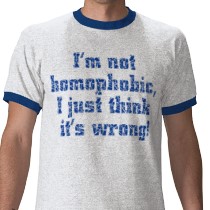
In the cultural battle between those who oppose and those who approve of homosexual behavior, homosex advocates often describe their ideological opponents as “homophobic” and label them as “homophobes.”  In addition to the fallacious nature of such an argument (commits the ad hominem fallacy), the charge itself is false.  A phobia is an irrational fear of something.  Those who suffer from arachnophobia have an irrational fear of spiders.  Those who suffer from claustrophobia have an irrational fear of small spaces.  Would it be accurate, however, to describe those who disapprove of homosex as having an irrational fear of homosex or homosexual persons?

In all my years of trafficking among people who oppose homosex, I have yet to meet a single individual who is genuinely fearful of homosex and/or homosexual persons.  While such individuals may exist, surely their numbers are exceedingly small, and thus they should not be used to characterize opponents of homosex generally.  It is not fear, but a sense of moral disapproval and/or personal revulsion to the act of homosex that drives most anti-homosex proponents.  This is the same basis on which most homosexuals would oppose incest and pedophilia.  In the same way that their opposition to these sexual practices should not be labeled incestophobic and pedophiliophobic, those who oppose homosex on moral or personal grounds should not be labeled homophobic.  It is a misuse of language.

(more…)

Christians are often accused of being judgmental by non-Christians—and sometimes, even by fellow-Christians.  Indeed, it’s not uncommon to even hear non-Christians quote Jesus’ words in Matthew 7:1 against Christians: “Judge not, lest you be judged.” (even if they’ve never read a page from the Bible in their life!)  I am persuaded that both the church and the culture at large have failed to understand the Biblical teaching on judgmentalism.  Before I explain, let’s look at a few more Biblical passages often cited in support of non-judgmentalism:

1 Cor 4:3-5 But with me it is a very small thing that I should be judged by you or by any human court. In fact, I do not even judge myself. 4 For I am not aware of anything against myself, but I am not thereby acquitted. It is the Lord who judges me. 5 Therefore do not pronounce judgment before the time, before the Lord comes, who will bring to light the things now hidden in darkness and will disclose the purposes of the heart. Then each one will receive his commendation from God. (ESV)

1 Cor 5:12-13 For what have I to do with judging outsiders? Is it not those inside the church whom you are to judge? 13 God judges those outside. “Purge the evil person from among you.” (ESV) [talking about executing punishment]

James 4:11-12 Do not speak evil against one another, brothers. The one who speaks against a brother or judges his brother, speaks evil against the law and judges the law. But if you judge the law, you are not a doer of the law but a judge. 12 There is only one lawgiver and judge, he who is able to save and to destroy. But who are you to judge your neighbor? (ESV)

(more…)

In today’s society everyone seems to be hyper-sensitive to judgmentalism.  The minute you tell someone you disagree with something they are doing, you are accused of being judgmental.  Of course, it always escapes their notice that they are judging you for being judgmental, so they are guilty of both judgmentalism and hypocrisy!  But the problem runs deeper than mere self-contradiction.

As the term is commonly used today, judgmentalism is thought to be limited to expressions of moral disapproval of X, or attempts to correct some person P for doing X.  In reality, judgment involves both moral disapproval and moral approval.  Judgment requires that we distinguish what is right/good from what is wrong/evil.  Judgments are involved when you say X is good, as well as when you say X is bad.  Indeed, the only way to say some X is good is if you know what bad is, and know X is not that.  The only way to avoid making judgments is to make no moral distinctions whatsoever.  No sane person can do this, nor is this a worthy goal.  Moral judgments are indispensable to a healthy society.

(more…)

As someone who supports Intelligent Design theory, I have often been puzzled by the many Catholic thinkers who do not.  The scientific basis for ID is strong, and ID is just as friendly to their theism as it is friendly to mine, so why do so many Catholic scholars reject ID, or at least have such strong reservations against it?  A recent essay by Edward Feser in Philosophia Christi[1] has enlightened me regarding the main source of contention between Catholic theology and ID theory, and it boils down to Aristotle, Thomas Aquinas, and final causation.

Feser explains that Thomists (those who follow the theological system of Thomas Aquinas, who followed the philosophy of Aristotle) believe teleology inheres within all substances (final cause) and is evident to rational minds, whereas ID theorists believe teleology must be imposed on substances from an external source (no final cause), and can only be detected empirically through various probability assessments (not evident).

(more…)

I was doing some research on William Lane Craig’s website the other day when I stumbled on an interesting objection to the kalam cosmological argument (KCA) I had not heard before.  I thought it was interesting, so I’m passing it along.  It requires a brief set-up.

According to Aristotle there are four types of causes:

1.      Material cause (that of which something is made)
2.      Formal cause (a thing’s essence, form, or pattern)
3.      Efficient cause (the thing that produces the change)
4.      Final cause (the purpose for which something is caused)

Consider a marble statue.  The block of marble from which it was formed is the material cause, the precise shape of the statue is the formal cause, the sculptor is the efficient cause, and beauty is the final cause.

The two causes we are most familiar with are material and efficient causes.  Point to anything in the universe and we can tell you what it is made of, and what caused it to exist.  But what about the universe itself?  The origin of the universe marks the beginning of material stuff, so it cannot have a material cause.  It came into being ex nihilo.  The KCA argues, however, that the universe still needs an efficient cause.  Something outside the universe is needed to cause the universe to come into being because contingent entities don’t just pop into existence uncaused.

(more…)

The Guttmacher Institute (leading authority on abortion statistics) recently released their data for U.S. abortions in 2008.  Not much has changed since 2005.  Here are some of the most important findings[1]:

  • In 2008 there were 6.4 million pregnancies to the 62 million women of reproductive age.  Of those, 19% ended in abortion, 66% ended in live birth, and 15% ended in miscarriage.  That means there were approximately 1.21 million abortions.
  • The abortion rate is 19.6 abortions per 1000 women, up 1% from 2005 (19.4).
  • In 2008, women in their 20s obtained > half of all abortions.
  • 61% of women who obtain abortions are mothers (i.e. they have previously given birth to at least one child).
  • Chemical/medical abortions accounted for 17% of all abortions in 2008 (the rest were surgical).
  • There are 1793 abortion facilities, representing a 3% decline from 2005.
  • States with the most abortions: CA (214,190), NY (153,110), FL (94,360), TX (84,610), IL (54,920).
  • States with the fewest abortions: WY (90), SD (850), ND (1400), VT (1510), AK (1700), ID (1800).
  • States with the highest abortion rates: DE (40), NY (37.6), NJ (31.3), DC (29.9), MD (29), CA (27.6), FL (27.2), NV (25.9), CT (24.6), RI (22.9).
  • States with the lowest abortion rates: WY (0.9), MS (4.6), KY (5.1), SD (5.6), ID (6), WV (6.6), UT (6.7).
  • 24% of CA pregnancies resulted in abortion (representing 17.7% of all U.S. abortions) and 61% in live birth (15% miscarriage).

[1]Rachel K. Jones and Kathryn Kooistra of the Guttmacher Institute, “Abortion Incidence and Access to Services In the United States, 2008,” Perspectives on Sexual and Reproductive Health, Volume 43, Number 1; March 2011; pp. 41-50.  Available from http://www.guttmacher.org/pubs/journals/4304111.pdf; Internet; accessed 10 January 2011.

Some of you have probably heard the news that in 2009, 41% of all non-miscarried pregnancies in New York City ended in abortion (87,273 abortions, 26,774 births, 11,620 miscarriages.).  For every 1000 babies born, 688 are aborted.

This is staggering in itself, but when you break it down by race it gets worse.  Among white women, 21.4% of pregnancies ended in abortion (9,853); among Asians, 22.7% (5,212); among Hispanics, 41.3% (28,364); among blacks, 60% (40,798).  So for every 2 black babies born in NYC, 3 are aborted.  While this is a wake-up call for all communities, a special plea needs to go out to the black community to wake up to these statistics.  By killing more of your children than you allow to be born, you have become your own worst enemy.  As one commentator wrote in response to what’s going on in NYC, “The Ku Klux Klan and the Aryan Nation are giving ‘fist bumps’ all around.”  Let it not be said.

A new website, The Ehrman Project, has launched.  It’s dedicated to evaluating and responding to Bart Ehrman’s claims.  It examines each of his three best-selling books: Misquoting Jesus, God’s Problem, Jesus Interrupted.  There are eight video responses to each book, each one covering a different topic.  There are also links to related books and articles. 

Participating scholars include Ben Witherington, Darrel Bock, D.A. Carson, Daniel Wallace, Alvin Plantinga, et al.  One of the coolest features of the site is that you can pose a question on the blog, and it will be answered by one of the scholars!  So if you have any difficult questions related to the issues Ehrman raises, now is the time to ask them.

HT: Ben Witherington

I often hear both non-theists and theists alike say it is impossible to disprove God’s existence because it is impossible to disprove a universal negative.  This conception, though popular, is mistaken.

While a universal negative cannot be proven empirically, it can be proven logically.  If something is logically contradictory, or incoherent, we can be sure it does not exist.  For example, I can prove there are no square circles.  I cannot, and need not do so empirically, but I can do so logically.  To prove that God does not exist, then, does not require omniscience so long as one can demonstrate that there is something in the very concept of God that is rationally incoherent.  Of course, that is difficult for atheists to do because there doesn’t seem to be anything about the idea of a divine, transcendent being that is internally incoherent or self-contradictory.  Nevertheless, if they could find one, they could disprove God’s existence.

The Pew Research Center released a major social trends report in November 2010 on the topic of marriage and family titled “The Decline of Marriage And Rise of New Families” (you may have heard about the cover article on this report featured in Time magazine).  They attempted to evaluate how Americans’ views of marriage have changed over the last 50 years.[1] Some of their findings merely confirmed what most see as common knowledge, but some of their findings were quite surprising.

It took me a number of lunch breaks to read through the report, but it was well worth the time spent seeing how it is chalked full of valuable social statistics.  While I would encourage you to read the full report, here are some of the most significant findings (organized by subject):

(more…)

I was listening to a podcast by Jim Wallace from PleaseConvinceMe.com the other day on my way to work.  He was talking about atheists’ stock objection to the cosmological arguments[1]: “Well, then, who caused God?”

Wallace pointed out that the question itself is meaningless.  He illustrates his point by asking, What sound does silence make?  Silence is soundless, of course, so it makes no sense to ask what kind of sound it makes.  Likewise, the question, Who created God? is a meaningless question because by definition God is an eternal, uncreated being.  To ask, Who caused God?, then, is to ask, Who caused the Uncreated Being to exist? which is meaningless.

For additional information on responding to the “Who made God?” objection, read my post “Inexcusable Ignorance Part II.”


[1]Which argue that the universe needs a cause, and that cause is God.

The reigning philosophy of science is methodological naturalism, which requires that scientists explain all natural phenomena in terms of naturalistic causes.  If a scientist thinks the evidence for some biological or natural entity points to an intelligent cause, the possibility is dismissed as unscientific by definition, and the scientist is charged with employing a “God of the gaps” argument in which God is invoked to plug up gaps in our knowledge.

I’ve always found this line of thinking interesting.  Can you imagine if this principle was applied to the non-biological world?  What caused Stonehenge?  “People made it,” you say.  Oh no!  You have broken the rules of science.  This is a physical entity, and thus it must be explained in terms of naturalistic causes.  “But,” you say, “it has all the elements of design.  The arrangement of parts is both complex and specified.”  But this is just the appearance of design, not real design.  While we may not know the natural process by which the pyramids were created, scientists are working on that.  We cannot give up on science by appealing to some unknown “designers.”  To do so is to employ a people of the gaps argument.

(more…)

translationA couple of months ago we had a guest preacher at our church.  He was a seasoned preacher, and overall, his message was edifying.  There was one point he made, however, that had me shaking my head.  He quoted John 14:2 where Jesus says “in my house are many mansions,” and then went on to explain that in the Greek this literally means “spiritual bodies.”

When we got home my wife asked me what I thought of the message.  I told her I liked it, except for his absurd interpretation of John 14:2.  She asked if I had looked up the Greek to know that this was the case.  I told her no.  She asked how I knew it was absurd, then.  Here is what I said, and what I want to share with you: If someone says the correct translation of a certain word is radically different than the translation appearing in mainstream translations, then you can bet your bottom dollar the person is mistaken. Think about it, what are the chances that hundreds of individuals who dedicated their entire lives to understanding the Biblical languages are going to miss the boat by a mile, but an individual who has no specialized training in Biblical languages is going to get it right simply by looking up a few words in Strong’s Concordance?

(more…)

Opponents of ID often argue against ID on the basis that it is not science.  Of course, the definition of science itself is disputable, and it is often disputed.  This is largely a red herring, however, because it shifts the focus away from the merits of ID arguments to the classification of those arguments.  As Thomas Nagel has written, “A purely semantic classification of a hypothesis or its denial as belonging or not to science is of limited interest to someone who wants to know whether the hypothesis is true or false.”[1]

While I think ID is a scientific conclusion, I do not wish to debate here whether ID properly qualifies as science, or whether it is better classified as religion/philosophy.  The question I want to raise is how scientists would respond if it could be demonstrated that ID is both properly categorized as religion/philosophy and ID is true.  Would scientists cease discussing certain subjects in science class?  Would they stop discussing the origin of life or origin of species?  In my estimation, this is doubtful.  I think most would continue to offer naturalistic explanations for these objects because their definition of science requires them to.  After all, if by definition alone science must provide naturalistic answers for all natural phenomena, then scientists must continue to offer naturalistic explanations for all phenomena—even phenomena  ID would have proven do not have naturalistic explanations.

(more…)

One of the most common objections against Intelligent Design is that if an intelligent agent is causally involved in the natural world, then science is no longer predictable because at any time the agent could intervene and mess with our experiments.  For example, Michael Ruse writes, ““[T]he relationship of the natural and the supernatural are unpredictable … [if] the cause of a natural event is the whim of a deity, the event is neither predictable nor fully understandable.”[1]

I think this objection is misguided.  First, it is based on a faulty understanding of ID.  ID only claims to have discovered evidence of a designer’s activity in the past.  It takes no position on the question of whether the designer is still in existence, whether the designer is presently involved in the cosmos, or whether the designer will be involved in the cosmos in the future.  Those are philosophical and religious questions.

(more…)

« Previous PageNext Page »