 In a previous post I addressed the “lottery” objection to the probabilistic argument against a naturalistic origin of life: “Just as the odds of winning the lottery are low, and yet people win the lottery all the time, so too the odds of forming life by chance may be low, but that doesn’t mean it is impossible.” I argued that unlike a lottery, the probabilistic resources available to form life are so unfathomably low that there is no reason to expect a winner in chance’s game of life. To prove my point, I compared the number of possible events in the whole history of the universe (10139)—the probabilistic resources—to the probability of a 250 gene organism forming by chance (1:1041,000). The odds of life forming by chance came up trillions upon trillions upon trillions of times short, and thus there is no rational basis on which to affirm that life originated by chance. What I didn’t realize then was that I had severely over-estimated the odds.
Apologetics
December 31, 2010
The origin of life is not a lottery II
Posted by Jason Dulle under Apologetics, Evolution, Intelligent Design, Science1 Comment
December 28, 2010
Americans’ Views on Creation
Posted by Jason Dulle under Apologetics, Evolution, Intelligent Design, Science, Statistics[2] Comments
A new Gallup poll reveals Americans’ views on creation:
- 40% believe humans were specially created by God 10,000 years ago (creationism)
- 38% believe God used evolutionary processes to create human beings from less advanced life forms over millions of years (theistic evolution)
- 16% believe humans developed from less advanced life forms over millions of years without any aid from a divine being (naturalism/atheism).
The number of theistic evolutionists has not changed much over the past 30 years, while there has been a slight decrease in the number of creationists (down from 47% in 1993) and a slight increase in the number of naturalists/atheists (up 7% from 1982).
One of the weaknesses of this poll is that it presents these three views as if they were the only options. Jay Richards wrote a short post elaborating on this point. Nevertheless, it does illustrate an important point: the vast majority of Americans do not buy into the materialistic paradigm of Darwinism.
December 14, 2010
Freedom, Life, and Abortion: A Strategic Approach to Persuading Pro-Choicers
Posted by Jason Dulle under Abortion, Apologetics, Bioethics, Tactics[14] Comments
When it comes to the issue of abortion, both opponents and proponents support the freedom of choice and the sanctity of human life. Those on the pro-choice side, however, think a woman’s freedom to choose trumps the life of the unborn. Those on the pro-life side think the sanctity of the life of the unborn trumps a woman’s freedom to choose. How do we break the impasse?
December 9, 2010
December 8, 2010
Unwarranted Skepticism of Premises in Theistic Arguments
Posted by Jason Dulle under Apologetics, Cosmological Argument, Epistemology, Logic, Philosophy, Theistic Arguments, Thinking[18] Comments
 In my experience, most opponents and skeptics of theism reject theistic arguments on less than epistemically justifiable grounds. For example, premise one of the kalam cosmological argument proposes that “everything which begins to exist has a cause” (and concludes that since the universe began to exist, the universe has a cause). Some detractors of the argument will counter that since our only experience with cause and effect is within the spatio-temporal world, we cannot be certain that causation is possible outside the spatio-temporal world. While I think this is a fair point to consider, does it really undermine the premise, and hence the conclusion? It doesn’t seem to me that it does. While it is possible that the principle of cause and effect does not apply beyond the temporal framework of our universe, unless one can demonstrate that non-temporal causality is incoherent/impossible, the mere logically possibility that the principle of causality does not hold outside of the universe does not override the warrant we have for thinking all effects require an antecedent cause (and that contingent things require an external cause).
December 3, 2010
The Gospels: Why Did It Take So Long for the Church to Write About Jesus?
Posted by Jason Dulle under Apologetics, Bible, Historical Jesus, Theology[13] Comments
 Our earliest canonical Gospel, Mark, was probably written sometime in the early or mid50s, approximately 20-25 years after Jesus ascended to heaven. Many have wondered why it took so long for Jesus’ followers to commit His teachings and deeds to writing. The most common answer is that they did not feel the need because they expected the imminent return of Christ. If Jesus was coming back soon, why bother? This answer is not adequate, however. First, it presumes that Jesus’ followers expected His imminent return. This is debatable. More importantly, we know from experience that groups expecting an impending apocalypse are often voluminous writers. Consider the Qumran community in Jesus’ day. They were expecting the imminent Day of the Lord, and yet they produced an abundance of written materials. An even more pertinent example is modern believers who espouse to a pre-tribulation, “at-any-moment” understanding of the return of Christ. Few have hotter print-presses than this group!
Why, then, did they not write sooner? Perhaps they did, but those documents were not preserved. Luke tells us that “many have undertaken [the task] to compile a narrative of the things that have been accomplished among us,” and he utilized at least some of those sources in the production of his own gospel (Luke 1:1-4). Luke’s gospel was probably written in the late 50s or early 60’s. For Luke to be aware of these other writings, they must have been written much earlier, possibly much earlier than Mark’s gospel.
November 18, 2010
Marriage, Same-Sex Marriage, and Fundamental Rights
Posted by Jason Dulle under Apologetics, Same-sex Marriage[4] Comments
 Same-sex marriage advocates—including the courts—often argue that marriage is a fundamental right, and therefore same-sex couples must be granted access to the institution even if that requires changing the definition of marriage itself.[1]
There are three problems with this argument. First, it proves too much. If marriage is a fundamental right, such that the qualifications for and definition of the institution must be revised to accommodate those who want access to the institution but do not qualify based on the traditional definition, then the institution will have to be revised to accommodate more than just same-sex couples. It will need to be revised every time any one wishes to participate in the institution, but does not qualify based on the legal definition in use at the time. Indeed, if the right to marriage is so fundamental that it requires society to change its definition of marriage to match the desires of hopeful participants, then society is left without a principled basis for declining anyone’s request to have their own idea of marriage recognized by the State. The State must change the definition of marriage to match every new request, whether we approve of their concept of marriage or not.
November 3, 2010
Iowa Supreme Court justices Ousted
Posted by Jason Dulle under Apologetics, Politics, Same-sex Marriage[2] Comments
Apparently Iowans didn’t like the idea of their Supreme Court forcing same-sex marriage on the state. In last night’s elections, the voters ousted all three Supreme Court justices who were up for re-election—justices, who in 2009, declared same-sex marriage to be a constitutional right. This is the first time any sitting Iowa Supreme Court justice has not been retained on the bench when put up for re-election. The voters have sent a clear message to the supreme judiciary in their state: interpret the constitution, don’t reinvent it in your own image. Of course, on a practical level this move will do nothing in the immediate future to change the status of same-sex marriage in Iowa.
October 28, 2010
Has 1 in 10 teens had a same-sex partner?
Posted by Jason Dulle under Apologetics, Homosexuality, Statistics[9] Comments
 That’s what AOL News claims based on an article in the journal Pediatrics. Kevin DeYoung smelled something fishy about this surprising statistic, so did a little investigating and found out that the claim is based on a misreading of the journal article. DeYoung writes:
AOL speaks of 1 in 10 teens; the original article concludes 9.3% of sexually active adolescents reported a same-sex partner. There’s a big difference. The survey analyzed data from 17,220 teenagers. Of those, 7,261 (or 42%) reported having had sex. So according this study 58% of teens are not having sex with anyone and 9.3% of those have, had same-sex partners, or 3.9% of the total sample.
October 28, 2010
Causes vs. Explanations
Posted by Jason Dulle under Apologetics, Philosophy, Theistic Arguments[14] Comments
On the way to work this morning I was thinking about the question, “Who made God?” Many people wonder about this question (answer here), but it is a favorite atheist objection to the cosmological argument which posits God as the best explanation for the origin of physical reality (the universe/multiverse). They use this objection in one of two ways. Either they argue, “If the universe needs a cause, then so does God,” or they argue, “If God doesn’t need a cause, then neither does the universe.” Both formulations are faulty, but my intent is not to evaluate the objection here. I bring it up only to highlight that there is a difference between an explanation and a cause. While everything that exists needs an explanation, not everything needs (or has) a cause.
October 27, 2010
More than Religion is Responsible for Opposition to Same-Sex Marriage
Posted by Jason Dulle under Apologetics, Same-sex Marriage, Statistics[2] Comments
Many proponents of same-sex marriage assume that opposition to same-sex marriage comes almost exclusively from religious citizens. A simple math calculation exposes the error of this assumption: religious believers account for approximately 95% of the population, and yet only 48% oppose same-sex marriage (41% favor). Clearly not all opposition to same-sex marriage is coming from religious believers. Who, then, is it coming from?
October 26, 2010
Amazing Pics of 10 Week Fetus In Situ
Posted by Jason Dulle under Abortion, Apologetics, Bioethics[99] Comments
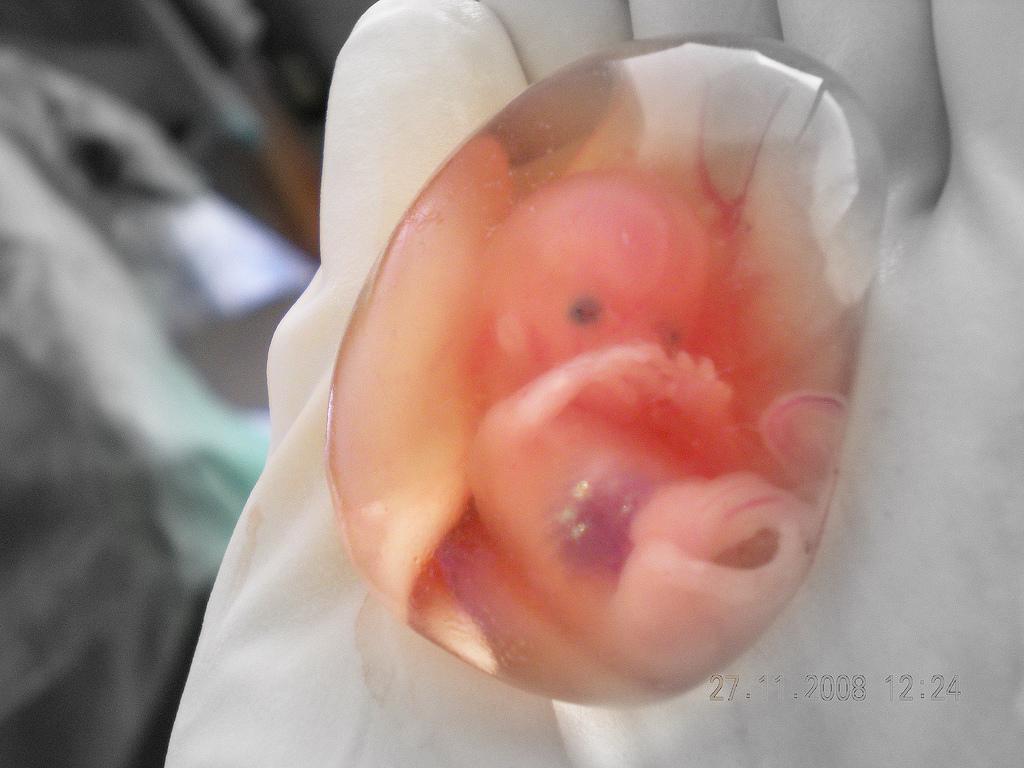
Speaking of the debate on abortion, check out the pictures of a 10 week fetus below, still in its amniotic sac. The mother was diagnosed with carcinoma of the cervix, so her entire uterus had to be removed, including the baby that was developing in it. Simply amazing. And to think that these babies are aborted on a regular basis in the name of choice. Sickening.

October 26, 2010
Scott Klusendorf on Abortion
Posted by Jason Dulle under Abortion, Apologetics, BioethicsLeave a Comment
 Check out Scott Klusendorf’s summary of his debate with PA State Senator Daylin Leach on the issue of abortion. The substance of his rebuttals to pro-choice assertions, as well as his tactics in delivering that substance, is unparalleled. This is why Scott is the best pro-life debater bar-none!
October 25, 2010
It Behooves Naturalists to Jettison Methodological Naturalism in Science
Posted by Jason Dulle under Apologetics, Naturalism, Philosophy, Science[11] Comments
In the latest edition of Philosophia Christi, the Evangelical Philosophical Society’s journal, philosopher Stephen C. Dilley wrote a really nice article titled “Philosophical Naturalism and Methodological Naturalism: Strange Bedfellows?” in which he argued that philosophical naturalists should dispense with the principle of methodological naturalism in science.
For those of you who may be unfamiliar with these terms, philosophical naturalism (PN) is the view that only physical things exist, while methodological naturalism (MN) is the view that we must restrict our method of scientific inquiry to naturalistic processes. MN does not require one to presuppose the truth of PN, but it does require that one investigate the natural world as if God does not exist, or if He does, as if He has no causal relationship to the natural world. According to MN, for an explanation to be considered “scientific” it must be naturalistic; i.e. it must appeal to naturalistic entities and processes.
October 22, 2010
What I’ve Been Reading: The Making of an Atheist, Part II
Posted by Jason Dulle under Apologetics, Atheism, Book Reviews[3] Comments
 For part 1 of this two-part series, go here.
From a psychological perspective, Spiegel argues that broken/absent father relationships can be a contributing factor in a persons’ rejection of God’s existence. He bases this, in part, from Sigmund Freud’s own psychological analysis that belief in God is a projection of one’s desire for a cosmic version of their earthly father, and, in part, from the research of ex-atheist Paul C. Vitz published in Faith of the Fatherless. Spiegel argues that just as a good relationship with one’s father may contribute to belief in a Cosmic Father, likewise, the lack of a relationship, or a bad relationship with one’s father may contribute to one’s disbelief in a Cosmic Father. Spiegel cites David Hume, Arthur Schopenhauer, Friedrich Nietzsche, Bertrand Russell, Jean-Paul Sartre, and Albert Camus as examples of atheists who experienced the death of their father at a young age. He also cites Thomas Hobbes, Voltaire, Ludwig Feuerback, Samuel Butler, Sigmund Freud, H. G. Wells, Madalyn Murray O’Hair, and Albert Ellis as examples of atheist who had a weak or abusive father (abandonment, neglect, bitter relationship). Contrast these individuals to well-known theists who had good relationships with their father: Blaise Pascal, George Berkeley, Joseph Butler, Thomas Reid, Edmund Burke, William Paley, William Wilberforce, Friedrich Schleiermacher, John Henry Newman, Alexis de Tocqueville, Soren Kierkegaard, G. K. Chesterton, Albert Schweitzer, Martin Buber, Karl Barth, Dietrich Bonhoeffer, and Abraham Heschel.
October 21, 2010
What I’ve Been Reading: The Making of an Atheist, Part I
Posted by Jason Dulle under Apologetics, Atheism, Book Reviews[7] Comments
 If you ask the typical atheist why s/he does not believe in God, you are likely to be provided with a list of intellectual objections to theism: the presence of evil is incompatible with a loving and powerful God, science demonstrates the irrelevancy of God, etc. Others will cite a lack of evidence for God’s existence. In either case, atheism is presented as, and perceived to be a purely intellectual conclusion.
James Spiegel begs to differ with this assessment and perception of atheism. In his book, The Making of an Atheist: How Immorality Leads to Unbelief, Spiegel argues that the root cause of atheism is immorality, not intellectual skepticism; disobedience, not evidence. While atheists offer intellectual arguments in support of their position, Spiegel claims that such arguments are not the cause of their unbelief, but mere symptoms of their moral rebellion—the real cause of atheism. As Soren Kierkegaard wrote, “People try to persuade us that the objections against Christianity spring from doubt. The objections against Christianity spring from insubordination, the dislike of obedience, rebellion against all authority. As a result people have hitherto been beating the air in the struggle against objections, because they have fought intellectually with doubt instead of fighting morally with rebellion.”[1]
Spiegel does not expect for atheists to agree with his assessment, but he is not attempting to persuade atheists; he is simply attempting develop a Christian account of atheism. The Biblical data is his starting point, but he offers other supporting data as well. In support of Spiegel’s contention that unbelief is caused by disobedience and moral rebellion, consider the following Scriptures:
October 18, 2010
 Sound like a spoof? It isn’t. An embryo was conceived via in vitro fertilization in 1990, and then frozen at the zygote stage (single cell). After nearly 20 years, the embryo was donated to a woman who was infertile. The embryo was implanted, resulting in a live birth to a 6 lb 15 oz baby boy in May 2010.
How does one “date” a child like this? Technically he is already 20 years old before he ever celebrates his first birthday. Interesting.
October 12, 2010
The Hiddenness of God Objection to Theism, Part II
Posted by Jason Dulle under Apologetics, Atheistic objections, Epistemology, Theistic Arguments[16] Comments
For the previous installment, click here.
So far I have provided what I consider to be reasonable responses to the HoG objection. Now I want to discuss a couple of popular responses I find inadequate for the task. The first is to assert that God has provided enough evidence to convince those who are willing to believe in and submit to a relationship with God, but not so much so as to compel the unwilling. The idea here is that if God were to provide more evidence of His existence, people would be compelled to believe in Him, and thus be robbed of their free will. But what exactly would they be compelled to do? At best, they would be compelled to believe that God exists (a rational obligation); however, such knowledge does not coerce one into a relationship with God. Rational obligations tell us what we ought to believe given the evidence; they do not coerce us into believing or doing anything in particular. Our beliefs and actions continue to be free.
October 11, 2010
The Hiddenness of God Objection to Theism, Part I
Posted by Jason Dulle under Apologetics, Atheistic objections, Epistemology, Theistic Arguments[4] Comments
Given the inadequacy of so many “old” philosophical arguments against God’s existence, atheists are increasingly turning to the “hiddenness of God” (HoG) to argue that God does not exist (or that His existence is highly improbable). The essence of this argument is that God’s existence is not as obvious as it should be. If God existed, we would expect to find more evidence of His existence than we in fact do. Given the inadequacy of the evidence, rational persons should conclude that God (probably) does not exist. Some HoG proponents go so far as to argue that if God existed He would prevent unbelief by making His existence obvious and undeniable. He does not do so, therefore, He does not exist, or if He does exist, the fault of human unbelief is to be laid at His feet.
There are a number of ways to respond to the HoG argument. One could agree with the HoG advocate that God’s existence is not as obvious as we might think it should be, but deny that the conclusion—“God (probably) does not exist”—follows from such an observation. After all, absence of evidence is not evidence of absence. Perhaps there is insufficient evidence on which to conclude that God exists, but God may exist nonetheless. At best, an insufficient amount of evidence for God’s existence should result in agnosticism, not atheism. To conclude that God does not exist one needs positive evidence against His existence, not a mere lack of evidence for it.
October 1, 2010
New and Improved Method for Obtaining iPS cells
Posted by Jason Dulle under Apologetics, Bioethics, Stem Cell ResearchLeave a Comment
A faster, safer, more productive method has been discovered for turning adult stem cells into an embryonic-like state (induced pluripotent stem cells).

 Thinking to Believe
