One of the regular visitors/commentators on this blog made me aware of a video on YouTube titled “You can’t prove God doesn’t exist (lies Christians tell #4), featuring a couple of quotes from yours truly. The video is posted below, followed by my response.
Apologetics
Archived Posts from this Category
December 7, 2009
My Response to YouTube Video Featuring Yours Truly
Posted by Jason Dulle under Apologetics, AtheismLeave a Comment
December 4, 2009
Signature in the Cell, Part 1: Information
Posted by Jason Dulle under Apologetics, Evolution, Intelligent Design, Science[27] Comments
 It’s not often that a book on Intelligent Design becomes a best-seller, or is opined (in print) to be one of the best books of the year by a prominent atheist philosopher. And yet that is true of Stephen Meyer’s book, Signature in the Cell: DNA and the Evidence for Intelligent Design. I must say it’s one of the best books I have read on the topic of the evidence for intelligent design in biology. The information was presented in a very logical, systematic order, with each chapter building naturally on the former. Not only was Meyer’s approach systematic, but he presented difficult concepts in very understandable ways. Coming in at 561 pages of text, it is not a quick read, but the time spent is well worth it.
Meyer’s thesis is that the origin of life is best explained by an intelligent cause. He begins his book by telling how the mystery of life’s origin was not recognized in Darwin’s day, but came to be realized in the decades that followed as knowledge of life’s complexity began to emerge. That mystery has not been solved over the decades, but rather looms larger and larger the more we discover about the internal workings of the cell, and what is required for even the simplest of life.
December 3, 2009
New York Senate Rejects Same-Sex Marriage Bill
Posted by Jason Dulle under Apologetics, Politics, Same-sex Marriage[9] Comments
I must say I am a little shocked at this one given how liberal NY is, but the NY Senate rejected a same-sex marriage (SSM) bill that passed in the NY House. The voted it down by a vote of 38-24.
So as of December 2009 five states allow for SSM: Iowa, Connecticut, Massachusetts, New Hampshire and Vermont. California was once on the list when the CA Supreme Court forced the CA legislature to legalize SSM (of course, SSM was already legal in practice, although not in name), but the CA voters amended their constitution in November 2008 to overturn the Supreme Court’s ruling. Maine was also on the list until last month, when the voters of Maine overturned a congressional law that passed in May of this year legalizing SSM.
The NJ Senate is expected to vote on a SSM bill next week, so we’ll have to wait and see what happens there.
November 19, 2009
The anatomy of a Dialogue with a Typical Atheist
Posted by Jason Dulle under Apologetics, Atheism[50] Comments
See comments #22-31. The atheist, awfrick, is responding to some comments I made regarding positive evidence for the existence of God. This little exchange was so typical of my “dialogues” with atheists. Here’s the anatomy of a dialogue with an atheist:
- Step 1 = Atheist tells theist how stupid they are for believing X
- Step 2 = Theist responds to atheist point-by-point, supplying evidence against the atheist’s assertions (rather than demanding that the atheist actually give evidence for his assertion)
- Step 3 = Atheist tells you to read some article/book that will show why your arguments are wrong, rather than offering any rebuttal of his own. It’s the “I know someone who can beat up your dad” response.
- Step 4 = Theist takes the time to read the article and interact with its claims. Responds to atheist with reasons why the article’s claims are mistaken.
- Step 5 = Atheist ignores everything you said in favor of nitpicking at some irrelevant point. Asks for more evidence.
- Step 6 = Theist provides more evidence
- Step 7 = Atheist acts like you skipped step 6, dismisses everything you say with a hand-wave rather than a rebuttal, and resorts to name calling and putdowns.
- Step 8 = Theist calls atheist on the carpet for what he’s doing. Atheist doesn’t respond.
- Step 9 = Atheist goes looking for easier targets – those who will cower at the mention of his intellectual superiority, have nothing to offer in the way of rebuttal, and do not even think to demand that the atheist offer any evidence for his claims.
Awfrick, if you are reading this, I invite you back to truly engage on the topic you started. All other atheists, if this is not descriptive of you, I am not claiming it is. I appreciate the atheists who have engaged me on this blog in a serious dialogue. I cannot appreciate those who assert the greatness of their intellectual superiority and strength of evidence, but never deliver on it. If you’ve got the goods, show me the money. If not, play at a different table. This blog is for the serious–for those who want to engage in dialogue on serious matters in a serious, sensible way.
November 18, 2009
Review of Bart Ehrman’s Jesus Interrupted
Posted by Jason Dulle under Apologetics, Bible, Bible Difficulties, Historical Jesus, Theology[3] Comments
 I just finished reading a tremendous review of Bart Ehrman’s latest book, Jesus Interrupted, by Michael Kruger. I would highly recommend it. The last paragraph is literary gold in my book. It’s one of those summary paragraphs that I would have loved to have penned myself.
HT: Justin Taylor
November 18, 2009
How Would You Vote in a Roe v Wade”less” World?”
Posted by Jason Dulle under Abortion, Apologetics, Bioethics[2] Comments
I have a question I would like to ask those who claim that they are personally opposed to abortion, but do not think it should be made illegal: “Let us suppose that the Supreme Court had not declared abortion to be a constitutional right, and let us suppose that a proposition was put on your state’s election ballot to legalize abortion in your state, and you have the opportunity to vote on it. Would you vote in favor, or in opposition to it?”
The answer to this question is more telling than the simple affirmation that one thinks abortion should be legal even though they are personally opposed to it, because this question helps reveal why someone holds the position they do. If someone says they would vote in opposition to such a proposition, it reveals that their real concern is not so much that they believe a woman should have the right to abort her unborn child, but rather that they should be able to keep the right once it has been granted to them. Many people are uncomfortable taking away rights that have already been granted, but would vote against granting such rights in the first place. If someone says they would vote in favor of such a law, it reveals that they either have a very idealistic view of liberty (that people’s liberty should be nearly autonomous, even when their liberty involves taking the life of an innocent and defenseless human being), they are relativistic when it comes to moral judgments, or they aren’t truly persuaded of the pro-life position and pro-life logic.
November 17, 2009
Are our Senses Reliable?
Posted by Jason Dulle under Apologetics, Epistemology, Philosophy[5] Comments
A young skeptic once called into Greg Koukl’s radio show, Stand to Reason, and asked why we should believe our senses are reliable. Why shouldn’t we believe we are in some computer program like the Matrix, which has fooled us into believing we are experiencing reality when in fact we are not?
Greg’s answer was ingenious: because we’re alive! Survival in the real world depends on our ability to accurately perceive the real world and maneuver safely within it. If our perception was off even a little, the effects would be disastrous. That’s why people who drive cars while intoxicated often end up in fatal accidents: their ability to accurately perceive the outside world is impaired. The fact that we are still alive demonstrates that our senses allow us to perceive reality in a fairly accurate manner.
But couldn’t it be the case that the outside world we think our senses are accurately perceiving isn’t really the outside world at all (like the Matrix)? Yes it’s possible, but why should I believe that to be the case? Just because it’s possible that we could be mistaken in what we perceive about reality does not mean we are mistaken, or should think we might be mistaken. Possibility and probability are not the same things. We are prima facie justified in trusting our senses that what we perceive to be the real world is the real world, until evidence arises to the contrary that would falsify this properly basic belief.
See J.P. Moreland’s short article entitled “Answering the Skeptic” for further reading.
November 16, 2009
I am reading Antony Flew’s book, There is a God. In an appendix written by Roy Varghese, he relates what appears to be an apocryphal, but nevertheless insightful exchange between a skeptical student and his wise professor. The student asks his teacher, “How can I be sure I even exist,” to which his teacher responded, “Who’s asking?” Classic!
November 11, 2009
Craig vs. Borg on Divine Ineffability
Posted by Jason Dulle under Apologetics, Nature of God, Pluralism, Theology[8] Comments
Marcus Borg, like so many other theological liberals (although I must admit that Borg is so liberal that even a lot of theological liberals would disown him as such), claims God is ineffable. During a recent debate between Borg and William Lane Craig, Craig pointed out that to say God is ineffable is to say that no human concept is applicable to God. But since ineffability is a human concept, it doesn’t apply to God either. This is self-refuting, and thus cannot be true. Great point!
November 6, 2009
How to Identify a Moral Constructivist
Posted by Jason Dulle under Apologetics, Moral Argument, Relativism, Theistic Arguments[2] Comments
 To determine if someone believes morals are merely social constructs ask, “If no humans existed, would objective moral values exist?” If they say “no” then they are moral constructivists. If they say “yes” then they believe morals exist in some objective sense independent of the human mind and human culture.
If they do exist in some objective sense independent of the human mind and human culture, what exactly is their source? God…maybe?!?!
November 4, 2009
Washington Upholds an “Everything-but-the-Name-Marriage” Law
Posted by Jason Dulle under Apologetics, Politics, Same-sex Marriage[32] Comments
I just became aware of another referendum related to same-sex partnerships, this one in Washington State. In May 2009 Washington’s legislature approved a bill that expanded the rights of domestic partners to include all the same rights as married couples, lacking only the name “marriage.” Again, this was put to the voters as a referendum, and the citizens said, “Yes.” The final vote was 51% to 49%.
I find it interesting that those who supported the referendum to expand domestic partnership rights, raised nearly 1.1 million dollars for their efforts. Those who opposed the referendum, however, only raised $60,000. And yet still, the vote was within 2% points.
November 4, 2009
Voters in Maine Reject Same-Sex Marriage
Posted by Jason Dulle under Apologetics, Politics, Same-sex Marriage[3] Comments
Once again, when the question of same-sex marriage is put to the voters, the voters say “No” (the 31st time). Last spring, Maine’s legislature passed a law making same-sex marriage legal in that state. The law was stayed, however, until the people had a chance to vote on it yesterday. And they said no, but not by much (53%).
November 4, 2009
November 4, 2009
Christians are not Objective?: Two Kinds of Objectivity
Posted by Jason Dulle under Apologetics, Epistemology, Thinking1 Comment
It’s common to hear people say Christians are biased, not objective. How can we respond to this charge? J.P. Moreland makes a distinction that I find helpful. He notes that there are two ways to be objective: (1) psychological objectivity: the absence of bias (2) rational objectivity: the ability to tell the difference between good and bad reasons for a belief, whether or not you accept that belief.[1]
Humans are psychologically objective (50/50) only in areas we know nothing, or care nothing about. Once we come to know something about a topic we typically go from being psychologically objective to psychologically biased, even if the degree of our bias is minimal. Such bias is to be expected, and is good. After all, what would be the use of studying out an issue/topic if after having studied it you could not draw a conclusion? We should expect informed people to be psychologically biased.
But does the presence of psychological bias eliminate the possibility of being rationally objective? Are we locked into our own culturally relevant way of viewing the world? Is reason and argumentation useless for the person who is no longer psychologically objective? No. We all know this to be true because we have all had experiences in which we changed our beliefs on an issue because they were challenged by good arguments. It should be clear, then, that our psychological bias (lack of psychological objectivity) does not eliminate our ability to be rationally objective. Postmodernists understand this. That’s why they try to reason with the modernists to change their worldview, while at the same time denying the validity of reason and argumentation!
[1]J.P. Moreland, “Truth, Contemporary Philosophy, and the Postmodern Turn,” a paper presented at the November 2004 Evangelical Theological Society meeting in San Antonio, TX.
November 2, 2009
 If I were a bumper-sticker manufacturer “fear error, not terror” would be my next product.
I was thinking this morning about all the things people tend to fear in this world. People fear local thieves and robbers, rapists and murderers. We fear for our financial future (or present in many cases). We worry about our relationships with other people, and the well-being of our loved ones. We fear terrorist attacks on this nation. But how often is it that we fear error?
I am bothered by the moral evil that runs rampant in our day. I am concerned for personal, relational, and national safety. But there is nothing I fear more than error. I’m not referring to some sort of emotional fear that grips my heart, but an intellectual fear that grips my mind. I am always cognizant of the existence of truth and error, and do my best to maximize true beliefs and minimize false beliefs. Why? Because nothing matters more in this world than the truth. Nothing has greater power than truth, but likewise nothing can be more damaging than belief in that which is false. You may live your whole life untouched by the egregious evils that occur in society, but if you embrace false ideas the consequences will be far worse than any terrorist attack.
October 29, 2009
CIRM is now directing their funds into non-embryonic stem cell research
Posted by Jason Dulle under Apologetics, Bioethics, Stem Cell ResearchLeave a Comment

CIRM is the CA agency that oversees the distribution of 3 billion dollars for stem cell research in CA. The agency was created by constitutional amendment via a ballot initiative in the 2004 election. From its inception, it has directed most of its energies and funds to promoting embryonic stem cell research (ESCR). It seems, however, that they have finally caught on to the fact that ESCR is not the most promising area of stem cell research. Of the $230 million in grants awarded to 14 institutions yesterday, 10 of them were for adult stem cell research (ASCR). Good.
HT: Wesley Smith
October 29, 2009
Darwinian evolution entails more than just the concept of one species changing into another over a long period of time. It involves a fully naturalistic process: natural selection working on random genetic mutations, genetic drift, etc. If Darwin’s theory of evolution is scientifically sound—meaning the naturalistic processes it invokes are fully capable of producing life and all of its many variegates—then adding God to the equation is superfluous. It would be like providing a scientific account of water boiling by saying water will boil at time t1 when X amount of heat is applied to Y amount of water at Z altitude, but then adding that fairies are also involved in the process. If naturalistic processes are adequate to explain why water boils, then not only is there no need for the fairy hypothesis, but there is no room for it. The same is true of Darwin’s theory of evolution. If the theory is scientifically sound, and naturalistic processes can fully account for all of life, then there is no need for, and no room to fit God into the picture. In other words, if Darwin’s theory is scientifically sound, positing a theistic form of evolution is superfluous.
One might say, however, that naturalistic processes are not fully adequate to account for all of life, and this is why one must add God to the equation to make it work. To make such a claim, however, is to admit that the scientific theory itself is not sound on its own. It requires some outside supernatural force to patch it up. Here’s the rub: If Darwin’s theory of evolution is not adequate in itself to explain the data, why should we feel compelled to fit theism into the picture? Let’s face it, the only reason a theist would postulate a theistic form of evolution is if he was convinced that the evidence for evolution was so compelling that intellectual honesty demands that he reconcile the scientific evidence with his theistic belief. But if Darwin’s theory of evolution lacks the evidence necessary to make it a sound scientific fact, what compelling reason is there to reconcile the theory with theism? If Darwin’s theory is not sound in itself, it doesn’t need God to shore it up.
For further reading see my article titled “Theistic Evolution: The Illegitimate Marriage of Theism and Evolution”
October 27, 2009
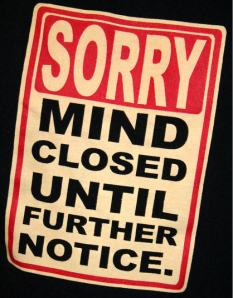 It’s common for those who reject the Christian worldview to accuse Christians of being closed-minded. Often this retort comes on the heels of a Christian’s outspokenness about his/her beliefs. How can you respond when someone tells you you’re being closed-minded, or that you need to be more open-minded?
The first thing you ought to do is ask the person what s/he means by such terms. S/he could mean one of several things, so we should not presume to know the answer. In fact, s/he may not even know exactly what s/he means, and our inquiry may force him/her to think it through for the first time. The truth of the matter is that those who use such terms often sling them blithely at anyone who disagrees with their point of view,[1] never stopping to think about what exactly it is that they mean. And since the accusation is usually effective at silencing their opponents they continue to use it over and over again as the trump card of choice when discussing religion with “right-wing, fundamentalist wackos” such as ourselves. If we can respond thoughtfully to his charge, not only will we rescue ourselves from a distasteful allegation, but we may disarm him/her from using this unfounded charge on other Christians in the future.
While there are several ways people define closed-mindedness, typically it is a label given to anyone who comes to a conclusion on a controversial matter, and believes that conclusion is true to the exclusion of all others. We are told we must be open-, rather than closed-minded, which means we have an intellectual obligation to remain “on the fence” of all divisive issues, never taking a definitive position, and never claiming that one position has more merit than another. There are a few ways to respond to this understanding of open- and closed-mindedness.
October 23, 2009
 It wasn’t many months ago that a fossil named Ida graced the cover of every magazine and was the talk of all the news channels. There was a media blitz over what some called the “fossil that changes everything.” Extravagant claims were made about it being an ancient ancestor to humans, and proving beyond doubt the truth of evolution. Of course, many saw through the hype and exaggerated claims right away. It’s no surprise, then, that upon further study scientists are reporting that the claims were wrong.
October 21, 2009
Arguing from Silence
Posted by Jason Dulle under Apologetics, Logic, Nature of God, Theology[45] Comments
While arguing from silence is a logical fallacy, I think there are times that an argument from silence must be reckoned with. For example, in discussing whether Matthew 28:19 originally read “in the name of the Father, Son, and Holy Spirit” or “in my name,” some Trinitarian scholars argue that the latter is original. “In my name” does not appear in any extant manuscript, so what is there basis? One reason is Justin Martyr’s silence on the passage. In one of Justin’s work he was arguing for “Father, Son, and Holy Spirit” as the appropriate baptismal formula, and yet he never once appealed to Matthew 28:19 for support as we would expect for him to have done if Matthew 28:19 originally read “Father, Son, and Holy Spirit.” Since he did not, it stands to reason that Matthew 28:19 did not read “Father, Son, and Holy Spirit,” in Justin’s day (or at least in the manuscripts he had access to), but rather “in my name.” While this is an argument from silence, it is a strong argument nonetheless.

 Thinking to Believe
