Bible


Barna Research Group reports that the number of American adults who view the Bible as “just…a book of stories and teachings written by men” has increased from 10% in 2011 to 17% in 2013.  That’s a significant increase in just two years.

Read the entire report here.

Dan Wallace reports on the release of a new New Testament.  A band off 19 liberal Christian and Jewish scholars got together for a “council” and decided to add 13 new books (two are prayers, and one is a song) to the New Testament.

Given some of those on this council (Karen King, John Dominic Crossan), it’s no surprise that they are Gnostic in character.  Both the “council” and the new testament they produced is a farce.

Glass SlipperIf we are honest with ourselves, all of us want the Bible to support our existing beliefs and practices.  We want it to support the teachings of the religious tradition we were raised in, or are currently part of.  We want it to affirm that which we think is morally right, and condemn that which we think is morally wrong.  There is always a danger, then, that we will engage in hermeneutical and logical gymnastics to ensure that we can walk away from the Bible without having to change our beliefs and practices.

I often ask myself, Would I interpret this passage in this way if I had been raised in a different tradition?  Would I think X is wrong or Y is right if I was Presbyterian rather than Pentecostal?  Are my reasons for interpreting the Bible as I do good enough to rationally compel others to adopt my position, or just good enough to for me to feel justified in my present beliefs?  Would I adopt my position if I were an outsider, listening to the same arguments?  If not, why not?

While I fully understand the desire to avoid change and theological conflict with one’s religious community, truth should always be our first priority.  If good hermeneutics and sound reason cause us to walk away from the Bible confirmed in our present beliefs, then great.  But if good hermeneutics and sound reason require us to change our beliefs and/or practices, then so be it.  Truth is more valuable than tradition.

queen-james-gay-bibleIf the title itself doesn’t give it away, the Queen James Bible is a new “gay Bible” based on the King James Version, complete with a rainbow-styled cross on the cover.  It was named “Queen James Bible” because King James I of England, who authorized the creation of the Bible that bears his name, was rumored to be bisexual.

According to the unnamed editors[1] of this version, “The Queen James Bible seeks to resolve interpretive ambiguity in the Bible as it pertains to homosexuality.[2] … We edited the Bible to prevent homophobic interpretations.”[3]  It is a near-identical reproduction of the KJV, but with gay-friendly edits made to eight verses that have been traditionally been interpreted as speaking negatively against homosex.  What follows is a comparison of the KJV to the QJV (changes in bold), followed by my comments on their changes:

(more…)

Michael KrugerEarlier this year Michael Kruger blogged his way through the 10 most common misconceptions about the NT canon.

Check them out to see which misconceptions you are guilty of, and then confess your intellectual sins in the comments section.

Portions of 1 John 4:1-6 are often cited in discussions of spiritual warfare.  John’s admonition to “test the spirits to see whether they are from God” (1 Jn 4:1) is cited as evidence that we need to exercise spiritual discernment to distinguish between angelic and demonic spirits, or even good and bad human spirits.  And then there is 1 John 4:4b: “Greater is he who is in you than he who is in the world.”  This Scripture is typically quoted in the context of overcoming the Devil.  But are these passages being interpreted correctly?  Are they referring to spiritual warfare?  To find out, let’s look at the context:

Beloved, do not believe every spirit, but test the spirits to see whether they are from God, for many false prophets have gone out into the world. [2] By this you know the Spirit of God: every spirit that confesses that Jesus Christ has come in the flesh is from God, [3] and every spirit that does not confess Jesus is not from God. This is the spirit of the antichrist, which you heard was coming and now is in the world already. [4] Little children, you are from God and have overcome them, for he who is in you is greater than he who is in the world. [5] They are from the world; therefore they speak from the world, and the world listens to them. [6] We are from God. Whoever knows God listens to us; whoever is not from God does not listen to us. By this we know the Spirit of truth and the spirit of error. (1 Jn 4:1-6, ESV)

A key word in this passage is “spirit.”  Many presume that when John talks about “test[ing] the spirits,” he is referring to angelic and demonic beings.  It’s clear, however, that John uses “spirit” in several ways in this passage.  And in verse one he uses “spirit” to refer to human teachers, not angels and demons.  This is evidenced by his juxtaposition of “spirits” with “false prophets” who “have gone out into the world.”

(more…)

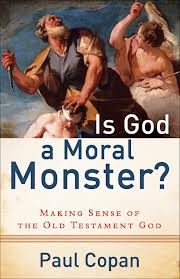
One of the distinguishing marks of the new atheists is that they not only think religion is false, but that it is dangerous and immoral too.  Even God himself is not above their judgment.  They regularly chide the God of the Bible as being a moral monster!  They accuse Him of being pro-genocide, anti-women, pro-rape, pro-slavery, etc.  Rather than the paradigm of moral goodness, God is an evil despot that is to be shunned.  You know it’s a bad day when even God is evil!

Is what they say true?  Is God – particularly as He is portrayed in the OT – morally evil?  Many Christians are sympathetic to this charge because they themselves struggle to understand God’s actions and commands, particularly as revealed in the OT.  Thankfully there have been some well-written responses to the problem of “theistic evil” written in recent years to dispel this negative portrait of God.  

(more…)

Philippians 4:13 reads “I can do all things through Christ who strengthens me.”  This is taken by many to mean they can do anything they set their mind to through Christ’s strength. 

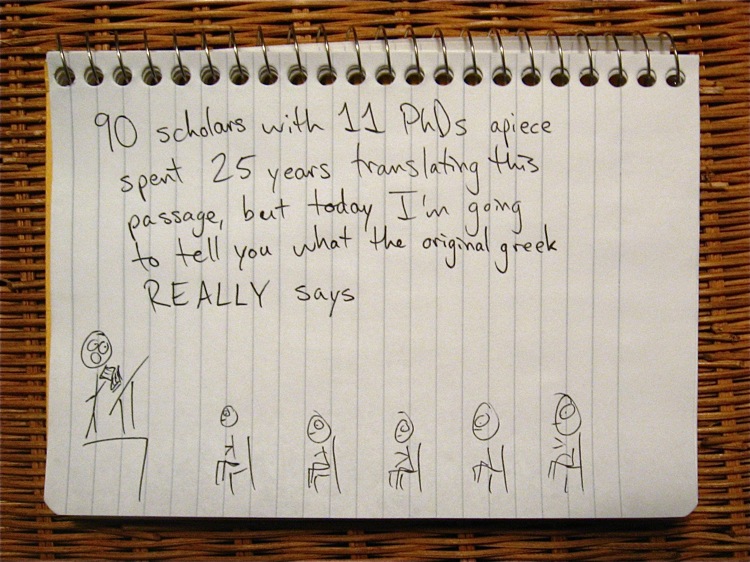
NT scholar Ben Witherington argues that this is a misreading of the text.  He notes that the Greek does not say “do.” The only verb in the Greek is “ischuo” which means “to be able, strong, healthy, valid, powerful.”  A literal rendering of the verse is “I am able all things in Him who empowers me.”  Read literally, it doesn’t make any sense.  Able to what?  The helping verb is missing, and can only be supplied by the surrounding context.  So what is the context of Paul’s statement? 

In verses 10-12 Paul wrote: “I rejoiced in the Lord greatly that now at length you have revived your concern for me. You were indeed concerned for me, but you had no opportunity. [11] Not that I am speaking of being in need, for I have learned in whatever situation I am to be content. [12] I know how to be brought low, and I know how to abound. In any and every circumstance, I have learned the secret of facing plenty and hunger, abundance and need.” (ESV). 

Paul had learned to be content in any state he found himself in.  He learned to endure both the good and the bad through Christ’s empowerment.  A better translation of Phil 4:13 then would be, “I am able [to be content in] all things in Him who empowers me” or “I am able [to endure] all things in Him who empowers me.”  This verse affirms our ability to persevere through the good and the bad by trusting in Christ, not our ability to accomplish any feat we want.

This story continues to fascinate me.  It’s like CSI Miami for Biblical nerds!  And new insights and arguments continue to be offered for and against the authenticity of the GosJesWife.

Christian Askeland has a nice 10 minute video demonstrating some of the peculiarities of the writing on the GosJesWife which cause scholars to doubt its authenticity.

Hugo Lundhaug and Alin Suciu discuss the problems around dating the GosJesWife and evidence that a paintbrush was used for the writing.

Timo Paananen disputes James Watson’s methodology for concluding that the GosJesWife is a patchwork of the Coptic GTh.

Peter Head examines some of the reasons King et al concluded that the writing was authentic, including the lack of ink in a hole created by an insect, the lack of ink where fibers have gone missing from the papyrus, ink on the frayed edges, and the faded ink on the recto and finds them wanting.

If you are a Christian theologian or teacher, or just a serious student of Scripture, you will engage in word studies.  This can be a very fruitful enterprise in exegesis, and yet there are so many ways it can go badly.  In his book, Biblical Words and Their Meaning: An Introduction to Lexical Semantics, Moises Silva addresses the subject of lexical semantics.  He discusses the proper study of words, and common fallacies to avoid.  This book is a must read for exegetes.  Here are just some of the gems I have gleaned from Silva:

  • Language and concepts are not necessarily correlated.  For example, just because Hebrew lacks a future tense does not mean Hebrew-speakers lack a concept of the future.  All talk of the “Hebrew mind” versus the “Greek mind,” based on linguistic differences, is simply fallacious.  Linguistics cannot tell us about  a person’s worldview and mental categories.
  • Etymological studies and cognate languages are of limited value to exegesis.  The history of a word’s meaning may be of interest if you are a historian, but it is of little value if you want to know what that word means in the Biblical text you are studying.  To determine the meaning of a word used in the Biblical text, we must determine what it meant in the author’s day (synchronic meaning), not its origin and evolution (diachronic meaning). (more…)

“Jesus said to them, ‘My wife'” highlighted.

The web continues to be abuzz with The Gospel of Jesus’ Wife.  So much is being written that it’s hard to keep up!  Here are the latest and most important developments.

James Watson has written two more papers (here and here) further developing his original thesis that The Gospel of Jesus’s Wife is a collage of various words and phrases culled from the Gospel of Thomas to form a new composition that is supposed to appear like a new gospel.  Andrew Bernhard has also tested Watson’s thesis in two papers (here and here), and agrees that “a modern author could have created the text of GJW simply by using short excerpts culled exclusively from Coptic GTh.”[1]  Both of Bernhard’s papers present an excellent visual and summary of the extensive semantic borrowing of the GosJesWife from the Coptic GTh.  He notes that only 14 out of 139 legible letters on the recto of the GosJesWife do not correspond to the Coptic GTh.  Eight of these 14 letters make up the phrase “my wife.”  Of the other 6 letter differences, they are either due to gender shifts in the pronoun or uninterpretable because they are single letters that come at the beginning or end of the line and lack sufficient context for reconstruction.

(more…)

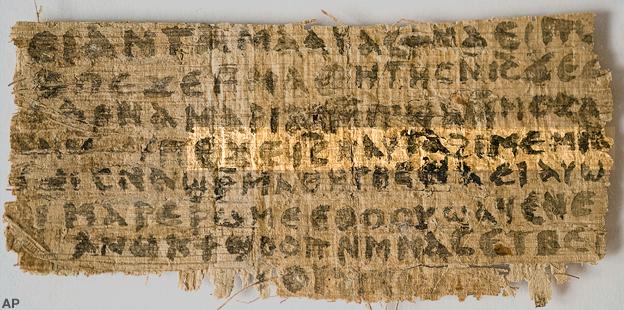
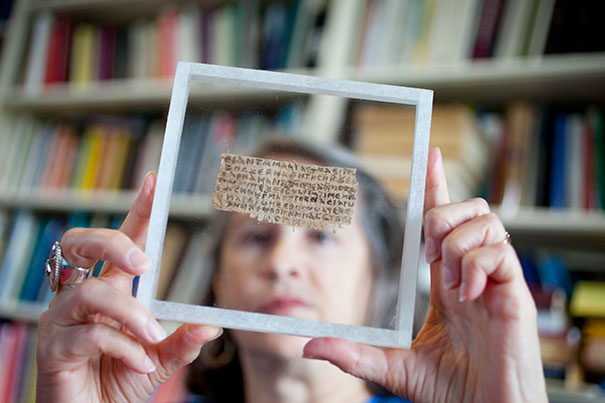
Karen King, professor of divinity at Harvard and specialist in Gnostic Christianity, recently announced the existence of a small (3” x 1.5”), late-4th century[1] fragment in which Jesus speaks of his wife. Written in Sahidic Coptic with black ink[2] on papyrus, the fragment contains eight lines of text on the recto and six lines of text on the verso, with all margins missing.[3]  The extant text on the recto side reads:

1  Not [to] me. My mother gave to me li[fe
2  The disciples said to Jesus
3  deny. Mary is worthy of it.[4]
4  Jesus said to them, “My wife
5  she will be able to be my disciple
6  Let wicked people swell up
7  As for me, I dwell with her in order to
8  an image[5]

Although the text bears some striking resemblance to known Gnostic texts (particularly the Gospel of Thomas[6], and to a lesser degree the Gospel of Philip), it does not match any known apocryphal or Gnostic gospel.  This may be an independent Gospel of unknown character (Gnostic, apocryphal, etc.) or, as Francis Watson has argued, it may be a modern forgery created using key words from the Coptic version of the Gospel of Thomas (more will be said concerning this momentarily).

(more…)

I’ve been reading through the book of Proverbs with my wife.  I’ve noticed something in the text that clues me into the history of the book, and poses interesting questions for the doctrine of Biblical inspiration.  

The book opens with the words, “The proverbs of Solomon, son of David, king of Israel” (Proverbs 1:1, ESV).  These words read like the words of an editor, not Solomon himself.  They were added by the individual(s) who compiled Solomon’s proverbs and edited them into the form and order we see in our Bibles.  There is reason to believe, however, that this collection of Solomonic proverbs consisted only of the first nine chapters.  Proverbs 10:1 reads, “The proverbs of Solomon.”  If the introduction to the book of Proverbs tells us these are the proverbs of Solomon, why mention this again unless (1) there had been a shift in authors from Solomon to someone else somewhere between chapter one and chapter nine, or (2) if the proverbs beginning with chapter 10 were not part of the original collection of proverbs.  There is no indication of a change in authorship between chapter one and chapter nine, so it follows that chapter 10 begins a new collection of Solomonic proverbs that was not part of the original collection.  How long did the first collection circulate before this second collection was added?  We do not know, but clearly enough time elapsed that when the new collection was added to the first, it was important to preface the collection by noting that these, too, were the proverbs of Solomon.  

(more…)

Daniel Wallace is a prominent evangelical NT textual critic.  He has written about the field in various places, but never in much detail, and never in a book dedicated to the topic.  So I was very excited when I heard he was editing a collection of essays on the topic.  

Revisiting the Corruption of the New Testament is not a general book on the topic of NT textual criticism, but a collection of essays criticizing the analysis and methodology of Bart Ehrman.  Indeed, if you have heard any of Wallace and Ehrman’s three debates, you will already be familiar with much of the material Wallace presents in his chapter.  But it is nice to have that wealth of information put to print and to have access to all of the details Wallace provides in the footnotes.  Here are a few facts about the NT manuscripts that are of note:  (more…)

The English name “Jesus” is an English transliteration of the Greek transliteration of the Hebrew name of our savior, YeshuaYeshua is an updated form of the old Hebrew name, Yehoshua, transliterated into English as “Joshua.”  That’s right, Jesus’ and Joshua had the same name, and thus Jesus’ name could rightly be pronounced “Joshua” in English!  This is made clear in the Greek New Testament in which the name of Joshua the son of Nun and the name of Jesus of Nazareth are both “Iesous.” 

Our fathers had the tabernacle of witness in the wilderness, as he had appointed, speaking unto Moses, that he should make it according to the fashion that he had seen. 45 Which also our fathers that came after brought in with Jesus into the possession of the Gentiles, whom God drave out before the face of our fathers, unto the days of David (Acts 7:44-45, KJV) 

For if Jesus had given them rest, then would he not afterward have spoken of another day. (Heb 4:8, KJV)

Most translations other than the KJV translate Iesous as “Joshua” in these verses since they are clearly referring to Joshua the son of Nun who succeeded Moses and led the children of Israel into the Promised Land.  I used to use these verses as examples of poor translation on the part of the KJV translators since it was clearly Joshua and not Jesus who led the children of Israel into the Promised Land, but truth be told the KJV translators were not only accurately translating the Greek, they were doing so in a more consistent manner than most modern translators since they translated every occurrence of Iesous as “Jesus” even when it referred to someone other than our savior. 

(more…)

Daniel Wallace revealed some additional details regarding some early NT papyri manuscripts in a video interview with Michael Licona, one of which is the highly touted first century fragment of Mark. 

In a nutshell:

  • Number: There are 7 papyri manuscripts of the gospels and Paul’s letters
  • Size: All manuscripts are less than 1 leaf
  • Dates: 1 is probably 1st century, 4 from the 2nd century, and 2 that are probably 2nd century but could be dated to the 3rd century
  • NT Books represented:
    • 1 = Matthew
    • 1 = Mark (possibly 1st century)
    • 1 = Luke
    • 1 = Romans
    • 1 = First Corinthians
    • 2 = Hebrews

I can’t wait to find out more about the collection in 2013!

It’s long been the conclusion of scholars that Esther and Nehemiah are the only books of the OT not represented among the Dead Sea Scrolls.  The May/June 2012 issue of Biblical Archaeology Review (BAR), however, reports that Norwegian scholar, Torleif Elgvin of the Evangelical Lutheran University College in Oslo, Norway, and Esther Eshel of Bar-Ilan University are publishing a collection of two dozen previously unknown DSS fragments from Cave 4, the Bar-Kokhba caves, and Wadi ed-Daliyeh in a book titled Gleanings from the Caves (T&T Clark publishers).  If this checks out, then Esther would remain the only book not found in the DSS.  Of course, if Nehemiah and Esther were written on the same scroll as most scholars believe, then while we may not have an extant copy of Esther from the DSS, there is good reason to believe the text was present in the community as part of the Nehemiah scroll.

What do you think of the pericope of the rich man and Lazarus in Luke 16?  Do you think it is a parable or a historical event?  Why?

In the early 20th century German theologian Walter Bauer proposed that Christian orthodoxy is a historical fiction.  Heretics were not those who departed from the original teachings of Jesus and the apostles, but those on the losing side of a political battle for dominance by one group of Christians over another.  Orthodoxy represents the side who won, not the side of those who remained faithful to Jesus’ teachings.  There is no such thing as Christianity per se, but rather a collage of various Christianities.

While Bauer’s proposal was severely critiqued by other scholars and joined the ash-heap of theological history, as is the case with most bad ideas, someone comes along later, picks up the idea, brushes off the ashes, repackages it, and tries to sell it again.  Such is the case with the Bauer thesis.  Today it is being peddled by people such as Bart Ehrman and Elaine Pagels.  Speaking to a postmodern generation that prizes diversity, detests absolute truth claims, and thinks truth claims are an attempt to gain power and exert control, they have found a receptive audience for their pluralistic view of Christian origins and history.  For them, the only true heresy is orthodoxy itself: the claim that there is one enduring truth, and one Christian faith that was once and for all delivered to the saints.

(more…)

« Previous PageNext Page »