 Many think a hypocrite is someone who fails his own moral standard. This cannot be the right definition because it would make everyone a hypocrite. We all have a moral standard we think we should live up to and fail that moral standard in one way or another.
To be a hypocrite is to be an actor. It’s a pretender. A hypocrite is one who professes to believe in a moral standard that they don’t actually believe in, or someone who has no intention of trying to live up to the moral standard they really do believe in.
Someone who sincerely believes X is wrong, and sincerely attempts to live by X but, nevertheless, fails to always do so is not a hypocrite. For example, a person might profess that it is wrong to lie, and thus does his best to avoid lying; nevertheless, in a time of trouble, he tells a lie to get out of trouble. After doing so, he repents to God and goes on trying to live a life of honesty. This man is guilty of a moral failure, but not of moral hypocrisy. The moral hypocrite is the one who says he believes in truth-telling but really doesn’t, or believes in truth-telling but consistently lies nonetheless.
 I’ve always assumed that David had sex with Bathsheba once. However, the text says that when David first saw her, she was bathing to purify herself of her uncleanness (2 Sam 11:1-5). This is referring to the bathing a woman would undergo after her menstrual cycle ended. Since one is least fertile immediately following menstruation, this suggests that David’s fling with Bathsheba was no one-night stand. Bathsheba probably remained with David for a number of days before returning to her house, during which they had sexual relations multiple times. If so, David’s sin was not a one-time mistake, but an ongoing sin.
 The pope has officially jumped the shark. While a number of mainline Protestant denominations and prominent Evangelical pastors have changed their position on homosexuality and same-sex marriage in recent years, I never expected that the Catholic Church would do so. On Monday, the pope issued a declaration (
 Most people would define a hypocrite as someone who does something that they claim is wrong. That can’t be the right definition, however, because it would consign everyone to being a hypocrite. Everyone sins, which means everyone who believes in morality acts in ways that is contrary to morality. That would make everyone a hypocrite. If your definition of hypocrite turns every person into a hypocrite, then your definition is not a meaningful definition. Something is wrong with the definition. A hypocrite is not someone who fails to live up to their moral ideals, but someone who falsely professes to believe in such ideals in the first place. A hypocrite is an actor.
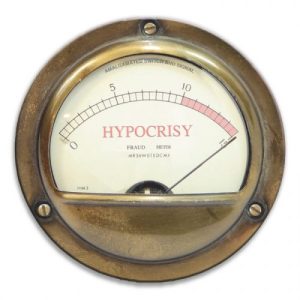 People often misunderstand and misapply the term “hypocrite.” A hypocrite literally refers to an actor. They are pretenders. In the realm of morals, a hypocrite is someone who pretends to be moral. They tell you not to do something, but have no intention of following their own commands. They are people who do not think their own rules apply to them. They might pretend to keep these rules, but secretly they flout them.
 I have long been concerned by the modern, therapeutic view of forgiveness. On this view, forgiveness is primarily about ridding oneself of anger toward those who have hurt us, and this can be done completely independent of the sinner. He does not need to repent, and he does not need to know we have forgiven him.
 If you think “God just wants me to be happy,” you are going to be very disappointed in your Christian life, and inclined toward sin and doubt. False expectations never end well.
 We are saved by faith, not works, but the faith that saves is a faith that works. True saving faith will produce good works. Faith, not works, is the causal condition for salvation, but good works are the necessary effect of our saving faith. That doesn’t mean we will be perfect, but it does mean we will be moving toward perfection via the process of sanctification.
 Our biggest temptation as humans is works righteousness – thinking that we can earn our salvation by own goodness. Ask the average nominal Christian in America how he knows he is saved and you’re likely to hear, “Well, I’m a pretty good person.” Even those who recognize that they are saved by grace alone often feel the temptation to believe they are “kept,” at least in part, by their good works. While we are certainly saved for good works (Eph 2:8-10; Tit 2:11-12), good works cannot save us or keep us saved. Our trust in Jesus alone saves us. Faith causes salvation – good works are the effect.
 Sometimes we are damned if we do and damned if we don’t. Let me give you two examples where Christians cannot seem to win with non-Christians.
 A hypocrite is not one who fails to live up to his own ideals, but one who falsely proclaims to have such ideals in the first place.
 We often speak of the need to “forgive yourself.” While I understand what is meant by this phrase, it is unintelligible on the Christian worldview. People speak of the need to forgive themselves in the context of feeling guilt for something they did (or failed to do). They recognize the need to eliminate this guilt and get on with their life – to stop beating themselves up for their failure.


 Thinking to Believe