Theology


Tim Keller had this to say about the relationship between immorality and irrationality:

Every one of our sinful actions has a suicidal power on the faculties that put that action forth. When you sin with the mind, that sin shrivels the rationality. When you sin with the heart or the emotions, that sin shrivels the emotions. When you sin with the will, that sin destroys and dissolves your willpower and your self-control. Sin is the suicidal action of the self against itself. Sin destroys freedom because sin is an enslaving power.

In other words, sin has a powerful effect in which your own freedom, your freedom to want the good, to will the good, and to think or understand the good, is all being undermined. By sin, you are more and more losing your freedom. Sin undermines your mind, it undermines your emotions, and it undermines your will.[1]

See also What I’ve Been Reading: The Making of an Atheist, Part I

HT: STR


Now Thomas, one of the Twelve, called the Twin, was not with them when Jesus came. [25] So the other disciples told him, “We have seen the Lord.” But he said to them, “Unless I see in his hands the mark of the nails, and place my finger into the mark of the nails, and place my hand into his side, I will never believe.” [26] Eight days later, his disciples were inside again, and Thomas was with them. Although the doors were locked, Jesus came and stood among them and said, “Peace be with you.” [27] Then he said to Thomas, “Put your finger here, and see my hands; and put out your hand, and place it in my side. Do not disbelieve, but believe.” [28] Thomas answered him, “My Lord and my God!” [29] Jesus said to him, “Have you believed because you have seen me? Blessed are those who have not seen and yet have believed.” (John 20:24-29 ESV) 

This passage of Scripture is often appealed to by those who see Christian apologetics as irrelevant to evangelism, or even contrary to Scripture.  On its face, it does seem to present an anti-evidence, anti-rational approach to the Christian faith: Jesus appears to berate Thomas for requiring evidence of His resurrection while pronouncing a blessing on those who believe without the need for evidence.  A closer examination of the passage in its context, however, reveals this reading of the text to be mistaken. 

(more…)

The woman said to the serpent, “We may eat of the fruit from the trees of the orchard; 3 but concerning the fruit of the tree that is in the middle of the orchard God said, ‘You must not eat from it, and you must not touch it, or else you will die.’ … 6 When the woman saw that the tree produced fruit that was good for food, was attractive to the eye, and was desirable for making one wise, she took some of its fruit and ate it. She also gave some of it to her husband who was with her, and he ate it. 7 Then the eyes of both of them opened, and they knew they were naked; so they sewed fig leaves together and made coverings for themselves. (Genesis 3:2-3, 6, NET)

It’s often said on the basis of Genesis 3:6 that Adam was with Eve when the serpent tempted her, and stood by idly, doing nothing (bad Adam!).  If you read the context closely, however, this is not the picture being painted.  The temptation and the Fall were separated in time, and Adam was not present with Eve during her temptation.  As Charles Powell has pointed out, when Eve was speaking to the serpent regarding the Tree of Knowledge of Good and Evil (TKGE), she describes it as being “in the middle of the orchard” (Genesis 3:3).  This geographical referent is telling, for if the temptation had taken place at the same point in time and same location as the Fall, then Eve would have been standing near the TKGE and should have described it as “this tree” in the same way I would describe my computer (which is obviously right in front of me) as being “here” rather than “there.”  By referring to the TKGE as being in the middle of the garden, it’s clear that Eve was not in the midst of the garden when the serpent tempted her, and thus not by the TKGE.  

There is a gap in time between Genesis 3:5 and Genesis 3:6.  Only later, when Adam and Eve were together again and journeyed to the middle of the garden, did Eve behold the fruit of the TKGE and see that it was good for food, attractive, and would make her wise as the serpent said.  Then she ate the fruit, gave some to her husband, and the rest is sad history.

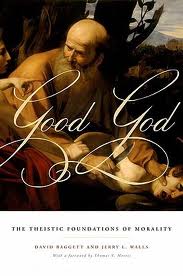
David Baggett and jerry Walls have written an excellent book exploring God’s relationship to morality.  The book aims to provide a moral argument for the existence of God, and to answer criticisms to theistic ethics.  After showing how various non-theistic foundations for ethics fail, the authors take a close look at the most common objection to theistic ethics: the Euthyphro argument.  They critique both horns of the dilemma: pure voluntarism (X is good because God commands it) and non-voluntarism (X is good wholly independent of God and His will).  If goodness is determined by God’s commands, then morality seems arbitrary.  Indeed, if God willed that rape is good rape would be good (abhorrent commands objection).  There is also the epistemic problem.  How would we know what God has commanded, or if God has changed His mind?  The problem with non-voluntarism is that it makes God irrelevant to morality.  Goodness stands outside of God.  Indeed, God is subject to the good in the same way we are.  At best His role is to communicate to us what is good.  He is like the divine meteorologist who reports the weather rather can creating it.  If goodness is independent of God, then God’s aseity (self-existence) is called into question.  He cannot be the metaphysical ultimate.

(more…)

I often hear Christians of every stripe say they wish hell did not exist, or that no people would end up there.  I understand what they mean.  Hell is a gruesome prospect.  The idea of people suffering for eternity is a grim one.  It’s hard to be excited about a doctrine like this, particularly when all of us have family and loved ones that we have good reason to believe will end up in hell.  On a purely emotional level, there is a sense in which all of us can say we wish there was no hell or that no one would go there. 

(more…)

Perhaps I am a slow learner, but it just occurred to me recently that the Calvinistic doctrine of eternal security, while germane to Calvinism, is not limited to a Calvinistic theology.  Even an Arminian could hold to the doctrine of eternal security (once saved always saved) while disagreeing with the Calvinists on the question of how people become saved.  Arminians could hold that it is impossible for someone whose spirit has been regenerated by the Spirit to fall away without accepting the Calvinist notion that God alone determines who will be regenerated.  The question of how we are saved (monergism or synergism) is separate from the question of the permanence of salvation.  It could be true that humans have to freely respond to God’s offer of grace before God saves them (synergism), and that once saved, a person will always persevere to the end.  There is no logical incompatibility between these two positions.

I’ve been reading through the book of Proverbs with my wife.  I’ve noticed something in the text that clues me into the history of the book, and poses interesting questions for the doctrine of Biblical inspiration.  

The book opens with the words, “The proverbs of Solomon, son of David, king of Israel” (Proverbs 1:1, ESV).  These words read like the words of an editor, not Solomon himself.  They were added by the individual(s) who compiled Solomon’s proverbs and edited them into the form and order we see in our Bibles.  There is reason to believe, however, that this collection of Solomonic proverbs consisted only of the first nine chapters.  Proverbs 10:1 reads, “The proverbs of Solomon.”  If the introduction to the book of Proverbs tells us these are the proverbs of Solomon, why mention this again unless (1) there had been a shift in authors from Solomon to someone else somewhere between chapter one and chapter nine, or (2) if the proverbs beginning with chapter 10 were not part of the original collection of proverbs.  There is no indication of a change in authorship between chapter one and chapter nine, so it follows that chapter 10 begins a new collection of Solomonic proverbs that was not part of the original collection.  How long did the first collection circulate before this second collection was added?  We do not know, but clearly enough time elapsed that when the new collection was added to the first, it was important to preface the collection by noting that these, too, were the proverbs of Solomon.  

(more…)

It is often said that Adam and Eve did not know the difference between good and evil prior to eating the fruit from the Tree of Knowledge of Good and Evil (TKGE).  This does seem to be the straightforward meaning of Genesis 3:22a: “Then the LORD God said, ‘Behold, the man has become like one of us in knowing good and evil.’” (ESV)  There are a couple of problems I see with this interpretation, however:

  1. The text does not say Adam and Eve only gained knowledge of evil after the Fall, but knowledge of “good and evil.”  If we understand “knowledge” in a cognitive sense, this would mean God originally created human beings as amoral beings, having no knowledge of moral concepts or moral categories.  If we were created as amoral beings, then our moral intuitions and our capacity for moral reasoning are not part of the imago Dei (image of God) in which we were created, but rather a consequence of the Fall.  That’s a tough pill to swallow for two reasons: (1) Moral reasoning is one of the unique characteristics of God that among God’s creatures, humans alone exhibit.  Since humans alone were created in the imago Dei, it stands to reason that moral reasoning was part of that original imago Dei; (2) How is it possible for an act of disobedience to produce in us the knowledge of good?  Evil, yes, but good?
  2. (more…)

The evidential problem of evil points to the improbability that the amount of evil we see in the world – particularly gratuitous evil – would exist if an omnipotent, omnibenevolent God exists.  The argument usually takes the following form:

(1)   If God exists, gratuitous evil would not exist
(2)   Gratuitous evil exists
(3)   Therefore God does not exist 

Many theists attempt to undermine this argument by attacking the veracity of premise two.  For example, William Lane Craig and William Alston argue that humans are not in an epistemic place to judge any act of evil as gratuitous since we cannot see the big picture of history.  For all we know, an act of seemingly gratuitous evil will result in a greater good years or even centuries from now, either in the life of the person who experienced the evil or in the life of another person in another country.  Our cognitive limitations should not be used as evidence that gratuitous evil exists.  At best we must remain agnostic on the question.

This is an appeal to the Greater-Good Defense, which argues that God has a morally sufficient reason for permitting all evils—including those that appear gratuitous to us—such as using them to bring about some greater good that could not have been brought about apart from those evils.

In the latest issue of Philosophia Christi, Kirk R. MacGregor provides some reasons for thinking that this response to the evidential problem of evil is misguided.  Just because our cognitive and temporal limitations make it impossible for us to prove that any act of evil is truly gratuitous does not mean that gratuitous evil does not exist.  He argues that the belief that some evils are gratuitous is a properly basic belief.  For example, we do not believe that every time we are bitten by a mosquito or stub our toe, that these evils have some greater purpose or will be used to accomplish a greater good.  Such things make virtually no difference in our own lives, yet alone on the grand scheme of things.  Given the proper basicality of belief in gratuitous evil, MacGregor says the burden of proof is on those who would deny the existence of gratuitous evils, and to meet their burden of proof they must explain how every instance of gratuitous evil actually results in some greater good.  This is not possible, and thus the person who believes in the existence of gratuitous evil is prima facie justified in maintaining that belief, even given his cognitive and temporal limitations.

(more…)

I’ve heard a lot of atheists hypothesize that one of the reasons religion was invented was because people had to manage their fear of death.  If people believe that they will continue to live on in some fashion after death, it mitigates their fear of death.  Can the fear of death explain the origin of religion, or the origin of religious faith in people today?  Perhaps, but three points should be made.  

First, not all religions include conscious existence beyond the grave.  For example, in many Eastern religions absorption into the One (personal extinction) is the end of all things.  Clearly immortality is not the motivation for those religions and religious practitioners.  

(more…)

Sam Storms has written an insightful analysis of the idea that we can or should “forgive God.”  While a few snippets cannot do it justice, the heart of his argument is as follows: 

First of all, let me say that I understand where this sort of question comes from. I understand how people quite often are confused by what God does or doesn’t do. … But my struggle is with the language of “forgiving God.” For one thing, I don’t find it ever used in Scripture. That alone ought to give us pause before we incorporate such language into our Christian vocabulary or allow it to shape our theology or our understanding of spiritual formation.

(more…)

Daniel Wallace is a prominent evangelical NT textual critic.  He has written about the field in various places, but never in much detail, and never in a book dedicated to the topic.  So I was very excited when I heard he was editing a collection of essays on the topic.  

Revisiting the Corruption of the New Testament is not a general book on the topic of NT textual criticism, but a collection of essays criticizing the analysis and methodology of Bart Ehrman.  Indeed, if you have heard any of Wallace and Ehrman’s three debates, you will already be familiar with much of the material Wallace presents in his chapter.  But it is nice to have that wealth of information put to print and to have access to all of the details Wallace provides in the footnotes.  Here are a few facts about the NT manuscripts that are of note:  (more…)

Inclusivism is the doctrine that while no one can be saved apart from Christ, one need not have conscious faith in Christ to be saved.  So, for example, while a good Buddhist may not trust in Christ for his salvation, since he is a good Buddhist Christ applies the merits of His substitutionary atonement to him. 

The NT is opposed to inclusivism.  It is quite clear that one must exercise conscious faith in Christ to experience salvation: 

John 3:14-18  And as Moses lifted up the serpent in the wilderness, so must the Son of Man be lifted up, [15] that whoever believes in him may have eternal life. [16] “For God so loved the world, that he gave his only Son, that whoever believes in him should not perish but have eternal life. [17] For God did not send his Son into the world to condemn the world, but in order that the world might be saved through him. [18] Whoever believes in him is not condemned, but whoever does not believe is condemned already, because he has not believed in the name of the only Son of God. 

(more…)

“Scripturally speaking, the problem is not that good people do not go to heaven; the problem is there are no good people.” — Trevin Wax, “Inclusivism and Its Effects” in Credo magazine, Issue 2, January 2012, 10.

The English name “Jesus” is an English transliteration of the Greek transliteration of the Hebrew name of our savior, YeshuaYeshua is an updated form of the old Hebrew name, Yehoshua, transliterated into English as “Joshua.”  That’s right, Jesus’ and Joshua had the same name, and thus Jesus’ name could rightly be pronounced “Joshua” in English!  This is made clear in the Greek New Testament in which the name of Joshua the son of Nun and the name of Jesus of Nazareth are both “Iesous.” 

Our fathers had the tabernacle of witness in the wilderness, as he had appointed, speaking unto Moses, that he should make it according to the fashion that he had seen. 45 Which also our fathers that came after brought in with Jesus into the possession of the Gentiles, whom God drave out before the face of our fathers, unto the days of David (Acts 7:44-45, KJV) 

For if Jesus had given them rest, then would he not afterward have spoken of another day. (Heb 4:8, KJV)

Most translations other than the KJV translate Iesous as “Joshua” in these verses since they are clearly referring to Joshua the son of Nun who succeeded Moses and led the children of Israel into the Promised Land.  I used to use these verses as examples of poor translation on the part of the KJV translators since it was clearly Joshua and not Jesus who led the children of Israel into the Promised Land, but truth be told the KJV translators were not only accurately translating the Greek, they were doing so in a more consistent manner than most modern translators since they translated every occurrence of Iesous as “Jesus” even when it referred to someone other than our savior. 

(more…)

Many atheists assert that an eternal universe is explanatorily equivalent to an eternal God.  For example, Sagan once asked, “If we say that God has always been, why not save a step and conclude that the universe has always been?”[1]  And just recently, two prominent atheists made the same claim.  In his new book, A Universe from Nothing, Lawrence Krauss writes, “[T]he declaration of a First Cause still leaves open the question, ‘Who created the Creator?’ After all, what is the difference between arguing in favor of an eternally existing creator versus an eternally existing universe without one?”[2]  Victor Stenger agrees with Krauss:

(more…)

Would you still serve God if there was no hell in which to be punished for your evil?  Would you still serve God if there was no heaven in which to be rewarded for your good?  Would your behavior change at all?

I would venture to say that most church-going Christians serve God, not out of a desire to be in relationship with God, but out of a desire to avoid hell.  If there was no hell, they would not serve God, or at least would not continue to live the way they do morally speaking.  While desiring to avoid hell is natural and a good motivator for initially deciding to serve God, it is a very poor motivator for continuing to serve God.

I don’t necessarily want you to respond in the comments section with your answers, but I do think this is something worth thinking about in the way of self-evaluation.

Update on 6/21: A new study appearing in the Public Library of Science journal, PLoS ONE, has evaluated crime rates involving 143,197 people in 67 countries over a span of 26 years and found that crime rates are lower in nations that believe in the possibility of some sort of divine punishment after death, and higher in nations that do not (or that only believe in divine rewards after death).

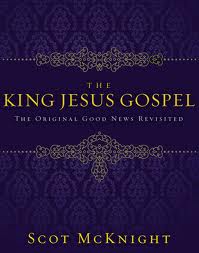
In The King Jesus Gospel: The Original Good News Revisited Scot McKnight argues that the gospel being preached in evangelicalism today is a truncated or distorted version of the original.  Some think the gospel is justification by faith, while others identify it as the saving work of Christ.  However it is characterized, the gospel is understood to be all about personal salvation.  While that is surely part of it, the gospel is much more.[1]

McKnight argues that the gospel as preached in the NT consists of four elements:

  1. The story ofIsrael
  2. The story of Jesus
  3. The plan of salvation
  4. The method of persuasion

We cannot make sense of the method of persuasion apart from the plan of salvation, and we cannot make sense of the plan of salvation apart from the story of Jesus, and we can’t make sense of the story of Jesus apart from the story ofIsrael.  All four elements were integral to the preaching of the gospel in the early church.  

(more…)

Daniel Wallace revealed some additional details regarding some early NT papyri manuscripts in a video interview with Michael Licona, one of which is the highly touted first century fragment of Mark. 

In a nutshell:

  • Number: There are 7 papyri manuscripts of the gospels and Paul’s letters
  • Size: All manuscripts are less than 1 leaf
  • Dates: 1 is probably 1st century, 4 from the 2nd century, and 2 that are probably 2nd century but could be dated to the 3rd century
  • NT Books represented:
    • 1 = Matthew
    • 1 = Mark (possibly 1st century)
    • 1 = Luke
    • 1 = Romans
    • 1 = First Corinthians
    • 2 = Hebrews

I can’t wait to find out more about the collection in 2013!

« Previous PageNext Page »