Theology


There is a doctrine that has circulated within my fellowship for many years called the Shekel and a Half doctrine.  Those espousing to this doctrine claim that in addition to paying tithes on ones income (10%), believers need to pay an additional 5%.  It is often said that the additional 5% is for the upkeep of the church, or to fund a church building program.  Exodus 30:11-16 is appealed to for Biblical support:

The Lord spoke to Moses: 12 “When you take a census of the Israelites according to their number, then each man is to pay a ransom for his life to the Lord when you number them, so that there will be no plague among them when you number them. 13 Everyone who crosses over to those who are numbered is to pay this: a half shekel according to the shekel of the sanctuary (a shekel weighs twenty gerahs). The half shekel is to be an offering to the Lord. 14 Everyone who crosses over to those numbered, from twenty years old and up, is to pay an offering to the Lord. 15 The rich are not to increase it, and the poor are not to pay less than the half shekel when giving the offering of the Lord, to make atonement for your lives. 16 You are to receive the atonement money from the Israelites and give it for the service of the tent of meeting. It will be a memorial for the Israelites before the Lord, to make atonement for your lives.”
(more…)

While arguing from silence is a logical fallacy, I think there are times that an argument from silence must be reckoned with.  For example, in discussing whether Matthew 28:19 originally read “in the name of the Father, Son, and Holy Spirit” or “in my name,” some Trinitarian scholars argue that the latter is original.  “In my name” does not appear in any extant manuscript, so what is there basis?  One reason is Justin Martyr’s silence on the passage.  In one of Justin’s work he was arguing for “Father, Son, and Holy Spirit” as the appropriate baptismal formula, and yet he never once appealed to Matthew 28:19 for support as we would expect for him to have done if Matthew 28:19 originally read “Father, Son, and Holy Spirit.”  Since he did not, it stands to reason that Matthew 28:19 did not read “Father, Son, and Holy Spirit,” in Justin’s day (or at least in the manuscripts he had access to), but rather “in my name.”  While this is an argument from silence, it is a strong argument nonetheless.

(more…)

twist-of-faithWe find ourselves in a world in which religious truth-claims have been demoted to private, subjective opinions or values.  Religious knowledge is not considered “real” knowledge.  In fact, religious truth-claims are not even testable, and thus must be taken on blind faith.

How did it come to this?  Here I offer a very condensed, if not simplistic path to how we privatized faith, drawing largely on Dr. James Sawyer’s work in this area.

It started with Renee Descartes.  He demanded that what we claim to “know” we know with the same level of certainty as mathematical principles.  This drove a wedge between faith and knowledge, because religious claims cannot be known with that degree of certainty (virtually nothing can).

Then came the opposite extreme offered by David Hume.  Hume argued that there are no innate ideas or truths that serve as a foundation for knowledge.  The mind is a blank slate upon which our sense perceptions are received, and from which we gain knowledge.  Knowledge, then, does not correspond with reality, but is simply a well-ordered, coherent system within our minds created by sense perception.  This left no room for the idea of truth.  There is no correspondence between reality and what we perceive to be reality.  Each person’s perspective is as valid as the next person’s perspective (relativism).

(more…)

I was having a conversation with some coworkers some time ago in regards to same-sex marriage.  They brought up the relationship of homosexuality to the Christian religion, at which point I affirmed that the Bible—and hence Christianity—is opposed to homosexuality.  Immediately I received the “Well, that’s just your interpretation” response.  My response to this charge was to explain the process of exegesis, which took several minutes of my time and got us off the real issue at hand.  In retrospect I thought of a more efficient and tactful response I would like to share with you.

The next time you are discussing some aspect of Biblical teaching with someone, and they give you the “Well, that’s just your interpretation” response, respond by saying something off-the-wall like, “So you are saying I don’t like pickles?!”  A blank and confused stare is sure to follow proceeded by the expected question: “What?!?!”  Explain to them that you have just demonstrated the fundamental principle of interpretation.  Valid interpretation only comes about when the receiver accurately understands the intent of the sender/author.  This is accomplished by correctly employing the use of grammatical and semantic rules, and considering the cultural/historical perspective of the sender.  If the sender’s intent is not properly understood, communication has not occurred and the result is misinterpretation.  If interpretation is rooted in authorial intent only one interpretation can be valid.  As long as the interpreter employs the proper tools they can walk away with the correct interpretation.

The Bible is no different.  There is a correct way and an incorrect way to interpret the Bible.  The same tools and rules we use to correctly interpret our modern conversations and writings apply equally to the Bible.  When those tools and rules are used properly the interpretation we walk away with is sound.  No, it’s not just our interpretation.  It is the meaning inherent within the text itself, discovered (not invented) by the interpreter using the universal rules and tools of language.

I have recently read some of the papers presented at the 2008 Urshan Graduate School of Theology Symposium.  Notable was David Norris’s response to Patrick Dotson’s paper arguing that the Oneness movement must move beyond the King James Version if we hope to reach our modern generation with the Word of God.  While others surely have done so, Norris is the first Apostolic minister I have encountered who has advocated for the use of other English translations, and made a case for the superiority of the Alexandrian text-type over the Byzantine text-type that undergirds the NT of the KJV.

This post has been updated to include additional content on 10/2

TargetSome Christians believe that while the Bible is without error when it speaks to spiritual matters (God, salvation), there may be errors in those sections that speak to scientific and historical matters, which should not concern us.  This view of Biblical inspiration is often called limited inerrancy.
While it would be worthwhile to examine each of the purported scientific and historical errors in the Bible to determine if they are indeed errors, the notion of limited inerrancy can be evaluated in a more fundamental way.  Greg Koukl has observed that it makes little sense to believe what the Bible says in matters we cannot test (such as miracles, resurrection, incarnation), when the Bible is shown to be untrustworthy in those matters we can test.  That’s not to say the presence of errors would necessarily invalidate every truth claim the Bible makes, but it is to say that it would make it much more difficult to trust its spiritual claims.  If God was not able to ensure that the Biblical authors accurately transmitted matters of history and science—which were naturally more accessible to them—why think He was able to ensure that they accurately transmitted spiritual matters?  I see little reason to do so.

(The following content has been added as of 10/2)

It’s a credibility issue.  Credibility is earned.  It is gained by being right, and lost by being wrong.  Limited inerrantists are telling us that we should trust everything the Biblical authors tell us about spiritual matters, but we cannot trust everything they tell us about non-spiritual matters because they have proven themselves to be mistaken in various ways on such matters.  But if they have proven themselves to make mistakes in areas that we can test them on, why should we think they haven’t made any errors on matters that we can’t test them on?  The limited inerrantist can’t respond by saying God’s involvement ensures that they will not err on such matters, because God is involved in the whole process.  If He couldn’t keep the authors from erring on non-spiritual matters, there is no reason to think He could keep them from erring in spiritual matters. 

A limited inerrantist might respond that God was only involved in those sections of Scripture dealing with spiritual matters.  But this portrays an absurd picture of inspiration.  Scripture goes back and forth between non-spiritual and spiritual claims.  Surely God’s involvement was not iterant so that when the author writes a word about geography God checks out, but when he is about to write a few words on spiritual truth God checks back in!  Even if this were possible, what reason would God have for deciding to inspire only those words dealing with spiritual matters?  He knew that people would question the credibility of the religious claims if His authors flubbed up their facts on non-spiritual matters.  So why wouldn’t God, in the interest of giving more credibility to the spiritual claims, superintend what His authors wrote about all matters?

James Anderson of Analogical Thoughts has a nice post on 12 prima facie reasons for taking Adam to be a genuine historical figure, as opposed to a myth or metaphor.

Speaking of James Anderson, there is another James Anderson you should check out: the James Anderson of Evidential Faith.  And while I’m plugging my friend’s blog, I should also direct your attention to another one of my friend’s blogs: Chad Moore’s Bookesmore


HT: Justin Taylor

Every denomination or religious tradition has its doctrinal peculiarities.  Not only may these be unique to the religious tradition in question, but they are often thought of as strange to outsiders.  Usually these doctrinal peculiarities are based on some Biblical text, but they either distort that text, fail to read it in light of other texts, or overemphasize it to the point that it becomes a distortion.  And yet, people who were raised in that tradition not only accept it as true, but will work up all the intellectual muster they can in defense of it.  While they manage to convince themselves with their reasons, they often fail to convince most others.

We need to be on guard that we do not become so intent on protecting all the teachings/traditions of our own particular religious tradition, that we will come up with, and actually settle for subpar arguments in their favor.  Are there things we believe and argue for simply because they are part of our religious tradition – things we would not believe if we were raised in a different tradition, and would not be persuaded of if presented with the same evidence that we use to justify the teaching/tradition?

(more…)

Please note, I updated this post on 9/26/09 to make some needed changes and clarifications per reader feedback.

Given my last post, I thought it would be helpful to examine some of the historic Christian creeds, showing which parts are acceptable to Oneness Pentecostals (black font), which parts are not (strikethrough), which parts are questionable (red font), followed by some brief comments.

A little bit about my method: The parts I have struck out, I have struck out because I cannot agree with the terminology.  The parts I have kept, I have kept because I can agree with the terminology, even if I do not mean the same thing by those words as the drafters of these creeds meant by those words.  Furthermore, by striking out some words, I did not necessarily intend to create a new context, so do not try to read through the creeds using only the words that remain, thinking that it will make sense on its own.  In some cases it will, but in other cases it will not.

I’ll begin with the Apostles’ Creed:

Apostles’ Creed

I believe in God, the Father Almighty,
the Maker of heaven and earth,
and in Jesus Christ, His only Son, our Lord:

(more…)

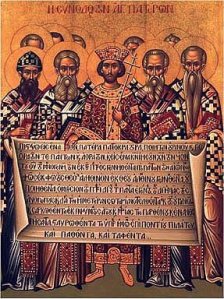
Nicaea_iconHistorically speaking, “creeds” and “Oneness Pentecostal” have not gone hand-in-hand.  We have typically eschewed creeds, viewing them quite negatively.  The reason for this is two-fold.  First, creedal statements have often been invested with an authority equal to that of Scripture, and we do not believe anything is equal in authority to the revealed Word of God.  Secondly, and more importantly, we have objected to the Trinitarianism that is either the backdrop of, or subject of the creeds.

Not only have we rejected the ancient creeds in particular, but we have rejected the notion of “creed” in general.  This is most unfortunate.  Not only are creeds useful as brief summations of the Christian faith, but they are Biblical as well.  We find several apparent creeds and creedal affirmations in the Bible:

arrogantChristians think their religion is true, and everybody else’s religion is false.  They think you have to believe in Jesus to be saved.  How arrogant, right?  Actually, no.  While there may be some Christians who are truly arrogant, thinking Christianity is the only true religion is not arrogant in itself.  When you think about it, everyone one of us thinks we are right in the things we believe.  If we didn’t think what we believed was true, we wouldn’t believe it.  After all, nobody believes things they think are false!  Of course, we could be mistaken in our beliefs.  What we think is true may actually be false, but everybody who believes something believes it because they think it is true.  And by force of logic, if what we believe is true, all contrary views must be false.  So if arrogance is defined as thinking one’s own view to be right and contrary views to be wrong, then everyone is arrogant – not just Christians.

(more…)

The NT authors often quote an OT passage, and say it was fulfilled in Christ.  Many Christians use these fulfillments as evidence for the veracity of the Christian faith.  For example, I’ve heard it claimed that the probability of just one man fulfilling 48 different prophecies is something like 1:10157.  It is reasoned that no man could match those odds unless the Biblical prophecies were divine in origin, and thus Jesus must be who He claimed to be.  The problem with this apologetic is that the vast majority of these “messianic prophecies” are neither prophetic, nor messianic in their original context.

Consider, for example, Hosea 11:1 – “When Israel was a young man, I loved him like a son, and I summoned my son out of Egypt.”  Matthew quotes this passage in reference to Jesus’ return to Nazareth, saying, “In this way what was spoken by the Lord through the prophet was fulfilled ‘I called my Son out of Egypt.’” (Matthew 2:14-15)  When one examines the original context of Hosea 11:1, however, they will quickly recognize that this passage is neither prophetic nor messianic.  It is a mere historical recounting of the Hebrews’ exodus from Egypt.

(more…)

The following information comes from a lecture I attended of William Lane Craig:

Religious pluralists often argue that there is a contradiction between the premise that “God is all-loving/powerful” and “some do not hear the Gospel and will be lost.”

To see them as contradictory there must be one of two hidden assumptions:

  1. If God is all powerful He can create a world in which everybody hears the Gospel and is freely saved.
  2. If God is all-loving, He prefers a world in which everybody hears the Gospel and is freely saved.

I will show that such is not the case, and argue that they are logically compatible.

(more…)

All of us tend to think of ourselves as good persons.  This assessment is largely true.  All of us are capable of, and often do many good things.  But if we’re honest with ourselves, this isn’t the whole story.  All of us are equally capable of evil, even if we are unequally guilty of evil.  Sure, you and I are not as bad as Joseph Stalin or Adolf Hitler.  Compared to them we are saints, relatively speaking.  But how do we stack up when compared to God?

God is a morally perfect being.  He requires that we be morally perfect as well, and yet we aren’t.  Whether our acts of evil are big or small, many or few, they are all violations of God’s moral perfection, and these violations have consequences.  Even if you only committed one sin per day between the ages of six and 75, that adds up to more than 25,000 violations of God’s moral law!  If you were guilty of breaking that many human laws, no judge could ignore it.  How, then, can we expect the God of perfect justice to turn a blind eye to our moral failures?  While God is a God of love, He is also a God of justice and cannot ignore these violations.  Acts of moral evil are deserving of punishment (death), and no amount of good works we do can negate those acts.  That’s bad news for you and me!  But Christianity offers a solution, and hope.

(more…)

Why is it that when someone challenges a traditional teaching/practice, he is often labeled as “divisive” or a “troublemaker,” and is summarily dismissed?  It may be true that the individual has a divisive attitude or is acting in a troublesome manner, but the attitude in which he dissents or questions a particular doctrine/practice is separate from the arguments he presents against it.  Someone may be the biggest jerk on the planet, but their attitude has nothing to do with whether their arguments are valid, and their beliefs correct.  Simply pointing out their bad attitude does not answer the question of what is true, nor does it excuse us from interacting with their arguments.  Labeling and dismissing those who question the mainstream view is often just a power play, usually employed by those without a rebutting argument.  It’s a way of avoiding discussion, and having to defend their own point of view.

(more…)

Many have wondered how, if God knows everything we will do in the future, can we be said to have free will?  After all, if we freely chose to do something other than what God foreknew, God would be wrong in what He foreknew; but since God cannot be mistaken we must do all that He foreknew we would do.  Doesn’t this reduce us to mere actors, playing out the parts written for us by God?  Are we puppets who have no control over our own actions?  Darwinist, Robert Eberle, encapsulates this supposedly intractable problem of free agency in light of an omniscient God nicely:

Aside from his simple declarations without any foundation that he believes certain biblical stories and miracles are true, he runs into major problems. One is the claim that God knows what was, is and will be. Collins asserts that there is still free will, but fails to explain his logic for arriving at this extraordinary conclusion. Either what will be is known and fixed or it is not. An infallible god that knows what is going to happen is in conflict with the idea that there is free choice and thus a responsibility for one’s actions.[1]

While it is true that the future is fixed because God perfectly knows all that will happen and cannot be mistaken, this does not mean He fixes the future.  It does not follow that God’s foreknowledge of our future acts causes us to choose those acts anymore than my knowledge of your past actions would make me the cause of your acts.  As William Lane (more…)

We know the NT speaks of “God” and “Father” regularly, but have you ever wondered how many times God is called “God” versus “Father,” or which appellation different NT authors prefer?  What about the NT use of “Son,” “Lord,” “Jesus,” and “Christ?  I have, so I took the time to research it, and here is what I found:

Mt =    Father =           43 times (all by Jesus)
Mt =    God =              42 times (27 by Jesus)
Mt =    Lord =             49 times (16 refer to God, 33 to Jesus)
Mt =    Son =               56 times
Mt =    Jesus =             182 times
Mt =    Christ =           12 times

Mk =   Father =           5 times (all by Jesus)
Mk =   God =              33 times (31 by Jesus)
Mk =   Lord =             14 times (7 refer to God, 7 to Jesus)
Mk =   Son =               24 times
Mk =   Jesus =             103 times
Mk =   Christ =           7 times

(more…)

hellWhy does somebody need to believe in Jesus to be saved?  Our stock answer is so that they will go to heaven, not hell.  While true in itself, it obscures the real message of the Gospel because it doesn’t explain why Jesus is necessary, only what the consequences are.  It makes God sound petty, and unbelievers are quick to point this out.

A common misconception among Christians and non-Christians alike is that people go to hell because they haven’t heard of Jesus.  This is not true.  People go to hell because they are guilty of sin.  The only way to escape hell is to be innocent of sin, and the only way to be innocent of sin is to accept Christ’s atonement.  Men are not even condemned because they don’t believe. They are condemned already.  Belief is the only thing that can save them from their condemnation.  Their failure to believe simply allows them to reach the destination they were already headed for.  People do not die because they don’t visit the doctor, but because they have a disease.  Our disease is sin.  We will die of this cancer unless we acknowledge that we are incapable of doing anything about it, and seek help from a powerful Doctor.

Other Christians believe people can only go to hell if they have heard of Jesus, and then reject Him.  Those who have not heard of Christ are innocent and should be saved because of their ignorance, providing they followed the revelation of God they did have.  This view is often called the “light doctrine.”  Such a perspective invalidates the Christian message.  It turns redemption on its head, making knowledge of Christ the cause of one’s damnation rather than their only hope of escaping sure judgment.  It presumes that humanity contracts a disease by visiting the doctor, rather than having the disease by nature.  Rest assured that humanity will not escape judgment because of their ignorance.  Even those who have not heard of Jesus have sufficient evidence to know of God’s existence/nature and seek after Him, but all fall short of this revelation and are deserving of judgment (Rom 1-3).  Without Jesus all would be lost.  Jesus is not the cause of anyone’s condemnation—they are condemned already.

(more…)

man in praiseSome have argued that a God whose essence is good is not worthy of our praise for doing good, since He cannot do otherwise.  Being praiseworthy entails merit, but there is no merit in doing what one must do of necessity; therefore, God, is not deserving of praise for doing good.

William Lane Craig offers three points in response (Question #114) to this argument:

(1)   While a good act must be free for it to be praiseworthy, this argument falsely assumes that since God cannot do evil, He is not free.  Freedom, however, does not require the ability to do otherwise (in this case, to commit evil).  It only requires that one’s choices are not causally determined by external factors.  In that sense, God’s freedom to do good is a free choice.  While God cannot do evil, He freely chooses to do good.

(2)   Strictly speaking, “moral praise” is inapplicable to God.  According to Craig, “Moral praise and blame have to do with duty fulfillment. Someone who fulfills his moral obligations is morally praiseworthy. But…I don’t think that God has any moral duties. For moral duties are constituted by God’s commands, and presumably God doesn’t issue commands to Himself. Therefore, He has no obligations to live up to. Borrowing a distinction from Kant, we can say that God acts in accordance with a duty but not from a duty. Because God is essentially loving, kind, impartial, fair, etc., He acts in ways that would for us be the fulfillment of our duties.”

(3)   God is to be praised, not for choosing to do good, but for being good.  As Craig writes, “I think that our praise of God for His goodness is…to be properly understood in terms of adoration. God is the paradigm and source of infinite goodness, and therefore we adore Him for who He is. We don’t offer Him moral praise in the sense of commending Him for living up to His moral obligations; rather we love Him because He is goodness itself.”

According to a recent Barna survey, American Christians have some very non-biblical points of view:

  • 59% think Satan is not a real being, but only a symbol of evil
  • 39% think Jesus sinned
  • 58% think the Holy Spirit is a symbol of God’s power/presence, but not a living entity
  • 41% think the Bible, the Quran, and the Book of Mormon are just different expressions of the same spiritual truths.

While the figures weren’t so bad when isolated specifically to born-again believers, I think this goes to show that just because someone claims to be a Christian, it does not mean they hold to a Christian, Biblical worldview.

Many also hold conflicting points of view.  For example, only 28% reject the idea that evil spirit beings exist and can influence human behavior, and yet 59% reject the existence of Satan.  But Satan is an evil being who can influence human behavior, so why do 31% more people accept the existence of evil spirits than the existence of Satan?  No idea.

« Previous PageNext Page »