Theology


Back in November I directed you to a couple of brief articles by Dan Wallace on Biblical textual criticism. His series has continued since then. For those who are interested, here are the other links (in historical order):

The Nature of Textual Variants
Textual Variants: What Issues Are at Stake?
Textual Variants: What Issues Are At Stake? Part 2
Why Did Scribes Make Mistakes when Copying Scripture? Part 1
Why Did Scribes Make Mistakes when Copying Scripture? Part 2
The Significance of Scribal Corruptions to the New Testament
The Composition of the Original Text

In 1 Corinthians 14 Paul spoke of singing in tongues. Interestingly, I hear few Pentecostals do so. Do you? If so, do you tend to sing new and unknown songs, or mimic the tune and tempo of known songs?

For all you tongues-speakers out there, can you speak in tongues at-will, or do you have to be in prayer for it to happen? In the days after I first received the Spirit, I had to be in prayer before I could speak in tongues again. But as time went on that was no longer the case. I could start and stop speaking in tongues at-will. But I know not everyone experiences this. What has your experience been?

I would like to keep our attention focused on the passage discussed in my last post. Not only is there the question of 2-3 interpretations per service versus per judgment, but there is also a question of whether there are to be 2-3 messages in tongues followed by a single interpretation, or 2-3 successive couplets of tongues and interpretations. In other words, did Paul mean 2-3 people should give messages in tongues, followed by a single interpretation of those messages, or did Paul mean there should only be 2-3 tongues each accompanied by a separate interpretation?


In support of the single interpretation view, notice that Paul says “someone” (singular) must interpret. That may mean Paul had a singular interpreter and interpretation in mind. Of course, even if we granted that Paul had a single interpreter, it does not resolve the question at hand, for it could be that Paul envisioned a single person interpreting each message individually, so that one person is giving 2-3 interpretations.


In support of the more traditional understanding that there are to be 2-3 interpretations accompanying the 2-3 messages, Paul may have been using “someone” generically to convey the notion that these tongues must have corresponding interpretations, not necessarily one interpretation by a single individual. In support of this view, notice that Paul used “someone” two times in verse 27. He said, “If someone speaks in a tongue, it should be two, or at the most three, one after the other, and someone must interpret.” Clearly the first use of someone does not refer to a single individual or single message, because Paul went on to speak of 2-3 different messages, and noted that they were consecutive. If the context makes it clear that Paul’s first use of the singular “someone” does not preclude multiple messages and speakers, there is no reason to think his second use of the singular “someone” precludes multiple interpreters and interpretations.


Of course, we might even ask whether the question at hand is pushing the text too far. Indeed, one could make the case from this passage that the interpreter should not be one of the individuals who gave a message since Paul makes a personal distinction between the speaker and interpreter in verse 28. But when we look at 1 Cor 14:5 and 13 it appears that the ideal situation is one in which the speaker provides the interpretation. Which is it? I would argue that either is acceptable, and that we only see a contradiction when we try to squeeze hard and fast rules out of passages that are not meant to communicate as much.


So maybe we should not be reading the text with a fine tooth comb, thinking we can glean a hard and fast rule for how many interpretations we should expect. Maybe experience can be our guide in this area, given the obscurity of the text. And when it comes to experience, some people have experienced multiple tongues followed by a single interpretation, while others have experienced 2-3 couplets of tongues and interpretations. If both are the work of the Holy Spirit, then so be it.


What do you think?

When you come together, each one has a song, has a lesson, has a revelation, has a tongue, has an interpretation. Let all these things be done for the strengthening of the church. 14:27 If someone speaks in a tongue, it should be two, or at the most three, one after the other, and someone must interpret. 14:28 But if there is no interpreter, he should be silent in the church. Let him speak to himself and to God. 14:29 Two or three prophets should speak and the others should evaluate what is said. 14:30 And if someone sitting down receives a revelation, the person who is speaking should conclude. 14:31 For you can all prophesy one after another, so all can learn and be encouraged. (1 Corinthians 14:26-31, NET Bible)

As a matter of practice, I have never heard more than three tongues and interpretations in the course of a service. This passage is usually cited to explain why. But does a proper interpretation of this passage limit the number of tongues-interpretations in a service, or does it merely limit the number of tongues-interpretations that can be given prior to an evaluation (judgment) of what was said by the body? The latter seems more probable given the context, and given common sense.

While Paul does not specifically mention a time for judging the interpreted tongues, he does mention a time for judging prophecies. Since Paul equated prophecy and interpreted tongues (1 Cor 14:1-5), and since both are revelatory speeches from God, and since Paul spoke of both in the same context, it stands to reason that the body must judge the content of both. Once the body has judged the content of the interpretations, however, why couldn’t more be given?

Logically speaking I don’t see why interpretations would be limited to a particular service. It seems rather arbitrary. If God provided us three tongues-interpretations, and we break for ½ lunch, and then return for more church, does the clock start over? Given the traditional interpretation of this verse, the answer would be yes. But that seems silly. Paul’s emphasis is not on how many interpretations can be given per se, but how many interpretations can be given before somebody evaluates their revelatory worth. After such an evaluation has been made, more could follow.

If you disagree with me, I’d be interested to hear your reasoning.

Have you ever had doubts about your own experience of speaking in tongues? Have you ever wondered if it was truly God, or just you making up sounds? What about others? Have you ever heard someone speaking in tongues, but doubted that it was the real deal? How do we tell the difference between fake and authentic tongues?


There are two ways we can test the validity of tongues. Both can be used to test the validity of our own personal tongues, while only one can be used to test the validity of others’ tongues.


Scripture teaches us that tongues are genuine languages. They are not meaningless sounds, or ecstatic gibberish. Languages employ a variety of sounds to compose a variety of words. If, when you speak in tongues, you find that you are repeating the same few sounds over and over and over again, it may indicate that you are not truly speaking in tongues. This same criterion can also be used to help us judge whether others’ use of tongues is legitimate or contrived.


Secondly, and more importantly, we learn from Scripture that it is the Spirit who enables us to speak in a new, and unlearned language (Acts 2:4). The words we speak have their origin with God, not man. We do not invent the language, and thus we do not invent the “sounds” that we speak.


In 1 Corinthians 14:14-15 Paul contrasted speaking in tongues with praying in his native tongue, saying the former prayer was with his spirit whereas the latter prayer was with his mind. He made the point that when his spirit prays, his mind is unproductive. This means our minds are not involved in the speaking process. Speaking in tongues is not something we have to think about. Contrast this to our native language. First we think about what we are going to say, and then we say it—in that order. The language of the Spirit, however, is not connected to the mind, but rather ensues from the spirit of man. That means we don’t think about what we are going to say in tongues and then say it, but rather we speak the words in tongues, and then upon hearing what we have spoken we think about the words or sounds we just heard. It is just the opposite of learned speech.


There have been many occasions in prayer in which I found myself thinking about things such as what I was going to do when I was finished praying, all the while speaking in tongues. Shame on me for not having my mind on prayer, but the fact that I could think on one thing while speaking another proves that the mind is not the source of tongues. If you find yourself having to think about what sounds you will speak next, that is a good indication you are not truly speaking in tongues. I hope such is not the case, but it is better to recognize this and seek the true experience than it is to persist in a false belief and experience, mistaking it for the true.

What relationship does rationality have to faith? While some only convert after they have examined the evidence for Christianity, most people convert based on a personal experience with Jesus Christ. That’s the way it was for me. I came to believe Christianity was true, not by a rational examination of the evidence, but because of my personal encounter with the risen Christ. I remain a Christian, however, not only because of my past and present experience, but because I have examined the rational evidence for Christianity and found it superior to all other worldviews.


Whether one first believes because of what they know by experience, or what they know by rationality, the fact remains that a robust faith requires both. He who first believes based on an experience needs to supplement that experience with a rational inquiry of the faith they now hold. He who first believes based on a rational examination of Christianity needs to supplement his persuasion with a personal encounter of Jesus Christ.


For further reading about the relationship of faith and rationality, see my articles on the topic at IBS:


Faith Has Its Reasons

What is the Relationship of Reason to Revelation?
A Balanced Perspective on Reason and Faith

Investigating Faith: Placing Religious Truth Back Into the Arena of Knowledge

Religious Truth Can Be Known
Scaling the Gulf Between Scientific and Religious Knowledge

I was always taught that the gifts of the Spirit were only for those who have first received the Spirit. The Scriptural justification given was usually an appeal to 1Corinthians 12:13, where in the context of discussing spiritual gifts Paul said, “For in one Spirit we were all baptized into one body. Whether Jews or Greeks or slaves or free, we were all made to drink of the one Spirit.” Paul went on to compare the church to a human body, arguing that each person has a function in the body of Christ based on His spiritual gifting. It is argued, then, that if one has not received the Spirit, He is not in the body of Christ, and thus does not have a spiritual gift. I think this interpretation is mistaken both exegetically and logically.


Exegetically, Paul does not make the point those who advance this idea claim he is making. He does not argue that one must be in the body of Christ in order to have a spiritual gift. He simply notes that of those who are in the body of Christ because they have received the Spirit have a spiritual gift as well. The only thing we can gather from the text is that having the Spirit is a sufficient condition for having a spiritual gift; we cannot conclude that it is a necessary condition. While all those in the body of Christ have a spiritual gift, that does not preclude anyone who is outside the body of Christ from having a spiritual gift. Having the Spirit may be the norm for those who have a spiritual gift in NT times, but it does not mean there can be no exceptions.


Logically, it is clear that the gifts of the Spirit are not predicated on one’s possession of the Spirit. The OT saints operated in the gifts of the Spirit even though they were not filled with the Spirit. One may counter that the spiritual gifts Paul spoke of are different than what we see operative in the OT, but why should we believe that? How does an OT miracle differ from a NT miracle? How did one’s ability to discern different spirits differ in the OT from the NT? Only two of the nine spiritual gifts are unique to the NT period (different kinds of tongues, interpretation of tongues). The rest were exhibited in days of old, and thus there is no reason to think that one must have the Spirit to have the gifts of the Spirit. Again, that may be the norm during the current dispensation, but there is no good reason to believe it is a hard and fast rule.

I’ve been giving some additional thought to the traditional OP interpretation of Matthew 28:19, particularly our emphasis on the importance of the singular nature of “name.” We argue that if Jesus meant for us to actually invoke three names over the baptizee (Father, Son, and Holy Spirit), He should have used the plural form, “names.” Instead, He used the singular form, “name,” which is grammatically incorrect. Why did He do so? Because He only had one name in view. The disciples properly discerned that name to be His name-Jesus-and used His name exclusively in their baptismal formula. They obeyed, rather than repeated Jesus’ words.

I’m not so sure our emphasis on the singular form of “name” is justified. The use of the singular “name” is grammatically justifiable. “Of the Father, and of the Son, and of the Holy Spirit” is a string of three genitival phrases modifying “name.” It could be argued that the prepositional phrase, “in the name,” is implied for both the Son and the Holy Spirit, so that the intended sense of the verse is, “Baptizing them in the name of the Father, and [in the name] of the Son, and [in the name] of the Holy Spirit.” It would be similar to my saying, “Arrest them in the name of the king, and the queen, and the motherland.” Here, the singular use of “name” is justified because “in the name of” is implied for both the queen and the motherland. The sentence should really read, “Arrest them in the name of the king, and [the name of] the queen, and [the name of] the motherland.” If the same is true of Matthew 28:19, then the singular “name” is being applied to each of the three appellations individually, and hence the singular use of name is grammatically justified.

If I am right, then making an ado over the singular use of “name” as an obvious signal that Jesus meant for the disciples to pick up on some deeper meaning is misguided, and irrelevant to understanding how Matthew 28:19 squares with the baptismal formula used by the apostles in Acts.

If I am right, how should we understand what Jesus said against what the apostles did? Why did they baptize in Jesus’ name? What clued them in to the fact that Jesus did not mean for them to literally repeat His words? If it wasn’t His singular use of “name,” maybe it was what Jesus said before speaking those controversial words. He prefaced His command to make disciples, baptizing them in the name of the F/S/HS by saying, “All authority in heaven and on earth has been given to me, therefore…” (28:18). After He issued His command He continued to speak exclusively of Himself: “Teaching them to obey everything I have commanded you. And remember, I am with you always” (28:20). The emphasis was on Christ alone. Together with the disciples recognition that Jesus encapsulates our experience of God, they understood His words to mean that they were to baptize in His name. The authority (name) in which we are baptized is the same as the one who just claimed all authority in heaven and earth: Jesus Christ. It is for that reason that we are baptized in His name.

Whether it was due to the singular use of “name,” or the context of Jesus’ command, the fact remains that the apostles understood Jesus to mean they were to baptize in His name, and we should follow their lead.

Any thoughts? Any grammatical or theological insights?

UPDATE: Someone emailed me a link to an article by a Oneness Pentecostal making the same points I made here, but in expanded form. The author, Mark Kennicott, also exegetes some of the key passages cited in support of the conclusion that Jesus is the singular name of the Father and Spirit. Check it out.
I’ve often heard Christians appeal to Paul’s Damascus road experience in support of the deity of Christ. We read: “As he was going along, approaching Damascus, suddenly a light from heaven flashed around him. 4 He fell to the ground and heard a voice saying to him, “Saul, Saul, why are you persecuting me?” 5 So he said, ‘Who are you, Lord?’ He replied, ‘I am Jesus whom you are persecuting!” (Acts 9:3-5)

It’s said that as a monotheistic Jew, Paul’s acknowledgement of Jesus as “Lord” is an explicit attribution of deity. I find this interpretation unlikely. First, the Greek word kurios simply means “master,” and is used of both human persons as well as God. The term applies to anyone who is in a position of authority over someone else. For example, we read that Sarah called Abraham “lord.” If anyone knew Abraham was not a god, it was Sarah! We have no reason to believe Paul used the term because He thought He was speaking to the one true God. He recognized that any voice speaking to him from heaven must be coming from someone who had authority over him, and thus addressed the as-of-yet unknown person with a term that acknowledged his authority.

(more…)

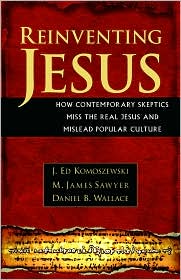
Reinventing Jesus: How Contemporary Skeptics Miss the Real Jesus and Mislead Popular Culture, by Daniel Wallace, M. James Sawyer, and J. Ed Komoszewski

I have not enjoyed reading a book this much since I Don’t Have Enough Faith to be an Atheist. Reinventing Jesus was released as a response to some of the claims made in The DaVinci Code (TDC), but unlike most of the other books released debunking TDC, this one deals with some of the more substantive issues raised by TDC with very little reference to the book itself.

Reinventing Jesus is divided into five sections:

1. Oral transmission of the Jesus story prior to the Gospels
2. The transmission and preservation of the NT text
3. How the NT canon was formed
4. What the early church thought about Jesu
5. Christianity is not an eclectic form of Greek mystery religions

Sections 2-3 are worth the price of the book. Daniel Wallace wrote the section on the NT text. He is one of the few NT textual critics in the world, so his personal insights are invaluable. James Sawyer wrote on the formation of the canon, a subject he has written about elsewhere.

The book is meant to be an introductory look at the issues. Often that means an intellectually watered down manuscript. Not this one. It is not lacking in intellectual vigor. No matter what your level of understanding, you will learn something from this book. The material is informative, and presented in a logical, clear manner. I give it five stars! Do yourself a favor and read it.

I would highly recommend you read a couple of blog posts (1 and 2) from Daniel Wallace at Parchment and Pen on the topic of textual criticism. Few are better equipped to address the issue than Wallace. He is very involved in the study of the Greek manuscripts, and very knowledgeable in the field of textual criticism.

Wallace notes that many Christians falsely define what a textual variant is, and misunderstand how textual critics have arrived at the conclusion that the NT text contains 300-400K variants. It is commonly believed that this number is so large because any given textual variant, when it appears in multiple manuscripts, is counted multiple times. So if a single variant in Romans 5:1 appears in 10 different manuscripts, it is counted as 10 variants. Not so. Read Wallace’s posts to uncover the truth about how textual variants are counted.

As opposed as I am to people using God’s name in useless ways such as an exclamation (“God!” or “Oh my God!”) or an expletive (“God d**n it!”), admittedly, this is not what Scripture means when it tells us not to take the name of the Lord in vain.


Read C. Michael Patton’s blog entry on this issue, particularly point #3. He makes it clear that while many of us would never think of saying “God d**n it,” we commonly take His name in vain without realizing it. Read it, and then think twice next time before you proclaim God told you such and such.

Back in May I posted a blog entry titled “Differences in the Gospels” in which I discussed some of the supposed contradictions the Gospels, and how they are not actual contradictions. As a case study I examined John’s report of Jesus baptizing in Judea. In one place he says Jesus baptized, while a little later he says it was Jesus’ disciples, and not Jesus Himself. If it was Luke rather than John who had noted that it was Jesus’ disciples, not Jesus Himself, who baptized, people would claim a contradiction between Luke and John. Since both appear in John, however, it is clear that there is no contradiction. It only illustrates the flexibility in which the Biblical authors reported historical events. John so no contradiction at all. I argued that this is illustrative of how we ought to view other supposed contradictions between the Gospels.

I just updated that post to include another example similar to the one above. In John 20:1 John only mentions Mary Magdalene as a witness to Jesus’ resurrection, while the other Gospel authors report a plurality of women (the lists differ as to who is identified). Some see this as a contradiction. And yet in the very next verse John records Mary as saying to the apostles, “We do not know where they have laid him.” While John only names Mary as a witness, he is clearly aware of the fact that there were more present than just Mary. Again, such ways of speaking should alert us not to be too rigid in our interpretation of the Gospels. We cannot impose modern standards of historiography on the apostles and the texts they created.

Beyond Death, by Gary Habermas and J.P. Moreland

This book is a comprehensive examination of the afterlife. The book begins with an examination of traditional arguments for the afterlife, showing both their strengths and weaknesses. It goes on to argue for the existence of the soul, as well as explore the nature of the soul.

The centerpiece of their case rests on near-death experiences. They detail many documented cases, as well as speak of the ongoing research in this area. This section is worth the cost of the book.

They also address the evidence for the resurrection of Jesus, reincarnation, and explore the nature of our existence beyond death.

The Missing Gospels: Unearthing the Truth Behind Alternative Christianities, by Darrel Bock

This book is an introductory look at the so-called lost Gospels some scholars claim challenge the very notion of Christian orthodoxy. The “new school” maintains that the early church held to a diverse set of beliefs, and those who call “orthodox” did not become orthodox until the third century via political maneuvering. The Missing Gospels attempts to show that the new school interpretation of Christian history is mistaken.

Bock contrasts the Gnostic materials with the Biblical and post-apostolic writings of the Fathers on four key ideas: (1) God and creation; (2) the person of Jesus as human and divine; (3) salvation; (4) the purpose of Jesus’ life and death. He concludes that the Gnostic materials present a radically different picture of Christianity than orthodoxy.

I would recommend this book for anyone interested in better familiarizing themselves with the Gnostic materials, as well as providing an answer to those who claim Gnosticism was one of a variety of original Christianities.

Oneness Pentecostals (OPs) understand Matthew 28:19 to refer to the name of Jesus Christ. Jesus said we are to be baptized in the name (singular) of the Father, Son, and Holy Spirit. He did not say names (plural), which we would expect grammatically if He literally wanted us to repeat “in the name of the Father, Son, and Holy Spirit” over the baptizee. His use of the singular “name,” as well as the context indicates He had a singular name in mind: His own = Jesus. Looking at how the apostles obeyed His command confirms this interpretation, for they always and only baptized in the name of Jesus Christ.

I’m taking this as a given. What I want to focus on is how “Jesus” is the name of the Father, Son, and Holy Spirit. OPs often interpret this verse to mean the name of the Father is Jesus, the name of the Son is Jesus, and the name of the Holy Spirit is Jesus. I am not persuaded this is the correct interpretation. Such an interpretation is foreign to the rest of Scripture. While Scripture identifies the name of the Son as Jesus, nowhere does it identify “Jesus” as the name of the Father and the name of the Holy Spirit. In fact, Scripture consistently uses Jesus/Son in contradistinction to Father and Holy Spirit. Jesus is used to refer to God’s human mode of existence as the Son/Messiah. Father is used to refer to God’s supracarnate existence (i.e. God’s existence beyond the incarnation). Scripture does not call the Father “Jesus” anymore than it calls Jesus “Father.” While Scripture teaches us that Jesus’ deity is the deity of the Father, it consistently distinguishes between the appellations “Father” and “Jesus” because these appellations are representative of the distinction in the uni-personal God’s modes of existence. To confuse the appellations is to confuse God’s two modes of existence: as God, as man. If we interpret Matthew 28:19 to mean the name of the Father is Jesus, however, we are doing just that: confusing the existential distinction between God’s existence as God, and His existence as man. If Scripture uses the name Jesus to refer to the Son and only the Son, we should not use it to refer to the Father and Holy Spirit as if it equally applies. While we may understand God to be one person, and recognize that Jesus’ deity is that of the Father, it does not give us license to use Biblical terms in unbiblical ways.


If you accept my reason for questioning the traditional interpretation, how do you think we should understand Jesus’ words? I have my own take on it, but I want to hold off sharing it until after I hear from you.


If you object to my reason for objecting to the traditional OP interpretation, and maintain the traditional view, what do you find problematic about my objection? Do you have any reasons you can provide me for accepting the traditional OP interpretation?

In Jesus’ debate with the Sadducees, He defended His resolve that the dead are raised by quoting from Exodus 3:6. Luke records Jesus as saying, “But even Moses revealed that the dead are raised in the passage about the bush, where he calls the Lord the God of Abraham and the God of Isaac and the God of Jacob. Now he is not God of the dead, but of the living, for all live before him.” (Luke 20:37-8, NET Bible).


Jesus’ argument seems to be as follows:


(1) God can only be “the God of…X”, if X exists

(2) God identified Himself as the God of Abraham, Isaac, and Jacob centuries after their death

(3) Therefore, Abraham, Isaac, and Jacob still existed when God spoke to Moses


I don’t see how Jesus’ argument supports His resolve. At best, Jesus demonstrated that man is a dualistic being whose immaterial self lives on beyond death (something the Sadducees denied). But how does it follow that the dead will rise? It could be that they continue in their non-corporeal state for time everlasting. It seems to me that Jesus would have to supply another argument to demonstrate why it is necessary for these non-corporeal persons to return to a bodily existence. No such argument is given.


I confess some trepidation in even writing this, but I don’t find Jesus’ argument persuasive. And yet when you read the text, Jesus’ opponents found it extremely persuasive. They were not able to offer any rebuttal. Am I missing something here? I do not want to say Jesus’ argument missed the point, but I cannot deny the fact that his argument appears to fall short of its intended goal. Does anyone have any insight on this passage they would like to offer me?

A blogger asked a question in the comments section of the “The Oneness of God and Baptism in Jesus’ Name are not Joined at the Hip” thread that deserves its own post. The question had to do with the validity of hybrid baptismal formulas.

Do you think it is acceptable to baptize someone with either of these hybrid baptismal formulas?:

  1. “I baptize you in the name of the Father, the Son, and the Holy Spirit, which is the name of Jesus Christ.”
  2. “In the name of Jesus Christ, I baptize you in the name of the Father, and of the Son, and of the Holy Spirit.”

Why or why not? Do you think someone who was baptized with such a formula is saved? Would you require them to be rebaptized?

I would like to hear your thoughts on this matter.

I remember hearing one of my college teachers say concerning humility, “Humility is one of those things that if you think you have it, you don’t.” I was uncomfortable with that statement. While there was a ring of truth to it, there was also something about it that didn’t seem right, but I couldn’t quit put my finger on it. That was years ago. Just today, however, as I was reflecting on the issue, I think I finally pinpointed why I was uncomfortable with that statement.

We are commanded to be humble, and to resist pride (humility is the absence of pride). The way we know we have obeyed Scripture is by introspection and reflection. For example, Scripture tells us to be patient. We assess our obedience to this command by reflecting on our disposition when confronted by events that put our patience to the test. If, upon reflection, we think we exhibited patience under those circumstances, we conclude that we have obeyed the command to be patient.

The same is true of humility. The only way we could know if we were obeying the command to be humble is if, upon introspection and/or reflection, we recognize the absence of pride in our life. If, however, the moment we think we have obeyed the command to be humble we instantiate or reveal pride, we could never be humble.

The only way out of this vicious cycle is to forego assessing ourselves in this area—to consign everyone to perpetual ignorance concerning their state of obedience. For the moment we assess ourselves, we risk losing the progress we have made. This is counter-intuitive. How can it be that the only way to obey Scripture is to not think one is obeying Scripture?

My teacher’s aphorism would mean that for a truly humble person to remain humble, they must think they are prideful. The moment they recognize the presence of humility in their life they lose their humility. In other words, on this view, one must think they are being disobedient in order to be obedient! The moment they think they have obeyed they have disobeyed. I find no sense in that. What other virtue is there that one must have, but cannot think they have it in order to have it? What other virtue are we commanded to have, but can never think we have obtained it? I know of none, and I highly doubt this is the one exception.

This is not to say there was no truth in what my teacher said. Indeed, I think one could become proud about their humility, but of course, in this case, they were never humble to begin with. They are deceiving themselves. This is vastly different from someone who desires to rid themselves of pride, and upon assessment, believes they have made great progress in this area.

All of my Pentecostal life I have heard how the issues of baptism and the Oneness of God are joined at the hip. It’s been taught over and over again that one will not “see” baptism in Jesus’ name until they “see” the Oneness of God. That idea never sat quite right with me. I saw the connection, but did not see any logical connection. While an understanding of the Oneness of God is sufficient to see that we are to be baptized in Jesus’ name, I do not think it is necessary to see that we are to be baptized in Jesus’ name.

One not need not believe in the Oneness of God to see the validity of Jesus’ name baptism (I have heard there are Trinitarian churches that baptize in Jesus’ name, although I cannot point to any specific church). Indeed, even if God were a Trinity, it would not change the fact that the intended baptismal formula is the Jesus’ name formula. Think of prayer. The Bible is clear that prayer is to be “in Jesus’ name.” No Trinitarian argues that since God is a Trinity, one should pray “in the name of the Father, Son, and Holy Spirit.” They accept the teaching of Scripture that prayer is to be said exclusively in Jesus’ name, and do not see that as detracting from the Trinity. Likewise, the Jesus’ name formula-if the intended formula-poses no challenge to Trinitarian theology.

The question of how many persons are in the Godhead and the question of the proper baptismal formula are two related, but separate issues. To determine the number of persons in the Godhead we examine those passages that teach us about God. To determine the proper baptismal formula we look to those passages that instruct us on that matter. When we do, it becomes apparent that the early church interpreted Jesus’ command in Matthew 28:19 to baptize in the singular name of the Father, Son, and Holy Spirit as a command to baptize in Jesus’ own name, as evidenced by their exclusive use of the Jesus’ name formula in evangelism.

The Jesus’ name formula makes sense given the purpose of baptism: to identify us with Christ’s death, burial, and resurrection (see Romans 6:1-4). In Trinitarian theology, the Father and Spirit did not die, were not buried, and were not resurrected. It was only Jesus. Therefore, even on a Trinitarian view it would be entirely reasonable to be baptized only in the name of Jesus.

I think all can agree that baptism in Jesus’ name makes more sense on a Oneness view of God, but the fact remains that both Trinitarians and Oneness believers alike can see (1) that the Jesus’ name formula is taught in Scripture, (2) that it is the authoritative apostolic interpretation of Jesus’ words in Matthew 28:19, (3) and that it makes theological sense to be baptized using the Jesus’ name formula given the purpose of baptism. We should continue to reach out to Trinitarians to help them understand the nature of God more perfectly, but we should not think their ability to see the validity of Jesus’ name baptism depends on their ability to see the Oneness of God.

« Previous PageNext Page »