During his recent debate with William Lane Craig on the topic “Is there Evidence for God,” physicist Lawrence Krauss claimed that only empirical data is an acceptable form of evidence.  Given our culture’s proclivity toward empiricism and naturalism, I doubt that most found Krauss’ epistemic principle controversial.  I think it is highly controversial, however.

First, to say empirical data alone counts as evidence is to relegate the entire discipline of philosophy to the ash heap of epistemic irrelevance.

Second, it seems to have escaped Krauss’ attention that his epistemic principle is itself a philosophical claim, not an empirical finding.  Indeed, what empirical evidence could he offer in its support?  None.  There is no empirical evidence to (more…)

Abort73.com is known for using powerful visuals to demonstrate the gravity of abortion.  Now they’ve used their talent to create a video that tackles the common misconception that the unborn are just a clump of cells in the first trimester of pregnancy.  Check it out.


Pro-life advocates often scoff at fetal homicide laws, arguing that they represent just how schizophrenic our legal system is when it comes to the unborn.  On the one hand our legal system says the unborn are not persons, and therefore they can be killed per the mother’s request.  On the other hand, fetal homicide laws treat the unborn as a person, allowing for an individual who kills an unborn child without the mother’s consent to be prosecuted for murder.  The legal distinction is based almost entirely on the mother’s will.  If she wants the child, it is illegal for someone else to kill it.  If she does not want the child, it is legal for someone else to kill it.

While I am pro-life, I want to argue that the current law is consistent in its treatment of abortion and fetal homicide.  Just because the unborn are not deemed persons with legal status—and can be killed at the mother’s request—does not mean the state could or should allow anyone to kill an unborn child without consequence.  If the unborn is not a person, then it is property[1], and the same laws we apply to property must be applied to the unborn as well.

(more…)

McCormick Professor of Jurisprudence at Princeton University, Robert George, et al have written what is arguably one of the best defenses for the traditional understanding of marriage available in print.  Titled “What is Marriage?”, this paper was first published in the Harvard Journal of Law & Public Policy, and later expanded into a book by the same title.[1]

I’ve often said the reason support for same-sex marriage has grown so fast in the West is because our culture has long forgotten what marriage is.  George et al understand that when it comes to the marriage debate, everything hinges on the question, What is marriage?  Does marriage have a fixed nature independent of cultural norms, or is it a mere social construction that can be whatever society wishes it to be?  The authors rightly begin their paper by defining and contrasting these two perspectives (what they call the “conjugal view” and “revisionist view”):

(more…)

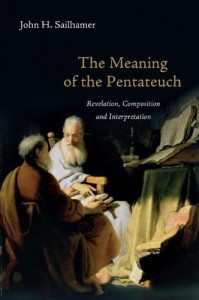
Not many months ago I finished reading John Sailhamer’s The Meaning of the Pentateuch.  If you are only going to read one book on the Pentateuch, this should be it.  Prior to reading this book I can honestly say I never saw much more than a chronological structure in the books, and never saw how the five books fit together.  Sailhamer has illuminated the meaning of the Pentateuch in a way I never thought possible.

Sailhamer argues that the structure of the Pentateuch reveals the meaning of the Pentateuch.  While most of us think the purpose of the Pentateuch is to record the Law of Moses for Israel, Sailhamer argues convincingly that this is not Moses’ primary intention (if it were, the inclusion of Genesis would be inexplicable).  The Pentateuch was not the first written record of the Law (Dt 27:1-8), and it was written well after the giving of the Law at Sinai, so its purpose must go beyond a mere record of the Law.  Sailhamer argues that the structure of the Pentateuch reveals that its primary purpose was to confront its readers with their inability to keep the Law, and the need to live a life of faith while they wait for the promised seed: the future king from Judah (Gen 15:6; Ex 19:9; Num 14:11; 20:12).  The golden calf incident lies at the heart of the Pentateuch, exposing the heart of Israel’s problem: their heart.  That’s why the Pentateuch ends with an acknowledgment that something needs to be done with the human heart for people to be able to keep God’s covenant (Dt 30:6).

(more…)

The other day a bizarre question popped into my mind: Is zero a number?  On one level, the answer is obviously yes.  Zero is not a letter, a flower, or a molecule.  It is in the class of things we call numbers.  While zero might be considered a number for classification purposes, does it truly exist in the real world?  While I can point to three eggs and say, “Here are three eggs,” I cannot point to some X and say, “Here are zero Xs.”  Zero does not correspond to anything in reality, because zero signifies the absence of reality.  To say one has zero eggs is just a mathematical way of saying one does not have any eggs.

Of course, the same could be said of negative numbers like -1, -5, or -100.  These numbers have no correlates in the real world.  You will never find -5 apples.  Negative numbers exist only in the mind.  Of course, the same could be said of all numbers.  While I can point to three eggs, five cows, or 17 cups, in none of these cases will I have located the numbers 3, 5, or 17.  I will have only found instances in which a specific numerical value is exemplified by particular objects.

(more…)

Pete Stark has introduced a bill in the U.S. House of Representatives that would prohibit any foster care or adoption agency who receives government funding (or is associated with an entity who does) from discriminating against prospective foster/adoptive parents on the basis of sexual orientation, gender identity, or marital status.  This is not the first time he has introduced a bill like this, so we’ll see what becomes of it.  But if this is passed, it will force many agencies to shut down their doors or violate their ethical principles.  As I wrote about previously, the debate over same-sex marriage and homosexuality matters, and has practical consequences that affect us all.

Go here for a legal analysis of the bill.

Gallup just released a new poll on abortion.  Historically, more Americans have identified themselves as “pro-choice” than “pro-life.”  This trend reversed in 2009.  For example, last year 47% of American adults identified themselves as “pro-life,” and 45% identified themselves as “pro-choice.”  The new poll indicates that the tables have reversed themselves again.  Now a slight majority self-identify with the pro-choice label (49% vs 45%).

While labels are helpful in gauging public opinion, people have different understandings of what “pro-life” and “pro-choice” mean.  For example, someone could understand these terms to refer to one’s position on the legality of abortion, in which case a person who is personally opposed to all abortion but thinks people should have the legal right to an abortion may identify as “pro-choice.”  The real test of Americans’ views on abortion comes to light when more specific questions are asked.  For example, when asked whether abortion is morally wrong, 51% agreed while only 39% disagreed.  This confirms that many adopting the pro-choice label do so as a reflection of their political views related to abortion, not their moral views.

(more…)

Justice Lamberth

Last summer I informed you that Justice Lamberth ruled Obama’s embryonic stem cell policy illegal, arguing that it violated the Dickey-Wicker amendment which prohibits the use of federal funds for destructive embryo research.  Lamberth slapped a preliminary injunction on the policy, suspending all use of federal money for embryonic stem cell research.  Shortly after, an appeals court lifted the injunction while they were considering the appeal against Lamberth’s decision.  On April 29, the U.S. Court of Appeals in Washington finally ruled against Lamberth’s interpretation of the Dickey-Wicker amendment, 2-1.  President Obama’s policy stands.

Given the number of non-apology apologies that are routine today, I must commend Ed Schultz for offering a truly apologetic apology to Laura Ingraham for calling her a slut on his radio program.

It appears that Harold Camping has gone the way of so many other false prophets in spiritualizing his false prediction.  The AP quoted Camping as saying, “”We’ve always said May 21 was the day, but we didn’t understand altogether the spiritual meaning.  The fact is there is only one kind of people who will ascend into heaven … if God has saved them they’re going to be caught up.”  The AP added, “The globe will be completely destroyed in five months, he said, when the apocalypse comes. But because God’s judgment and salvation were completed on Saturday, there’s no point in continuing to warn people about it, so his network will now just play Christian music and programs until the final end on Oct. 21.”  How convenient.

I wonder what his excuse will be when 10-21 comes and goes without incident?

When it comes to abortion, we always hear about women’s rights.  Currently, the law allows a woman to abort her child without the father’s knowledge or consent.  Fathers are completely excluded from the decision.  Why are fathers’ rights being denied?  For example, fathers who want to abort their child – but are prevented from doing so because the mother will not consent to an abortion – lack both the freedom to determine the fate of the child they co-created as well as the freedom to decide whether to financially support the child.  Why should a man be legally obligated to pay for a child that he did not want?  If a woman can abort a child she does not want to support or care for, why can’t a man?  If a father cannot choose to abort his child, then he should not be forced to support it.  The law unfairly discriminates against men by saying fathers have no rights to determine the fate of their children in utero, and yet also saying fathers have obligations to their unwanted children after birth.

(more…)

I’m sure you’ve heard about it.  Harold Camping has predicted that judgment day is tomorrow, May 21.  He and his followers are expecting the rapture to happen, but it won’t.  Unfortunately, many Christians’ hopes will be dashed, and some will probably give up their faith in Christ.  His followers should have learned from his first false prediction that the Lord would return in 1994 that Camping is a false prophet.

I would love to hear Camping’s radio program on Monday.  What kind of calls is he going to get?  I would imagine that he’d receive calls from irate followers who spent their life savings to advertise “the end” Camping predicted and guaranteed.  There will be irate callers who racked up their credit cards in expectation that they would never have to pay them back.  There will be scoffers who just want to rub it in his face.  It’s my understanding that the day after his 1994 prediction failed, Camping acted like nothing happened on his radio show.  Perhaps he’ll do the same again.  Or perhaps he’ll decide it’s time to retire.  Hopefully the latter.

A mother whose unborn child was diagnosed with spina bifida tells her story of the choice to abort:

I said at that stage, a termination was out of the question. I felt such strong love for this baby already and I wanted to nurture and protect him. … As an adult, I felt a woman should have the right to terminate a pregnancy — but that was a view forged from rational thought, not personal experience. I never once imagined it was anything I would do.  I believed that choosing to keep a baby, whatever its disability, was the mark of a good mother. How fate mocks our lofty ideals.
(more…)

A popular maxim advanced by naturalists and atheists is that “extraordinary claims require extraordinary evidence.”  This maxim is often invoked in discussions about the existence of God and the resurrection of Jesus.  These are extraordinary claims, they say, and thus require extraordinary evidence.  Not surprisingly, those who advance this maxim think Christian theists have failed to provide the required evidence.

J.W. Wartick wrote a nice article questioning the truth of this maxim.  He notes that on first blush the maxim seems obviously true, but upon further reflection it can be shown to be obviously false.  Consider the claim that I am a giant pink salamander.  This is an extraordinary claim, and yet the claim could be evidenced in rather ordinary ways.  For example, one could come to my home and observe me.  If I appear to be a giant pink salamander (one who talks and types), then the extraordinary claim is justified.  If one is not convinced by their eyes, then perhaps they could take a DNA sample and compare it to other salamanders.  Such evidence is ordinary, but sufficient to verify the rather extraordinary claim that I am a pink salamander.  It is false, then, that extraordinary claims require extraordinary evidence.  All that is required to justify an extraordinary claim is sufficient evidence.

(more…)

On Tuesday May 10, 2011, the Presbyterian Church (USA) changed its ordination requirements to allow open homosexuals as clergy.  They are the fourth major church body to do so (following the lead of the Episcopal Church (US), the United Church of Christ, and the Evangelical Lutheran Church in America).

HT: Albert Mohler

Theists argue that the fine-tuning of the physical constants of the universe provide evidence that the universe is designed.  For example, if gravitational force was 1/100,000,000,000,000th (1/100 trillionth) degree stronger the universe would not have expanded to form the terrestrial bodies.  If the force was 1/100,000,000,000,000th degree weaker the universe would expand at rate too fast for matter to coalesce into terrestrial bodies.  The ratio of electrons to protons is fine-tuned to 1 part in 1037, meaning if the ratio was altered by just 1 part in 10,000,000,000,000,000,000,000,000,000,
000,000,000 complex life would not be possible.

To give you a sense of the specificity involved, Hugh Ross asks us to imagine covering the entire North American continent with dimes, all the way up to the moon (239,000 miles high).  Do the same thing on 1,000,000,000 other continents of identical size, “[p]aint one dime red and mix it into the billion of piles of dimes.  Blindfold a friend and ask him to pick out one dime.  The odds that he will pick the red dime are one in 1037.”[1]

(more…)

I was directed by Justin Taylor to a post by Trevin Wax discussing common urban legends propagated by preachers.  I went to the list expecting to have a good laugh.  And I was not disappointed.  Wax spoke of the “the eye of the needle was a gate in Jerusalem” legend, the “rope-around-the-high-priest’s-ankle” legend, and the “scribes took baths before writing the divine name” legend.  Oh how I chuckled!

(more…)

For a long time I have been wanting to read Harold Hoehner’s standard work on the chronology of Christ, Chronological Aspects of the Life of Christ.  I finally got around to purchasing and reading the book.  Here is my summary of his arguments for dating the birth (5 BC), ministry (AD 29-33), and death of Christ (AD 33).  Text in “[]” reflects my own thoughts/research.

Date of Christ’s Birth

Jesus was born while Herod was still alive (Mk 2:1; Lk 1:5).  Herod was declared king in 40 BC byRome, and took physical control of Palenstine in 37 BC.  He reigned 34 years.

Josephus tells us there was an eclipse shortly before Herod died.  The eclipse occurred on March 12/13, 4 BC.  He also tells us the Passover was celebrated shortly after (April 11, 4 BC).  So Herod died sometime between mid-March and early April, 4 BC.  Jesus must have been born before this.  (more…)

Some have made the claim that an acrostic of the accusation Pilate wrote above Jesus’ cross spells “YHWH.” (example).  There is at least one reason to seriously question the claim, and a second reason that proves it false.  Let me deal with each in turn.

One reason to question this claim is the fact that we cannot be certain what was actually written on the titulus (the placard on which the victim’s crime was recorded) above the cross.  The evangelists do not present us with a single version of what was written:

  • Matthew: “This is Jesus, the king of the Jews” (27:37)
  • Mark: “The king of the Jews” (15:26)
  • Luke: “This is the king of the Jews” (23:38)
  • John: “Jesus of Nazareth the king of the Jews” (19:19)

(more…)