How the article ends gives you a good sense of it: “We wouldn’t dream of dropping our daughters off at college and saying: ‘Study hard and floss every night, honey—and for heaven’s sake, get laid!’ But that’s essentially what we’re saying by allowing them to dress the way they do while they’re still living under our own roofs.”—Jennifer Moses.


HT: Justin Taylor


Oxford professor of chemistry, Peter Atkins (atheist) recently engaged in dialogue with Oxford professor of mathematics, John Lennox (theist), on the question of God’s existence.  While atheists such as Atkins often portray their atheism as being the result of being brave enough to follow the evidence to where it leads, at one point in the debate Atkins showed his true hand.

LENNOX: Do you think it’s an illegitimate thing from a scientific perspective…to see whether scientifically one can establish whether intelligence needs to be involved in the origin of life?

ATKINS: … Let’s just take the laws of nature as available.  And seeing that, letting them run free in the environment that we can speculate existed…billions of years ago, and seeing whether that sort of process leads to life.  And if it does, that seems to me to abrogate the need for the imposition of intelligence.

LENNOX: And if it doesn’t?

ATKINS: Then, if we go on trying (we may have to try for a hundred years), and if in the end we come to the conclusion that an external intelligence must have done it, then we will have to accept that.

LENNOX: Would you be prepared to accept that?

(more…)

Ponce de Leon may not have discovered the fountain of youth, but life just got younger nonetheless.  Scientists have long held that life has existed on Earth for 3.5 billion years based on what was thought to be fossilized bacteria discovered in a rock in Australia.  That research has been called into serious question by new research.  Geologists at the University of Kansas have concluded that the structures in question are hematites (a mineral), not bacteria.  If their findings are confirmed, then life will be downgraded from 3.5 billion years old to 2 billion years old.

This is both good and bad for materialists.  (more…)

I’m sure you’ve heard that Christians have the same divorce rate as non-Christians.  I’ve long suspected that this is a myth driven by a poor definition of “Christian.”  Many people are only nominal Christians; i.e. while they profess to be a Christian, there is little evidence from their conduct and beliefs that they are.

It seems my suspicions are correct.  The Pew Forum released a summary of recent reassessments of the data that found a strong correlation between church attendance and divorce rates. Brian Wilcox, director of the National Marriage Project at the University of Virginia, concluded that “Americans who attend religious services several times a month were about 35 percent less likely to divorce than those with no religious affiliation.”

In an earlier post I argued that the nature of science is such that it cannot demonstrate an entity/event to be uncaused, and thus scientific discoveries can never inveigh against the causal premise (“whatever begins to exist has a cause”) of the kalam cosmological argument (KCA) for God’s existence.  Here I want to extend the discussion to the cosmological premise (“the universe began to exist”) of the KCA as well.

The contrapositive of the second premise is “the universe is eternal.”  The nature of science, however, renders it incapable of demonstrating the universe to be eternal even if the universe were eternal.  Why?  Science is an empirical discipline based on what can be observed and quantified.  For science to prove that the universe is eternal, it would have to do so empirically.  But this is impossible.  An eternal past cannot be observed or quantified.

(more…)

The four gospels contain a lot of Jesus’ teachings on a variety of topics.  What do you consider to be the most important things Jesus taught or did?  I’m not looking for generalities such as “His moral teachings,” but specifics such as “Jesus’ teaching that we are to love our enemies as found in Mt 5:43-44.”


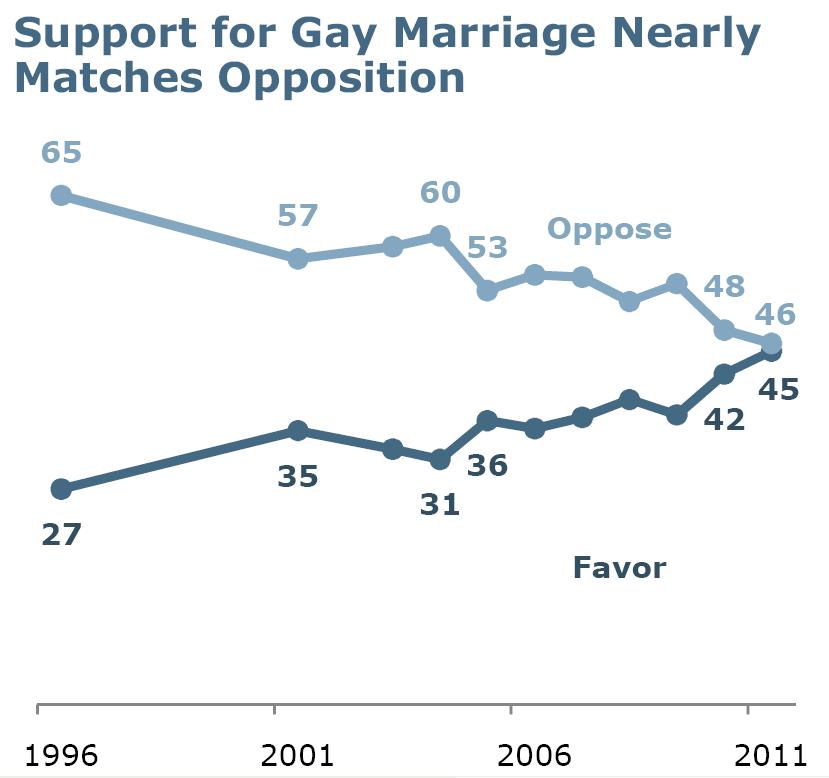
The most recent polling data from the Pew Research Center has found that support same-sex marriage has risen to 45%, up from 42% last year.  Opposition currently stands at 46%.  As you can see from the chart, support for same-sex marriage has steadily increased, and opposition has steadily decreased since 1996.  It doesn’t take a prophet to predict that unless social conservatives start making a persuasive case in the public square real quick, those who oppose same-sex marriage will be in the minority within two years.  In some parts of the country (Northeast, West), this has already happened.

Support for abortion rights has also risen back to 2008 levels, after a substantial dip in 2009 (47% in 2009, 54% now).  I have a feeling the dip in 2009 was due to some sort of sampling error.  It seems too unlikely to me that public opinion would change so fast, and then change back just as quickly.

I was directed to an article that reports on a recent survey by the American Academy of Matrimonial Lawyers that found Facebook is being cited in 1 out of every 5 divorce cases.  Apparently a lot of people are becoming emotionally and physically involved with an old friend or boyfriend/girlfriend they friended on Facebook.  It makes sense.  So maybe that pastor who asked his congregation to delete their Facebook accounts wasn’t so crazy after all.


The kalam cosmological argument (KCA) for God’s existence goes as follows:

(1) Anything that begins to exist requires a cause
(2) The universe began to exist
(3) Thus, the universe requires a cause

Additional reasoning leads us to conclude that the cause of the universe is God.  Given that whatever caused space, time, and matter to begin to exist cannot itself be spatial, temporal, or material.  Furthermore, whatever caused our orderly universe to come into being a finite time ago must be immensely powerful, intelligent, conscious, and hence personal.  These are apt descriptions of a being theists have long identified as God.

Some seek to undermine this causal argument for God’s existence by denying the first premise.  They point to quantum mechanics and virtual particles as evidence that there are exceptions to the causal principle.

(more…)

One of the distinct features of the canonical gospels is the amount of geographical and temporal details they contain.  They do not just tell you the things Jesus said and did, but they tell you where and when He did them.  This is in stark contrast to many of the Gnostic gospels such as The Gospel of Thomas which provide few (if any) details regarding geography and time.

I have spent a lot of time in the past six months studying and comparing the four Gospels.  In the course of my studies, I noticed that certain evangelists seem to provide more geographical and temporal markers than other evangelists, so I thought it would be interesting to catalogue all of the geographical and temporal markers in the Gospels to determine who provided the most detail.

(more…)

My last post was about the importance of the debate over same-sex marriage.  While many people (including Christians) think it does not matter, I argued that the legalization of same-sex marriage will have a large impact on society as a whole, as well as Christian freedoms.

In that vein, I just read this story today coming out of Britain.  A Christian husband and wife, Eunice and Owen Johns, have been denied the right to serve as foster parents due to their convictions against homosexuality.  While they have provided foster care to 15 children in the past, social workers recommended that they not be allowed to care for children in the future because they would not agree to instruct those children that homosexuality was morally acceptable.  According to the article “Lord Justice Munby and Mr Justice Beatson ruled that laws protecting people from discrimination because of their sexual orientation ‘should take precedence’ over the right not to be discriminated against on religious grounds.”

(more…)

When it comes to controversial subjects, it’s not often that those of one persuasion will cede the objections offered by those of a contrary persuasion.  The cogency of some objections is so strong, however, that those of one persuasion will cede the merits of their opponents’ objection even though they do not cede the merit of their opponents’ position.  I have found this to be the case with the debate over same-sex marriage.  Many opponents of same-sex marriage cede some of their opponents’ objections to prohibiting the legal recognition of same-sex partnerships as “marriage.”  While several come to mind, the one I want to discuss is what I call the irrelevancy objection: recognizing same-sex relationships as “marriage” will not affect your marriage or society-at-large, so why make a big deal about it?

Is the debate over same-sex marriage irrelevant?  What do we stand to gain or lose in this cultural/moral/political battle?  What would the fallout be if same-sex marriage becomes the law of the land?  I think we would feel the effects in two main areas: (more…)

I have made two attempts at offering a rational argument for monotheism.  The first one failed, and Scalia challenged my second one.  I did not respond to his challenge immediately because I knew it would require some additional thought.  After putting it off for a while I have given it some additional thought, and concluded that my second attempt failed as well.   

I’ve been working on some additional arguments, but haven’t thought them through entirely.  If you were following the previous post, you might be interested in checking out the comments section again for my response to Scalia’s objection, and my new proposals.  Hopefully you can weigh in on their strengths and weaknesses.  If they seem to be sound, perhaps I’ll make them the subject of another post, “Omnipotence and Monotheism III”!

The National Council of Church’s report on church membership lists the following organizations as the top ten biggest religious denominations in the U.S.A.: 

  1. The Catholic Church: 68.5 million
  2. Southern Baptist Convention: 16.1 million
  3. The United Methodist Church: 7.8 million
  4. The Church of Jesus Christ of Latter-day Saints: 6 million
  5. The Church of God in Christ: 5.5 million
  6. National Baptist Convention, USA: 5 million
  7. Evangelical Lutheran Church in America: 4.5 million
  8. National Baptist Convention of America: 3.5 million
  9. Assemblies of God: 2.9 million
  10. Presbyterian Church (USA): 2.7 million

I was surprised by the large gap between the number one and number two slots, and I was astounded to learn that Mormonism is the 4th largest denomination in America.  

HT: Theology in the News

That’s a name I never thought I would mention on this blog!  No, I’m not a fan.  I’m male and 35 years old, so I’m out of his target audience by 20 years and one gender!  But I was pleased to read this morning that in his interview with Rolling Stone magazine Bieber came out candidly in favor of the pro-life position.  Bieber confessed, “I really don’t believe in abortion. It’s like killing a baby?”  When asked about cases in which rape was involved Bieber was a little less sure of himself, but still came out on the pro-life side: “Um. Well, I think that’s really sad, but everything happens for a reason. ‘I don’t know how that would be a reason. I guess I haven’t been in that position, so I wouldn’t be able to judge that.”

It’s nice to hear a mega-star (especially a young one) voice his support for the pro-life side.  While I do not look to a 16 year old pop star for sound moral advice, there are millions of teenage girls who will bank on his every word.  I hope they hear about this interview and are influenced by his thinking in a good way.  

HT: Jivin Jehoshaphat

Homosex advocates often try to argue their case theologically.  One of the most popular arguments is based on the love of God “If God is love,” they ask, “why would He deny me the opportunity to love and be loved?”  While this is emotionally compelling, it is not theologically or logically compelling.  Three points should be made in response.  First, even if we find it difficult to reconcile God’s desire for us to give and receive love with God’s prohibition against homosex, the fact remains that He has specifically and clearly prohibited us from engaging in homosex.

Secondly, why think homosex is truly loving?  If homosex results in physical, emotional, and spiritual degradation, then engaging in homosex is anything but loving.

(more…)

In the cultural battle between those who oppose and those who approve of homosexual behavior, homosex advocates often describe their ideological opponents as “homophobic” and label them as “homophobes.”  In addition to the fallacious nature of such an argument (commits the ad hominem fallacy), the charge itself is false.  A phobia is an irrational fear of something.  Those who suffer from arachnophobia have an irrational fear of spiders.  Those who suffer from claustrophobia have an irrational fear of small spaces.  Would it be accurate, however, to describe those who disapprove of homosex as having an irrational fear of homosex or homosexual persons?

In all my years of trafficking among people who oppose homosex, I have yet to meet a single individual who is genuinely fearful of homosex and/or homosexual persons.  While such individuals may exist, surely their numbers are exceedingly small, and thus they should not be used to characterize opponents of homosex generally.  It is not fear, but a sense of moral disapproval and/or personal revulsion to the act of homosex that drives most anti-homosex proponents.  This is the same basis on which most homosexuals would oppose incest and pedophilia.  In the same way that their opposition to these sexual practices should not be labeled incestophobic and pedophiliophobic, those who oppose homosex on moral or personal grounds should not be labeled homophobic.  It is a misuse of language.

(more…)

Christians are often accused of being judgmental by non-Christians—and sometimes, even by fellow-Christians.  Indeed, it’s not uncommon to even hear non-Christians quote Jesus’ words in Matthew 7:1 against Christians: “Judge not, lest you be judged.” (even if they’ve never read a page from the Bible in their life!)  I am persuaded that both the church and the culture at large have failed to understand the Biblical teaching on judgmentalism.  Before I explain, let’s look at a few more Biblical passages often cited in support of non-judgmentalism:

1 Cor 4:3-5 But with me it is a very small thing that I should be judged by you or by any human court. In fact, I do not even judge myself. 4 For I am not aware of anything against myself, but I am not thereby acquitted. It is the Lord who judges me. 5 Therefore do not pronounce judgment before the time, before the Lord comes, who will bring to light the things now hidden in darkness and will disclose the purposes of the heart. Then each one will receive his commendation from God. (ESV)

1 Cor 5:12-13 For what have I to do with judging outsiders? Is it not those inside the church whom you are to judge? 13 God judges those outside. “Purge the evil person from among you.” (ESV) [talking about executing punishment]

James 4:11-12 Do not speak evil against one another, brothers. The one who speaks against a brother or judges his brother, speaks evil against the law and judges the law. But if you judge the law, you are not a doer of the law but a judge. 12 There is only one lawgiver and judge, he who is able to save and to destroy. But who are you to judge your neighbor? (ESV)

(more…)

In today’s society everyone seems to be hyper-sensitive to judgmentalism.  The minute you tell someone you disagree with something they are doing, you are accused of being judgmental.  Of course, it always escapes their notice that they are judging you for being judgmental, so they are guilty of both judgmentalism and hypocrisy!  But the problem runs deeper than mere self-contradiction.

As the term is commonly used today, judgmentalism is thought to be limited to expressions of moral disapproval of X, or attempts to correct some person P for doing X.  In reality, judgment involves both moral disapproval and moral approval.  Judgment requires that we distinguish what is right/good from what is wrong/evil.  Judgments are involved when you say X is good, as well as when you say X is bad.  Indeed, the only way to say some X is good is if you know what bad is, and know X is not that.  The only way to avoid making judgments is to make no moral distinctions whatsoever.  No sane person can do this, nor is this a worthy goal.  Moral judgments are indispensable to a healthy society.

(more…)

As someone who supports Intelligent Design theory, I have often been puzzled by the many Catholic thinkers who do not.  The scientific basis for ID is strong, and ID is just as friendly to their theism as it is friendly to mine, so why do so many Catholic scholars reject ID, or at least have such strong reservations against it?  A recent essay by Edward Feser in Philosophia Christi[1] has enlightened me regarding the main source of contention between Catholic theology and ID theory, and it boils down to Aristotle, Thomas Aquinas, and final causation.

Feser explains that Thomists (those who follow the theological system of Thomas Aquinas, who followed the philosophy of Aristotle) believe teleology inheres within all substances (final cause) and is evident to rational minds, whereas ID theorists believe teleology must be imposed on substances from an external source (no final cause), and can only be detected empirically through various probability assessments (not evident).

(more…)