Science


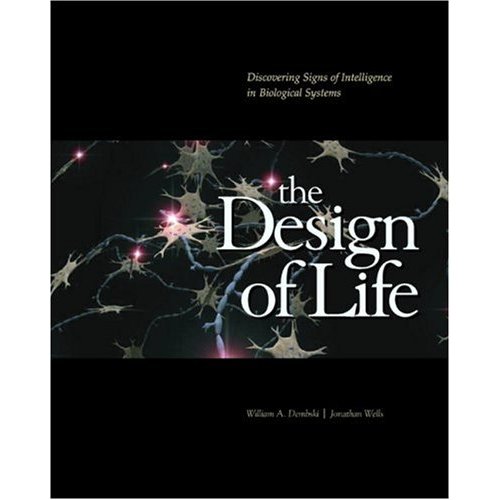
I just finished reading The Design of Life: Discovering Signs of Intelligence in Biological Systems by William Dembski and Jonathan Wells (which someone was kind enough to buy me from my Ministry Resource List!).  This book was a joy to read!  I’ve been following the Intelligent Design vs. Darwinism debate for a long time, and I’ve read a good number of books and countless articles and blog entries on the subject.  So to be honest, I wasn’t expecting to glean a lot of additional insight from The Design of Life.  But I couldn’t have been more wrong.  My highlighter got a real workout with this book!

The Design of Life is essentially a textbook on Intelligent Design.  Most of the resources I have read on the topic deal with a specific subject: Darwin’s Black Box looks at irreducible complexity as an indication of intelligence; Edge of Evolution examines the power of random mutation and natural selection to produce novel biological changes; Signature in the Cell examines the origin-of-life, etc.  The Design of Life, however, is a more comprehensive look at ID.  But don’t think “comprehensive” means it only provides a little information about a lot of topics.  Not at all!  I was quite impressed with the balance achieved between comprehensiveness and detail.

The book covers human origins, genetics and macroevolution, the fossil record, the origin of species, homology, irreducible complexity, specified complexity, and the origin of life.  It even has a supplementary CD containing additional details on the topics covered in the book.  If you are looking for a good, well-rounded book to learn more about the claims of and evidence for ID, I would highly recommend this book!

Many people think that as one grows in knowledge of science, they will give up their faith in God.  There are probably several reasons for this belief.  For one, many of the scientists that are household names are atheists.  For example, Stephen J. Gould and Richard Dawkins.  Also, we have probably known individuals who have abandoned their faith after studying science (even if just a course or two in school).  But the idea that the majority of scientists are atheists or agnostics is not true.

In May-June of 2009, the Pew Research Center conducted a survey of the religious beliefs of members of the American Association for the Advancement of Science.  They discovered that 51% believe in God or some higher power.  Only 41% do not.  Interestingly, the number of scientists who believe in God is higher today than 100 years ago.  In 1914 a survey of 1000 leading U.S. scientists revealed that 42% believed in a personal God, while 42% did not.[1]

No doubt, the number of practicing scientists who believe in God is far less than the number of non-scientists who believe in God (92% of Americans), but the fact remains that unbelief in the scientific community is not as rampant as many believe.  One is just as likely to meet a believing scientist as an unbelieving one.

This data ought to dispel the myth that science and theism are necessarily at odds with one another.  They are not.  Indeed, many would argue that science is serving to confirm the existence of God.  I agree.  Science is a friend of Christianity, not an enemy.


[1]Admittedly, the sources chosen for these various surveys may skew the results at times.  For example, a survey of members of the National Academy of Sciences found that 95% of them were either atheists or agnostics.  There is also evidence to show that belief in God is more prevalent in some scientific disciples over others (more in physics, less in biology).  Overall, however, most of these surveys show that a large minority of scientists—if not a slight majority—believe in a divine being(s) of some sort.

Here is part 2 of my summary of Stephen Meyer’s response to key objections raised against ID (read part 1).  This post will conclude my review/summary of Meyer’s book.  Links to the entire series: 1, 2, 3, 4, 5, 6, 7a.

“ID is an argument from ignorance”

Not at all.  Arguments from ignorance take the following form: X cannot explain Y, therefore Z does.  That is not the form of ID arguments.  ID does not reason that if all naturalistic proposals fail, ID must be true by default.  There are positive evidences provided for inferring design in the universe/biology.  We are not ignorant of how information arises.  We also know from experience that only intelligent designers are capable of producing information (functional, complex specificity).  So postulating an intelligent designer to explain the biological information we observe in the cell is based on what we know, not what we don’t.  If chance and necessity are not adequate to explain the origin of biological information, whereas intelligent agency is, then it is reasonable to view intelligence is the best explanation.[1]

“Doesn’t this presuppose a naturalistic explanation won’t be found in the future?” 

No, it doesn’t.  It merely recognizes that our conclusions should be based on the evidence available to us in the present, not hypothetical evidence that might possibly be discovered in the future.  We must reason to the best explanation given our current data, and our current data gives us no reason to believe life originated by purely naturalistic means, but good reason to believe its origin is due to the activity of a designing intelligence. 

(more…)

Stephen Meyer addressed key objections to the design hypothesis that I will share.  Each objection could be answered in much greater detail, but I’ll stick to offering short summaries of key points.  Because of the abundance of objections, I’ll break part 7 into 2 posts. 

“Intelligent Design is not science” 

This is a red herring in that it shifts the focus away from the merits of ID arguments to the classification of those arguments; from the truth of ID to the definition of science.  As Thomas Nagel has written, “A purely semantic classification of a hypothesis or its denial as belonging or not to science is of limited interest to someone who wants to know whether the hypothesis is true or false.”[1]  Arguably, ID is science and should be classified as such.  But even if all parties agreed that it should not be considered science, that does not mean it is false.  It could be that ID is true, but not a scientific truth.  

This objection also presumes that there is a standard definition of science.  There isn’t.  This is called the “demarcation problem.”  Philosophers of science do not agree that there is a single, standard definition of science.  According to Larry Laudan, “There is no demarcation line between science and non-science, or between science and pseudoscience, which would win assent from a majority of philosophers.”[2]  Similarly, philosopher Martin Eger wrote, “Demarcation arguments have collapsed.  Philosophers of science don’t hold them anymore.  They may still enjoy acceptance in the popular world, but that’s a different world.”[3] 

(more…)

A Matter of Days is a book on the young-earth vs. old-earth creationism debate written by astronomer and Christian apologist, Hugh Ross.  Ross is an old-earth creationist, meaning he rejects both Darwinism and theistic evolution.  He argues that both the scientific and Biblical data support an ancient universe.  Not only does he provide evidence for his view, but he interacts with and critiques the arguments and objections raised by young-earth creationists.

If you are interested in the old-earth vs. young-earth debate, this is a must-read book.

It’s been a month, but I haven’t forgotten!  For new readers, this is part 6 in my series of posts summarizing Stephen Meyer’s argument for design from his new book, Signature in the Cell.  Past posts can be found here: Parts 1, 2, 3, 4, and 5.

In the last two installments we demonstrated that the OOL cannot be explained by either chance or necessity.  Now we’ll turn our attention to the possibility that the OOL can be explained by a combination of both chance and necessity.  While many models could be examined—and were examined by Meyer—I will only examine the RNA-first, a.k.a. the RNA World hypothesis, since this is the prevailing OOL model today.

The cell presents OOL researchers with a chicken-and-the-egg paradox of which came first: the DNA that makes proteins, or the proteins necessary for replicating DNA?  The paradox was insoluble, so another solution was required.  If neither DNA nor proteins could arise first, what did?

Carl Woese, Francis Crick, and Leslie Orgel proposed an RNA-first model in the late 1960s, followed by Walter Gilbert (Harvard biophysicists) who developed it in the 1980s and gave it its common name.[1]  This model proposes that the first cell consisted of a much simpler self-replicating, self-catalyzing RNA (RNA is similar to DNA, but it is a single strand rather than a double helix, and the nucleotide, thymine, is replaced by uracil).[2]  This model was largely fueled by the discovery of Thomas Cech and Sidney Altman in the early 1980s that sometimes RNA can catalyze chemical reactions like an enzyme does, and thus RNA could serve the dual purpose of information storage (like DNA) and enzymatic functions (like proteins).  “The paradox of the chicken and the egg was thus resolved by the hypothesis that the chicken was the egg.”[3]

(more…)

As a result of the failure of the chance hypothesis to explain the origin of life, Dean Kenyon and Gary Steinman proposed a novel solution: life’s origin is due to physical necessity, not chance (Biochemical Predestination, 1969).  Like many others in their day, Kenyon and Steinman were proponents of the protein-first model, maintaining that the first life was based on proteins rather than DNA (DNA came later).  They got around the utterly implausible odds of forming proteins by chance by just denying that chance was involved at all.  They suggested that law-like processes direct the self-organization of chemicals, making the origin of life inevitable, not some lucky happenstance.  Just like electrostatic forces draw sodium and chloride together in ordered patterns to form crystals, some (yet-to-be-discovered) natural law organized biochemicals to form the biological information that makes life possible. 

As evidence for their view that proteins could self-organize to form the basis of life, they pointed to the fact that amino acids bond with certain other amino acids better than others, making certain sequences more likely than others.  This explained how the biological information necessary for life could arise without DNA, RNA, and the transcription-translation process.[1]

Eventually, however, Kenyon came to question his model.  He recognized that even if it could explain the origin of biological information, he still needed to explain the origin of DNA as well as how protein synthesis transformed itself from a self-organizing and self-originating process to one that depended entirely on DNA transcription and translation.  He dismissed the possibility that proteins constructed DNA because the information flow in modern cells is unidirectional, and it’s in the complete opposite direction: information flows from DNA to proteins, not vice-versa.  Because DNA wholly determines the amino acid sequencing of proteins, and because there is no evidence suggesting or reason to think this order was ever different in the past he eventually abandoned the protein-first model.  DNA must have come first.  But based on his knowledge of its chemical properties, he doubted that DNA possessed the same sort of self-organizational properties he thought were present in amino acids.  He was forced by the evidence to abandon his proposal that life originated by necessity.

(more…)

Now that we have established what needs explaining (biological information, and the origin and functional interrelatedness of cellular machinery) and the scientific method biologists employ to formulate an explanation, we turn our attention to the four possible explanations for life’s origin: (1) Chance; (2) Necessity; (3) Combination of chance and necessity; (4) Intelligent agency.  In this post I will examine the possibility that life can be explained in terms of chance processes alone.

Just like the lottery, specific probabilities can be assessed for the origin of life by chance.  To illustrate how probabilities are assessed, consider a combination lock.  What are the chances of someone guessing the correct combination of a lock with four dials containing 10 digits each?  To determine the chances one must multiply the number of digits on each dial (10) by itself four times (because there are four dials): 10 x 10 x 10 x 10 = 10,000 different possible combinations.  The chances of guessing the correct combination, then, are 1 in 10,000.  If one more dial was added to the lock, it would decrease the odds by a factor of 10 (1 in 100,000).  If one is given only one try, the odds of getting the right combination are overwhelmingly against him—so much so that if the lock opened everyone would suspect that his selection was not random, but based on intelligence, or that the lock was faulty.  The odds of cracking the combination increase, however, as one increases the number of attempts.  If one is given 100,000 tries to guess the combination, then the odds are that he will eventually guess the combination through random attempts alone (if each try took 10 seconds, you could crack the 4-dial code in about 28 hours, and the 5-dial code in about 11 days).

(more…)

What is the scientific method?  Everyone who sat through grade-school science class knows the answer to this question, right?: observation, hypothesis, prediction, experimentation, conclusion.  What may surprise you is that there is no such thing as the scientific method.  There are a variety of methods scientists employ in their quest to discover the truth about the natural world, none of which can be claimed as the scientific method.  Which method a scientist uses depends on what he is studying.  While the method outlined above works well for “experimental scientists” such as chemists and physicists, it doesn’t apply to “historical scientists” (i.e. those who study the past) such as paleontologists, astronomers, and evolutionary biologists.  Those in the historical sciences require a different method.

Historical scientists study the past, not the present.  They seek to discover the historical causes responsible for past events – effects that we observe in the present.  For such a task the scientific method outlined above simply won’t work.  It’s the wrong tool.  To explain the structure of the fossil record, for example, one cannot engage in experimentation.  Likewise, there is no need for making predictions since predictions address the future, not the past.  How, then, do historical scientists test their theories?

(more…)

In my first post on Meyer’s Signature in the Cell I discussed information theory, and claimed that the cell exhibits functional information—information that cannot be explained in terms of the physical machinery of the cell.  In this post I want to provide some background on the machinery and inner workings of the cell to provide evidence for the claim that the cell contains complex specified information (functional information), and explain why biologists have come to recognize that DNA stores and transmits “genetic information,” contains a “genetic blueprint” with “assembly instructions,” and expresses a “digital code.” 

The two most basic components of the cell are DNA and proteins.  DNA is made up of a 4 character chemical alphabet: adenine, thymine, guanine, cytosine (these are called nucleotides).  These nucleotides always appear in complimentary pairs: adenine is paired with thymine, and guanine is paired with cytosine. 

Proteins—the workhorses of the cell—are composed of amino acids.  The cell contains 20 different kinds of amino acids.  To create functional proteins, these amino acids must be sequenced together in a specific order, forming a “chain” of amino acids (proteins come in varying lengths, with shorter proteins consisting of ~100 amino acids, most proteins consisting of several hundred, and some as large as 34,350 [titin]).  While there are a number of ways in which amino acids can be sequenced, the vast majority of combinations are functionless.  They sequence must be specified if the protein is to have function (functionality also requires the protein to be folded into a particular shape).

(more…)

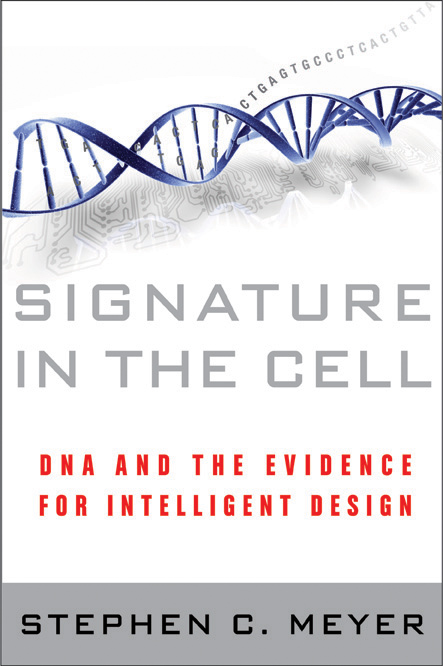
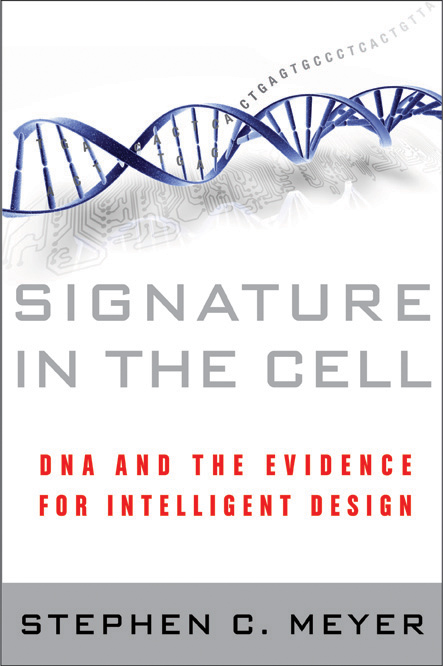
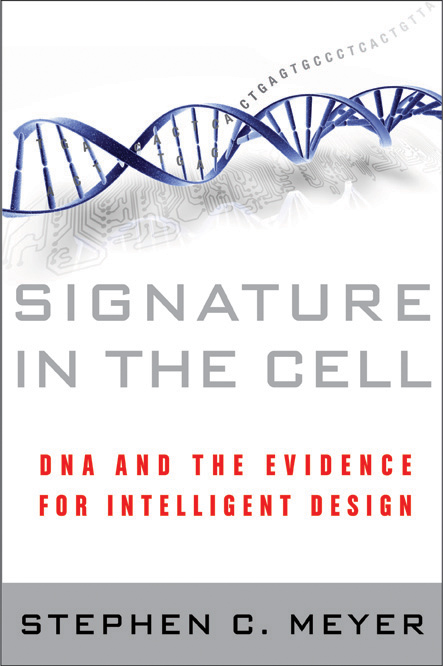
It’s not often that a book on Intelligent Design becomes a best-seller, or is opined (in print) to be one of the best books of the year by a prominent atheist philosopher.  And yet that is true of Stephen Meyer’s book, Signature in the Cell: DNA and the Evidence for Intelligent Design.  I must say it’s one of the best books I have read on the topic of the evidence for intelligent design in biology.  The information was presented in a very logical, systematic order, with each chapter building naturally on the former.  Not only was Meyer’s approach systematic, but he presented difficult concepts in very understandable ways.  Coming in at 561 pages of text, it is not a quick read, but the time spent is well worth it.

Meyer’s thesis is that the origin of life is best explained by an intelligent cause.  He begins his book by telling how the mystery of life’s origin was not recognized in Darwin’s day, but came to be realized in the decades that followed as knowledge of life’s complexity began to emerge.  That mystery has not been solved over the decades, but rather looms larger and larger the more we discover about the internal workings of the cell, and what is required for even the simplest of life. 

(more…)

Very cool.  Use the scroll button beneath the picture to zoom in.


HT: William Dembski

Darwinian evolution entails more than just the concept of one species changing into another over a long period of time.  It involves a fully naturalistic process: natural selection working on random genetic mutations, genetic drift, etc.  If Darwin’s theory of evolution is scientifically sound—meaning the naturalistic processes it invokes are fully capable of producing life and all of its many variegates—then adding God to the equation is superfluous.  It would be like providing a scientific account of water boiling by saying water will boil at time t1 when X amount of heat is applied to Y amount of water at Z altitude, but then adding that fairies are also involved in the process.  If naturalistic processes are adequate to explain why water boils, then not only is there no need for the fairy hypothesis, but there is no room for it.  The same is true of Darwin’s theory of evolution.  If the theory is scientifically sound, and naturalistic processes can fully account for all of life, then there is no need for, and no room to fit God into the picture.  In other words, if Darwin’s theory is scientifically sound, positing a theistic form of evolution is superfluous.

One might say, however, that naturalistic processes are not fully adequate to account for all of life, and this is why one must add God to the equation to make it work.  To make such a claim, however, is to admit that the scientific theory itself is not sound on its own.  It requires some outside supernatural force to patch it up.  Here’s the rub: If Darwin’s theory of evolution is not adequate in itself to explain the data, why should we feel compelled to fit theism into the picture?  Let’s face it, the only reason a theist would postulate a theistic form of evolution is if he was convinced that the evidence for evolution was so compelling that intellectual honesty demands that he reconcile the scientific evidence with his theistic belief.  But if Darwin’s theory of evolution lacks the evidence necessary to make it a sound scientific fact, what compelling reason is there to reconcile the theory with theism?  If Darwin’s theory is not sound in itself, it doesn’t need God to shore it up.

For further reading see my article titled “Theistic Evolution: The Illegitimate Marriage of Theism and Evolution

bridge-the-gap-failedScience-types tend to dismiss theism on grounds that it’s rooted in an ignorance of material explanations for natural phenomena.  Science has discovered material explanations for most things once thought to be acts of God (lightning, gravity, etc.).  Seeing that the gaps in our understanding (gaps once occupied by God) have increasingly been filled by materialist explanations, so, they say, is the need for theism.  Furthermore, given the track record of scientific progress in the last few centuries, even those gaps that remain are likely to be filled with materialistic explanations, leaving no room for theism.  Are these conclusions reasonable?

I’ll begin by addressing the question of whether scientific progress eliminates the need for God.  To speak of the need for God, in this context, is to speak of His explanatory power.  Scientists who think finding materialistic explanations for natural phenomena eliminates the need for God presuppose that God is just a hypothesis, and that this God-hypothesis is only needed to explain the natural world.  Both presuppositions are false.

Most people who believe in God do not do so because God explains some X that is otherwise inexplicable.  For them, God is not an explanatory entity, but a living reality they encounter.  They believe in God because they have experienced Him.  There are, however, some theists who believe in God only because of the explanatory power such a being holds.  What these science-types miss, however, is that for these individuals, God explains much more than just the natural world.  There are non-physical realities that need to be explained such as the existence of objective moral values/duties, the existence of mind/consciousness, and freedom of the will.  Materialistic explanation of these phenomena are not plausible.  An immaterial being, however, provides a sufficient cause.  So even if God was no longer needed to explain all features the universe, His explanatory power would not be obsolete.  There would still be a need for the God-hypothesis.

(more…)

LiveScience reported on a new “breakthrough” in origin-of-life (OOL) research.  Robert Roy Britt began the article by describing the current state of OOL research: “One of life’s greatest mysteries is how it began.  Scientists have pinned it down to roughly this: Some chemical reactions occurred about 4 billion years ago – perhaps in a primordial tidal soup or maybe with help of volcanoes or possibly at the bottom of the sea or between the mica sheets – to create biology.” 

I like how Britt “pinned it down” to chemical reactions in a soup, or maybe volcanoes, or maybe the sea, or maybe between mica sheets.  The specificity is overwhelming.  Can you imagine if homicide detectives worked like this?: “Captain, we haven’t caught the killer yet, but we’ve pinned it down to a human being, living on some continent, on this planet.”  Good work guys.  I’m glad you narrowed it down for us.  Now I can check outer-space off my list as a possible location for the origin of life.  Oh wait, some scientists think life did originate in outer-space!  Maybe the killer isn’t living on this planet after all.  Someone better alert the detectives to broaden their search.  End of sarcasm.

So what was the big breakthrough?: a self-replicating RNA molecule.  Some background information will be helpful.  One theory of how life originated from inorganic material by purely chance, natural processes is the RNA-world hypothesis.  According to this hypothesis, RNA strands formed from nucleotides, which later gave rise to DNA, proteins, and the basic cell.  Among its many problems, however, is the fact that no RNA strand has ever self-replicated in the lab.  But Gerald Joyce and his team at the Scripps Research Institute was able to get RNA to do just that.  This isn’t much of a breakthrough, however, at least not as it concerns OOL research. 

Joyce was able to get RNA to replicate only by engineering the RNA molecules to copy “word-by-word” rather than letter-by-letter (nucleotide by nucleotide).  But that is not how RNA replicates in natural conditions, so why think this experiment tells us anything about how RNA might have been able to self-replicate on the early Earth, and how life got started?  If anything, it seems to demonstrate that for RNA to replicate apart from the cell requires an intelligent agent to manipulate it into behaving in ways it does not behave in nature.  And if that’s what we’re doing, then the results of the experiment don’t tell us anything about the chance, physical process by which life emerged. 

Then there is the matter of the nucleotide strings Joyce and his team put in the beaker with the RNA.  These raw materials are necessary for RNA replication, but why think they would have been available in the early Earth, and/or available in the quantities and locations needed?  If an ancient RNA molecule needed thousands of nucleotides at location X for replication to occur, but only 50 were present at location Y, there would be no replication.  As Stuart Kauffman wrote:

The rate of chemical reactions depends on how rapidly the reacting molecular species encounter one another-and that depends on how high their concentrations are. If the concentration of each is low, the chance that they will collide is very much lower. In a dilute prebiotic soup, reactions would be very slow indeed. A wonderful cartoon I recently saw captures this. It was entitled ‘The Origin of Life.’ Dateline 3.874 billion years ago. Two amino acids drift close together at the base of a bleak rocky cliff; three seconds later, the two amino acids drift apart. About 4.12 million years later, two amino acids drift close to each other at the base of a primeval cliff…. Well Rome wasn’t built in a day.[1]

Is it any surprise that if you provide the right kind of “RNA food” in the right quantities, in the right location, and re-program the RNA so that it is able to join itself to those nucleotides, that it does so?  No.  Because it is not surprising that when an intelligent agent involves itself in the process, what is naturally impossible becomes possible.  Take away that intelligent agent, however, and you are left with the impossible.  Joyce’s work was not a breakthrough for OOL research, but a reaffirmation of what we already know: intelligent agents can do things nature cannot do on its own.


[1]Stuart Kauffman, At Home in the Universe: The Search for Laws of Self-Organization and Complexity, [1995] (Penguin: London, 1996, reprint), 34-35.

Over the past 60 years, the branch of science known as cosmology (studies the history of the universe) has become infested with scientists who engage in metaphysical speculations masquerading as real science.  There’s been everything from Fred Hoyle’s Steady State universe, to the modern multiverse theory.  But few theories have been as speculative and bizarre as Max Tegmark’s.  According to Tegmark, the universe is just math.  In fact, every mathematical “structure” is its own separate universe.  Math is all that really exists.  In his words, “I have this sort of crazy-sounding idea that the reason why mathematics is so effective at describing reality is that it is reality. That is the mathematical universe hypothesis: Mathematical things actually exist, and they are actually physical reality.”  No Max, it doesn’t just sound crazy-it is crazy!  Read the whole piece.

What I find disheartening is that many in the public, because they think scientists only believe that which has been empirically proven, might mistake this bologna for real scientific knowledge.  Sorry folks, not only are scientists biased, but their conclusions often reflect certain philosophical presuppositions and speculations as well.

The universe is incredibly finely-tuned, not only for its own existence, but for the existence of complex, intelligent life.  This fact does not set well with naturalists and atheists.  It is enormously difficult to explain the unfathomable specificity and precision of the cosmos on the basis of chance alone.  Indeed, the value of some physical constants were initial conditions present at the universe’s origin, and thus cannot possibly be explained by random chance processes.  So how do non-theists explain how our universe got so lucky?

While there are a few different approaches floating out there, the one garnering the most attention and support recently is the multiverse hypothesis (a.k.a the Landscape).  Multiverse theory proposes the existence of a near-infinite number of universes.  Given the multitude of universes–it is reasoned–there is bound to be at least one that is life-permitting.  As David Berlinski writes, “[B]y multiplying universes, the Landscape dissolves improbabilities.  To the question What are the odds? the Landscape provides the invigorating answer that it hardly matters.”[1]

Scientist who subscribe to the multiverse view it as the only viable naturalistic alternative to a divine creator.  As Tim Folger wrote:

Physicists don’t like coincidences. They like even less the notion that life is somehow central to the universe, and yet recent discoveries are forcing them to confront that very idea. Life, it seems, is not an incidental component of the universe, burped up out of a random chemical brew on a lonely planet to endure for a few fleeting ticks of the cosmic clock. In some strange sense, it appears that we are not adapted to the universe; the universe is adapted to us.

Call it a fluke, a mystery, a miracle. Or call it the biggest problem in physics. Short of invoking a benevolent creator, many physicists see only one possible explanation: Our universe may be but one of perhaps infinitely many universes in an inconceivably vast multi­verse. Most of those universes are barren, but some, like ours, have conditions suitable for life.

The idea is controversial. Critics say it doesn’t even qualify as a scientific theory because the existence of other universes cannot be proved or disproved. Advocates argue that, like it or not, the multiverse may well be the only viable non­religious explanation for what is often called the “fine-tuning problem”-the baffling observation that the laws of the universe seem custom-tailored to favor the emergence of life.[2]

What I find particularly interesting is how fine-tuning is viewed as a problem in the first place.  No theist would view it as a problem.  It is only problematic to atheists and naturalists because it implies a designing intelligence, and such a being is anathema to them.  In order to avoid the obvious conclusion that an intelligent being was responsible for fine-tuning the universe for existence and life, they propose a naturalistic theory that is, admittedly, not even scientific (because it is neither provable nor falsifiable).  Proponents of the multiverse are honest about this fact.  Consider Andre Linde.  When asked if physicists will ever be able to prove the multiverse hypothesis, he responded:

“Nothing else fits the data.  We don’t have any alternative explanation for the dark energy; we don’t have any alternative explanation for the smallness of the mass of the electron; we don’t have any alternative explanation for many properties of particles.  What I am saying is, look at it with open eyes. These are experimental facts, and these facts fit one theory: the multiverse theory. They do not fit any other theory so far. I’m not saying these properties necessarily imply the multiverse theory is right, but you asked me if there is any experimental evidence, and the answer is yes. It was Arthur Conan Doyle who said, ‘When you have eliminated the impossible, whatever remains, however improbable, must be the truth.’?”

In other words, it doesn’t need to be proven by evidence.  It doesn’t even need to be probable.  It only needs to be the last man standing.  I’ll agree with Linde that no other naturalistic hypothesis has more explanatory power than the multiverse (even though it has no empirical support), but when the list of live options is expanded beyond naturalistic hypotheses, there is a better explanation of the data: theism.  But Linde excludes theism a priori from the list of live options.  Why do that?  Theism has more explanatory plausibility and rational evidence in its favor than the multiverse, and thus should be preferred.

The reason those like Linde take the multiverse hypothesis seriously, is not because they are following the evidence where it leads, but because the evidence points to a designer of the universe, and they wish to avoid such a being at all costs, even if it means believing in an improbable, improvable theory.  As Bernard Carr, a cosmologist at Queen Mary University of London said, “If there is only one universe you might have to have a fine-tuner. If you don’t want God, you’d better have a multiverse.”  Apparently “it is better to have many worlds than one God.”[3] If ridding themselves of one supposed fairy tale (theism) requires belief in another, so be it.

The father of multiverse theory, Leonard Susskind, is very clear about the anti-theistic motivations of theories such as the multiverse.  When asked if we are stuck with an intelligent designer if his Landscape theory doesn’t pan out, he responded:

I doubt that physicists will see it that way. If, for some unforeseen reason, the landscape turns out to be inconsistent – maybe for mathematical reasons, or because it disagrees with observation – I am pretty sure that physicists will go on searching for natural explanations of the world. But I have to say that if that happens, as things stand now we will be in a very awkward position. Without any explanation of nature’s fine-tunings we will be hard pressed to answer the ID critics. One might argue that the hope that a mathematically unique solution will emerge is as faith-based as ID.[4]

His point could not be clearer.  The desire of naturalists is to find a plausible naturalistic explanation on par with the design hypothesis is their driving motivation.  Any theory will do, even if, according to Susskind, it is as faith-based as Intelligent Design.  It appears that blind faith is acceptable in science, so long as its object is not God.  They’ll blindly believe in the existence of universes they cannot see, but not in the existence of a God who has made Himself known in the very cosmos they study.


[1]David Berlinski, The Devil’s Delusion: Atheism and Its Scientific Pretensions(New York: Crown Forum, 2008), 124.[2]Tim Folger, “Science’s Alternative to an Intelligent Creator: the Multiverse Theory” in Discover magazine; available from http://discovermagazine.com/2008/dec/10-sciences-alternative-to-an-intelligent-creator; Internet; accessed 11 November 2008.
[3]David Berlinski, The Devil’s Delusion: Atheism and Its Scientific Pretensions (New York: Crown Forum, 2008), 135.[4]Leonard Susskind, in an interview with Amanda Gefter of New Scientist, “Is String Theory in Trouble?”, December 17 2005 edition, p. 48; available from http://www.newscientist.com/channel/fundamentals/mg18825305.800.html; Internet; accessed 5 January 2006.
big-bangFor millennia philosophers maintained that the universe is eternal.  The philosophical payoff of this view was that it avoided the God question.  If the universe has always been, it did not need a creator.  The emergence of the Big Bang theory in the early part of the 20th century, however, changed all of that.  The Big Bang model successfully predicted that the universe–including all spatio-temporal-material reality–had an absolute origin at a point in the finite past, from which it expanded, and continues to expand today.

The theistic implications of this model were recognized instantly.  If the universe began to exist, it seemed to require a supernatural cause (one outside the confines of the natural world).  That’s why it was met with fierce opposition, and why it took several decades and many lines of empirical confirmation to become the reigning paradigm it is today.  Even now, cosmogenists continue to put forth alternative models in hopes of averting the beginning of the universe, many of which are little more than exercises in metaphysical speculation, incapable of both verification and falsification.

While not friendly to an atheistic worldview, many atheists eventually made their peace with the empirical evidence, and accepted the theory.  But the theistic implications of a temporally finite universe have not gone away.  Anything that begins to exist requires a cause.  If the universe began to exist, what caused it to exist?  It could not be a natural law, because natural laws originated with the universe.  It could not be self-caused, because this is incoherent.  Something cannot bring itself into existence, for that would entail its existence prior to its existence.

The atheist has two options.  He can either admit to the existence of an external cause of the universe, or affirm that the universe is uncaused.  For most atheists the first option is out of the question.  An external cause of the universe looks too much like God: immaterial, eternal, non-spatial, intelligent, and personal.  That leaves them the second option.  But this won’t do either.  The causal principle is one of the most basic intuitions we have.  Things don’t just pop into existence uncaused from nothing, so why think the universe did?  If everything that begins to exist has a sufficient cause, on what grounds is the origin of the universe excepted?  If one excepts it on the basis that it is impossible to have a cause prior to the first event, they are guilty of begging the question in favor of atheism, for they are assuming that physical reality is the only reality, and thus the only possible cause of the Big Bang must be a physical cause.  But it is entirely plausible that the external cause of the Big Bang was an eternal, non-physical reality.  The only way to demonstrate that the universe cannot have a cause, then, is to demonstrate that the existence of an eternal, non-physical reality like God is impossible.  But the very beginning of the universe is an argument for such a being’s existence!

Some atheists, recognizing the problem the principle of causal sufficiency makes for the atheistic worldview, cling to an eternal universe despite the scientific and philosophic evidence to the contrary.  They recognize that it is nonsense to think something can come from nothing, uncaused.  Something can only come from something.  From nothing, nothing comes.  If there was ever a time when nothing existed (as the Big Bang model predicts), then of necessity there would be nothing still, because nothing has no potential to become something.  And yet there is something, so there could not have been a time when nothing existed.  As a matter of historical fact, there can’t ever be a time when there was nothing.  Something must exist eternally.  If something must exist eternally, and the universe is not that something, then something resembling the God of theism must exist.  Rather than admit the obvious-that this is evidence for the existence of God-these atheists reject the scientific and philosophical evidence for a finite universe, and assert that the universe must exist eternally.

What’s important to see, here, is that this sort of atheist is not being intellectually honest with the evidence.  He has an a priori philosophical and volitional commitment to atheism, and that commitment biases him to such an extent that he will not accept the destination to which the rational evidence leads.  Only theism is consistent with the evidence, and consistent with reason.  While I commend atheists who reject the notion that the universe could come into being from nothing totally uncaused as an irrational leap of faith, I admonish them to go one step further, and recognize that the principle that something only comes from something, combined with the scientific an philosophical evidence for the finitude of the universe, supports theism, not atheism.  To be consistent and honest with the data, they should accept the finitude of the universe, and admit that its existence requires a personal and supernatural cause.

Who Was Adam? by Fazale Rana and Hugh Ross

Rana and Ross build a Biblical model of human origins, and then subject it to scientific testing. Point by point they show how a Biblical model of human origins fits the data much better than an evolutionary model. Anyone who doubts that creationist models can be tested scientifically or that human evolution is a shut case should read this book.

There is a good survey of major fossil finds, and how anthropaleontologists have gone about interpreting them. It’s interesting to discover how the experts are far from decided on the proper interpretation. There is not one evolutionary tree of human origins, but multiple trees. And the more data we gather, the more the trees appear to rot.

A lot of time is spent on research into the age and relationship of humans and other hominids. Good stuff.

Five Views On Apologetics edited by Steven Cowan

If you aren’t into (and I mean really into) apologetics, you probably won’t enjoy this book. But if you are, it’s a must read. It is one of Zondervan’s Point-Counterpoint books. Five apologists are featured, each making a case that his apologetic philosophy and methodology is the preferred strategy. There is a good discussion on the role of apologetics in evangelism, what we should expect our apologetic to do, whether faith is warranted without evidence, and the like.

Paul Davies recently wrote a piece in The New York Times titled “Taking Science by Faith. Davies is a astrophysicist, origin of life researchers, and philosopher. He is also a pantheist, which is a “religious” version of atheism. That may sound strange, but both share the same ontology (God does not exist). The latter differs from atheism in that it views the universe as an object of religious devotion. For Davies, the laws that govern the universe are the object of religious devotion.


Davies’ metaphysical commitments make his article all the more interesting. He argues that both science and religion have faith commitments. While many philosophers have pointed this out, it is rare for a practicing scientist to admit it. Maybe his background in philosophy is forcing his honesty! I quite Davies at length:


Science, we are repeatedly told, is the most reliable form of knowledge about the world because it is based on testable hypotheses. Religion, by contrast, is based on faith. … The problem with this neat separation into “non-overlapping magisteria,” as Stephen Jay Gould described science and religion, is that science has its own faith-based belief system. All science proceeds on the assumption that nature is ordered in a rational and intelligible way. … The most refined expression of the rational intelligibility of the cosmos is found in the laws of physics, the fundamental rules on which nature runs. The laws of gravitation and electromagnetism, the laws that regulate the world within the atom, the laws of motion — all are expressed as tidy mathematical relationships. But where do these laws come from? And why do they have the form that they do?


His point is that before a scientist can even begin the work of science, he must presuppose certain things to be true about the natural world. Those presuppositions are not obtained through the scientific method, but rather give rise to the method itself. Without those presuppositions, science cannot get off the ground.


He speaks of the laws of physics. Where do they come from, and why are they what they are? Why should there be any laws at all? Why doesn’t the physical world behave differently in different places and at different times? Science does not know the answer to these questions. And yet they must rely on the physical laws to inquire of physical reality. He continues:


When I was a student, the laws of physics were regarded as completely off limits. The job of the scientist, we were told, is to discover the laws and apply them, not inquire into their provenance. The laws were treated as “given” — imprinted on the universe like a maker’s mark at the moment of cosmic birth — and fixed forevermore. Therefore, to be a scientist, you had to have faith that the universe is governed by dependable, immutable, absolute, universal, mathematical laws of an unspecified origin. You’ve got to believe that these laws won’t fail, that we won’t wake up tomorrow to find heat flowing from cold to hot, or the speed of light changing by the hour.

Over the years I have often asked my physicist colleagues why the laws of physics are what they are. The answers vary from “that’s not a scientific question” to “nobody knows.” The favorite reply is, “There is no reason they are what they are — they just are.” The idea that the laws exist reasonlessly is deeply anti-rational. After all, the very essence of a scientific explanation of some phenomenon is that the world is ordered logically and that there are reasons things are as they are. If one traces these reasons all the way down to the bedrock of reality — the laws of physics — only to find that reason then deserts us, it makes a mockery of science.


“They just are.” That’s the explanation some atheists give for the existence of the entire cosmos. Why is there something rather than nothing? There is no reason, they say. It just exists as a brute contingent fact, completely inexplicable. As Davies says, this is deeply anti-rational. And yet science, operating on the principle that agent-causation is not a valid explanation for physical phenomena, cannot explain why the universe exists, or why there are physical laws. They are left merely with the observation that they exist, inexplicably. Why? Because the cause of the physical laws, like the cause of the universe, cannot be physical. If science cannot allow a non-physical, agent cause to explain physical phenomenon, science must be content with anti-rational answers like the ones Davies laments. Davies notes the fact that the explanation must lie outside the physical universe:


Clearly, then, both religion and science are founded on faith — namely, on belief in the existence of something outside the universe, like an unexplained God or an unexplained set of physical laws, maybe even a huge ensemble of unseen universes, too. For that reason, both monotheistic religion and orthodox science fail to provide a complete account of physical existence.

This shared failing is no surprise, because the very notion of physical law is a theological one in the first place, a fact that makes many scientists squirm. Isaac Newton first got the idea of absolute, universal, perfect, immutable laws from the Christian doctrine that God created the world and ordered it in a rational way. Christians envisage God as upholding the natural order from beyond the universe, while physicists think of their laws as inhabiting an abstract transcendent realm of perfect mathematical relationships.

It seems to me there is no hope of ever explaining why the physical universe is as it is so long as we are fixated on immutable laws or meta-laws that exist reasonlessly or are imposed by divine providence. The alternative is to regard the laws of physics and the universe they govern as part and parcel of a unitary system, and to be incorporated together within a common explanatory scheme.

In other words, the laws should have an explanation from within the universe and not involve appealing to an external agency. The specifics of that explanation are a matter for future research. But until science comes up with a testable theory of the laws of the universe, its claim to be free of faith is manifestly bogus.


I find it interesting that Davies thinks more research can unveil a materialistic cause for the natural laws. Unless he wishes to advance the notion that the laws of nature developed over time, this project is doomed from the start. Physical laws began with the existence of the universe. If they were there from the beginning of physical reality, physical reality cannot explain their origin. Whatever caused them cannot itself be physical. Only an immaterial source can cause physical reality and physical laws. Davies will never solve the dilemma of where the natural laws came from until he opens himself to the metaphysical possibility of God’s existence. Only an immaterial, personal, intelligent, rational, and powerful being could produce physical reality with all of its attendant laws.

« Previous PageNext Page »