Apologetics


Some people want to reject the testimony of the NT evangelists on the basis that they are biased.  I have written on the problems of this claim before, but here is a brief summary of my argument (with some added insight offered by Greg Koukl in his September 10, 2012 podcast):

  • This is an example of the genetic fallacy – dismissing one’s arguments because of its origin, rather than addressing it on its own merits.
  • Having a bias is irrelevant to the legitimacy of one’s testimony and/or arguments.  One must grapple with the evidence rather than dismiss it because it comes from a biased source.
  • Everyone has a bias, including those who reject Jesus.  The only people without a bias are those who are ignorant of the matter.
  • (more…)

This story continues to fascinate me.  It’s like CSI Miami for Biblical nerds!  And new insights and arguments continue to be offered for and against the authenticity of the GosJesWife.

Christian Askeland has a nice 10 minute video demonstrating some of the peculiarities of the writing on the GosJesWife which cause scholars to doubt its authenticity.

Hugo Lundhaug and Alin Suciu discuss the problems around dating the GosJesWife and evidence that a paintbrush was used for the writing.

Timo Paananen disputes James Watson’s methodology for concluding that the GosJesWife is a patchwork of the Coptic GTh.

Peter Head examines some of the reasons King et al concluded that the writing was authentic, including the lack of ink in a hole created by an insect, the lack of ink where fibers have gone missing from the papyrus, ink on the frayed edges, and the faded ink on the recto and finds them wanting.

In his new book, atheist Thomas Nagel had some interesting things to say about why scientists are so opposed to Intelligent Design: “Nevertheless, I believe the defenders of intelligent design deserve our gratitude for challenging a scientific world view that owes some of the passion displayed by its adherents precisely to the fact that it is thought to liberate us from religion.” – Thomas Nagel, Mind and Cosmos: Why the Materialist Neo-Darwinian Conception of Nature is Almost Certainly False, 12.

Great post from Amy Hall of Stand to Reason.  Reproduced below in its entirety:

On Harper’s Magazine’s blog, Christopher Beha discusses his recent article on what he calls the “New New Atheists”—that is, atheists (such as Alain de Botton) who, having determined that God does not exist, are now exploring the question of how to restore those aspects of life whose foundations were destroyed along with God: meaning, wonder, morality, etc. But, he says, there’s a problem:

Rosenberg—a philosopher at Duke with a predictable commitment to rigor—insists that doing away with religion means doing away with most of what comes with it: a sense of order in the universe, the hope that life has some inherent meaning, even the belief in free will….

I was interested in the attempts of Harris and Botton to salvage some religious splendor for the secularists. So I was only more disappointed to find Rosenberg’s insistence that such efforts were hopeless far more convincing than the efforts themselves.

(more…)

Moral relativism – the notion that there are no moral truths, and thus “morals” are subjective preferences relative to individuals or societies – is widespread in our day, particularly among the younger segments of society.  I would venture to say that moral relativism appeals to so many people because it gives them the intellectual justification they need to engage in their sins of choice.  This cheap form of moral justification is not without its costs, however.

While moral relativism is an easy way to justify participation in acts that others consider morally objectionable, it also makes it impossible to condemn the acts of others that one finds morally repugnant.  And believe me, every moral relativist has a list of beliefs, attitudes, and behaviors that they think are morally wrong – not just for them, but for everyone!

(more…)

“Jesus said to them, ‘My wife'” highlighted.

The web continues to be abuzz with The Gospel of Jesus’ Wife.  So much is being written that it’s hard to keep up!  Here are the latest and most important developments.

James Watson has written two more papers (here and here) further developing his original thesis that The Gospel of Jesus’s Wife is a collage of various words and phrases culled from the Gospel of Thomas to form a new composition that is supposed to appear like a new gospel.  Andrew Bernhard has also tested Watson’s thesis in two papers (here and here), and agrees that “a modern author could have created the text of GJW simply by using short excerpts culled exclusively from Coptic GTh.”[1]  Both of Bernhard’s papers present an excellent visual and summary of the extensive semantic borrowing of the GosJesWife from the Coptic GTh.  He notes that only 14 out of 139 legible letters on the recto of the GosJesWife do not correspond to the Coptic GTh.  Eight of these 14 letters make up the phrase “my wife.”  Of the other 6 letter differences, they are either due to gender shifts in the pronoun or uninterpretable because they are single letters that come at the beginning or end of the line and lack sufficient context for reconstruction.

(more…)

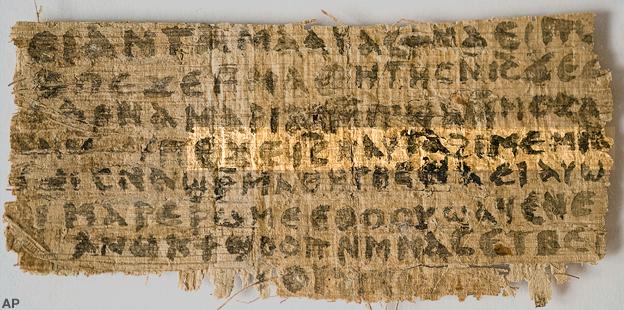
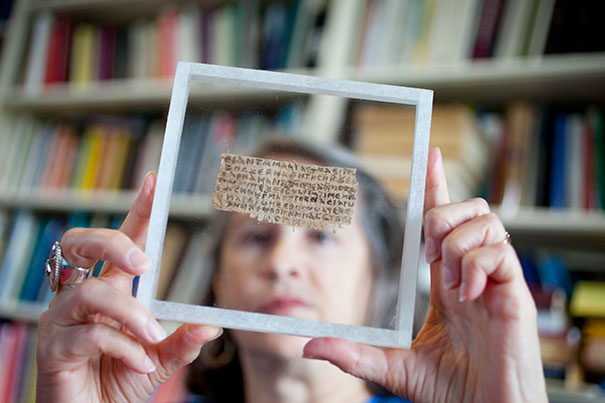
Karen King, professor of divinity at Harvard and specialist in Gnostic Christianity, recently announced the existence of a small (3” x 1.5”), late-4th century[1] fragment in which Jesus speaks of his wife. Written in Sahidic Coptic with black ink[2] on papyrus, the fragment contains eight lines of text on the recto and six lines of text on the verso, with all margins missing.[3]  The extant text on the recto side reads:

1  Not [to] me. My mother gave to me li[fe
2  The disciples said to Jesus
3  deny. Mary is worthy of it.[4]
4  Jesus said to them, “My wife
5  she will be able to be my disciple
6  Let wicked people swell up
7  As for me, I dwell with her in order to
8  an image[5]

Although the text bears some striking resemblance to known Gnostic texts (particularly the Gospel of Thomas[6], and to a lesser degree the Gospel of Philip), it does not match any known apocryphal or Gnostic gospel.  This may be an independent Gospel of unknown character (Gnostic, apocryphal, etc.) or, as Francis Watson has argued, it may be a modern forgery created using key words from the Coptic version of the Gospel of Thomas (more will be said concerning this momentarily).

(more…)

J.W. Wartick has a nice article on the failure of religious pluralism. He makes the point that while religious pluralists want to affirm all religions as being valid, they can only do so at the expense of charging all religions as false. It’s quite the paradox, similar to hitting people to demonstrate your love for them.

While pluralists charge all religious traditions as false in order to affirm them, their own views are presented as objective truth. They do not claim to know the true nature of the Transcendent anymore than the next guy, but they do claim to be the only ones who know the true nature of religion. How convenient.

In my opinion, abortion is the greatest moral issue of our day.  Nothing is more unjust than depriving innocent human beings of their God-given, inalienable right to life simply because we are inconvenienced by them.  For that reason, the issue of abortion figures prominently in my political affiliations and the way I vote.  While I am not a one-issue voter, and while I do not think it is always wrong to vote for a pro-choice political candidate (there are some political offices for which one’s personal views on abortion are irrelevant on a practical level), I will almost always vote for the pro-life candidate even if I have fundamental disagreements with him on other matters.  It’s not that I think economic issues do not matter, or that foreign policy does not matter, but that I think the moral injustice of abortion is much more important than these others. 

That is why I was disheartened to read the results of two polls which sought to determine what voters think the most important issues are when choosing the candidates they will give their vote to.  

(more…)

While dialoguing with a friend on the topic of abortion, I was asked how I define abortion.  After communicating my own definition of abortion, I thought it would be interesting to see how various dictionaries define it.  Needless to say, I was amazed at how inaccurate and politically correct the definitions were.  Here are a few: 

Dictionary.com
Abortion:

  1. The removal of an embryo or fetus from the uterus in order to end a pregnancy.
  2. Any of various surgical methods for terminating a pregnancy, especially during the first six months.

Interestingly, there is no mention of the fate of the unborn baby.  Instead, the focus is on the “pregnancy” and terminating that pregnancy.  

The first six months?  How is that relevant to the definition?  If a child is killed in utero at seven months, that is also called an abortion.  

(more…)

Tim Keller on why apologetics is essential:

Apologetics is an answer to the “why” question after you’ve already answered the “what” question. The what question, of course, is, “What is the gospel?” But when you call people to believe in the gospel and they ask, “Why should I believe that?”—then you need apologetics.

I’ve heard plenty of Christians try to answer the why question by going back to the what. “You have to believe because Jesus is the Son of God.” But that’s answering the why with more what. Increasingly we live in a time when you can’t avoid the why question. Just giving the what (for example, a vivid gospel presentation) worked in the days when the cultural institutions created an environment in which Christianity just felt true or at least honorable. But in a post-Christendom society, in the marketplace of ideas, you have to explain why this is true, or people will just dismiss it.

One of the hot button issues in our culture is homosexuality and the related issue of same-sex marriage.  I have offered a non-religious argument against both (here and here).  As I have continued to reflect on these issues, however, I am persuaded that a non-religious case against homosexuality is much more difficult to make than the case against same-sex marriage.  One reason for this is the fact that the case against same-sex marriage can be made purely on policy grounds without any recourse to moral judgments.  One could believe homosex is morally irrelevant and still be opposed to the government regulating same-sex relationships.  Moral judgments, however, are not so easily divorced from one’s view on homosex.

Take for example the argument from natural law.  We argue that the natural purpose of our sexual organs requires heterosexual sex.  To use our sex organs in such a way that their natural purpose cannot be realized is morally wrong.  There are a few reasons why this will not be convincing to many who think homosex should not be opposed.

(more…)

Now Thomas, one of the Twelve, called the Twin, was not with them when Jesus came. [25] So the other disciples told him, “We have seen the Lord.” But he said to them, “Unless I see in his hands the mark of the nails, and place my finger into the mark of the nails, and place my hand into his side, I will never believe.” [26] Eight days later, his disciples were inside again, and Thomas was with them. Although the doors were locked, Jesus came and stood among them and said, “Peace be with you.” [27] Then he said to Thomas, “Put your finger here, and see my hands; and put out your hand, and place it in my side. Do not disbelieve, but believe.” [28] Thomas answered him, “My Lord and my God!” [29] Jesus said to him, “Have you believed because you have seen me? Blessed are those who have not seen and yet have believed.” (John 20:24-29 ESV) 

This passage of Scripture is often appealed to by those who see Christian apologetics as irrelevant to evangelism, or even contrary to Scripture.  On its face, it does seem to present an anti-evidence, anti-rational approach to the Christian faith: Jesus appears to berate Thomas for requiring evidence of His resurrection while pronouncing a blessing on those who believe without the need for evidence.  A closer examination of the passage in its context, however, reveals this reading of the text to be mistaken. 

(more…)

In the context of the moral realism vs. moral subjectivism and theism vs. atheism debates the question of moral semantics is often raised: How do we define goodness?  Some are under the mistaken impression that if we cannot define goodness (a question of moral semantics) then we cannot claim to know goodness exists (a question of moral ontology) or identify what is good (a question of moral epistemology).  

I do not want to focus on whether it is possible to provide an adequate account of moral semantics, but rather to point out that even if we are unable to do so, it does not follow that there are no objective moral goods or that we are incapable of knowing them.  Greg Koukl illustrates this point beautifully.  He notes how our experience of goodness is similar to our experience of color.  We recognize color as color when we see it.  If someone were to ask us how we know what green is, we would respond, “I just see it.”  We don’t need to define green to know it when we encounter it.  Similarly, we do not need to define goodness to know that we have encountered it.  God has given us moral intuitions to recognize good and discern between good and evil. 

(more…)

Scott McKnight alerted me to a couple of posts by philosopher Jeff Cook on the topic of desire and reason in evangelism (1,2).  Cook contends that “the debate about God today is not about what’s reasonable—it is almost entirely about preferences and desire.”  That doesn’t mean he is opposed to using reason or providing evidence for Christianity in our evangelism of the lost.  He simply believes that this alone will not persuade most people because it is not rationality alone that causes them to reject Christianity. 

Cook proposes that if people are going to be persuaded by our reasons for Christianity, they must first want there to be a God.  In his words, “Wanting God to exist is more important than believing in God.  By ‘more important,’ I mean desire is more crucial to the transformation of a person’s heart, more helpful in moving them toward faith in Christ, and more instrumental in one’s ‘salvation’ than right thinking. … It seems then that enticing the passions and wills of those who do not follow Christ is far more important than targeting their intellect with arguments for God’s existence. Showing that God is desirable will be the primary target of the successful 21st century apologist, for wanting God to exist opens highways for subpar apologetics; yet a closed heart will not here [sic] the voice of wisdom.” 

(more…)

Wesley J. Smith wrote about the most recent statistics available on the number of deaths caused by euthanasia in the Netherlands.  The official report as reported in the Lancet notes that only 2.8% of all deaths in the Netherlands were the result of euthanasia.  The truth is about a decimal point off, however, and Smith explains why.

First, the report also notes that only 77% of all cases of euthanasia were reported to a review committee.  That means 23% of deaths by euthanasia were not reported, raising the total number to 3.5%.  But this leaves out the deaths involving terminal sedation, which is nothing more than “slow motion euthanasia.”  The practice of terminal sedation involves sedating a person to the point of unconsciousness, and then depriving them of food and water until they die.  In 2012 a full 12.3% of people were killed this way!  Since approximately 2% of people are so close to death when they receive terminal sedation that they die of their disease before they die of dehydration, we can reduce this number to approximately 10%.  That means that nearly 14% of deaths in the Netherlands are caused by doctors actively killing the patients.

It gets worse.  The 14% figure is based on the total number of deaths.  Given the fact that approximately half of all deaths do not involve end-of-life medical decisions (accidents, heart attacks), the reality is that approximately 28% of all deaths involving end-of-life decision making are the result of intentional killing by the medical community!  Of course, the headline “28% of deaths involving end-of-life medical care caused by suicide at the hands of doctors!” doesn’t sound nearly as good as “Only 2.8% of Dutch die by euthanasia.”  You’ve got to be careful when it comes to stats.  If you’re not careful, they (stats and Dutch doctors) will kill you.

That’s the claim anyway. Michael Shermer is fond of using this kind of argument in debates.  He reasons that God’s existence is irrelevant to morality because even if God didn’t exist, people would still think killing, stealing, and lying were wrong.  Want proof?  If it could be proven to you today that God doesn’t exist, would you go out and kill/steal tomorrow (particularly if you knew you could do so without getting caught and punished by the authorities)?  No.  There are still good reasons to act morally even in the absence of God.  Therefore, it follows, claims Shermer, that God is not necessary for morality.

While this has great rhetorical force in a debate, Shermer misses the point completely.  The question isn’t whether one needs to believe in God to know and do good, but whether God’s existence is necessary for the good that we know to actually be “good.”

(more…)

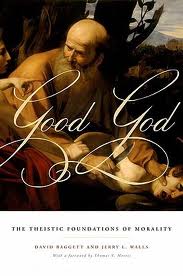
David Baggett and jerry Walls have written an excellent book exploring God’s relationship to morality.  The book aims to provide a moral argument for the existence of God, and to answer criticisms to theistic ethics.  After showing how various non-theistic foundations for ethics fail, the authors take a close look at the most common objection to theistic ethics: the Euthyphro argument.  They critique both horns of the dilemma: pure voluntarism (X is good because God commands it) and non-voluntarism (X is good wholly independent of God and His will).  If goodness is determined by God’s commands, then morality seems arbitrary.  Indeed, if God willed that rape is good rape would be good (abhorrent commands objection).  There is also the epistemic problem.  How would we know what God has commanded, or if God has changed His mind?  The problem with non-voluntarism is that it makes God irrelevant to morality.  Goodness stands outside of God.  Indeed, God is subject to the good in the same way we are.  At best His role is to communicate to us what is good.  He is like the divine meteorologist who reports the weather rather can creating it.  If goodness is independent of God, then God’s aseity (self-existence) is called into question.  He cannot be the metaphysical ultimate.

(more…)

The evidential problem of evil points to the improbability that the amount of evil we see in the world – particularly gratuitous evil – would exist if an omnipotent, omnibenevolent God exists.  The argument usually takes the following form:

(1)   If God exists, gratuitous evil would not exist
(2)   Gratuitous evil exists
(3)   Therefore God does not exist 

Many theists attempt to undermine this argument by attacking the veracity of premise two.  For example, William Lane Craig and William Alston argue that humans are not in an epistemic place to judge any act of evil as gratuitous since we cannot see the big picture of history.  For all we know, an act of seemingly gratuitous evil will result in a greater good years or even centuries from now, either in the life of the person who experienced the evil or in the life of another person in another country.  Our cognitive limitations should not be used as evidence that gratuitous evil exists.  At best we must remain agnostic on the question.

This is an appeal to the Greater-Good Defense, which argues that God has a morally sufficient reason for permitting all evils—including those that appear gratuitous to us—such as using them to bring about some greater good that could not have been brought about apart from those evils.

In the latest issue of Philosophia Christi, Kirk R. MacGregor provides some reasons for thinking that this response to the evidential problem of evil is misguided.  Just because our cognitive and temporal limitations make it impossible for us to prove that any act of evil is truly gratuitous does not mean that gratuitous evil does not exist.  He argues that the belief that some evils are gratuitous is a properly basic belief.  For example, we do not believe that every time we are bitten by a mosquito or stub our toe, that these evils have some greater purpose or will be used to accomplish a greater good.  Such things make virtually no difference in our own lives, yet alone on the grand scheme of things.  Given the proper basicality of belief in gratuitous evil, MacGregor says the burden of proof is on those who would deny the existence of gratuitous evils, and to meet their burden of proof they must explain how every instance of gratuitous evil actually results in some greater good.  This is not possible, and thus the person who believes in the existence of gratuitous evil is prima facie justified in maintaining that belief, even given his cognitive and temporal limitations.

(more…)

A former professor of medical ethics and former chairman of the Institute of Medical Ethics in Britain, Raanan Gillon, wrote an editorial in the British Medical Journal lambasting a judicial ruling that gave pre-eminence to the sanctity of life.  Gillon argues that given scant medical resources, physicians should be allowed to withdraw treatment from stable, but minimally conscious patients suffering from severe dementia in order to cause their premature death.  

Yes, this is a preeminent bioethicist.  The field has become overrun with utilitarians who espouse views that are anything but ethical.

« Previous PageNext Page »